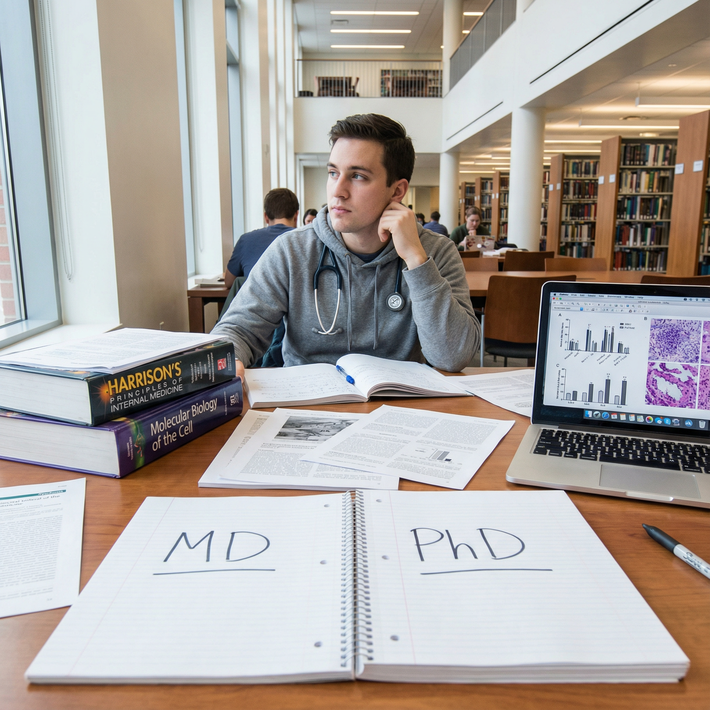
Leaving a PhD program to chase an MD isn't a failure. It's a pivot. And if you're going to do it, you need to treat it like a military operation with a timeline, milestones, and zero room for self-pity. I've watched brilliant people botch this transition because they agonized over the decision for eight months and then scrambled through the AMCAS cycle in six weeks. Don't be them.
The myth is that PhD coursework and research "count" heavily toward MD admissions. The reality is that admissions committees want a clean, compelling narrative: why medicine, why now, and what have you done recently to prove it? Your dissertation on mitochondrial bioenergetics is impressive, but if your last clinical experience was shadowing an ER doc in 2019, you've got a problem. This guide walks you through every month, week, and day of the transition so you don't waste time and don't leave gaps that committees will flag.
This article is for educational purposes only. It is not financial advice, not legal advice, and not tax advice. Figures vary by individual circumstances, so consult a qualified professional before acting.
The Core Challenge
Before making this leap, it is helpful to understand the Premed Timeline: When to Decide Between MD, PhD, and MD-PhD Tracks.
The biggest pitfall I see, over and over, is timing. People think they can decide in January that they want an MD and still submit a competitive primary application by late May. Technically possible? Sure. Smart? Absolutely not.
Here's what actually happens when you drop your PhD mid-stream and target an MD cycle:

The GAP Problem. Admissions committees notice unexplained time gaps. When you leave a PhD program, there's a discontinuity in your academic record. If you don't address it head-on in your personal statement and through your activities, they'll assume the worst, that you washed out, couldn't handle the rigor, or are running from something. You need to reframe it as running toward something.
The Clinical Hours Problem. PhD students are notorious for having thin clinical portfolios. You've spent years in a lab. At this point you should have at least 150 hours of direct patient contact, but most PhD candidates I've mentored have fewer than 50. That's a red flag. MD admissions expects you to have tested medicine at the bedside, not just admired it from a molecular biology bench.
The MCAT Problem. If you've been in a PhD program for two or three years, your undergraduate science knowledge is rusty. The MCAT tests foundational biochemistry, physics, and organic chemistry, material you may not have touched since sophomore year of undergrad. I've seen people score 515+ on practice tests and then crater on exam day because they underestimated how much they'd forgotten. You need a dedicated study window, not weekend cramming between pipetting sessions.
Evaluating your overarching goals requires studying MD vs PhD: Navigating Your Medical Education Pathway for Success.
The Letter Problem. Your PhD advisor's letter of recommendation is gold, but only if they support your departure. If your PI feels blindsided or betrayed, you'll get a lukewarm letter that whispers "this person quit my lab." You must have the conversation early, honestly, and with a plan. I'll show you exactly when.
The Narrative Problem. "I realized I want to work with patients, not just cells" is the single most overused personal statement opener in the history of medical school applications. It's not wrong, but it's boring. Your story needs specificity. What patient interaction changed your mind? What clinical experience made the lab feel insufficient? At this point you should be collecting those stories deliberately, not hoping you'll remember them later.
How to navigate all of this successfully: You work backward from the AMCAS submission date and build a Gantt chart of your life. Everything, MCAT study, clinical volunteering, PI conversations, letter requests, goes on the calendar with hard deadlines. No floating goals. No "I'll get to it." The timeline below is your operating procedure.
Actionable Next Steps
Here's the month-by-month battle plan. I'm assuming you're targeting the following year's application cycle, which opens in late May. Adjust accordingly.
Month 1: The Decision and the Conversation
Week 1. Make the decision. Stop oscillating. If you're 60/40, stay in your PhD. If you're 85/15, commit and move.
Week 2. Schedule a meeting with your PI. At this point you should have a script prepared: "I've decided to transition toward clinical medicine. I want to finish my current project responsibly and discuss a timeline for wrapping up my contributions to the lab." Offer 2-3 months of continued work. Don't spring this on them in an email.
Week 3. Register for the MCAT. Pick a date that gives you 3-4 months of study time. Lock it in. Money spent on registration is a commitment mechanism.
Week 4. Identify 2-3 clinical volunteering opportunities. Hospitals, free clinics, hospice programs. Apply now because background checks and orientations take 4-6 weeks.
Month 2-3: Foundations
- Weeks 5-8. Begin clinical volunteering. Aim for 8-10 hours per week. At this point you should be logging every hour in a spreadsheet with date, setting, and a one-line reflection. These reflections become personal statement fodder later.
- Weeks 9-12. Start MCAT prep. Take a full-length diagnostic cold. It will hurt your ego. That's fine, you need a baseline. Identify your three weakest content areas and attack them first.
Month 4-6: The Grind
- Weeks 13-20. This is the meat of your MCAT preparation. At this point you should be doing 20-25 hours of focused study per week, taking a practice full-length every 10-14 days, and reviewing every single question you got wrong, and the ones you got right by guessing.
- Weeks 17-20. Draft your personal statement. Write three versions. Show one to a physician mentor, one to a former advisor, and one to someone who knows nothing about medicine. The third person will tell you if your story is intelligible to a human.
Month 7: MCAT and Letters
- Weeks 21-24. Take the MCAT. While waiting for scores, request letters of recommendation. You need 3-5 letters: ideally one from your PI, one from a clinical supervisor, one from a science faculty member, and one from a non-science professor or community leader. At this point you should provide each letter writer with your CV, personal statement draft, and a polite deadline of 4 weeks. Waive your FERPA rights. Always.
Month 8-9: Application
Weeks 25-28. Finalize your personal statement. Complete your AMCAS work and activities section. List your PhD experience honestly, include expected departure date and describe what you accomplished, not just what you planned.
Week 29. Submit your AMCAS primary. Early. The difference between submitting on May 31 and July 15 can be the difference between three interview offers and zero. I'm not exaggerating.
Weeks 30-35. Pre-write secondary essays. Many schools reuse prompts from prior years. At this point you should have a bank of 8-10 reusable essays covering: diversity, adversity, gap years, why this school, and ethical dilemmas. When secondaries arrive, you'll customize and return them within 5-7 days.
Resources to Use
- AAMC Official MCAT resources, the only prep material that exactly mirrors exam content. Non-negotiable.
- MSAR (Medical School Admission Requirements), use it to build a realistic school list. If your GPA is 3.4 and your MCAT is 508, don't waste money applying to schools with 3.8/518 medians. Build a list of 20-25 schools with a mix of reach, target, and safety.
- SDN (Student Doctor Network), useful for school-specific secondary prompts and interview formats. Ignore the anxiety spirals in the forums.
- Your undergrad premed advisor, even if you graduated years ago, many will still review your application. Ask.
Key Takeaways
- Be prepared. This is a 9-12 month project, not a last-minute career change. The people who succeed treat it like a job with deliverables and deadlines. The people who fail treat it like a hope.
- Focus on high-yield areas. Clinical hours, MCAT score, and narrative coherence matter more than everything else combined. Your PhD research is a bonus, not a substitute. A 520 MCAT and 200 clinical hours will open more doors than a Nature paper and a 505.
- Have the hard conversations early. Your PI, your program director, your partner, your bank account. No surprises. No delays. The timeline doesn't wait for your comfort.
- Submit early. Rolling admissions is real. If you're not submitted by late June, you're already behind.