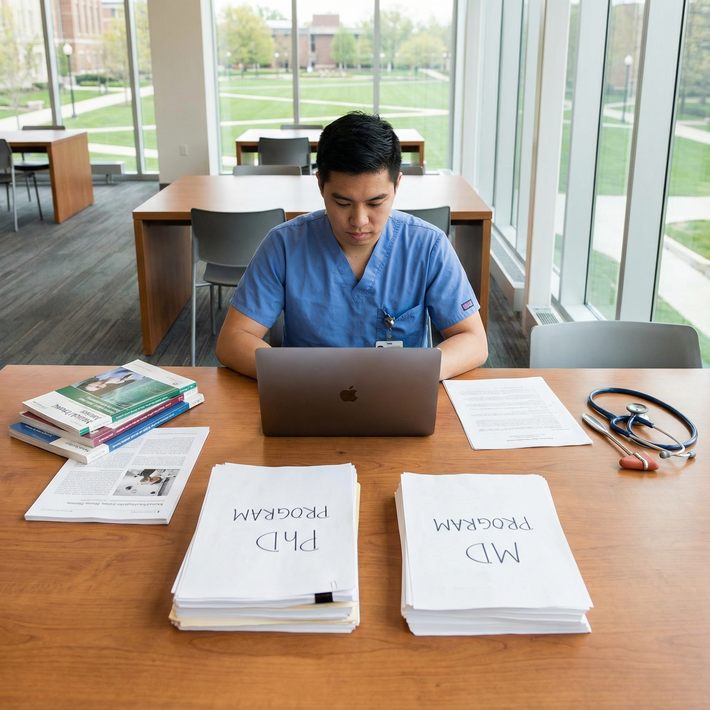
Picture this because I've seen versions of it over and over.
A student comes in with a 3.2 GPA, an MCAT that didn't land where it needed to, maybe two semesters of shaky science grades, and a personal statement full of vague lines about "loving science and helping people." Clinical exposure? Thin. Shadowing? A few scattered hours. Research? Yes, technically, but the story around it is weak, disconnected, and sounds more like résumé stuffing than a real calling.
Then comes the dangerous idea.
"I'll do a PhD first. That'll prove I'm capable. Then med schools will take me seriously."
No. Don't make that mistake.
A PhD can be valuable. Deeply valuable, in the right context. But it is not academic bleach. It does not wipe out low stats, missing prerequisites, weak clinical readiness, poor school fit, or a confused reason for pursuing medicine. Admissions committees are not dazzled by extra letters after your name if the core file still says the same thing: this applicant is not ready.
That's the real issue. Readiness.
Medical schools want evidence that you can handle medical academics, understand patient care, show maturity, and explain clearly why medicine, not just science, not just prestige, not just "I'm good at school." More credentials don't automatically create that evidence. Sometimes they just make the file look more complicated.
And worse, sometimes a PhD becomes a very expensive, very time-consuming way to avoid fixing the real problem.
Here's where applicants get sloppy. They assume admissions works like a point system. Weak GPA? Add doctorate. Weak MCAT? Add publications. Thin clinical work? Add another degree. Problem solved.
That is not how this works.
Myth: A PhD proves intelligence and compensates for weak academics
Reality: committees evaluate academic readiness directly.
They still look at:
- Undergraduate GPA
- Science GPA
- Course rigor
- Grade trends
- MCAT performance
- Whether the weak spots were fixed in a believable way
A PhD does not erase a bad academic foundation. If your undergraduate record shows repeated trouble with core science coursework, a graduate research degree does not automatically reassure anyone that you're ready for the pace and volume of medical school. Those are different tasks. Different demands.
I've watched applicants make this exact mistake: years in a lab, strong niche knowledge, even a dissertation defense, and still a file that raises the same old concern. Can this person handle broad, high-volume medical coursework and standardized testing? If the answer is still unclear, the PhD didn't fix the core weakness.
Myth: Research-heavy training automatically makes you a stronger med school candidate
Reality: research helps only when it fits the story and doesn't crowd out medicine.
Research is excellent. But medicine is not just research. If your application screams "I love experiments, data, and bench work" but whispers "I've barely spent time with patients," admissions committees notice. Quickly.
They should.
A strong MD applicant needs evidence of:
- Patient exposure
- Service orientation
- Understanding of clinical environments
- Interpersonal maturity
- A compelling reason for choosing medicine specifically
If your PhD comes at the expense of those things, it may actually weaken your MD case. You don't want reviewers asking, "Why not just stay in science?" That question kills momentum fast.
Myth: A PhD makes you more competitive everywhere
Reality: it may help at research-intensive schools, but it can be neutral or even distracting elsewhere.
At highly research-focused institutions, a serious scientific background can absolutely add weight. Especially if you have:
- Publications
- Strong mentors
- A clear translational interest
- A believable physician-scientist trajectory
But many medical schools are evaluating broader readiness for physician training. If your file has shiny research and weak everything else, the PhD doesn't make you more attractive. It makes you lopsided.
And lopsided applicants lose out all the time.
So when does a PhD genuinely add value?
Not as a rescue mission. As alignment.
A PhD helps when it reflects a real and sustained identity:
- You have strong academic fundamentals already.
- You've shown serious research commitment over time.
- You can explain why medicine and science belong together in your career.
- Your clinical exposure confirms that you understand what physicians actually do.
- The PhD is part of your direction, not a panic move after disappointing stats.
That last point matters most. A panicked PhD is usually obvious. Committees can smell desperation through polished prose.
The Pitfalls Applicants Miss: How a PhD Can Hurt Instead of Help
This is the part people don't want to hear. A PhD can actively hurt your path to medicine if you use it badly.
Danger sign 1: You're using the PhD to avoid the real problem
Low MCAT? Weak GPA? Inconsistent grades? Poor study strategy? Missing clinical depth?
Then fix those.
Don't hide behind a doctorate because it sounds impressive at family gatherings. Prestige is not remediation. I've seen applicants spend five or six years earning a degree that never addressed the actual admissions weakness sitting right in the middle of the file.
That's not strategy. That's avoidance dressed up as ambition.
Danger sign 2: You lose years without improving MD readiness
Time matters. Not because there's one perfect age to apply, but because years should produce the right growth.
If you spend those years:
- out of clinical environments,
- disconnected from patient care,
- accumulating highly specialized research experience,
- and not repairing your academic or testing weaknesses,
you may emerge older but not stronger.
That's a brutal outcome. And common.
Medical schools want to see momentum toward medicine. If your timeline creates distance from medicine instead, expect questions:
- Why now?
- Why medicine after all this?
- What changed?
- Why didn't you address your original weak points directly?
If your answers sound improvised, the application suffers.

Danger sign 3: Your narrative starts to look scattered
Admissions readers hate one thing more than weakness: confusion.
If your application says:
- I wanted medicine,
- then I disappeared into a PhD,
- then I came back,
- and now I'm trying to explain how it all fits,
you'd better have a clean, honest, convincing narrative. Most applicants don't. They ramble. They over-explain. They sound like they're retrofitting meaning onto a detour.
That's a mistake.
A scattered path can work if the thread is obvious. But "I kept collecting credentials until something worked" is not a thread. It's drift.
Danger sign 4: You overestimate how much research can compensate for weak service or patient exposure
This one burns applicants every cycle.
They have posters. Abstracts. Maybe first-author work. They assume that demonstrates maturity, discipline, and commitment. Sometimes it does. But it does not replace:
- showing up for patients,
- working in teams under pressure,
- serving communities,
- understanding illness beyond data.
Medicine is a human profession. If your application is all intellect and no lived service, it feels cold. Detached. Risky.
And yes, committees notice that too.
What Actually Fixes a Weak MD Application Before You Add a PhD
Here's the safer, smarter move: diagnose the weakness correctly.
Not the weakness you wish you had. The real one.
Start with a blunt self-audit
Ask yourself:
- Are my numbers the problem?
- Is my clinical exposure too thin?
- Is my service record weak or inconsistent?
- Do my letters of recommendation truly support me?
- Does my personal statement actually explain why medicine?
- Does my application show maturity and direction?
- Am I applying with obvious unresolved red flags?
Be ruthless. Better you find the weakness now than a committee finds it later.
Fix the highest-yield problem first
If the issue is academics, prestige is not the answer. Remediation is.
If the issue is the MCAT, another degree is not the answer. A better test strategy is.
If the issue is clinical exposure, the answer is not more bench work. It's time with patients.
That sounds obvious. People still get it wrong constantly.
Common weaknesses and the right repair path
1. Low GPA
Best fixes:
- Post-bacc coursework
- Special Master's Program if appropriate
- Demonstrated upward trend in hard science classes
What not to do:
- Assume a PhD will erase undergraduate weakness
- Ignore poor performance in prerequisite sciences
If the academic record is the problem, show recent proof that the academic record has changed. Directly. Cleanly.
2. Low MCAT
Best fixes:
- Honest review of prior prep mistakes
- New study plan
- Better timing
- High-quality practice testing
- Retake only when truly ready
What not to do:
- Treat the MCAT like an annoyance med schools will overlook
- Hope research productivity distracts from the score
It won't. Don't make that mistake.
3. Limited clinical exposure
Best fixes:
- Medical assistant work
- Scribing
- EMT experience
- Meaningful patient-facing volunteering
- Consistent shadowing
What not to do:
- Count lab time as proof you understand medicine
- Apply with token clinical hours and expect goodwill
You need real contact with the sick, the anxious, the grieving, the complicated. Otherwise your "why medicine" stays abstract.
4. Weak service or maturity signals
Best fixes:
- Longitudinal community service
- Roles with responsibility
- Sustained commitments, not random one-off events
- Reflection that shows humility and growth
What not to do:
- Build a sterile achievement machine of grades and publications only
Medical schools are training physicians, not just smart test-takers.
5. Weak narrative coherence
Best fixes:
- Better advising
- Stronger personal statement revision
- Honest school list strategy
- Interview practice that tests whether your story actually makes sense
What not to do:
- Add another giant credential hoping it writes the story for you
Degrees do not create meaning. You do.
Don't choose the route that sounds impressive. Choose the one that works.
This is the trap. Applicants pick the glamorous option over the effective one.
A post-bacc may be less sexy than a PhD. A year as a medical assistant may impress fewer relatives than doctoral research. A delayed application may bruise your ego.
Do it anyway if that's what your file needs.
I'd rather see an applicant who correctly repaired the problem than one who spent years building a beautiful detour around it.
When a PhD Does Make Sense: The Narrow Case, Not the Default
Let's be fair. There is a legitimate lane for the PhD.
It makes sense if you are genuinely pursuing a physician-scientist path and already show the bones of a strong medical applicant:
- solid academics,
- credible MCAT performance,
- meaningful clinical exposure,
- sustained research productivity,
- and a clear reason to integrate science with patient care.
That's a fit. Not a workaround.
Warning signs that you're using a PhD as an escape hatch:
- You can't explain why you want the PhD beyond "it'll help me get into med school."
- You haven't fixed your low GPA or MCAT.
- Your clinical exposure is still thin.
- You keep delaying application decisions because facing rejection feels worse than adding another credential.
- Your story changes depending on who asks.
Here's the checklist I give people:
- If you applied to MD programs now, are your fundamentals strong enough?
- Does the PhD strengthen a real career direction?
- Would you still want the PhD if medical school admissions vanished tomorrow?
- Will the PhD solve the actual weakness, or just postpone dealing with it?
If your answers are shaky, stop. Don't drift into a doctorate for the wrong reason.
Choose the path that repairs the application. Not the path that lets you hide from it for a few more years.
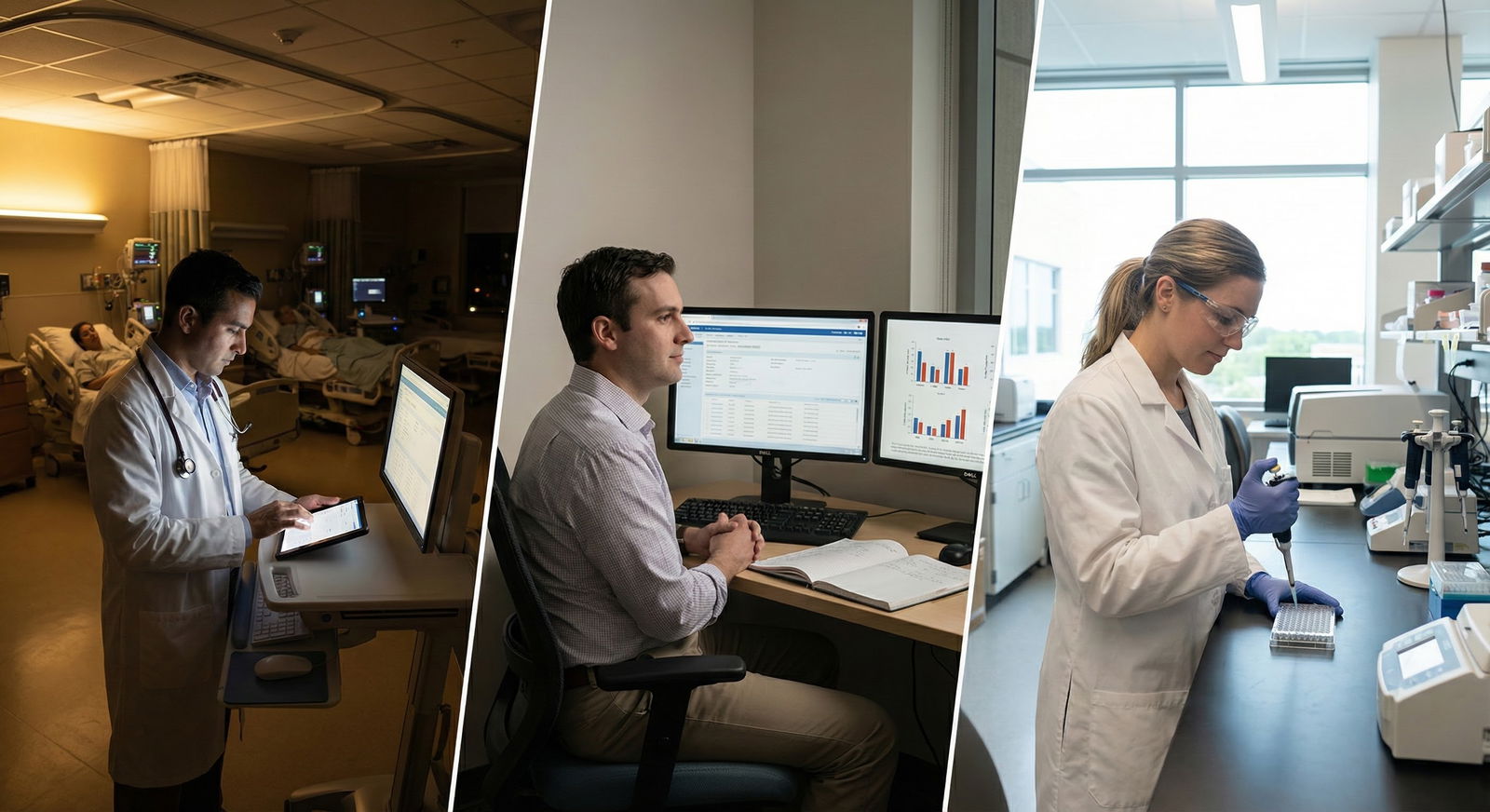
If this article hit a nerve, good. That usually means you're close to making a fixable mistake. Pause before chasing another degree. Audit your file. Get blunt feedback. Repair the real weakness first. That decision can save you years.