
It’s 11:47 p.m. You’re sitting in a call room or a dorm-like med school apartment, a half‑cold coffee next to First Aid or some monster of a path textbook. Your phone is open to a friend’s Instagram: they’re in a lab, pipetting calmly, posting “finally submitted my manuscript” with three celebratory emojis. And your brain whispers the line you’ve been trying to shut up for months:
“Did I make a mistake choosing an MD instead of a PhD?”
And then the spiral starts.
What if you picked the wrong degree. What if you’re too far in to change. What if you spend the next 30 years in clinic wishing you were at a bench or analyzing data. What if this – all this debt, all this time – was the wrong fork in the road.
Let’s walk straight into that anxiety instead of trying to positive‑thinking it away. Because you’re not the first person to have this regret. And you’re not as trapped as it feels at 11:47 p.m.
First: Are You Actually Regretting MD… Or Something Else?
You’re exhausted. You’re drowning in Anki. You’re on your third shelf exam in eight weeks. Of course PhD life looks calmer and more “intellectual” from where you’re sitting.
But the key question isn’t “Do I hate med school right now?” because almost everyone does at some point.
The real questions:
- Do you feel a deep pull toward discovery work – designing questions, building experiments, living in long, uncertain projects?
- Or do you mostly feel burned out by the grind, the hierarchy, the feeling of zero control?
I’ve watched people confuse three different things:
Hating med school structure
Rigid schedule, pimping, arbitrary hoops, feeling like a cog. Honestly, this is awful for a lot of us. That doesn’t automatically mean you’re “meant” to be a PhD.Disliking clinical work itself
When you’re on rotations and everything about direct patient care feels draining – not just the notes and bureaucracy, but actually being in rooms with patients, hearing their stories, doing the exam – that’s different. That might be a sign you really don’t want a career that’s majority clinical.FOMO for a “pure science” path
Watching friends talk about CRISPR or machine learning pipelines or causal inference models while you write progress notes about CHF exacerbations… it’s easy to romanticize research. But do you love the day‑to‑day of it? Or just the idea?
The reason I’m hammering this: the “I regret MD not PhD” panic often spikes at the ugliest points of medical training. You need to separate “this sucks right now” from “this is the wrong career long‑term.”
That said, let’s assume your regret is real. You actually want more research, more theory, more depth, less patient volume. What realistic doors are still open?
Can You Actually Do a PhD After an MD?
Short answer: yes. People do this. It’s not common, but it’s not some urban legend either.
There are a few main routes:
1. MD → PhD after med school (or during residency)
This is the “I finish MD, then pivot” option.
I’ve seen this a few ways:
- Graduate med school, realize you don’t want to practice clinically, and apply to PhD programs in fields like:
- Biomedical sciences (immunology, neuroscience, molecular biology)
- Public health / epidemiology / biostats
- Health policy
- Computer science / AI in medicine
- Or start residency, crash into the reality that you hate it, step away, and then apply for PhD.
Is it allowed? Yes. Are you “too educated”? Not really. Programs like having people with clinical knowledge who want to do research.
The catch: funding and fit.
Pure basic‑science PhD programs sometimes get weird about funding someone who already has an MD, because their budget model assumes you’re not also a physician. But lots of departments don’t care. Public health, epidemiology, biostats, health policy, computational biology, and CS tend to be more flexible.
Here’s roughly how that trade‑off looks:
| Factor | Upside | Downside |
|---|---|---|
| Age/Timing | More clarity about interests | Older than typical PhD entrants |
| Funding | Still often funded (stipend) | Some programs wary of MDs |
| Career later | Strong for physician-scientist | Longer training, more opportunity cost |
You’d basically be re‑starting training in a new world. Different culture, different metrics of success. Publications matter even more. Your USMLE score? No one cares.
Is that insane? Not necessarily. I’ve seen IM residents leave after intern year and start a PhD in epidemiology, then wind up at NIH or policy think tanks. Or med grads who hate clinic and become straight-up data scientists.
But you have to accept: you’re adding 4–6 more years of training. On top of whatever you already did.
“Did I Miss the Boat on MD/PhD?”
This one hurts. You look at MSTP folks and think, “That should’ve been me. I blew it.”
Listen. MD/PhD is not the only path to a research‑heavy life. It’s the cleanest, sure. Funded, integrated, socially approved. But not the only way.
If what you really want is:
- Time protected for research
- Respect in the academic world
- Ability to run your own lab or group
Then yes, an MD/PhD makes the road smoother. But you can still get there from regular MD with:
- A PhD later (we just talked about that)
- Or a research‑heavy residency + fellowship
- Or formal research training (Master’s, postdoc‑like experiences, K‑awards) after residency
The MD/PhD folks don’t have a monopoly on serious science. They just start earlier.
Where you might feel the burn: certain hardcore basic science departments that really like the MSTP pedigree. But if your work is good and your publications are strong, people get over that pretty fast.
Alternate Degrees: Not Everything Has to Be a Full PhD
Sometimes the “I wish I’d done a PhD” feeling is really “I wish I were doing more rigorous, structured thinking than SOAP notes.”
For that, there are shorter, more targeted options that don’t require detonating your whole MD path.
MD + Master’s (during or after residency)
Common combos:
- MD + MPH (public health / epi / global health)
- MD + MS/MA in Clinical Research, Biostats, or Epidemiology
- MD + MS in Biomedical Informatics / Data Science
- MD + MEd (medical education)
- MD + MPP or MPA (policy/administration)
A LOT of academic physicians go this route instead of a second doctorate.
You can:
- Take a research year in med school to start a Master’s
- Do it between residency and fellowship
- Or do it part‑time during residency/fellowship at some programs
This gives you:
- Solid methodological training
- Credentials that signal “I’m serious about research”
- A way to build a niche: outcomes research, AI in medicine, health services research, etc.
No, it’s not a PhD. But for many careers (NIH‑funded clinical investigator, health services researcher, policy person), an MD + strong research training + Master’s + publications is completely sufficient.
What If I Actually Hate Clinical Medicine?
Let’s go to the darkest version, because that’s probably where your 3 a.m. brain is going anyway.
“I think I straight‑up don’t want to practice. At all. I just want to be a scientist.”
Is that survivable? Yes. Is it messy? Also yes.
Realistic options if you’re in this camp:
1. Finish MD, then pivot and never do residency
You graduate, get your MD, never get licensed, never see clinic again.
You then aim for:
- PhD programs
- Industry roles (pharma, biotech, medtech) as a research scientist, clinical development person, or medical affairs role
- Data science / health tech roles, if you have or acquire the quantitative skills
You’ll get questions about why you didn’t do residency. You’ll need a clear story that doesn’t sound like “I quit because I couldn’t hack it,” even if internally it kind of feels like that.
But long‑term? People adjust. The PhD‑and‑up world mostly cares about: can you do rigorous work, can you think, can you publish, can you collaborate.
2. Do a minimal residency, then a research career
Some people do a short residency (like prelim year IM, TY, or limited specialty training), get licensed, then shift heavily to research.
- You’d maintain an MD identity with at least some clinical legitimacy.
- You can pick low‑volume clinics later to keep your license, while spending most of your time in research.
This is the “I don’t love clinic, but I’m okay doing a bit of it to keep doors open” path.
3. Cut your losses early
If you’re pre‑clinical and absolutely certain, walking away before finishing is the nuclear option. Sometimes it’s right. If the entire concept of medicine makes your skin crawl, forcing yourself through years more of it “just in case” can be its own trap.
But: this is very rarely clear in M1/M2, because everyone is miserable. I’d only consider this if:
- You’ve had real exposure to actual PhD‑style lab work or rigorous theory work and loved it
and - You’ve had some patient exposure and truly dreaded it at a values level, not just “ugh this is tiring.”
You Can Build a Research‑Heavy Career Within Medicine
Here’s the part no one tells you when you’re drowning in med school: the life of, say, a basic hospitalist and the life of a physician‑scientist in a big academic center are completely different.
The physician‑scientist version might:
- See patients 1–2 days a week
- Run a lab, supervise grad students / postdocs
- Apply for grants, write papers, go to conferences
- Think about mechanisms or data sets more than they think about clinic flow
Is it easy to get there? Nope. You need:
- Mentors who actually live that life
- Early research involvement (med school, residency)
- Protected research time in residency/fellowship
- A string of publications and, eventually, grants
But if what you’re mourning is “never getting to be a scientist,” that fear is premature. Clinical + research is not a myth. It just looks impossible right now because your entire reality is memorizing pathways and trying not to look stupid on rounds.
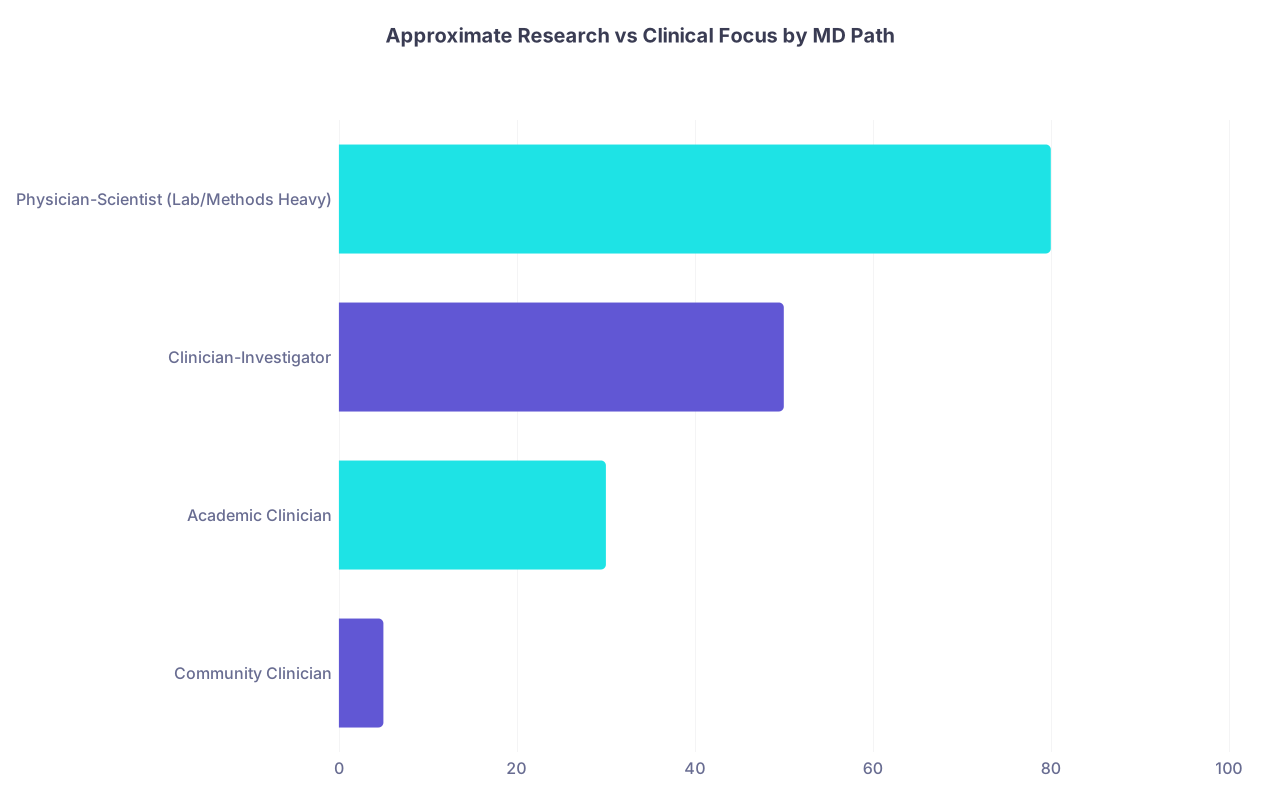
Here’s roughly how “research intensity” can look across MD paths:
| Category | Value |
|---|---|
| Community Clinician | 5 |
| Academic Clinician | 30 |
| Clinician-Investigator | 50 |
| Physician-Scientist (Lab/Methods Heavy) | 80 |
(Values are rough % of time on research vs clinical – not sacred, but you get the idea.)
You’re not locked into the 5% box.
Timing Reality Check: Are You “Too Late”?
This one gnaws at people.
“I’m already M3.”
“I’m already a PGY‑2.”
“I’m 30. I can’t start over.”
Here’s the harsh but freeing truth: every path costs time. Including staying exactly where you are and being miserable.
I’ve seen:
- A 33‑year‑old IM resident leave after PGY‑2 for a PhD in epidemiology, then land at a big academic center with an R01 later.
- A 35‑year‑old hospitalist go back for a PhD in health policy. Now advises major organizations and barely does clinical work.
- A med student who did a research year, realized they loved methods, and later built a career as a stats‑heavy clinical investigator with an MD + MS.
Were they “behind”? A little. Were they burned out during the transition? Also yes. But mid‑30s with 30+ more career years ahead is not exactly “too late” to course‑correct.
What you can’t do is wait forever. If this regret keeps resurfacing every few months for years, you owe it more than “maybe it’ll go away.”
How to Experiment Now Without Blowing Up Your Life
Before you apply for a whole other doctorate, stress‑test the fantasy.
If you’re still in med school:
- Take a real research year. Not “I’m on a random project.” Actually embed in a lab or research group. Live like a junior PhD student for a year. See how you feel.
- Pick research‑heavy electives. NIH, big academic centers, T32‑funded spots.
- Ask to join lab meetings. The politics, the endless revisions, the waiting for data – does that energize you, or drain you?
If you’re in residency:
- Look for tracks with built‑in research time (research tracks, clinician‑investigator pathways).
- Start a Master’s in something like epi, biostats, or informatics if your program supports it.
- Talk to the people who are already doing 70–80% research. Ask them what their last six months actually looked like.
Because here’s an uncomfortable truth: I’ve watched people romanticize PhD life, then do a research year and realize they hate uncertainty, long timelines, and the publish-or-perish pressure even more than clinic.
You want to test that before committing another half‑decade.
How Bad Is This “Regret” Really Going to Mess Up My Career?
Let’s be brutally practical for a second. Worst‑case scenario brain wants to know: am I doomed?
Realistic worst cases:
- You grind through MD, realize you truly despise clinical, and never practice. You pivot to research or industry a bit later than ideal. You carry some extra debt and some emotional scars from training. But you still build a life you like by your 30s or early 40s.
- You oscillate for too long, half‑in/half‑out, never fully committing to either side. This is actually the most dangerous version. Not choosing is its own choice.
Far more likely:
- You end up in some hybrid you didn’t even know existed when you were M1. MD plus strong research training. Maybe an extra degree. Maybe industry. Maybe health tech. You’re not in the “pure PhD” world, but you’re not a full‑time clinic churn machine either.
Medicine feels more rigid from the inside than it actually is. Once you’re past the exam‑every‑two‑weeks stage, the branching options get wider, not narrower.
To make that real, here’s a snapshot of a few “I regret MD” people I’ve known and where they landed:
| Starting Point | Pivot Choice | Current Type of Work |
|---|---|---|
| M4, hated clinic | PhD in Epidemiology | Policy research + occasional consulting |
| PGY-1 IM, burned out | Left, PhD in Biostats | Biotech data science lead |
| Hospitalist, 5 years | PhD Health Policy | Academic policy researcher, light clinic |
| M3, research year | MD + MS Informatics | AI in healthcare industry, no clinic |
Did any of them take the “ideal” path? No. Did it matter in the end? Less than they thought.
Okay, So What Should You Actually Do Next?
Not in five years. Not “someday.” Next.
A few concrete moves:
- Identify 2–3 people who have careers you think you want. Not vague “research doctors.” Actual names at your institution or online. Email them. Ask for 20 minutes to understand their path.
- If you’ve never really done sustained research, find a way to do a real project or a research block, not some random side thing squeezed into weekends.
- Start journaling – yeah, I know – after clinical days: What parts did I hate? What parts did I like? And after research days: same questions. You need data on your own mind, not just vibes.
- Give yourself a deadline. “By the end of M3” or “By the end of PGY‑1 I will decide if I’m committing to a research‑heavy MD path, or seriously pursuing PhD applications.”
And talk about this with someone you trust who won’t just say, “You’re fine, everyone feels that way.” That’s the academic version of gaslighting.
| Category | Value |
|---|---|
| MS1 | 10 |
| MS2 | 20 |
| MS3 | 30 |
| MS4 | 25 |
| PGY1 | 20 |
| PGY2-3 | 15 |
| Attending | 10 |
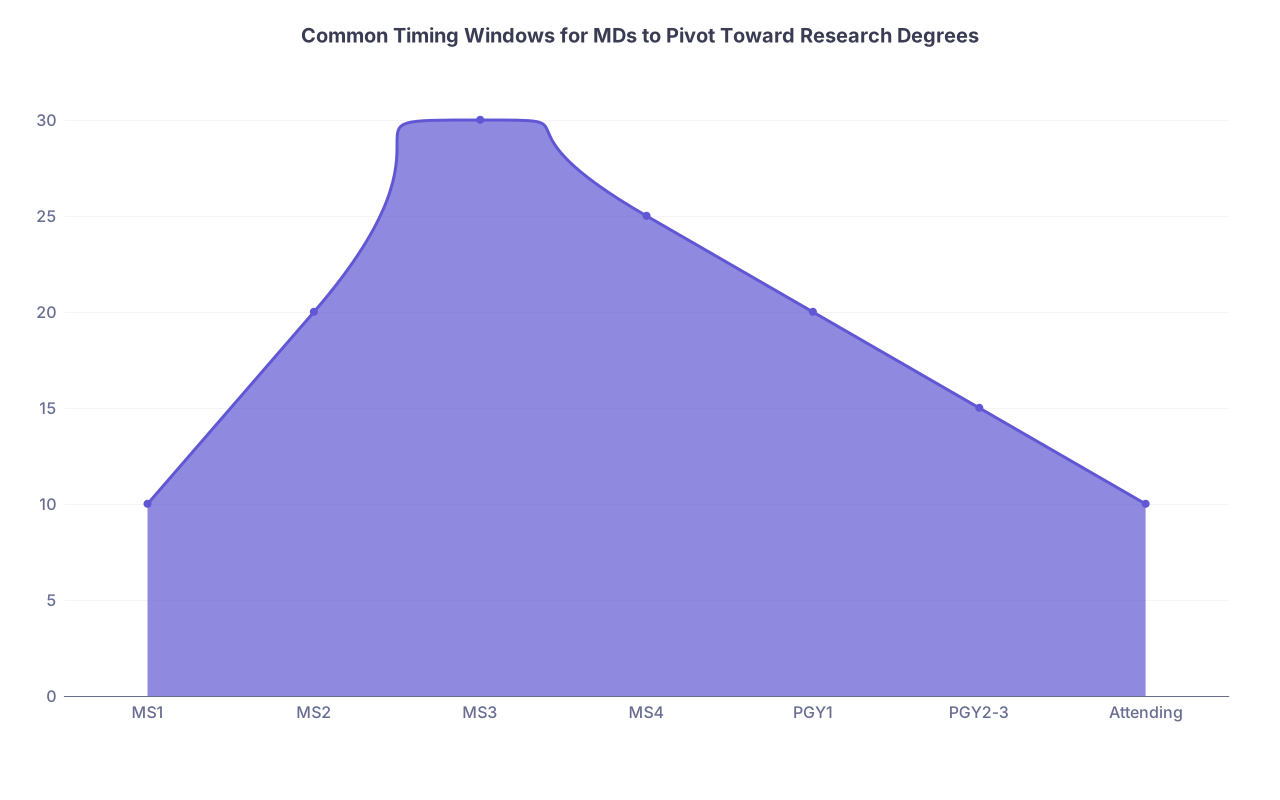
(Those numbers roughly represent how often I’ve personally seen people start seriously planning a major pivot. Not exact stats, just a reminder: people reconsider at every stage.)
The Short Version, If Your Brain Is Fried
You’re not the only one looking at the MD path and wondering if you chose wrong.
Three points to hold onto:
You’re not locked out of PhD‑level work. You can do a PhD after MD, or build a serious research career through residency, fellowships, Master’s degrees, and protected time. You did not “miss the last train” when you didn’t apply MD/PhD at 21.
There are real escape hatches if you truly hate clinical medicine. They’re not painless, but they exist: finish MD and pivot, do minimal residency then mostly research, or step out earlier if you’re absolutely sure. None of those paths = life ruined.
Don’t blow up your life on a fantasy. Before applying to PhD programs, give yourself real exposure to research life now – a research year, a serious project, close contact with labs or methods groups – and watch your own reactions carefully.
You’re allowed to regret things. You’re also allowed to change directions. The MD you already chose doesn’t have to be a trap; it can just be one chapter in a longer, more complicated story where you gradually steer yourself closer to the kind of thinking and work you actually want to do.