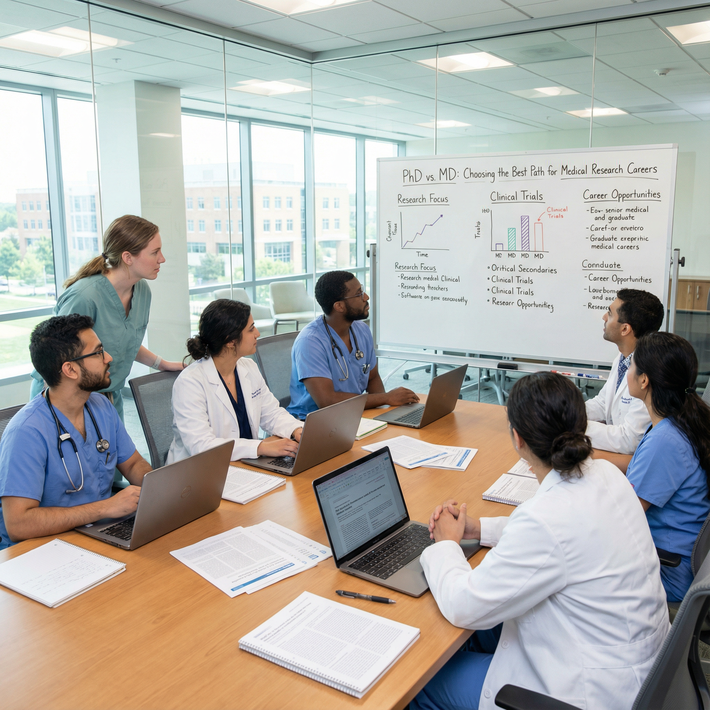
You’re sitting at your desk, AMCAS open on one tab, a half-written MD/PhD essay on another, and your phone lit up with a group chat where half your friends are raving about doing a physician-scientist track. You keep thinking the same thing over and over:
“If I just choose straight MD now… am I slamming the door on ever going back to research? Like… permanently?”
And the spiral starts. You picture future-you, attending on the wards, watching the “real scientists” present at conferences, and you’re stuck just clicking “next” in Epic. You imagine committees looking at you thinking, “Well, if you really cared about research you would’ve done MD/PhD.”
Let me say this as clearly as possible:
If you choose straight MD, you are not permanently exiled from research. Not even close.
But the anxiety you’re feeling is real, and there are tradeoffs. So let’s actually walk through them instead of just relying on vibes and Reddit horror stories.
The Big Question: Does Not Doing MD/PhD Close Doors?
Short answer: No. But it changes how you walk through them.
I’ve seen:
- Straight MDs become PIs with R01s
- MDs go back for PhDs in the middle of residency or after fellowship
- Clinicians who build 50–70% research careers without a PhD
- People who barely touched research in med school then pivoted hard in fellowship and ended up at major academic centers
The catch? The path is less “pre-packaged.” MD/PhD hands you a structured pipeline. Straight MD means you have to assemble that pipeline yourself later.
Here’s the reality breakdown:
| Path | Typical Length | Main Focus | Built-in Research Time |
|---|---|---|---|
| MD only | 4 years | Clinical training | Variable, often limited |
| MD with research track | 4 years | Clinical + projects | Moderate |
| MD/PhD | 7–9 years | Dual training | Extensive |
| MD + later PhD | 4 + 3–5 years | Clinical then research | Extensive |
| MD + research fellowship | 4 + 3–7 years | Clinical subspecialty + research | High |
You’re not choosing “research or no research forever.”
You’re choosing:
- Do I want a long, highly structured research training now, with guaranteed funding and identity as a physician-scientist?
- Or do I want to get the MD first and decide how deep into research I want to go once I’ve actually seen real medicine?
Both are valid. What freaks you out is the idea that if you don’t choose MD/PhD now, you’ll never be “legit” later.
That’s just wrong.
What If I Do Straight MD, Then Change My Mind?
Picture this: You start med school MD-only. You kind of think research sounds nice, but you’re not ready to commit 7–9 years to an MD/PhD right now.
Year 1: You join a small project, maybe a chart review or QI project. The usual low-stakes stuff.
Year 2: You realize you actually like asking questions and not just checking boxes. You start wondering: “Did I just screw up by not doing MD/PhD?”
This is where the panic usually hits.
But here are the actual, concrete ways you can “go back” to research:
1. Research in Medical School (Without a PhD)
Most med schools have:
- Summer research fellowships between M1–M2
- Scholarly concentration programs
- Longitudinal research tracks
- Optional research years (often funded by NIH, HHMI, Doris Duke, etc.)
This is not fake research. This is real mentored work that can lead to:
- Publications
- Abstracts
- Presentations at national conferences
- Letters from serious investigators
You’re not barred from any of that as a straight MD. In fact, some MD-only students build stronger research CVs than some MD/PhDs because they hustle, choose good mentors, and stay productive.
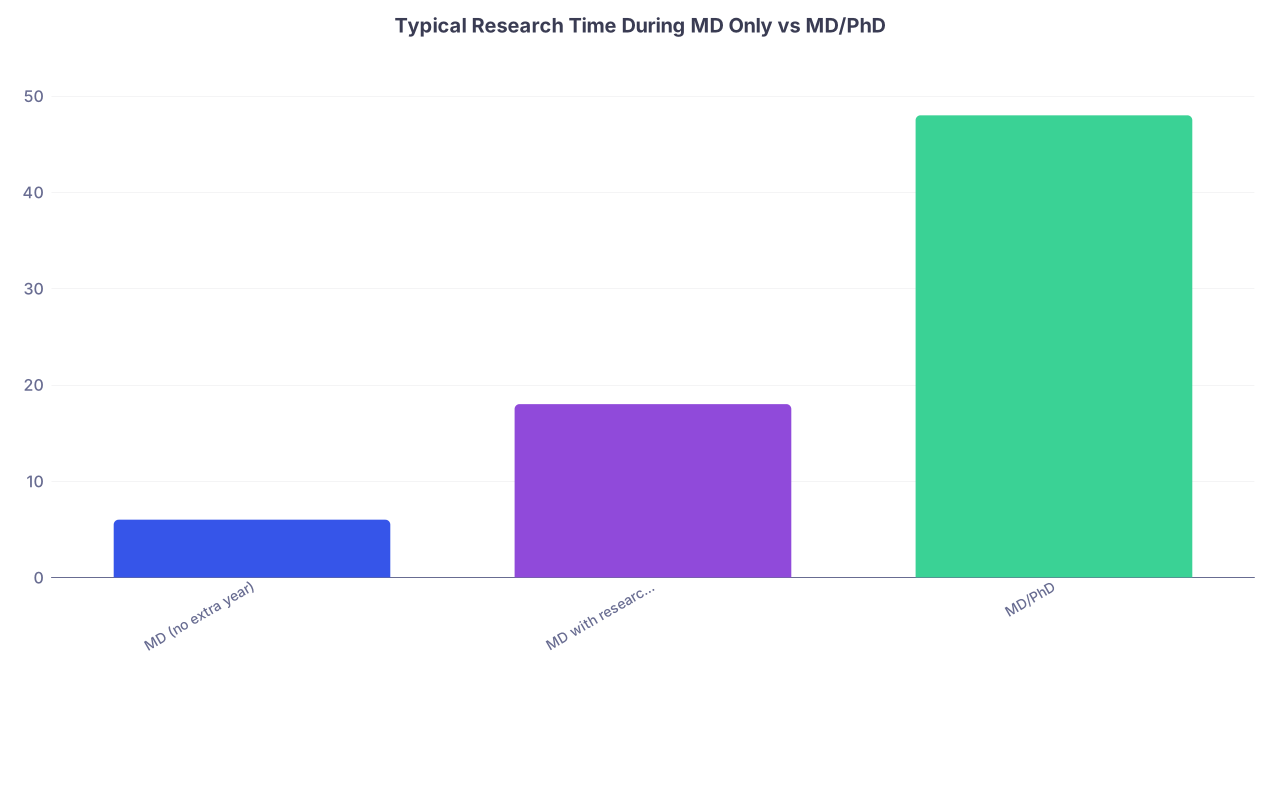
| Category | Value |
|---|---|
| MD (no extra year) | 6 |
| MD with research year | 18 |
| MD/PhD | 48 |
(Values are rough months of focused research.)
2. Taking a Dedicated Research Year
You can literally bolt on a research year during med school. Common timing:
- Between M2 and M3
- Between M3 and M4
- Occasionally after M4 before residency
These can be:
- At your home institution
- At NIH
- Through funded programs (HHMI, Doris Duke, Sarnoff, etc.)
Does it equal an 8-year MD/PhD? No. But it doesn’t have to. If your goal is a research-leaning clinical career (e.g., academic cardiology, heme/onc, GI, neuro), a strong research year + some continued projects can be plenty.
Can I Do a PhD After My MD?
Yes. People actually do this. Not tons, but enough that it’s a thing, not a myth.
Here are the main options:
Option A: PhD During Residency or Fellowship
Some programs, especially at big academic centers, have combined clinical–research tracks where you do:
- Core clinical training (residency+maybe early fellowship)
- Then a PhD embedded in your training, often with funding and protected time
You’ll see things like:
- Internal medicine + PhD in Clinical Investigation
- Neurology + PhD in Neuroscience
- Pediatrics + PhD in Epidemiology or Public Health
The downsides:
- It lengthens training even more (you’re now stacking residency/fellowship + PhD)
- You need to be at a place that can actually support this
- You’re juggling a grown-up life now (partner, kids, loans, fatigue)
But doors are not shut. Far from it.
Option B: PhD After Residency/Fellowship
Rarer, but I’ve seen:
- A cardiologist who went back for a PhD in biostatistics to do outcomes research
- A psychiatrist who did a PhD in neuroscience after finishing fellowship
- An EM doc who went back for a PhD in public health
This is more of a “I’m all-in on being a scientist-clinician and I want the full toolkit” move. Your age will be higher. Your classmates may be younger. But academically? Totally legitimate.
Do I Need a PhD to Have a Research Career?
No. And this is where people massively overestimate how “necessary” a PhD is.
I’ll be blunt: A PhD makes a few things easier:
- Grants committees see it and think, “Okay, formal scientific training.”
- You’ve likely had more time to learn experimental design, stats, and how to live in a lab.
- Some institutes still instinctively trust the MD/PhD identity more for hardcore bench science.
But plenty of MD-only folks:
- Lead labs
- Get R01s
- Run clinical trials
- Do outcomes or implementation science
- Become division chiefs for research
Especially for:
- Clinical trials
- Health services research
- Outcomes research
- Medical education research
…an MD plus focused research training (fellowship, master’s, mentored time) can be enough.
Where a PhD is more heavily favored:
- Deep bench/basic science
- Translational wet-lab-heavy work
- Competing for certain basic science-heavy R01s
Even there, MD-only investigators exist. They just usually did serious post-doc-style research time during fellowship or early faculty years.
What Actually Matters More Than Your Degree Letters
Here’s the part nobody wants to hear because it’s not as clean as “MD/PhD = researcher, MD = clinician.”
The thing that actually matters most long-term is not whether you do MD/PhD.
It’s whether you can show:
- A consistent track record of research productivity
- Increasing independence over time (from “helper” to “idea generator”)
- Strong mentorship and letters from known investigators
- Some serious methodologic skill (stats, trial design, coding, etc.)
You can build that as:
- MD/PhD
- MD with a research year
- MD with a research-heavy fellowship
- MD with a later master’s/PhD
The path differs. The output and skills are what people eventually care about.
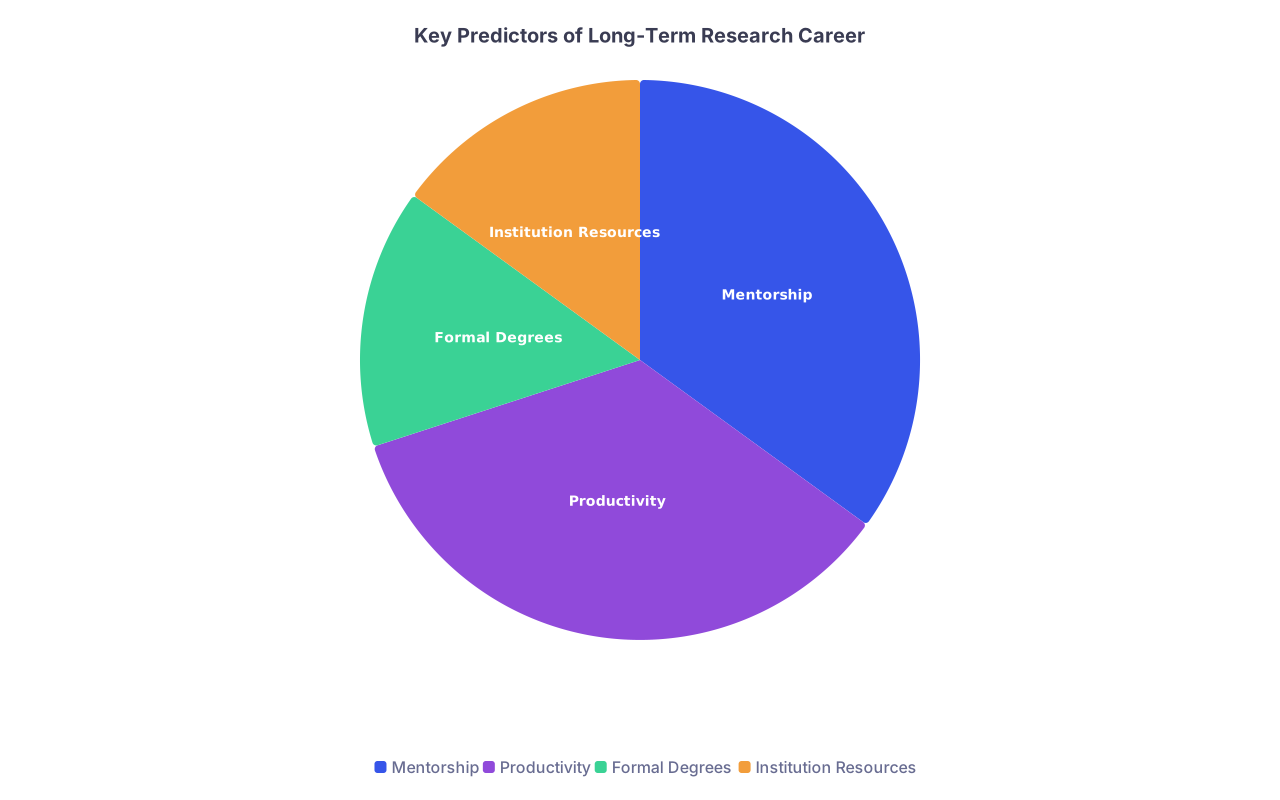
| Category | Value |
|---|---|
| Mentorship | 35 |
| Productivity | 35 |
| Formal Degrees | 15 |
| Institution Resources | 15 |
Are MD/PhD grads more likely, on average, to end up in heavy research roles? Yes. Because the whole pipeline pushes them that way. But that doesn’t make it impossible—or even rare—for MDs to do it differently.
The Hidden Tradeoffs Nobody Really Spells Out
Your anxiety is probably not just “Can I do research?” It’s:
“What if I pick wrong and ruin everything?”
So let’s name some actual tradeoffs.
If You Choose Straight MD Now
Pros:
- 4 years instead of 7–9 before residency
- More flexibility if you change your mind and want to be mostly clinical
- You can test-drive research without committing your 20s/early 30s to it
- You can still build a research-heavy CV with intention
Cons:
- No built-in 3–5 years of protected research time early on
- You’ll have to be more proactive finding mentors and opportunities
- For hardcore bench research, you may have to fight a bit more for credibility and training time
- Training for a “50%+ research” career often ends up being pieced together over many years
If You Had Done MD/PhD
Pros:
- Strong identity as physician-scientist from the start
- Tons of protected research time early
- You come out with serious scientific training and a long CV
- Easier to convince people (and yourself) that you’re “legit” as a scientist
Cons:
- You just added 3–5 extra years before you even start residency
- If you fall in love with pure clinical work, you may feel guilty/boxed in
- Burnout is real; a lot of MD/PhDs gradually drift toward more clinical time anyway
- The financial and personal life delay is not trivial
That’s the irony I’ve watched play out: some MD/PhDs drift away from research; some MDs drift toward it.
Your MD-only choice doesn’t lock you in. It just means your pivot, if you choose one later, looks different.
“But Will Programs Take Me Seriously Without a PhD?”
This is the insecure little voice talking, and I get it.
You’re picturing yourself on a faculty website next to “John Smith, MD, PhD, R01 this and that” and you’re just “You, MD.” And you’re like, “Yeah, okay, I’m the sidekick.”
Reality on the ground: people care about what you actually do.
If by the time you’re applying for:
- Research-heavy fellowships
- K awards
- Early faculty positions
…you have:
- A good handful of first-author papers
- Some solid co-author papers
- Real, mentored projects with depth
- Maybe some methodologic training (MPH, MS, certificate in clinical research, etc.)
No one’s tossing your app because you didn’t have the foresight at 21 to do MD/PhD.
I’ve seen selection committee discussions. The vibe is much more:
“Does this person actually seem like they can produce? Do they have the grit and track record?”
Not: “Did they check the exact training pipeline box at age 20?”
What If I’m Already in Med School and Panicking?
Maybe this isn’t theoretical. Maybe you’re already:
- M1 or M2
- MD-only
- Watching some friends re-apply for MD/PhD
- Feeling like you made the “less serious” choice
Here’s what you can do this year if you think research might be a real part of your future:
- Get one serious, longitudinal research mentor. Not 5 random PIs. One or two good ones.
- Aim for projects that have a clear path to publication, not just busywork.
- Consider a dedicated research year if, by mid-M2, you’re genuinely excited and productive.
- Be intentional about your narrative: “I chose to get grounded in clinical medicine first, then built research training around what truly interested me.”

| Step | Description |
|---|---|
| Step 1 | Start MD |
| Step 2 | Join small project |
| Step 3 | Focus on clinical |
| Step 4 | Find strong mentor |
| Step 5 | Summer or part time research |
| Step 6 | Apply to academic residency |
| Step 7 | Take research year |
| Step 8 | Research heavy residency or fellowship |
| Step 9 | Protected research time as faculty |
| Step 10 | Enjoy research? |
| Step 11 | Want more depth? |
That’s a perfectly legitimate path. No asterisk.
A Quick Reality Check: You Don’t Actually Know Yet
Harsh truth: you don’t know enough right now to make a perfectly optimized 20-year career decision.
You haven’t:
- Lived the grind of residency
- Experienced the difference between lab time and clinical time long-term
- Seen what 80% research vs 80% clinical weeks actually feel like
And yet med school apps pretend you’re supposed to know, right now, if you’re an “MD person” or an “MD/PhD person” for life.
You’re not broken for being unsure. You’re… normal.
The question isn’t “What guarantees the perfect future?”
It’s more: “Given who I am right now, what’s the amount of commitment to research that I can make without lying to myself?”
If that’s MD only with openness to research later? That’s fine. And reversible. Not perfectly, not without tradeoffs—but definitely not final.
FAQs
1. If I do straight MD, is it basically impossible to become a PI with big grants like R01s?
Not impossible. Hard, but not because you’re MD-only—because it’s hard for everyone. MD/PhDs statistically end up in those roles more often, but I’ve seen plenty of MDs run labs and hold R01s. The common pattern? They did serious research time during fellowship or early faculty years (2–4+ years of protected time) and had excellent mentorship. If you’re willing to commit that time later, you can absolutely get there.
2. Will top academic residencies care that I didn’t do MD/PhD if I want a research career?
They care more about: “Did this person actually do research that shows they can think and produce?” If you apply with no research at all and say “I want a research career,” it rings hollow. If you apply with a coherent story, some publications, good letters from PIs, and maybe a research year, most academic programs will take you very seriously—even if you’re MD-only.
3. Is going back for a PhD after MD realistic financially and logistically?
It’s realistic, but not simple. You’ll likely be older, maybe with more life responsibilities. The good news: many PhD programs embedded in residency/fellowship will fund your tuition and give you a stipend. The bad news: you’re stretching training and delaying higher attending income even further. It’s not a bad move if you’re truly all-in, but it’s not something to do lightly just to “catch up” to MD/PhDs.
4. Should I re-apply as MD/PhD instead of going MD-only if I’m even thinking about research?
Not automatically. Ask yourself: Do you want to spend 7–9 years in training before residency? Are you genuinely excited by long, slow, sometimes frustrating experiments and grant writing? Or do you like the idea of research because it feels prestigious and “intellectual”? If your gut is unsure or you’re more drawn to patient care at this point, MD-only with built-in research opportunities can be a safer, more honest choice that still leaves doors open.
5. What’s one concrete thing I can do in M1/M2 to keep research doors open without committing to MD/PhD?
Find one serious mentor doing work that at least vaguely interests you and stick with them for more than a semester. Ask for a project with a realistic chance of publication and be the annoying-but-reliable student who actually follows through. One sustained, productive research relationship beats five scattered, half-finished projects. That single step will keep more doors open than obsessing over degree labels.
Open your notes app—or a blank document—right now and write two short lists:
- “Reasons I’m drawn to MD/PhD–style research,” and
- “Reasons I hesitate to commit to MD/PhD.”
Look at those lists and circle which side feels more honest to you today. Not ideal, not impressive—honest. That’s the version of you you should make this decision for. The rest—research paths, PhDs later, academic careers—you can still build if and when future-you decides you actually want them.