
It’s 7:30 pm, you’re the last one in the lab, and your Western is running while you stare at your half-drafted K award aims. At the same time, your inbox has a “Faculty Position – Assistant Professor” posting from a department you admire. You’re in that no-man’s-land: too trained to be “just a trainee,” not yet established enough to feel safe.
You’re asking the right question: What do department chairs actually look for when they hire a physician-scientist? Not the brochure version. The real version. The one that gets discussed behind closed doors in the dean’s office and on those “executive session” Zoom calls you’ll never see.
Let me walk you through what really happens.
The Chair’s Real Problem (And Why It Has Almost Nothing To Do With Your Personality)
You read job ads and see the same fluff: “commitment to excellence in clinical care, research, and education.” Chairs do not care about that sentence. Legal made them put it there.
Here’s what a chair is actually thinking when they plan a physician‑scientist hire:
- Can this person reliably bring in external money in the next 3–5 years?
- Will this person elevate my department’s academic reputation (papers, talks, prestige)?
- Will this person cover enough clinical work that I can justify the FTE to the dean?
- Are they going to crash and burn under the load and leave me with an expensive failure I have to explain at the next budget meeting?
You are an investment. A risky one. The MD-only clinician is a predictable revenue stream. The PhD-only basic scientist is a clearer grant equation. The physician‑scientist is complicated: high potential upside, high burn rate, and politically sensitive.
Once you accept that frame, everything else makes more sense.
The Metrics That Actually Matter (Not The Ones You Think)
You obsess about your H‑index and whether that Cell paper’s impact factor looks better than JCI. Chairs look at different signals.
Let’s parse the unspoken scorecard.
1. Funding Trajectory: The K vs R Conversation
Chairs don’t just look at whether you have awards; they look at what those awards predict.
Here’s the rough internal hierarchy they’ll never admit in writing:
| Signal | Chair's Real Reaction |
|---|---|
| Active R01 (or equivalent) | "We should probably just hire them." |
| K08/K23 or equivalent + strong pubs | "High potential; protect them and bet on them." |
| NIH F32/T32 + great mentorship | "Good science, but needs a clear path to K/R." |
| Foundation career awards (Doris Duke, etc.) | "Serious contender; strong external validation." |
| No career-type award | "Risky. Need something else to make it worth it." |
They also look at timing. If you’re 1 year into a K08 with 3–4 solid papers and a clear R01 plan, you’re much more attractive than someone 4 years into a K with thin output. They’re watching the slope of your trajectory, not just the absolute position.
The brutal truth: a lot of chairs privately label people as “will get an R” vs “probably won’t” after a 30‑minute chalk talk. They’ve seen hundreds of candidates. They’re not always right, but they’re not guessing at random.
2. Papers: It’s Not Just Where, It’s How
You think it’s all about the journal name. Chairs care more about this combination:
- First/last-author density: Are you driving projects or tagging along?
- Coherence of your story: Does your CV tell a clear mechanistic or clinical narrative, or is it scattered?
- Independence from your mentor: Are the last-author names always your PI’s? Same methods, same disease, same exact angle? That’s a problem.
I’ve watched search committees literally put CVs side by side: candidate vs mentor. If your work looks like a weaker copy of your mentor’s, the skepticism kicks in.
You want your recent work to say: “I’m not my mentor’s technician. I have my own question and can push my own field.”
If you’re coming in as an MD with a PhD vs MD-only, the bar doesn’t change much. The story does. PhD‑MDs are expected to show deeper mechanistic chops and more first-author basic science. MD‑only folks are “allowed” to have more clinical/epidemiologic work, but the signal of independence still has to be there.
What Chairs Actually Say On The Hiring Call
This is the part you never hear. The 12–15 minute “executive session” where the committee summarizes you for the chair and other leaders who barely met you.
Here’s how those conversations actually sound:
“She’s on a K08, year 2, with 2 JCI first‑authors and a solid R01 aim structure. Needs protected time but could be a star.”
“He’s very likable, but his pubs are all middle‑author multi‑site clinical trials. I don’t see where the R01 comes from.”
“The science is strong, but they need heavy start‑up. We’d have to cover 70–80% protected time for at least 3 years. Can we realistically do that?”
“Their clinical niche fills a serious gap in our service line. Even if the R doesn’t hit immediately, it helps us with the spine program.”
Notice what’s missing: no one is talking about your volunteer work, your “passion for mentorship,” or that quirky hobby your mentor told you to mention.
They talk about four things: grants, papers, clinical value, and risk.
Protected Time: The Currency You Don’t Realize You’re Negotiating
You read job offers and focus on salary and title. Chairs focus on protected time and start‑up.
Here’s the brutal internal math:
- Every 10% of protected time you get is clinical revenue they lose.
- Every dollar of startup you get is money that could have gone to someone else who’s already producing.
They’re asking themselves: “If I give this person 70–80% research time for 3–5 years, what’s the probability they land an R01 and become net-positive academically?”
Let me translate the usual “tracks” into what they actually mean when they’re discussing you:
| Track / Setup | What It Actually Signals |
|---|---|
| 80% research / 20% clinical | Chair believes you’re a real R01 bet. |
| 50–60% research / 40–50% clinical | Hedge. They like you but are not all‑in. |
| 30–40% research / 60–70% clinical | You’re essentially a clinician with aspirations. |
| “We’ll adjust protected time after a few years” | They’re keeping options open. For them, not you. |
I’ve watched junior people accept 40% research thinking “I’ll bootstrap my way up.” No. You will drown. You will be the person charting at 11 pm trying to write a Specific Aim in between Epic messages.
Chairs know this. Some will be honest about it. Some won’t.
MD vs PhD vs MD‑PhD: How The Chair Calculates Your “Load”
Underneath the politeness, there’s a simple matrix the chair (and the CFO) runs on every candidate: How many wRVUs, how much indirects, and what kind of prestige does this person bring?
1. Pure PhD Hire
- No clinical revenue.
- Must be grant-productive to justify salary and space.
- Bar for R01-level funding is high and immediate.
- If they go 5–7 years with spotty funding, they’re in real danger.
Chairs compare PhDs against each other. It’s a clearer equation.
2. MD‑Only Physician-Scientist
This category splits:
- Clinically heavy with “some research”: These hires often get described as “academic clinicians” even if the ad said physician‑scientist. The chair expects reliable clinical coverage plus some scholarly output.
- Serious research MD‑only: These are rarer. They tend to have strong K awards, big clinical trials, or advanced methods (informatics, outcomes, implementation science).
If you’re an MD-only trying to be taken seriously as a physician‑scientist, the chair looks very closely at: Can you plausibly sustain extramural funding, or are you always going to be 70% clinic?
3. MD‑PhD
Here’s the dirty secret: MD‑PhD is a label, not a guarantee.
Chairs have all met MD‑PhDs who haven’t touched a pipette or dataset in 10 years. So the degree doesn’t buy you automatic credibility.
What it really does is raise expectations. You’ll hear things like:
“They did their PhD 10 years ago and haven’t had a first‑author basic paper since. Are they really a scientist?”
For MD‑PhDs, chairs look at:
- Continuity: Have you actually maintained research involvement during residency/fellowship?
- Upgrade path: Have you moved from trainee‑level work to clear, independent ideas?
- Alignment: Does your current research match your clinical niche in a way that’s fundable?
If your PhD work is in Drosophila signaling and now you’re a transplant cardiologist doing observational registries, you better have a clear story why that pivot makes you more fundable, not less.
What Wins The Job: The Chalk Talk, Not The Polished Talk
This one surprises people.
Your formal seminar is rehearsed, polished, and safe. Everyone claps. It’s fine.
The chalk talk is where your fate is decided.
Chairs and senior faculty are sitting in that room asking:
- Does this person own their field or just recite it?
- Do they think experimentally?
- Can they generate fundable aims on the fly when we poke holes?
- Do they understand feasibility given our environment?
The specific Aim 1 / Aim 2 / Aim 3 is not what matters most. They’re watching how you think under pressure with imperfect information. Because that’s exactly what writing and defending a grant feels like.
I’ve seen two candidates with similar CVs:
- Candidate A: Better journals, more prestigious postdoc, slicker talk.
- Candidate B: Slightly weaker CV, but during chalk talk, handled every challenge, pivoted intelligently, and clearly saw several steps ahead.
Guess who got the offer? B. Every time.
Why? Because chairs know CVs can be inflated by luck, big labs, or heavy mentor involvement. But in a chalk talk, your brain is on display with no filter.
The Political Layer You Don’t See: Divisions, Service Lines, and Turf Wars
You think you’re applying to “the department.” You’re not. You’re walking into an internal power map.
Three invisible forces shape your odds:
- Service line priorities
If the hospital CEO and chair have decided “we are going to dominate in heart failure and transplant,” then a heart failure physician‑scientist will be pushed hard, sometimes even over more obviously “better” candidates from other subspecialties.
- Division politics
Maybe the division chief of GI has been asking for a physician‑scientist for 3 years and keeps getting blocked by Pulm/CC who brings in ICU revenue. When the GI slot finally opens, that chief is desperate not to lose it again. You’re stepping into a long‑running negotiation you’ll never see.
- Strategic initiatives
When the dean says “we need precision oncology” or “we’re building AI in radiology,” money follows. If you match one of those buzzwords and have real substance, you’re far more likely to get a serious package.
So you send out 30 applications and randomly get traction at 3 places. It’s not random. You happened to fit a political and financial niche they needed to fill that year.
Start‑Up Packages: How They Actually Decide Your Number
You’ll never see the back‑room spreadsheet, but I have.
Columns like: salary, % protected, lab space, major equipment, technician support, bridge fund, mentoring plan. Rows with different candidates and internal benchmarks.
They’re asking:
- What did we give the last few successful hires at this level?
- What do our peer institutions give for similar fields?
- How badly do we want this specific person?
The number is not driven by “what you need.” It is driven by “what they think you’re worth in 5–10 years to the department and school.” That’s cold, but accurate.
If you’re coming from a big‑name lab (Broad, UCSF, Penn, etc.), your start‑up will often be higher for the same CV because they’re assuming your mentor pipeline and credibility will accelerate your R‑funding odds.
One more truth: Soft‑money rich departments (medicine, radiology) behave differently than hard‑money fields (pathology, some surgical subspecialties). They’re staring at different risk calculations.
Visibility and Endorsement: The Unfair Advantage You Can Actually Build
You think “My work should speak for itself.” It doesn’t.
Here’s how it really plays out:
- The chair or division chief calls someone they trust: “Do you know this person?”
- Your mentor either sells you hard, offers faint praise, or—worst—hedges.
- That one call can move you from “borderline” to “must interview” or the reverse.
A K award plus a glowing, specific endorsement from a senior person the chair respects will often beat slightly better metrics with a lukewarm backchannel.
Backchannel questions they ask (yes, these exact phrases):
- “Are they self‑propelled or do they need a lot of hand‑holding?”
- “Would you hire them again if you could?”
- “Do you actually think they’ll get an R in the next few years?”
You can’t control everything, but you can absolutely cultivate the right champions. And you should.
How Timing Really Works: Batches, Not Singles
Hiring doesn’t happen in smooth waves. It happens in bursts.
A dean frees up lines. A big-name senior person retires. A service line expands. Suddenly, a department has budget for 2–3 hires. They post broadly, but in the chair’s mind, they’re thinking: “We need one basic scientist, one translational, and maybe one clinician‑investigator.”
You might be the perfect person in the wrong year. Or the right year but for the wrong mix they had in mind.
That’s why “apply once, get rejected, never try again” is dumb. Chairs do remember strong near‑misses. When the next slot opens, your name comes back up: “We should circle back to that K08 candidate from Hopkins we liked last time.”
Visualizing Your Trajectory vs What Chairs Want
Here’s a crude but honest look at how chairs perceive physician‑scientist time allocation early on.
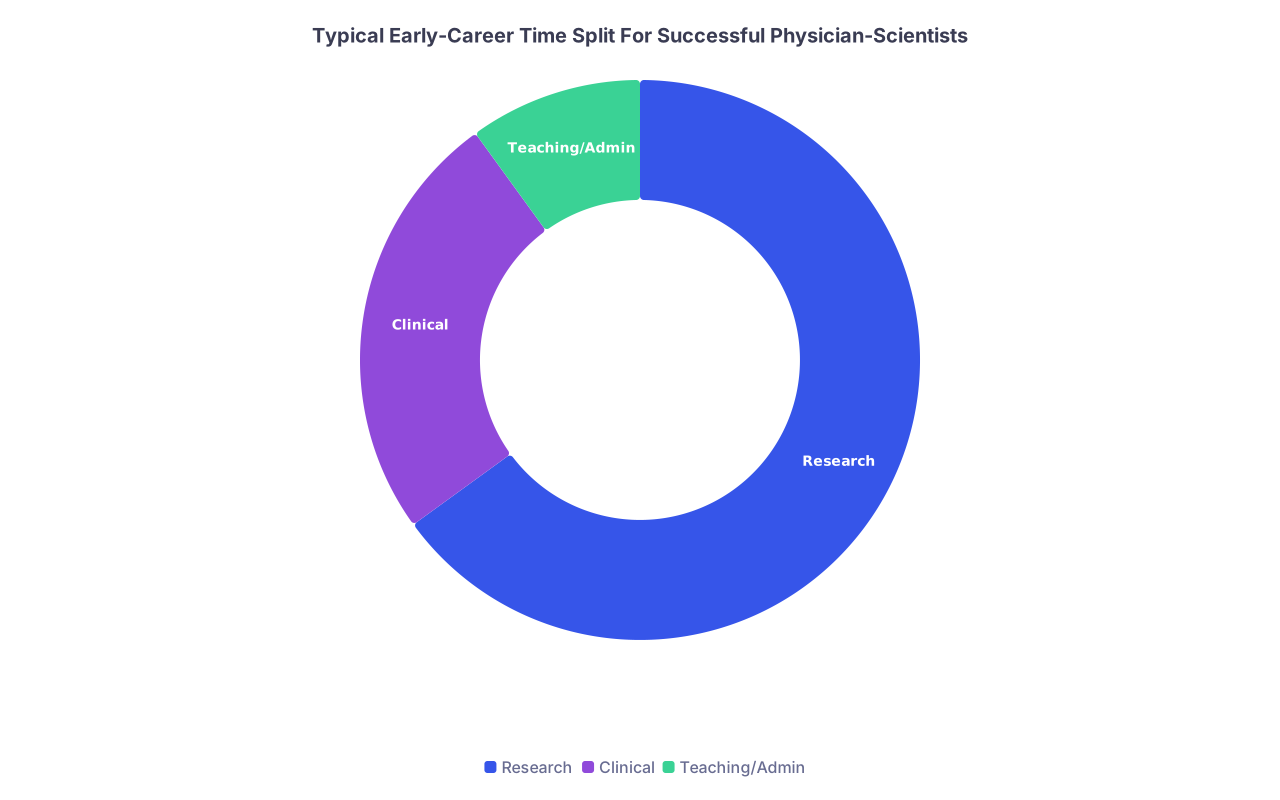
| Category | Value |
|---|---|
| Research | 65 |
| Clinical | 25 |
| Teaching/Admin | 10 |
If your realistic first 3–5 years look more like 40% research, 50% clinical, 10% everything else, you’re not being hired as a true physician‑scientist, no matter what your business card says.
How To Read Between The Lines Of A Job Offer
Let’s decode some phrases chairs and chiefs use and what they actually mean.
| Phrase in Offer / Conversation | What It Usually Means |
|---|---|
| "We’re very supportive of research" | Vague. Ask for specific % and resources. |
| "We expect everyone to be academically active" | You will be writing papers on your own time. |
| "Protected time will evolve with your grants" | You start higher; it can shrink fast if no funding. |
| "We don’t do hard guarantees of % effort" | They want maximum flexibility; you carry risk. |
| "We’ll find you space once you get here" | Space is tight. Be careful. |
You want specifics:
- Exact % research effort for first 3 years, and what conditions change it.
- Explicit start-up details (dollars, years, what counts as “spent”).
- Mentoring structure that’s more than a name on a form.
- Clear lab or office space commitment.
If they’re vague, it’s not because they “haven’t thought about it yet.” It’s because they don’t want to lock themselves in.
Image: The Internal Hiring Flow
To tie this together, here’s the rough internal flow that plays out in these decisions.

| Step | Description |
|---|---|
| Step 1 | Position Approved |
| Step 2 | Define Strategic Need |
| Step 3 | Screen CVs |
| Step 4 | Keep in Reserve or Reject |
| Step 5 | Invite for Visit |
| Step 6 | Seminar and Meetings |
| Step 7 | Chalk Talk |
| Step 8 | Discuss Package and Protected Time |
| Step 9 | Reference and Backchannel Checks |
| Step 10 | Make Offer |
| Step 11 | Funding and Pub Signal Strong? |
| Step 12 | R01 Potential and Fit? |
| Step 13 | Risk Acceptable? |
You can see exactly where your dossier gets killed or championed.
Three Things Chairs Will Never Put In Writing But Operate On Constantly
- They’d rather bet big on one or two high-upside people than sprinkle small support on five “maybe” candidates. That’s why some early hires get lavish packages and others get crumbs.
- They are more scared of hiring a pleasant, mediocre producer than a slightly abrasive high‑achiever. The former is hard to push out. The latter at least moves the needle.
- They care deeply about how you will look to the dean and external reviewers at their next 5‑year departmental review. Your CV is a tool in their political arsenal.
If you understand that, you stop taking rejections personally, and you start optimizing for the metrics that actually move a chair’s needle.

FAQ: Five Questions You’re Probably Asking
1. Do I absolutely need a K award to be hired as a physician‑scientist?
No, but without it, the bar is much higher. If you don’t have a K (or equivalent), you need compensating strengths: major first/last‑author papers, clear preliminary data for an R‑level project, or rare and highly monetizable clinical expertise that the department desperately wants. Most chairs feel safer with a K in hand because it validates your trajectory and buys you time.
2. How much protected time is “enough” for a realistic shot at R‑level funding?
For a true physician‑scientist hire, less than 60% research early on is dangerous. The sweet spot I see among people who actually succeed is 70–80% research for at least the first 3–5 years, with real protection (not constantly eroded by “urgent clinical needs”). Below that, you can still publish, but hitting and sustaining R‑level funding becomes much harder unless your research is tightly embedded in your clinical work.
3. Does being MD‑PhD really give me an advantage over MD‑only?
It gives you initial credibility with some committees, but only if your record matches the degree. An MD‑PhD with weak or stale research looks worse than an MD‑only with a strong K and a coherent portfolio. What matters in the end: are you doing fundable, high‑quality science and is there a plausible path to independence in this environment? The letters after your name just change the starting assumptions; they don’t override your track record.
4. How much do clinical skills and reputation matter in these decisions?
More than people admit, but they’re secondary to the funding/research equation for a true physician‑scientist slot. If you’re clinically excellent, easy to work with, and fill a painful coverage gap (e.g., advanced heart failure, interventional pulm), that can push you ahead among similar research candidates. But if you’re mostly a workhorse clinician with light research, you’ll be hired as an academic clinician, not a protected physician‑scientist, no matter what your title says.
5. Should I take a more clinical-heavy job now and try to “transition” into a physician‑scientist role later?
That almost always fails. Once you’re known in a system as a reliable clinician who covers a lot of service, it’s very hard to claw back meaningful protected time. Departments are addicted to your wRVUs. If your long‑term identity is physician‑scientist, you need to opt for the more protected, research‑heavy job early, even if the salary or location is slightly less attractive. You’re buying the only thing that actually matters in this game: time to build a fundable, independent program.
If you remember nothing else:
- Chairs are betting on your future R01s and reputation, not your current charm.
- Protected time and start‑up reflect how much they actually believe in that bet.
- You’re not just “a candidate” — you’re a move in their political and financial chessboard. Act accordingly.