
The worst time to discover you hate research is halfway through a PhD or in the middle of an MD/PhD program.
You can avoid that trap. You can test-drive a PhD-level research life before medical school and make a clear-eyed decision instead of a prestige-driven guess.
Here is how you do it, step by step.
Step 1: Get Clear On What “PhD-Level Research Life” Actually Means
Most premeds have a cartoon version of “doing research”: pipetting, posters, maybe a publication if the stars align. That is not PhD life. That is the trailer, not the movie.
PhD-level research means:
- You generate questions, not just follow protocols.
- Your success is measured in publications, grants, and citations.
- Long stretches of work with no external validation.
- Your PI is not your boss forever; eventually you are the PI, writing grants to keep your lab alive.
To test-drive that, you must sample the realities that matter:
- Time structure
- Unstructured days.
- Long cycles: months of work before any “result”.
- Intellectual demands
- Reading and critiquing dense papers.
- Designing experiments and defending them.
- Output pressure
- Writing manuscripts.
- Presenting to people who know more than you.
- Career realities
- Funding uncertainty.
- Long training pipeline before stability.
You are not trying to learn every technique. You are trying to answer one question:
Do I want a career where this kind of thinking and uncertainty is the core of my work?
Everything below is built around giving you a serious, honest sample of that life before med school locks you onto a path.
Step 2: Choose the Right Test-Drive Format
You have 4 realistic ways to test-drive a PhD-style research life before medical school:
| Option | Duration | Depth of Exposure | Ideal For |
|---|---|---|---|
| Intense undergrad lab stint | 6–18 months | Moderate | Still in college |
| Dedicated postbac research job | 1–2 years | High | After graduation, before apps |
| Formal postbac research program | 1–2 years | Very high | Strong stats, aiming MD/PhD |
| Research MS (not PhD) | 1–2 years | Very high | Testing grad school environment |
Option A: Serious Undergrad Lab Commitment (Not “Tourist” Research)
If you are still in college, this is your minimum test.
You want:
- At least 10–15 hours/week in one lab.
- Commitment of 2–3 semesters or 1 summer + 1 semester.
- A project that is more than washing glassware.
How to set this up properly (not half-baked):
Pick labs that actually do hypothesis-driven work
- Avoid pure service labs (just genotyping, just core facility work).
- Look for labs with:
- Recent first- or last-author papers by the PI.
- Active grad students and postdocs.
- Regular lab meetings.
When you email PIs, ask the right question Do not just say “I want research experience.” Say you want to understand what PhD-level research life is like and you are willing to commit long-term.
Script you can copy and adjust:
Subject: Long-term undergrad position – interested in PhD-level research experience
Dear Dr. [Name],
I am a [year, major] interested in a potential MD/PhD or research-focused MD career. Before medical school I want to understand what PhD-level research truly involves, beyond short-term undergrad projects.
I would like to commit [X hours/week] for at least [Y semesters/summer + semester], attend lab meetings, and work toward an independent sub-project if possible. Could we discuss whether there might be a fit in your group?
I have attached my CV and transcript.
Best regards,
[Name]Negotiate expectations up front Ask directly:
- “Will I be able to attend lab meetings?”
- “Will I be mentored by a grad student or postdoc?”
- “If I stay a year, could I own part of a project?”
If they are vague or noncommittal, you will just be a pair of hands. That is fine for exposure, but it is not a true PhD test-drive.
Option B: Full-Time Postbac Research Job (The Gold Standard Test-Drive)
This is the closest you will get to PhD life without enrolling.
These are typically titles like:
- Research assistant / associate
- Lab technician
- Clinical research coordinator (for more translational work)
You work 40+ hours/week in a lab or research group after graduating, usually for 1–2 years before med school.
What this gives you:
- Real immersion: you see the daily grind, not the Instagram highlights.
- Repetition: enough cycles of experiment → failure → troubleshooting.
- Responsibility: you may manage a sub-project, coordinate patients, or handle data pipelines.
- Professional culture: you see how PIs, postdocs, and grad students actually operate.
Where to look:
- Major academic centers: Harvard, UCSF, Hopkins, Mayo, big state flagships.
- NIH IRTA / NIH Postbac IRTA.
- HHMI-affiliated labs.
- Large hospital systems with research institutes.
Filter postings aggressively. Look for:
- “Involvement in experimental design”
- “Participation in lab meetings and journal clubs”
- “Opportunities to present data at conferences”
If the job is “data entry, specimen transport, scheduling” and nothing else – that is not a PhD test-drive. That is admin work near research.
Option C: Structured Postbac Research Programs
These wrap the job in extra structure – lectures, career panels, GRE support, sometimes MCAT.
Programs worth investigating:
- NIH Postbac IRTA
- Postbaccalaureate Research Education Programs (PREP) at various universities
- HHMI’s Janelia undergraduate/postbac programs
- Some CTSA-funded clinical and translational postbac programs at academic medical centers
These are designed to feed people into PhD and MD/PhD pipelines. That means:
- You are surrounded by people actively choosing research careers.
- You get formal mentorship and evaluation.
- You are often pushed toward taking real ownership of a project.
If you are leaning MD/PhD and want a true stress test: this is your best bet.
Option D: Research Master’s as a Test (Use Carefully)
A 1–2 year research MS can approximate PhD training:
- You take graduate-level coursework.
- You complete a thesis.
- You work closely with a PI.
The problem: tuition and time. If the program is not funded, you are paying to test-drive a life you could test for free in a job.
Use this only if:
- You need a formal academic credential to repair a GPA or show you can do rigorous science.
- You can get funding / stipend or significant tuition reduction.
- The program is thesis-based, not just coursework with a token project.
If you go this route, you must treat it like a mini-PhD: comprehensive literature review, real hypothesis testing, and manuscript writing.
Step 3: Structure Your Test-Drive Like a Real Experiment
You are not just “doing research.” You are running an experiment on your future career.
So act like a scientist.
Phase 1: Baseline Assessment (Before You Start)
Write this down. Literally.
Why you think you might want PhD-level research:
- Intellectual reasons (“I like unanswered questions in immunology”).
- Lifestyle reasons (“I like idea-driven work more than procedures”).
- Identity reasons (“I want to lead a lab”).
What you fear you might hate:
- Long uncertainty.
- Pressure to publish.
- Grant writing.
- Isolation.
Your hypotheses:
- “I will enjoy reading and critiquing papers weekly.”
- “I will tolerate experiments failing most of the time.”
- “I will find lab politics draining / manageable.”
You are going to test these.
Phase 2: Design Your Exposure
Do not just show up, pipette, go home. That is shadowing, not a test-drive.
Negotiate (politely) to include these components in your role:
Lab meetings
- Non-negotiable. You must see how ideas are discussed, how criticism works, how people handle failure.
- You should be:
- Present every week.
- Expected to speak up occasionally (with help early on).
Journal club
- At least monthly, preferably weekly.
- You attend and eventually present.
- You learn:
- How to dissect methods.
- How to sniff out weak conclusions.
Project ownership
- Your name is attached to a clearly defined sub-aim or set of experiments.
- You are responsible for:
- Planning timelines.
- Interpreting data.
- Troubleshooting when things go bad (they will).
Written output
- A manuscript draft, abstract, or extended methods section.
- Even if it never gets submitted, you experience the writing cycle:
- Draft → red ink from PI → revision.
External presentation
- Local research day, regional conference, even just a department poster session.
- You stand by a poster and answer questions from strangers.
If your current setting does not allow at least three of these, you are not really test-driving a PhD life. You are playing near it.
Phase 3: Weekly and Monthly Self-Check
You need structured reflection, not vague vibes.
Create a simple tracking document with 4 weekly questions, graded 1–5:
- “How mentally engaged did I feel by the ideas in my work this week?”
- “How frustrated vs. energized was I by experimental failures or setbacks?”
- “How much did I enjoy deep reading/writing tasks this week?”
- “How much did I resent the unstructured nature of my time?”
Add brief notes. Example from a real postbac I worked with:
- Week 7:
- Q1: 4 – New signaling pathway paper blew my mind.
- Q2: 3 – 3rd failed Western, annoyed but still want to crack it.
- Q3: 2 – Writing methods is tedious, but seeing it come together was okay.
- Q4: 4 – Hard to stop thinking about experiments at night, not sure if good or bad.
Then every 2–3 months, zoom out:
- What patterns do you see?
- Are bad weeks transient or the default?
- Do you find yourself looking forward more to:
- The clinical side (when shadowing or volunteering)?
- Or the next experiment / paper?
Step 4: Force Real Contact With Actual PhD Lives
Do not extrapolate from your own narrow experience. Others are living the life you are sampling. Use that.
You need structured conversations with:
- 2–3 PhD students
- 2–3 postdocs
- 1–2 junior faculty (assistant professors)
- 1 clinician-scientist (MD or MD/PhD) if you are considering dual training
Do not ask “So, do you like it?” That is useless.
Ask targeted, uncomfortable questions:
To PhD students:
- “If you could go back to right before you started, what would you tell yourself?”
- “On a typical week, how many hours do you spend doing:
- Wet-lab / experiments
- Data analysis / coding
- Writing
- Admin / meetings
- “What are your three biggest sources of stress right now?”
- “How often do you seriously think about quitting?”
To postdocs:
- “How different is postdoc life from grad school?”
- “What is your honest plan B if the PI track does not work?”
- “How much of your time is spent writing vs. doing experiments now?”
To junior faculty:
- “What percentage of your work week is grant writing and admin vs. actual science?”
- “What surprised you most in the transition from trainee to PI?”
- “What would you want a premed considering an MD/PhD to understand that they never ask about?”
To clinician-scientists:
- “Be specific: What does your weekly schedule look like, broken down by hours?”
- “What part of your job do you feel guilty neglecting: clinic, research, teaching, or home?”
- “If you had to choose today, would you still do MD/PhD, or pick just one?”
Take notes immediately after each conversation. Patterns will emerge. Pay attention to what resonates with you and what horrifies you.
Step 5: Compare Against Purely Clinical Exposure
A huge mistake: testing only research and assuming “if I do not love it, I must want more clinic.” False dichotomy.
You need a parallel test-drive of:
- Shadowing in multiple clinical settings (outpatient, inpatient, maybe OR).
- Longitudinal clinical volunteering (same clinic or unit weekly).
- Possibly a scribe or medical assistant job if you have the time.
Then you can make a direct comparison:
- On days you do both lab and clinic, which drains you more? Which leaves you more energized at 7 pm?
- Which discussions do you replay in your head: patient interactions or data discussions?
- When you imagine yourself at 40, which feels more natural:
- Running a lab and going to grant review panels.
- Running a busy clinic and chairing quality improvement meetings.
- Or explicitly splitting time (and accepting you will feel pulled in two directions forever).
You are not choosing “what you are good at.” You are choosing what kind of daily problems you want to solve for decades.
Step 6: Do a Hard-Nosed Career Reality Check
Enjoying the lab is necessary. It is not sufficient. You must also be okay with the career structure.
Here is the blunt version of the pipeline if you go heavy on the PhD route:
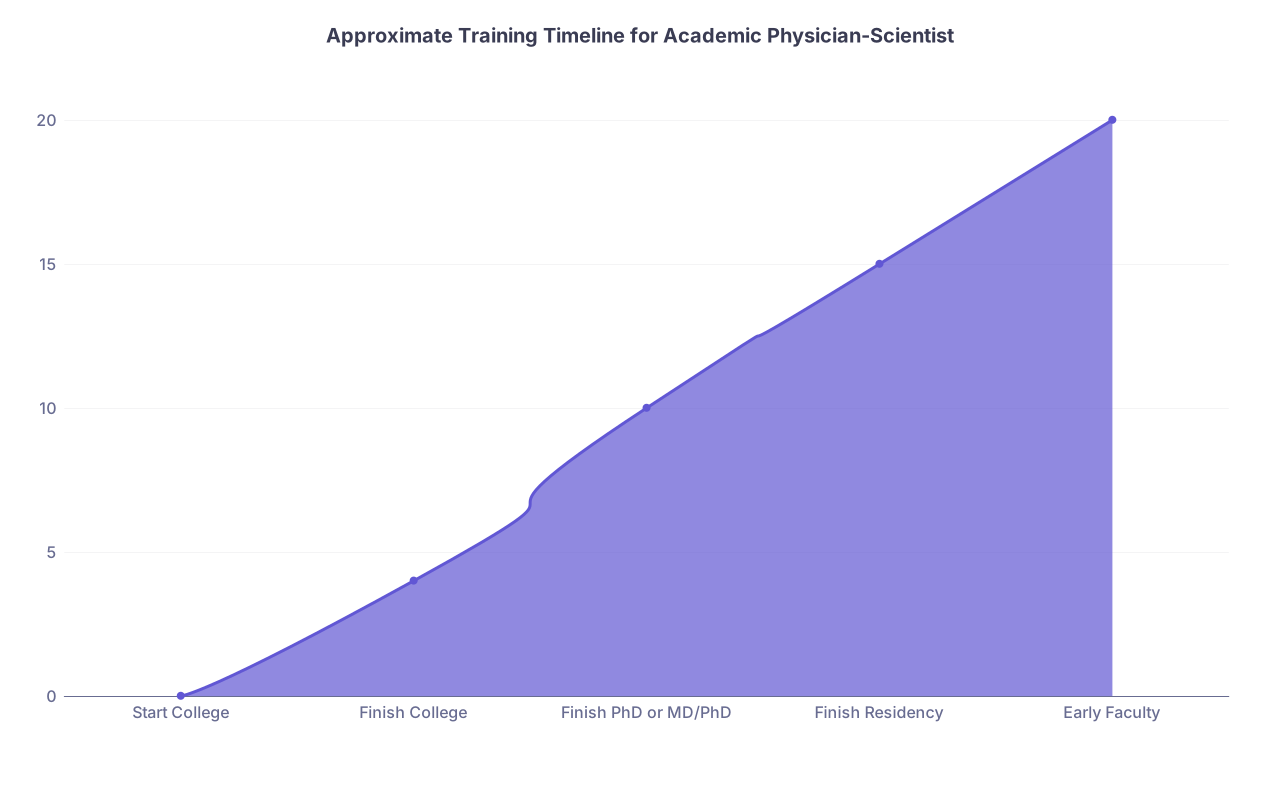
| Category | Value |
|---|---|
| Start College | 0 |
| Finish College | 4 |
| Finish PhD or MD/PhD | 10 |
| Finish Residency | 15 |
| Early Faculty | 20 |
Interpret that:
- You are often in your mid-to-late 30s before you have true autonomy and stability.
- You will move cities multiple times.
- Grants will be rejected. Often.
Questions you must answer honestly:
- Am I willing to trade earlier financial stability for a decade+ of training?
- How do I feel about a career where my lab’s survival depends on grant review panels every 3–5 years?
- Do I enjoy the process of writing (not just the idea of “publishing”) enough to do it endlessly?
If your reaction is “I love discovery, but the grant chase sounds miserable,” you may still be fine with a research-heavy clinical career in industry or in a non-PI academic role. Not everything has to be tenure-track.
Step 7: Make a Deliberate Call – MD, MD with Research, MD/PhD, or PhD
After 1–2 years of serious test-driving, you need to stop sampling and decide.
Here is a simple decision scaffold. Not perfect. But better than “I like science, so MD/PhD?”

| Step | Description |
|---|---|
| Step 1 | Serious Research Test Drive Completed |
| Step 2 | Primarily Clinical MD |
| Step 3 | MD with research involvement |
| Step 4 | PhD track |
| Step 5 | MD/PhD or research heavy MD |
| Step 6 | Do you crave leading research questions? |
| Step 7 | Do you enjoy long unstructured discovery work? |
| Step 8 | Is clinical work essential to your identity? |
Translate this to practical choices:
Primarily Clinical MD (with optional lighter research)
- You liked research conceptually but not as a full-time identity.
- Clinic energizes you more than lab meetings.
- You want:
- QI projects.
- Occasional clinical studies.
- Maybe some education research.
- You do not need a PhD for this. A strong MD program with research opportunities is enough.
MD with Heavy Research (but no PhD)
- You genuinely enjoy research and writing.
- You want real clinical time.
- You are okay with doing extra work (research fellowships, protected time negotiations).
- You might:
- Do a research year in med school.
- Choose a residency with a research track.
- You accept that you will be “bilingual”: clinic and research.
MD/PhD Warning: over-chosen for the wrong reasons. Correct reasons look like this:
- You feel restless without big, long-term questions to own.
- Projects that take 3–5 years do not scare you; they feel natural.
- You want to run an independent lab and also practice clinically.
- You understand:
- Training will be 7–9 years just for MD/PhD, then residency, possibly fellowship.
- Your clinical volume may be lower than a pure MD colleague.
- You will write a lot of grants.
If you test-drove hard and still feel pulled strongly here, fine. But be honest: if your main driver is “Tuition is free” or “It sounds impressive,” that is a red flag.
Pure PhD (No MD)
- You find clinic uninteresting or draining.
- You love:
- Deep technical skill.
- Long blocks of solitary or small-team work.
- The idea of being the expert on a narrow question.
- You might work in:
- Academia.
- Industry R&D.
- Government or policy roles drawing on scientific expertise.
If the lab feels like “home” and the hospital feels like a distraction, do not force the MD just for external validation.
Step 8: Communicate Your Decision Coherently in Applications
Whatever you choose, you will need to explain it.
For med school or MD/PhD applications, your test-drive becomes material:
- Personal statement:
- Show a specific arc:
- Concrete research experiences.
- What they taught you about how you think.
- How that led you to your chosen path (MD, MD/PhD, etc).
- Show a specific arc:
- Secondaries / MD vs MD/PhD essays:
- Focus on:
- Evidence that you understand the reality of your chosen path.
- Conversations with people living that life.
- Your own reflections and data (from your tracking, even if you do not call it that).
- Focus on:
- Interviews:
- Be prepared for:
- “Why not just MD?”
- “Why not just PhD?”
- “What will your career look like in 15 years?”
- Use specifics:
- Number of years in lab.
- Concrete responsibilities.
- A time you hated research and why you returned anyway (or did not).
- Be prepared for:
Programs are extremely good at spotting applicants who like the idea of research versus those who have lived in its messiness. Your test-drive, done correctly, puts you firmly in the second category.
Step 9: Build an Exit Plan Before You Commit to Anything Long-Term
Last piece most people skip: exit criteria.
Even during your test-drive, set conditions under which you will not pursue a PhD-heavy path. For example:
- “If after 18 months I still dread lab 3+ days per week, I will prioritize a primarily clinical MD.”
- “If I find myself consistently avoiding deep reading and writing tasks, I will not pursue MD/PhD.”
- “If I am excited by the science but paralyzed by the idea of constant grant pressure, I will aim for industry or a more clinical role.”
Write these down now, when you are relatively unbiased. Future you, knee-deep in sunk-cost feelings and letter-of-rec anxiety, will thank you.
And remember: choosing against a PhD-heavy path after a serious test-drive is a success, not a failure. You just saved yourself 5–8 years of mismatch.

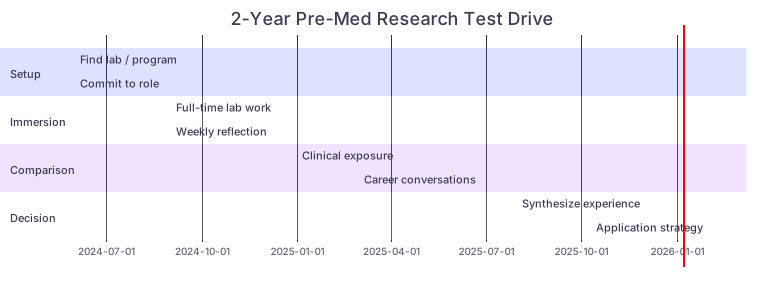
| Task | Details |
|---|---|
| Setup: Find lab / program | a1, 2024-06, 2m |
| Setup: Commit to role | a2, after a1, 1m |
| Immersion: Full-time lab work | b1, 2024-09, 18m |
| Immersion: Weekly reflection | b2, 2024-09, 18m |
| Comparison: Clinical exposure | c1, 2025-01, 12m |
| Comparison: Career conversations | c2, 2025-03, 9m |
| Decision: Synthesize experience | d1, 2025-12, 2m |
| Decision: Application strategy | d2, 2026-02, 2m |
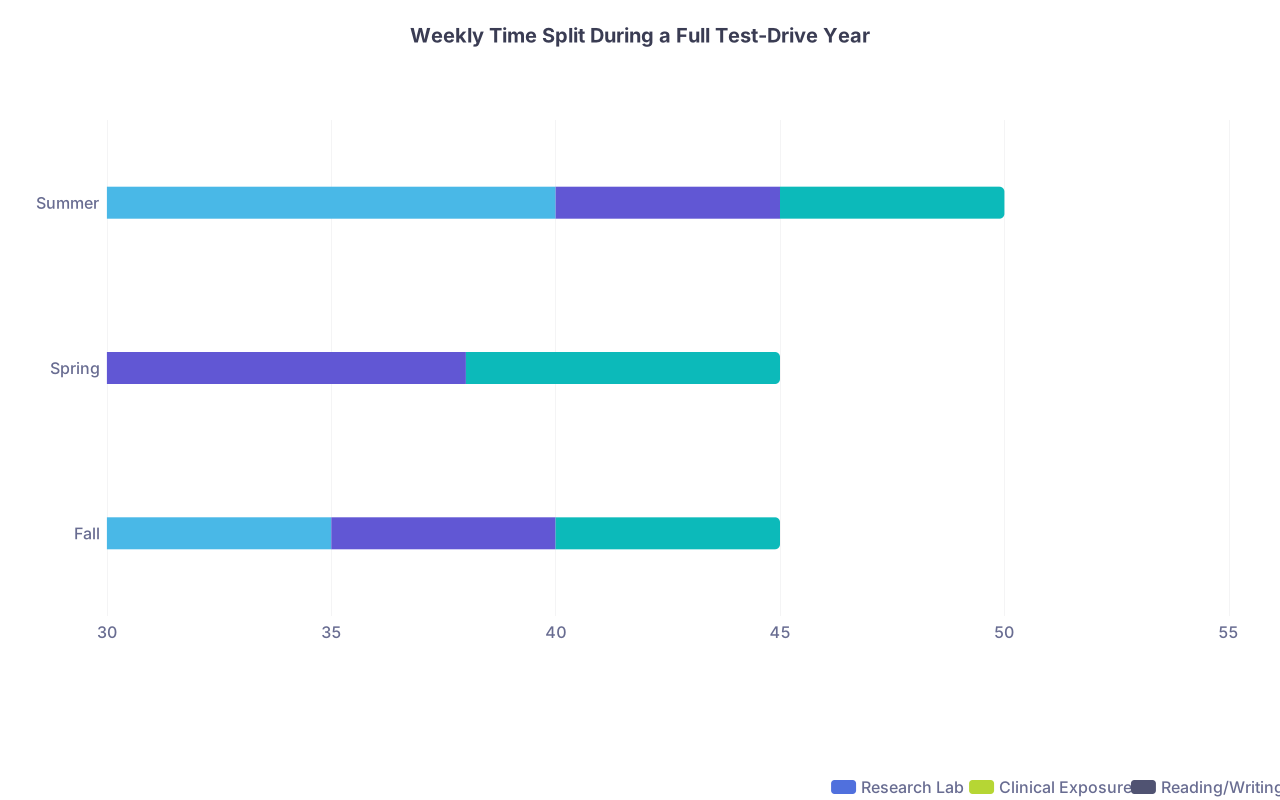
| Category | Research Lab | Clinical Exposure | Reading/Writing |
|---|---|---|---|
| Fall | 35 | 5 | 5 |
| Spring | 30 | 8 | 7 |
| Summer | 40 | 5 | 5 |

The Bottom Line
Three points, and then you are done:
You cannot decide MD vs PhD vs MD/PhD from a few semesters of casual undergrad research. You need at least one serious, structured test-drive where you own part of a project and live in the daily grind.
Treat this like an experiment, not a vibe check. Define your hypotheses, track your reactions, talk to people actually living each path, and write down your exit criteria.
A “no” after a real test-drive is as valuable as a “yes.” Walking away from a research-heavy path before a PhD or MD/PhD saves you years. That is not quitting. That is good experimental design applied to your own life.