
It’s 9:02 AM in a windowless conference room at your institution. You’re not in the room, of course—you’re tracking the time from your office, refreshing your email and pretending to work. Your K award or R01 just went to study section last week.
You’re doing the mental math: “My primary reviewer is an MD. The secondary is a PhD. Is that good for me? Bad? Neutral?”
Let me cut through the mythology and tell you what actually happens in those rooms—NIH study sections, foundation panels, internal pilot review committees. I’ve sat in those meetings. I’ve watched how people react when they see an MD PI, a PhD PI, or the dreaded “MD with no publications trying to be a PI.”
The question is simple: Do MDs or PhDs have the edge in grant review?
The answer is not simple. But it is very predictable once you know the unwritten rules.
What Grant Reviewers Actually Look At First
Let me start with the part nobody wants to admit.
When a grant gets assigned, the reviewer does not start by reading your Specific Aims with an open heart and a blank slate. They start by glancing at three things, often in this exact order:
- Your name and degrees
- Your institution
- Your biosketch / publication track record
The science matters, but they’re anchoring on who you are before they decide how hard to work to understand what you’re doing.
And here’s the punchline: in most serious study sections, MD vs PhD is not the first dividing line. It’s:
- MD-scientist with a credible research identity
- PhD-scientist with a credible research identity
- “Clinically excellent but research-light” MD attempting a grant outside their lane
- Underpowered early-career anything with no track record and no support
MD vs PhD only starts to matter in particular contexts: clinical trials, mechanistic work, heavy basic science, or when there’s a political balance on the panel.
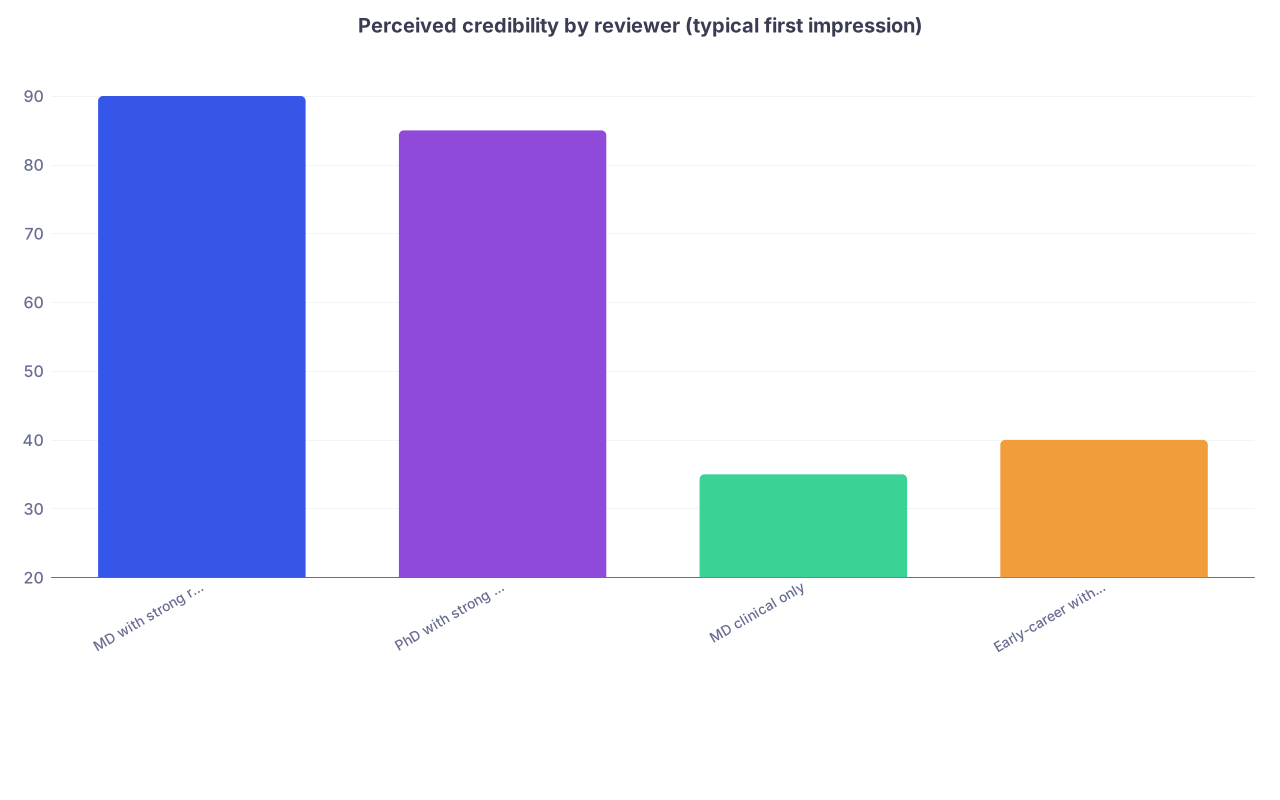
| Category | Value |
|---|---|
| MD with strong research | 90 |
| PhD with strong research | 85 |
| MD clinical only | 35 |
| Early-career with weak record | 40 |
Those numbers aren’t from a formal study; they’re roughly where experienced reviewers would place their gut confidence (out of 100) before reading a word of your proposal. That gut drives how forgiving they are when they encounter flaws.
Where MDs Quietly Have the Edge
Let me be blunt: a real physician–scientist, with a coherent body of work, has an edge in several specific situations. And reviewers will never say it openly on the record.
1. Clinical relevance and “does this matter to patients?”
When discussion turns to: “Is this meaningful? Is this feasible? Is this something patients would consent to?” the MD in the room who still sees patients automatically gets de facto authority.
I’ve heard lines like:
- “As someone who runs this clinic, I can tell you recruitment will be trivial for this population.”
- “No patient with this level of disease is going to agree to six extra biopsies. This design is fantasy.”
If you’re an MD PI proposing clinical or translational work and you actually see that population, your credibility jumps. Reviewers assume you know the workflow, the constraints, and the patient mindset. Often correctly.
On the flip side, PhD-only PIs proposing clinical projects sometimes trigger an immediate skepticism reaction: “Who’s actually going to run this? Who’s consented a patient in the last 10 years?”
If the clinical details feel off, the panel will crucify it. And yes, the MDs lead the attack.
2. Access to patients and samples
On any review panel, people know the politics of access. MDs embedded in big health systems control:
- Recruitment pipelines
- Access to tissue, imaging, procedures
- Integration with clinical care pathways
So when an MD PI at, say, a large academic center proposes a prospective cohort or biobank, even if the methods are not flawless, reviewers think, “They can actually pull this off.”
I’ve watched PhD reviewers say things like, “I’m not thrilled with the power calculation, but she clearly runs this clinic and can get 500 patients easily. I believe the enrollment.”
That belief matters more than anything in borderline scores.
3. Perceived “impact”
MD investigators, especially in visible specialties (oncology, cardiology, neuro), get an unconscious bump on perceived impact.
Try this thought experiment. Same study, same Specific Aims:
- Version A (MD PI): “I’m a cardiologist at [Big Name Center] studying a new prognostic marker in heart failure patients.”
- Version B (PhD PI): “I’m a cardiovascular scientist in a physiology department studying the same marker in the same population, partnering with clinicians.”
On paper, those are equivalent if the team is solid. In the room, though, people instinctively assign more ownership and “real world translation” weight to Version A if that MD has a visible clinic footprint.
Is that always rational? No. Does it happen? All the time.
Where PhDs Have the Edge (And MDs Get Burned)
Now for the other side of the table. When the topic shifts to hardcore mechanistic work, heavy methods, or theory, MDs are often outgunned unless they’re truly dual-trained.
1. Depth of mechanistic rigor
Reviewers can sniff out a “clinical tourist in the basic science world” in about 30 seconds. Phrases that give it away:
- Vague mechanistic language: “We will explore pathways that might be involved…”
- Fluffy methods sections with hand-wavy phrases like “standard assays will be used.”
- No real grasp of controls, confounders, or technical pitfalls.
In those moments, the PhD on the panel becomes the authority. I’ve seen a senior PhD say, very calmly:
“The PI is a very accomplished surgeon, but this is not their sandbox. The proposed CRISPR work is not grounded, the model is wrong, and there’s no evidence they understand the nuances.”
And the panel follows their lead.
When it’s bench-heavy, PhD PIs with a long methods history are trusted more. MDs without solid bench track records are treated as dabblers unless their collaborator list screams “real lab.”
2. Methodologies and statistics
On most panels, the headache-inducing parts—complex -omics pipelines, advanced biostatistics, high-dimensional modeling—are policed by PhDs and quantitatively strong folks.
If you’re an MD proposing:
- Single-cell RNAseq
- Advanced ML models
- Novel imaging processing techniques
…and your grasp of the pipeline lives at the “we’ll send it to core” level, the PhD reviewers will shred it. Not maliciously, just clinically.
There’s a bias—often deserved—that PhDs “live in the data” more. If your biosketch doesn’t show that you’ve actually published using these techniques, reviewers will downgrade Feasibility and Approach hard.
3. Perceived dedication to science
This one stings, but it’s real.
PhDs are often seen as “all-in” on research. It’s their whole job. MDs, especially clinically heavy ones, are viewed as splitting their focus:
- Clinic
- Call
- Teaching
- Admin meetings
- A little research squeezed in
So if a proposal looks ambitious, people start asking: “Where is this MD going to find 30% effort for this project when they’re on service 8 months a year?”
With a PhD PI, that question comes up less. The default assumption is: research is their main thing.
This is where MDs absolutely must have believable effort protection, strong environment letters, and administrative support clearly spelled out. Otherwise, reviewers just do not believe the project will happen, no matter how smart it is.
How Degree Type Plays at Different Grant Levels
Let’s talk specific mechanisms. MD vs PhD matters differently for K awards, early R series, and big multi-PI projects.
| Mechanism | Slight Edge | Why (in the review room) |
|---|---|---|
| K08 / K23 | MD (if real clinician) | “Future independent physician–scientist” narrative is prized |
| K99/R00 | PhD | Classic path for postdoc PhDs; structure fits them |
| R21 | Neutral / Topic-dependent | Methods vs innovation; degree less critical than idea and feasibility |
| R01 (basic) | PhD | Seen as their home turf unless MD has serious bench record |
| R01 (clinical / translational) | MD | Clinical credibility and access heavily weighted |
Career Development (K awards)
K08, K23, foundation clinician–scientist awards: MDs have the narrative advantage.
Panels are explicitly told to invest in physician–scientists as a “scarce resource.” If you’re an MD with even halfway-decent preliminary data and a believable mentoring team, reviewers bend over backwards to justify funding you. Especially in specialties considered “short on researchers” (surgery, some procedurals).
K99/R00, on the other hand, is engineered for PhD postdocs. An MD can get it, but they’re playing in someone else’s designed sandbox. Study sections expect a certain maturity in bench science from K99s that many MDs who did only clinical fellowships just don’t have.
Early independent R grants
For R21s, MD vs PhD is almost irrelevant compared to two questions:
- Is this actually innovative or just rebranded incremental work?
- Can this team technically pull it off in a short time window with limited funds?
But for R01s, the split is real:
- Pure mechanistic R01 → PhD has default credibility
- Heavily clinical R01 with real patients, outcomes, and practice change → MD has default credibility
An MD with a string of serious bench papers and clear technical chops can absolutely dominate basic R01 space. But they’re rare, and panels know it.
Inside the Study Section: How Degree Bias Actually Shows Up
Let’s walk through a typical discussion where degree quietly shapes the tone.

| Step | Description |
|---|---|
| Step 1 | Primary reviewer summary |
| Step 2 | Focus on science and details |
| Step 3 | Question feasibility and support |
| Step 4 | MD expertise weighted |
| Step 5 | PhD expertise weighted |
| Step 6 | Score dragged by feasibility concerns |
| Step 7 | Debate recruitment, relevance, impact |
| Step 8 | Debate methods, rigor, innovation |
| Step 9 | Final scores |
| Step 10 | PI background strong? |
| Step 11 | Clinical or basic focus? |
A few behind-the-scenes behaviors you do not see in the summary statement:
- People absolutely comment on degree and training. “This is a PhD PI with a very clinical proposal and the MD collaborator is weak.” Or, “The PI is an MD with no first-author mechanistic publications in this area.”
- Senior MDs will explicitly defend clinically relevant, messy proposals: “Look, the stats aren’t perfect, but if this works, it changes practice. That’s worth funding.”
- Senior PhDs will explicitly defend technically strong, niche mechanistic work that MDs sometimes dismiss as “too far from the bedside.”
And program officers listen to this balance. They are thinking about portfolio: clinical, mechanistic, training, impact, diversity of perspectives.
The Real “Edge”: It’s Not the Degree, It’s the Story
Here’s the part applicants miss. Grant review is not a philosophical debate about whether MDs or PhDs are more deserving. It’s a credibility audit:
- Does this PI clearly live and breathe the type of science they’re proposing?
- Does their track record, training, and team back that up?
- Is the clinical or mechanistic depth believable, not aspirational?
When MDs win:
- Their clinical role and patient access are tightly integrated into the proposal.
- Their mentors and co-investigators cover any technical gaps with real, publishable evidence.
- Their career narrative screams “future independent physician–scientist,” not “clinic-heavy doc dabbling in research to pad their CV.”
When PhDs win:
- They dominate the methods and rigor conversation.
- Their publication record cleanly backs every technique and model in the application.
- For clinical-ish projects, they name credible MD partners with clear, delineated roles (not just a token “clinical collaborator”).
The edge is in internal coherence: your degree, training, environment, aims, and methods all tell the same believable story.
Strategic Advice: How to Play to Your Degree Type
You want the insider playbook? Fine. Here it is.
If you’re an MD (especially clinically heavy)
- Do not pretend to be a bench scientist if you’re not. Reviewers can smell the pose.
- Lean hard into what you actually control: patients, workflow, outcomes, clinical insight.
- Build a ruthless methods bench: PhD co-investigators, strong biostatisticians, core directors deeply integrated in the grant. Name them, spell out their contributions.
- Make your effort and protected time bulletproof. Explicit letters, division chief support, reduced clinical load spelled out in writing.
- Your Specific Aims should make it obvious why this project requires a clinician PI. Not just “nice to have,” but “only possible because this MD is leading it.”
If you’re a PhD
- Do not fake clinical proximity. If you don’t see patients, own your lane and bring clinicians in early and visibly.
- Make your methods sections flawless. This is your home-field advantage. You should be the person the reviewers quote when others are confused.
- For human subjects work, spell out the clinical logistics in uncomfortable detail: clinics, recruitment flows, consent, follow-up, dropouts. Use your MD collaborators’ letters to prove it.
- Use your publication record aggressively to defuse doubt: every key method in the proposal should map to a prior publication from you or your core team.
- Frame your work in terms of long-term clinical relevance without pretending you’re the one changing practice next year. Reviewers respect honesty about the translational timescale.
One More Ugly Truth: Institutional Politics
I’d be lying if I pretended all of this happens in a vacuum of pure merit.
In the room, people also react to:
- Big-name institutions vs “unknown” medical centers
- Repeat applicants they’ve seen grow (or not)
- Strategic pushes (e.g., “We need more surgeon–scientists,” “We’re underfunding pediatrics,” etc.)
MDs from big academic centers sometimes get the benefit of the doubt on feasibility. PhDs from pure research powerhouses get extra credit on rigor.
Foundation grants and internal pilot awards are even more political. Departments want their MDs funded because it boosts clinical department prestige. Basic science departments want their PhDs funded because it’s their lifeblood.
I’ve watched internal review committees knowingly over-score a mediocre clinician grant because they “really need to keep this rising star surgeon here.” You won’t see that in the written comments, but it happens.
FAQs
1. I’m an MD with limited research experience. Should I be PI or co-PI with a PhD?
If your track record is thin and the project is mechanistic or methods-heavy, you’re probably better as co-PI or MPI with a seasoned PhD who covers your weaknesses. You can still frame yourself as the clinical engine of the project. Being PI with no clear research infrastructure often looks arrogant rather than ambitious. Grow into PI with a couple of co-authored grants and papers first.
2. I’m a PhD wanting to do more clinical research. How do I avoid the “tourist” label?
Get embedded. Formal appointments in a clinical department, regular presence at clinical conferences, and very visible MD collaborators with defined roles. Your proposal should show that clinical questions came from actual patient care discussions, not from you browsing PubMed in isolation. And your MD partners must be more than letterheads—they should be in the aims, the design, the recruitment, and the interpretation.
3. Does having both an MD and PhD (MD/PhD) automatically give me an edge?
Only if your record shows you actually used both. Panels have seen plenty of MD/PhDs who did a PhD 10 years ago and then went 100% clinical. If your publications and current effort are overwhelmingly clinical, reviewers treat you like an MD with an old lab story. To leverage the dual degree, your application needs a living, current research arc that clearly integrates both sides.
4. How much do reviewers really care about my degree versus my publications and environment?
They care about the degree as a shortcut until your track record either confirms or destroys their assumptions. A PhD with a powerhouse publication list in clinical data science beats an MD with two weak retrospective case series for a data-heavy grant, every time. Conversely, an MD with a serious record of patient-oriented research and strong institutional support will beat a methodologically wobbly PhD on a pragmatic clinical trial. Degree gets you a stereotype; your record either locks it in or breaks it.
Key point one: MD vs PhD is not a cosmic hierarchy in grant review. It’s a context-dependent bias about who “belongs” in which scientific space.
Key point two: The real edge goes to whoever tells the most coherent story—where their degree, track record, team, and aims all align with the type of work proposed.
You want an advantage in the grant review room? Stop trying to be what your degree is not, and start doubling down on what it actually makes you uniquely credible to do.