
It’s 7:45 pm on a Tuesday. The clinic is closed, the residents are finishing notes, and the lights are mostly off in the department suite—except for one office.
The chair is in there, jacket off, tie loosened, glasses on the end of his nose, scrolling through a spreadsheet of applicants. MDs. MD/PhDs. Pure PhDs. A couple DOs. A “joint search” for a clinician-scientist that somehow turned into a free‑for‑all.
On paper, the official line is simple: “We are looking for the best candidate who fits our mission across clinical, research, and educational domains.”
Behind closed doors? The rank list is being built with a very different set of rules.
Let me walk you through how chairs actually stack MD vs PhD candidates in academic medicine. Not the brochure version. The version that decides who gets the offer—and who gets the polite rejection email three months late.
The First Hard Split: Who Makes the Real Shortlist
Here’s the first thing most applicants never grasp: chairs do not evaluate MDs and PhDs in one big pool with a neutral rubric. There’s an invisible fork in the road right at the beginning.
Hidden Category #1: The “Revenue” Line
Chairs won’t say this out loud at Grand Rounds, but in the search committee prep meeting you’ll hear some version of this:
“I need someone who can cover call and generate wRVUs. If they have R01 potential, great. But I cannot take another 0.1 FTE clinician and pretend that’s a real doctor.”
For clinical departments—medicine, surgery, OB/GYN, radiology, anesthesia, EM—the first question about an MD candidate is almost always:
- Can this person safely see patients and cover service in our real-world schedule?
If yes, they’re in the “revenue” line. In that line, MDs (and MD/PhDs) are weighed with two big levers:
- clinical need, and
- protected time costs.
A pure PhD? They’re not even in that line. They’re in a completely different bucket.
Hidden Category #2: The “Research Infrastructure” Line
PhDs live here. So do MD/PhDs who are being sold as 50–80% research.
The questions change:
- Do we have the space, startup, and mentorship to make this person successful as a funded investigator?
- Will they bring indirects (F&A) and prestige that justify their non-clinical salary?
This is where MD vs PhD becomes less about degree and more about “grant probability” and “how easy will this person be to justify to the Dean in three years.”
The quiet truth:
Chairs mentally build two parallel rank lists:
- “Who helps my clinical machine run and maybe does some scholarship?”
- “Who will build my research footprint and not sink my budget?”
And then they negotiate internally how many slots they can allocate to each category. MD vs PhD isn’t a single competition—it’s two different games with different scoring.
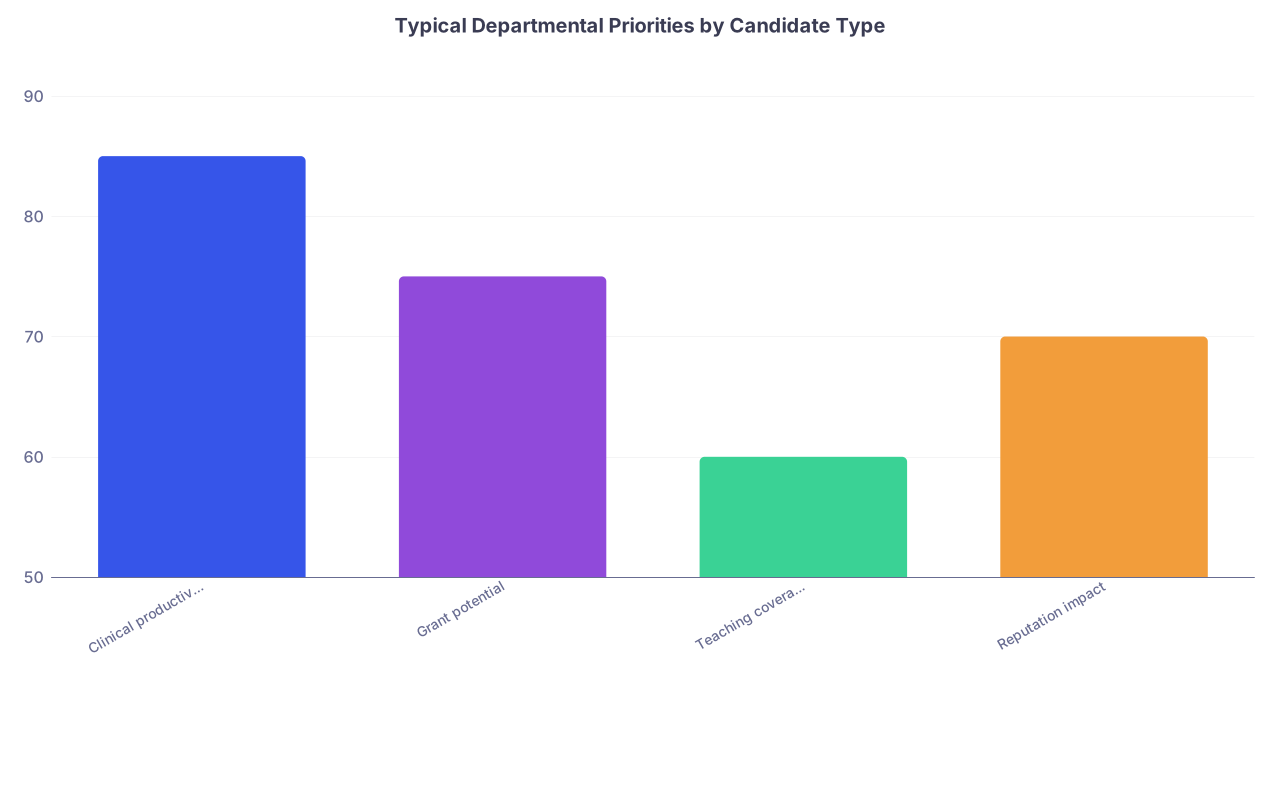
| Category | Value |
|---|---|
| Clinical productivity | 85 |
| Grant potential | 75 |
| Teaching coverage | 60 |
| Reputation impact | 70 |
(Think of these numbers as relative “importance weights” chairs silently apply when looking at academic candidates, especially in clinical departments.)
How Chairs Actually Judge MD Candidates
Let’s start with the MDs, because most of you underestimate both what helps you and what hurts you.
When a chair looks at an MD or MD/PhD whose primary role is clinical (even with “protected time”), the internal checklist looks like this:
1. Can I plug this person into my service model tomorrow?
Chairs will not lead with research. They lead with:
“Can this person cover nights, weekends, and that miserable clinic block nobody wants?”
If your CV screams “needs 70% protected time, hates clinic, only wants niche procedures,” you just got quietly demoted unless the position was explicitly advertised as a heavy research role.
You’ll see chairs say things in closed meetings like:
“This MD/PhD looks great, but I do not have the bandwidth to carve out another 50% research FTE in year one. The division is drowning.”
That’s how a clinically strong MD with modest research—not flashy, but solid—beats a pedigreed MD/PhD who looks like they actually want to be in the lab.
2. Are you “academically safe”?
Chairs love “safe” hires. A safe MD candidate looks like this:
- Board-certified or truly board-eligible without drama
- Trained at reputable programs (not necessarily Top 10, but not random)
- A handful of publications, preferably in decent journals
- Good letters that say things like “team player,” “reliable,” “excellent clinician,” “great with learners”
Notice what’s not on that list:
Nobel-level science.
For many lines, they don’t need a star. They need a dependable clinician who will not embarrass the department and who can generate predictable RVUs.
If you’re an MD with a light publication record and strong clinical training, you’re much more competitive than you think—as long as you don’t pretend you’re a 75% research hire.
3. Do you understand the politics of protected time?
This part is usually invisible to applicants, but it drives ranking.
Protected time is a political currency. Every % comes out of somebody’s margin. A chair will ask:
- Who is going to pay for their non-billable time year 2, year 3?
- Will they actually use that time productively, or will they just see it as a lifestyle perk?
An MD who says in negotiation, “I want 30% protected for education and scholarship and I have a clear plan” is very different from the MD who says, “I need 50% research and I don’t really have preliminary data yet.”
Chairs will prioritize MDs who:
- Ask for modest, realistic protected time
- Attach that time to concrete deliverables (papers, curriculum, QI program, pilot data)
Over MDs (and yes, sometimes MD/PhDs) who ask for a fantasy setup that the department simply can’t sustain.
How Chairs Actually Judge PhD Candidates
Now let’s flip the lens. When a chair looks at a PhD, there’s a very different internal monologue.
No one cares whether you can run a clinic. They care if you can justify your existence financially and reputationally.
1. Are you a near-term grant bet or a long-term gamble?
This is the first real split for PhDs:
- Already funded (or recently funded) with K/R-type awards, or clearly fundable in 1–2 years
- “Promising” but unfunded and early in the game
I’ve heard chairs say, verbatim:
“I’m not hiring another ‘promising’ PhD without any grant track record. I cannot go to the Dean with that again.”
If you are a PhD, the private scoring rubric looks like this:
- Current funding (PI or co-PI)
- Recent grant submissions with scores (study section comments matter more than you think)
- Death by a thousand small awards (some chairs like this; others see it as scattered)
- Strong, coherent research agenda that matches institutional priorities
PhDs without clear funding trajectory get ranked low unless the department is in a growth phase with a supportive Dean and startup money burning a hole in someone’s pocket. That’s rare.
2. Will you integrate or become an academic orphan?
Chairs know what happens to PhDs dropped into purely clinical departments without a research ecosystem: they wander, resent, and eventually leave.
So you’ll hear them ask:
- Who will this person collaborate with?
- Do we have at least one senior investigator who can co-mentor, co-write, co-PI with them?
- Can we put them into an existing center, core, or program?
MDs often miss this, but PhD rank is heavily influenced by departmental architecture. If the chair can picture you plugging into a research center, a cancer institute, a clinical trials unit—you jump up the list.
If they cannot picture you collaborating with anyone on campus, you quietly fall.
3. Can you teach in a way that matters to them?
PhDs get judged hard on teaching. Not because chairs suddenly care more about students, but because your teaching is often your visible “value-add” to the MD-heavy culture.
Chairs will look at:
- Experience with medical students, residents, or fellows
- Ability to teach core curriculum or high-value electives
- Evidence you can handle the messy, real learners they have (not just graduate students who want to be there)
I’ve seen PhD hires blocked late in the game because a vice chair said, “We already have three PhDs who don’t want to teach in the med school curriculum. I’m not adding a fourth.”
The unspoken rule:
PhDs who lean into teaching and show flexibility get ranked higher than PhDs who clearly see teaching as a burden.

MD vs PhD: The Quiet Tie-Breakers Chairs Use
When an MD and a PhD both look “strong,” there are a set of unspoken tie-breakers. These rarely appear in any policy document, but I’ve watched them play out over and over.
1. RVUs vs Indirects: Where the Money Really Comes From
At the chair level, this is the real math:
- MDs bring clinical revenue (RVUs, downstream admissions, procedures)
- PhDs bring grant indirects (F&A), prestige, and sometimes center growth
If the department is struggling clinically—too few bodies covering too much service—the MD wins. Nearly every time.
If the department is clinically flush but is under pressure from the Dean to “increase research metrics,” the PhD or MD/PhD with major grant potential jumps the line.
There’s a dirty little secret here: many chairs would rather hire an MD who brings in decent RVUs and some grants, than a brilliant PhD who might bring in big grants but contributes nothing clinically. Because only one of those hires helps them when the hospital CEO calls and asks why their procedural volume is down 15%.
2. Promotion Trajectory and “Risk”
MDs often fall upward in academic promotion systems. You’ll hear promotion committee members say:
“He’s not a superstar, but he is a great clinician, well-liked teacher, and he runs the ICU schedule. We should not block his promotion.”
PhDs do not get that kind of mercy. Their promotion is judged almost entirely on grants and publications.
Chairs know this. So when they’re ranking, they ask themselves:
- Will this person be promotable at this institution in 5–7 years?
- Am I creating a future headache by hiring someone the promotion committee will later block?
If a PhD doesn’t look clearly promotable, their rank sinks. With MDs, the bar for “acceptable” is lower, because clinical and educational contributions carry real weight.
3. Institutional Politics
Another factor everyone pretends doesn’t exist: external mandates.
Sometimes the Dean basically tells chairs:
“You will hire a PhD to build X.”
Or:
“You must shore up your clinical operations; no more non-clinical FTEs this year.”
When that happens, MD vs PhD is decided before the job posting even goes up. The rank list is performance art.
If you’re applying, you’ll never see that. But make no mistake: half the outcome is decided in meetings that happened six months before the ad was written.
| Attribute | MD / MD-PhD Weight | PhD Weight |
|---|---|---|
| Clinical productivity | Very High | None |
| Grant funding potential | Medium–High | Very High |
| Teaching flexibility | Medium | High |
| Promotion likelihood | Medium | High |
| Startup cost tolerance | Low–Medium | Medium |
The “Hybrid” Problem: How MD/PhDs Get Ranked
MD/PhDs think they’re the best of both worlds. Chairs see something more complicated: a cost center that might pay off.
Behind closed doors, discussion about an MD/PhD candidate often sounds like this:
“If I give this person 60% research and they never get funded, I’m eating a huge financial loss. If I treat them like a 90% clinician, I will lose them in 3 years when they realize they’re essentially a service doc with a longer CV.”
So the chair runs an internal risk–benefit calculation:
- Are they already funded or nearly funded? If yes, they’re gold.
- Are they being realistic about starting at maybe 30–40% research? If yes, they move up.
- Are they insisting on 75–80% from day one without data or preliminary grants? That’s a hard sell.
The MD/PhDs that get ranked highest are the ones who:
- Have genuine research traction (K, foundation awards, pilot data, clear agenda)
- Are willing to shoulder real clinical work at the beginning
- Present as “I want to build something with you,” not “I want you to subsidize my lab while I avoid clinic”
How You Can Tilt the Quiet Scales in Your Favor
Now the part you actually care about: how to play inside these rules.
If you’re an MD (or DO) aiming at academic roles
Stop trying to cosplay as a full-time scientist if you are not one.
Lean into what chairs actually need:
- Demonstrate you’re a safe, strong clinician who can cover real service.
- Show tangible, concrete scholarship: QI projects, education research, clinical series, guideline work.
- Ask for realistic protected time with a concrete plan: “With 20–30% protected time, my goal is X manuscripts and Y grant/funding attempts in the first 3 years.”
Do that, and you vault over a surprising number of more “academic-looking” candidates who are asking for unsustainable setups.
If you’re a PhD targeting medical school or academic medicine departments
You must walk in as a near-term asset, not a long-term experiment.
- Have a sharp, focused research agenda aligned with the institution’s declared priorities (cancer, population health, AI, etc.).
- Show a real funding trajectory: recent submissions, scored applications, clear next steps.
- Embrace teaching and integration. Make it painfully easy for the chair to picture you contributing to core courses, mentorship, and collaborative projects.
And understand this: chairs are allergic to “pure basic science in a clinically drowning department.” Build bridges to clinical collaborators on paper before you ever set foot in the interview.
If you’re an MD/PhD
Pick a lane for the first five years and sell it.
The worst thing you can do is show up as a vaguely defined “triple threat” who wants maximum research and also light clinical and also significant teaching. Chairs know that person usually ends up mediocre at all three and burned out.
Come in with:
- A clear primary identity (e.g., “Clinician-investigator in outcomes research with 40% research start, aiming for K/R funding”)
- A realistic understanding of clinical needs
- A proactive plan for mentorship, collaborations, and deliverables
Then when the chair is staring at that spreadsheet late at night, you look like an investment with a real business plan, not an idealistic drain on the budget.

| Step | Description |
|---|---|
| Step 1 | Applicant Pool |
| Step 2 | Clinical Line |
| Step 3 | Research Line |
| Step 4 | Rank High - MD/MDPhD |
| Step 5 | Rank Low or Reject |
| Step 6 | Rank High - PhD or MDPhD |
| Step 7 | Rank Lower - Only if extra slot |
| Step 8 | Clinical FTE needed |
| Step 9 | Strong Clinician |
| Step 10 | Near-term Funding Potential |
FAQ: What You’re Probably Still Wondering
1. Do MDs without significant research really have a shot in academic departments anymore?
Yes—if they solve clinical problems. Departments are constantly short on dependable clinicians who teach well and don’t implode. If you bring stable clinical productivity, some teaching, and even modest scholarship, you’re very hireable. Just don’t demand 50% “research” without a track record.
2. Are PhDs at a disadvantage compared to MDs in medical schools?
Different game, different rules. PhDs are at a disadvantage in clinically dominated departments that are financially stressed. They’re at a major advantage in research-focused units or when the Dean is pushing hard for NIH growth. Your leverage is almost entirely about grant potential and fit into existing research structures.
3. How much does pedigree (big-name school or lab) really matter?
Less than applicants think, more than chairs admit. Top-name training gets you on the shortlist faster, but it will not save you if you’re unrealistic about funding or protected time. Chairs will pick a “less fancy” candidate who fits their real needs over a prestige hire they can’t afford.
4. Is it worth doing an MD/PhD if my goal is academic medicine?
Only if you genuinely want to live in the research world and are willing to grind for grants. Chairs love successful MD/PhD clinician-investigators. They have no patience for MD/PhDs who hate clinic, don’t write grants, and expect permanent 70% research with no funding. The degree opens doors; it does not guarantee the setup you think you deserve.
5. What actually moves me up the rank list during interviews?
Chairs move you up when you make their life easier. That means: you understand their department’s pain points, you propose a role that addresses those pain points, and you present a realistic, concrete plan for your first 3–5 years. Show that you get the financial and workload realities and still have a clear academic trajectory—and you quietly jump several spots up that spreadsheet.
Three things to walk away with:
- MD vs PhD isn’t one competition. Chairs run two silent contests—clinical coverage and research growth—and slot you accordingly.
- Protected time is political currency. Ask for it with a plan, or you’ll get buried in the rank list.
- The candidates who win are the ones who show up as realistic, low‑risk solutions to the chair’s actual problems—not the ones with the prettiest CV on paper.