
Last cycle, a brilliant MS2 with an MSTP acceptance letter sat in my office, almost whispering: “Be honest… will people respect me more if I do the MD–PhD?”
I laughed—not at the question, but because I’d just come from a faculty meeting where three attendings rolled their eyes at yet another “CV-maximizing” dual-degree applicant who clearly had no idea what they were signing up for.
You’re asking about MD–PhD prestige. Let me tell you what faculty actually respect—and what’s just brochure fantasy.
The Myth vs. The Rooms That Actually Matter
Students talk about “prestige.” Faculty don’t. We talk about:
- “Can they actually produce?”
- “Would I trust them with a K award?”
- “Are they a workhorse or a tourist?”
That’s the real currency.
The public story is this: MD–PhDs are the “elite physician-scientists,” the smartest of the smart, guaranteed academic jobs, automatic faculty respect, doors flung wide open.
Behind closed doors, the reality is narrower and sharper:
- Being MD–PhD only adds prestige in specific contexts: academic medicine, research-heavy departments, NIH culture, certain subspecialties.
- Outside those worlds? The letters don’t move the needle nearly as much as you think. Sometimes they even raise skeptical eyebrows.
Let’s split the world in two:
- Clinical-world prestige (what clinicians, PDs, hospital admins care about)
- Academic-world prestige (what NIH study sections, department chairs, research committees care about)
Different game. Different scoreboard.
What Clinicians Really Think About MD–PhDs
Picture a busy community cardiologist seeing 25–30 patients a day, running a service, maybe doing some teaching. That’s the default “doctor” for the general public.
To that world, “MD–PhD” means one of three things:
- “They’re probably smart.”
- “They’re probably research-y.”
- “Do they actually see patients or are they always in the lab?”
Notice what’s missing: reverence.
I've sat in residency rank meetings where someone mentions, “Oh, this applicant is MD–PhD,” and the PD shrugs: “Sure, but how are their clinical evals? Do they actually like medicine?”
That’s the key. Clinical people respect:
- Solid clinical performance
- Reliability on the wards
- Good judgment, quick thinking
- Being a team player instead of a prima donna
If you’re MD–PhD and you’re excellent clinically? People will be impressed. Not because of the PhD alone, but because it didn’t derail your clinical growth.
If you’re MD–PhD and just average (or awkward) clinically? The prestige evaporates. Rapidly. Then the quiet whisper becomes: “Yeah, smart, but not very practical.”
Let me be blunt:
A strong MD who crushes residency, leads QI projects, and becomes a trusted attending will be respected more by most clinicians than an MD–PhD who spends their time name-dropping mentors and reminiscing about “my R01 work” while fumbling on rounds.
Where the MD–PhD Actually Does Carry Weight
Now shift environments.
You’re in a major academic center. Subspecialty division meeting. NIH PI visiting. Department chair at the head of the table. This is where “physician-scientist” has real meaning.
In these rooms, MD–PhD often functions as a signal:
- This person has been formally trained as a scientist
- They know how to think in hypotheses, not anecdotes
- They understand grants, papers, study design, statistical rigor
- They can (in theory) bridge bench or translational work with clinical reality
Notice: I said signal. It’s not proof. It gets you a bit of initial benefit of the doubt.
Here’s how it actually plays out:
- For early-career hires (assistant professors), a solid MD–PhD with strong publications can absolutely tilt a hiring decision in your favor—especially in departments that need NIH-funded investigators to justify their existence.
- For K- and R-level grants, having MD–PhD plus a coherent research arc can make reviewers think, “OK, this isn’t a hobbyist clinician trying to play scientist.”
But even in those rooms, there are MD–PhDs faculty quietly do not respect.
Because what faculty really respect is output and trajectory, not degrees.
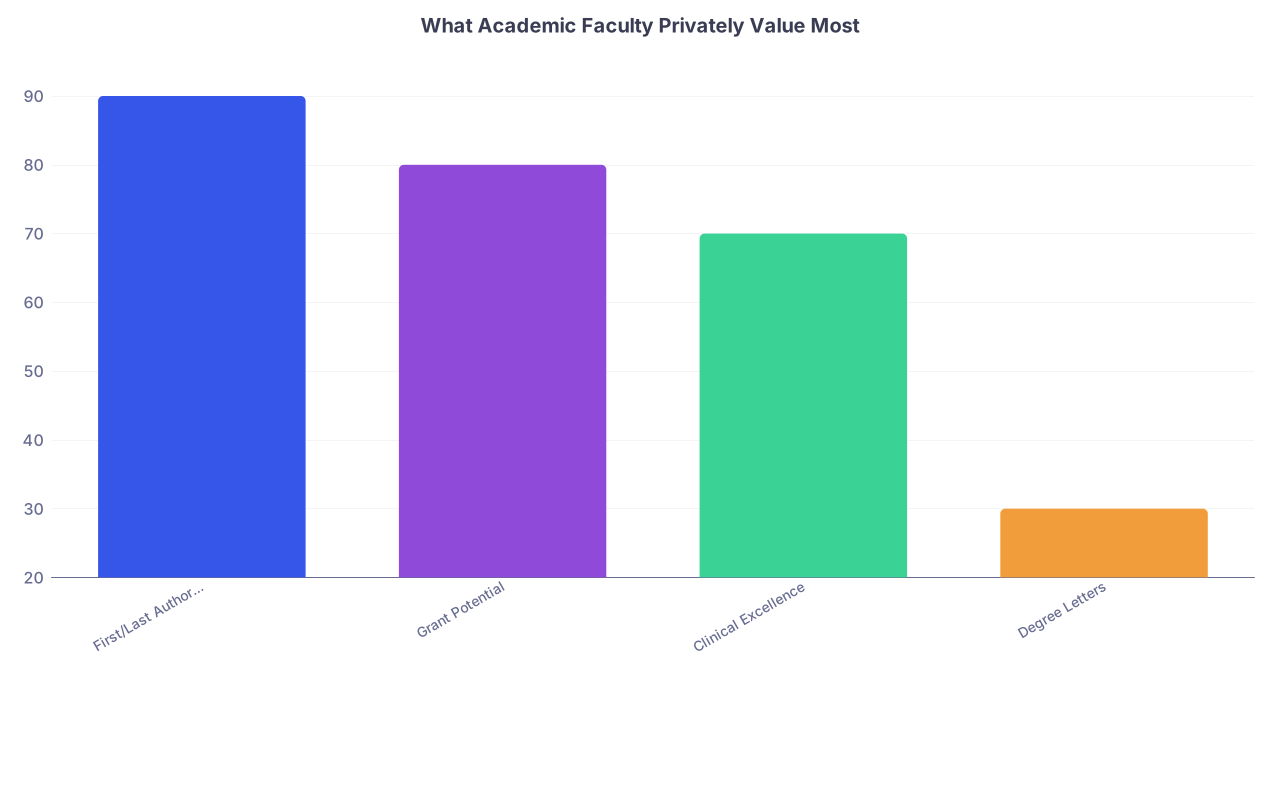
| Category | Value |
|---|---|
| First/Last Author Papers | 90 |
| Grant Potential | 80 |
| Clinical Excellence | 70 |
| Degree Letters | 30 |
If you’re asking, “Will the MD–PhD itself get me more respect?” you’re already framing it wrong. The degree is a tool, not the achievement.
Types of MD–PhDs: Who Gets Quiet Respect vs Eye Rolls
Let me categorize something faculty almost never say out loud, but absolutely think.
There are four archetypes we see:
The Producer
This one finishes the PhD with 2–4 solid first-author papers, follows through in residency with at least some scholarly activity, and actually carves a research niche by early faculty years. They write grants, collaborate well, publish consistently.
Prestige level? High. Not because of letters, but because results match the training.The Tourist
Did the PhD in a hot lab, got some middle-author papers, loved the identity of “physician-scientist,” then never wrote another IRB or grant proposal after graduation.
Clinical-only career. Continues to use the MD–PhD title heavily.
Behind closed doors? “Nice person, but that PhD is basically decorative.”The Derailer
Spent 5–7 years in a PhD, got lost, hated the lab, barely finished. Then struggles clinically during clerkships and residency because they’re so out of the flow, out of the habit of clinical decision-making.
Faculty see this and think: “They would’ve been better off not doing this.”The Unicorn
Clinically excellent. Best resident on the team. Also drops a first-author NEJM or JCI paper during fellowship, lands a K award on schedule, ends up running a lab or big multi-site clinical trial.
This person gets maximum respect from almost everyone. MD–PhD helped—but execution is what made them.
Most premeds and med students imagine they’ll be #4. Faculty know most will end up as #2.
We notice which one you are. Very quickly.
MD–PhD vs MD Only: What Chairs and PDs Actually Weigh
When a department chair is building a division, they’re not thinking “I want more letters.” They’re thinking about funding streams and balance.
They usually want a mix:
- Some pure clinicians who generate RVUs, take call, carry the service
- Some physician-scientists who bring in grant money and reputation
- Maybe a couple of clinical researchers who do trials, QI, implementation science
Where does MD–PhD fit?
- If you want to be a lab-based or translational investigator, the MD–PhD absolutely has real professional cachet. It signals training, seriousness, and you’ll be more legible to NIH reviewers.
- If you want to be primarily a clinician with maybe some teaching and a bit of research/QI? An MD done well is enough. The MD–PhD does not buy you much more respect. Sometimes less.
I’ve been in hiring committees where an MD-only with a clean, strong clinical track and a couple of good first-author clinical papers clearly beat out an MD–PhD with a messy, unfocused trajectory. No one around the table apologized for that. We all knew who would carry their weight.
Here’s the part students don’t see: when PDs and chairs whisper after a candidate leaves the room.
You’ll hear:
- “Impressive CV, but where are they going with this?”
- “Eight-year MD–PhD and still no clear research direction?”
- “Honestly, I’d rather have the MD who actually wants to be in clinic.”
The letters don’t rescue a weak story.
Where MD–PhD Prestige Completely Fizzles Out
A few hard truths:
Community practice
In most community hospitals, being MD–PhD is a curiosity, not a status booster. It might get you one extra question at dinner: “So what was your PhD in?” Then everyone moves on.Private groups and compensation
Partners care about: productivity, patient satisfaction, complication rates, call coverage, business sense. Your PhD means nothing if you aren’t a dependable partner. It will not justify a higher salary offer on its own.Patients
Most patients do not care what the second degree is. They barely know the difference between MD, DO, NP. They care if you listen, explain, and help.Surgical culture
Some surgical subspecialties respect research a lot, sure. But in the OR lounge, nobody defers to you because you have a PhD. They watch your hands, your judgment, your poise under pressure.
If your main goal is “to be respected as a doctor,” MD–PhD is not the lever. Good clinical training and character are.
How MD–PhDs Lose Faculty Respect
Let me flip the question. How do MD–PhDs burn whatever prestige they started with?
Patterns I’ve seen too many times:
Using MD–PhD as identity instead of tool
Constantly reminding everyone: “In my PhD, we did…” while contributing very little right now.
Faculty note the mismatch between past and present.Never following through post-graduation
No projects, no manuscripts, no grants. You disappear from the academic conversation. People mentally move you from “physician-scientist” to “clinician with a long training detour.”Arrogance without output
Talking like an NIH lifer with no K, no serious proposal, no tangible research agenda. Faculty smell this a mile away.Clerkship and residency rust
Being clinically unsafe, slow, or lost—then blaming it on “being out of the game for so long because of my PhD.” Fair explanation, but after a point, no one cares. You’re either reliable or you’re not.Another degree chasing
MD–PhD–MBA–MPH without any coherent narrative often reads as “I like credentials more than work.” Every institution has one of these. Nobody wants to replicate the experience.
You want real respect? Pick a lane, commit, produce.
What Actually Impresses Faculty More Than Letters
Here’s what faculty, PDs, and chairs really respect when it comes to MD vs MD–PhD. Not in brochures, but behind closed doors.
| Signal | Why It Matters |
|---|---|
| First/last-author peer-reviewed papers | Shows you can complete real scholarly work |
| Clear, coherent research narrative | Signals you are not randomly collecting lines |
| Strong clinical evals & reputation | Means you are safe and reliable in patient care |
| Mentors who vouch enthusiastically | Tells us you are good to work with |
| Evidence of persistence & follow-through | Separates talkers from doers |
Notice what is not on that list: “MD–PhD by itself.”
The PhD is a force multiplier if you already have these things. It can be a distraction if you don’t.
The Hard Question You Should Be Asking Instead
Instead of, “Is MD–PhD more prestigious?” the real question is:
“Do I actually want to live a life where research productivity is part of my job description forever?”
Because that’s where MD–PhD shines: if you want a career where 30–80% of your time is:
- Writing and revising grants
- Designing studies and protocols
- Mentoring students and postdocs
- Arguing with reviewers
- Presenting at conferences
- Thinking in terms of mechanisms, not just guidelines
Then yes—the MD–PhD puts you in a strong position. Faculty in academic medicine will take that seriously.
If that sounds exhausting, and what you really want is to be clinically excellent, maybe teach, maybe dabble in some QI or small projects? You do not need the PhD for respect. A well-used MD is already enough.
Reality Check: How MD–PhDs End Up Allocating Their Time
Most students wildly misjudge the day-to-day reality of a “physician-scientist.”
Here’s a rough breakdown of what I’ve actually seen in real MD–PhD academic attendings vs pure MD academic attendings:
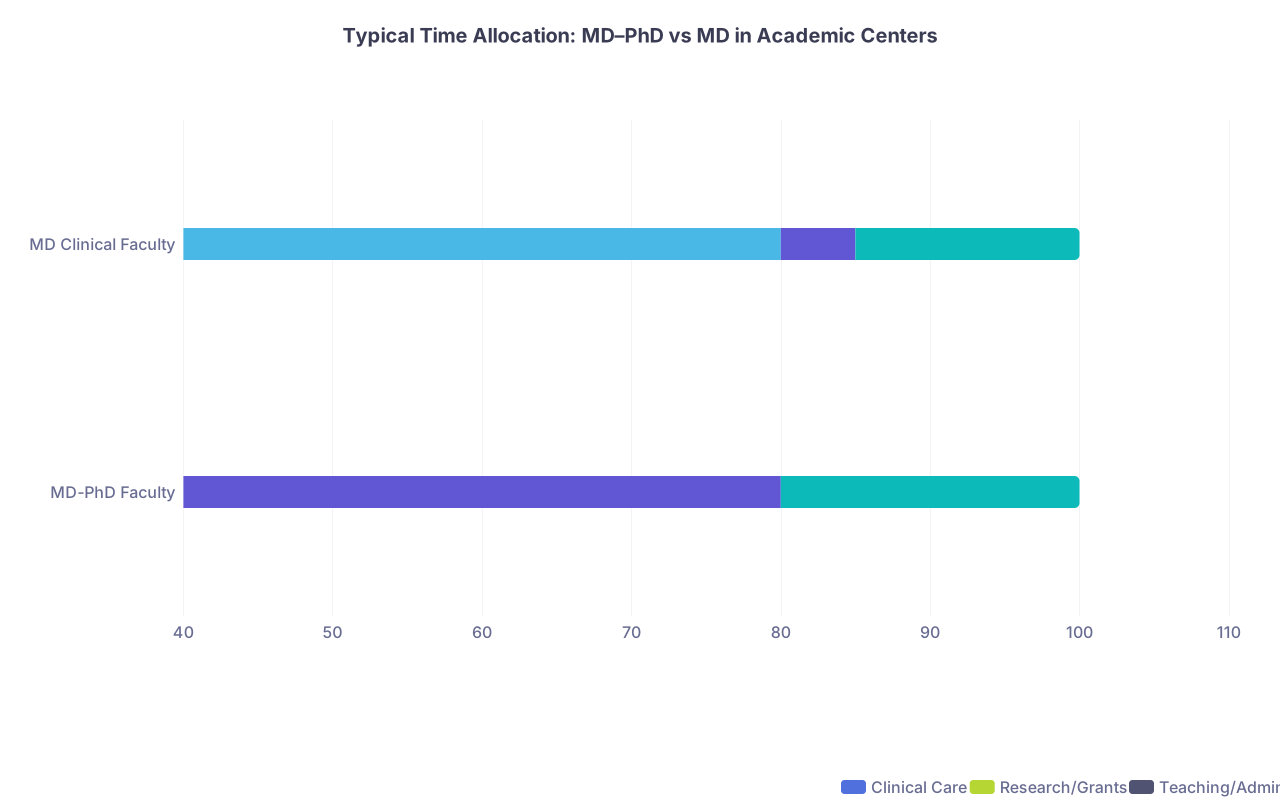
| Category | Clinical Care | Research/Grants | Teaching/Admin |
|---|---|---|---|
| MD-PhD Faculty | 40 | 40 | 20 |
| MD Clinical Faculty | 80 | 5 | 15 |
If you want 80% clinical, 20% teaching/admin, 0–5% research? That’s a perfectly respectable path. And in most institutions, the MD-only clinician who’s excellent on the wards and in clinic is quietly the backbone of the department.
No one is whispering, “Shame they didn’t get a PhD.”
The Quiet Hierarchy Faculty Won’t Admit Publicly
Let me say what most people only imply.
In academic medicine, the real status hierarchy often looks like this:
- Productive physician-scientist with funding and good clinical rep
- Highly respected clinician-educator or clinical leader
- MD–PhD who does no real research and is average clinically
- Anyone who coasts on titles without doing the work
Your degree can nudge where you start. Your behavior decides where you land.
You want to be in group 1 or 2. Both are respected. One just uses the PhD; the other doesn’t need it.
How to Decide If You’re a Good Fit for MD–PhD (Prestige Aside)
Forget prestige for a second. Ask yourself some brutal questions:
- During undergrad, did I enjoy the process of research, or just the outcome on my CV?
- Have I stuck with one research area long enough to see a project through, or do I just bounce lab to lab?
- Do I like reading primary literature and thinking about mechanisms, or do I tolerate it because “it’ll help my application”?
- Could I see myself spending multiple years where my main output is ideas and papers, not direct clinical care?
If your honest answers are yes, and you’re OK with a longer, more complicated training path, then MD–PhD can be a powerful, respected route.
If not, chasing it for prestige is a trap. Faculty can smell that from your personal statement, from your letters, from how you talk about your work.
And truthfully? Most of us are less impressed by someone who did a long degree track for clout than by someone who knew themselves early and went all-in on the right path.
FAQ – The Stuff Students Keep Asking Faculty Behind Closed Doors
1. Do MD–PhDs match better into competitive specialties?
Sometimes, but not because programs worship the letters. MD–PhDs tend to have stronger research portfolios, unique niches, and compelling stories—that can help at top academic residencies, especially in fields like radiation oncology, dermatology, neurosurgery, certain IM subspecialties. But if your clinical performance, Step scores, and letters are mediocre, the PhD will not rescue you. Program directors tell me this every year during rank meetings.
2. Does having an MD–PhD guarantee an academic job?
Absolutely not. It makes you more legible as a potential academic hire, especially if your PhD was productive and you stay on the research track. But departments hire for fit, funding potential, and specific needs. I’ve seen MD–PhDs fail to land the jobs they wanted because they had weak research continuity, no clear niche, or lackluster clinical reputations. Meanwhile, MD-only clinician-educators with stellar teaching reputations walked right into academic positions.
3. Will faculty respect me less if I do an MD–PhD and then choose not to do research?
Some will quietly think the training was “wasted.” Many won’t care at all as long as you’re good at what you actually do. What they absolutely will not respect is pretending to be a physician-scientist while never producing. If you’re honest—“I trained as MD–PhD, but ultimately found I love full-time clinical work”—most decent colleagues will accept that. Just don’t build your identity around a role you’re not actually playing.
Years from now, no one will remember whether you chased the most “prestigious” combination of degrees. They’ll remember whether you became the colleague they could rely on—the one who either pushed the field forward, or cared for patients so well it set the standard. Letters open some doors, but how you walk through them is what actually earns respect.