
The truth is blunt: your PhD years are either your biggest asset or the easiest thing for a PD to ignore. It depends entirely on how you present them—and how they read between the lines.
I’ve sat in rooms where a PhD made a candidate untouchably strong. I’ve also watched committees roll their eyes at “another seven-year student who thinks pipetting makes them special.” The gap between those two reactions is what you need to understand.
This is what your residency program director is actually thinking about your PhD years, not the polite nonsense you hear on interview day.
The First Screen: “Is This a Scientist or a Future Physician?”
Before anyone gushes about your publications, the PD is asking one basic question:
“Is this person primarily a doctor… or primarily a scientist who happens to have an MD?”
You don’t hear that phrasing on the trail. You hear: “We value your research background” and “We love physician-scientists.” Behind closed doors it’s less romantic.
The mental triage looks roughly like this:
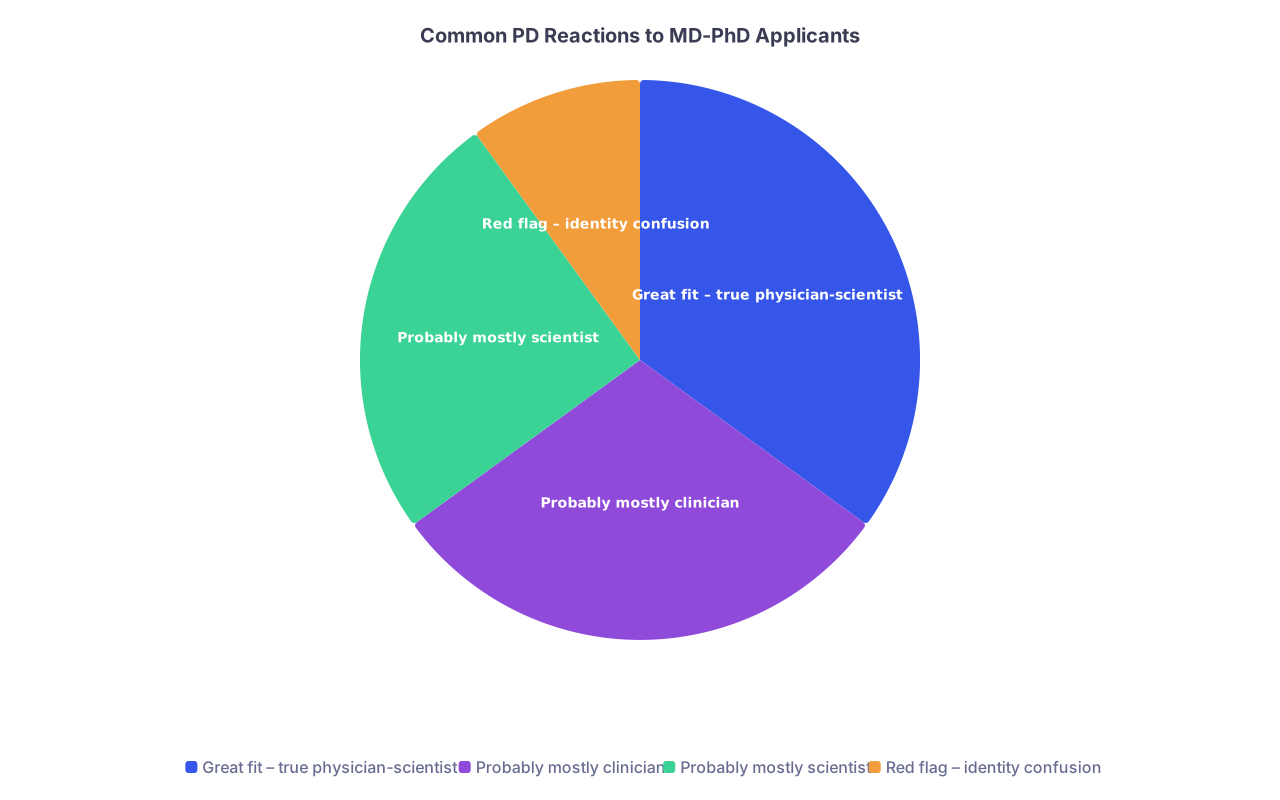
| Category | Value |
|---|---|
| Great fit – true physician-scientist | 35 |
| Probably mostly clinician | 30 |
| Probably mostly scientist | 25 |
| Red flag – identity confusion | 10 |
The PD skims your file and looks for clues:
- Did you do well clinically right after coming back from the lab, or did you flounder?
- Are your letters from clinical attendings as strong as your research letters?
- Does your personal statement sound like you’re applying for a postdoc, not residency?
Here’s the quiet bias: for many PDs, you need to prove you’re not “just a PhD with a medical hobby.” They already assume you can do research. They are not convinced you can function as a PGY-1 until they see proof.
So they go hunting for it:
- Clerkship comments: “Efficient,” “Reliable,” “Team player,” “Strong fund of knowledge,” “Great with patients.” Or not.
- Shelf scores and Step 2: Did your brain survive the lab years?
- The order you talk about things: If every answer on interview day drifts back to “my project,” you lose points.
If they come away thinking, “strong scientist, questionable clinician,” you’re done at a lot of programs—no matter how shiny your Nature paper is.
Length of PhD: “Productive, or Just Lost in the Wilderness?”
Let me be direct: the timeline matters more than people admit.
A 3.5–5 year PhD with clear progress, consistent output, and graduation on schedule? That looks disciplined.
A 7–8 year saga with one paper and a vague story about “changing directions”? That triggers alarms.
PDs won’t say this to your face, but I’ve heard the exact phrases in conferences:
- “What took them so long?”
- “Were they actually productive or just hanging around?”
- “If they needed eight years to get it together, how will they handle intern year deadlines?”
Here’s the mental table they’re running, whether they spell it out or not:
| PhD Length | Default PD Interpretation (unless contradicted) |
|---|---|
| 3–4 years | Efficient, focused, probably organized |
| 5–6 years | Fine, typical, neutral |
| 7 years | Needs an explanation, maybe some bumps |
| 8+ years | Red flag unless there is a very strong story |
If your PhD was longer, you must control the narrative. The story “my experiments were hard” does not cut it. Everyone’s experiments are hard. The question they’re really asking is: did you show judgment? Did you cut losses? Did you know when to pivot?
You want them thinking: “This person stuck with something hard and navigated complexity,” not “this person stays too long on a sinking ship.”
On the flip side, a shorter, efficient PhD with multiple projects and clear progression makes PDs think: “Okay, they can set goals, execute, and move on. Good.”
Publications: Quality, Timing, and the Ugly Truth About Middle Authors
The public line is “we value any scholarly work.” The private line is closer to: “Show me first or senior author, or I don’t care much.”
You’ll never hear that phrase in front of a student, but it’s how most academic PDs mentally rank MD-PhDs:
- 1st or 2nd author in strong specialty-relevant journals? Big plus.
- Multiple middle-author papers in monster labs? Meh. “They were part of a big machine.”
- Everything “in preparation” or “submitted”? Discounted heavily.
And then there’s timing. They look at the years:
- Did you peak early and then coast?
- Did you steadily produce throughout most of the PhD?
- Did everything show up in the final year, like a last-minute scramble?
A common reaction I’ve heard: “If they were in the lab for five years and this is it… where did the time go?”
You’re thinking in terms of “number of papers.” The PD is thinking in terms of “evidence of trajectory.” Do they see a mind that asks questions, closes loops, and finishes things—or someone who just got dragged along by their mentor?
What They Think When You Talk About Your Project
Here’s a little secret: a lot of PDs and faculty tune out as soon as you start reciting your thesis abstract. I’ve watched it happen in real time.
Their internal monologue goes something like: “I don’t care about phosphorylation of X in obscure yeast pathways. I care whether this person can reason, handle complexity, and learn fast.”
So when you talk, they’re not evaluating your science. They’re evaluating your thinking.
What wins points:
- You can explain a complex project in 2–3 sentences. No jargon crutch.
- You clearly know what your central hypothesis was and why it mattered.
- You can describe a failed direction without sounding bitter or lost.
- You pivot smoothly from “what I did” to “how that changed how I think and work.”
What makes them quietly mark you down:
- You ramble. You talk like a dissertation defense, not a clinical handoff.
- You dive deep into methods nobody asked for.
- You can’t articulate your own specific contribution.
- You seem more in love with the project than with medicine.
There’s a reason some PDs walk out of an interview saying, “smart, but I don’t know if they’ll actually want to be on the floors.” That comment usually comes after a PhD-heavy conversation where you never once sounded excited about patients.
The Hidden Fear: “Are We Just a Holding Pattern Before Their K Award?”
This is the part nobody tells you outright.
A decent chunk of PDs in non-research-heavy programs are wary of MD-PhDs. Why? Because of this pattern they’ve seen before:
- MD-PhD comes in talking big about research.
- Struggles with the grind of ward months and call.
- Loses interest in day-to-day clinical life.
- Either bolts for a research-heavy fellowship at a big name place or mentally checks out during residency.
So when they read your personal statement and see endless talk about “building my lab” and “my independent research program,” part of their brain goes: “Are we just three years of service work until they get back to grants?”
We’re not talking only about hardcore physician-scientist tracks. Even in categorical programs, this fear is common. They want residents who will actually show up, carry the pager, and contribute to the team. Not someone bidding time until the next R01.
This doesn’t mean you should hide your research ambitions. It means you have to show you understand:
- Residency is primarily a clinical training period.
- You’re not “above” the daily scut.
- You actually want to be great clinically, not just “good enough.”
When you say on interview day, “I see myself as an academic physician who is genuinely excited to be strong on the clinical side and build a research career,” and you sound like you mean it—PDs relax a little.
Clinical Rust: What They Really Think of Your Return to the Wards
Every PD who has taken MD-PhDs for a while has a mental file of “what happens when they come back from the lab.” It varies wildly.
Some MD-PhDs return rusty for two weeks and then accelerate faster than their MD-only classmates. Others never quite shake off the slowness.
There are specific things they look at:
Your first 1–2 clerkships after the PhD years
Did those evaluations say “needed more time to adjust, but by the end was excellent”? Or did the lukewarm performance persist?Step 2 CK timing and score
If Step 2 is late and mediocre after lab years, they start wondering if you really reengaged with clinical material.Narrative comments like: “Initially quiet but grew into a strong team member.”
That’s fine. But if there’s a lot of “quiet,” “reserved,” “needs to speak up,” it feeds into the stereotype of the socially withdrawn bench scientist.
There’s a recurring whisper in selection meetings: “Are we going to spend the entire intern year dragging them up to speed clinically while they dream about running Western blots?”
What reassures them:
- A clear upward trend the year you returned to the wards.
- A strong letter from a senior clinician saying, essentially, “yes, they took a bit to warm up, but by the end they were one of the best students I’ve worked with.”
- Any sign that you sought out extra clinical exposure to shake the rust off instead of hiding in comfort zones.
Specialty Choice: Where Your PhD Helps, and Where It Doesn’t
Now let’s talk about the part everyone gossips about quietly: how your PhD affects competitiveness in different fields.
Your PhD is not a universal “boost.” It’s targeted ammo.
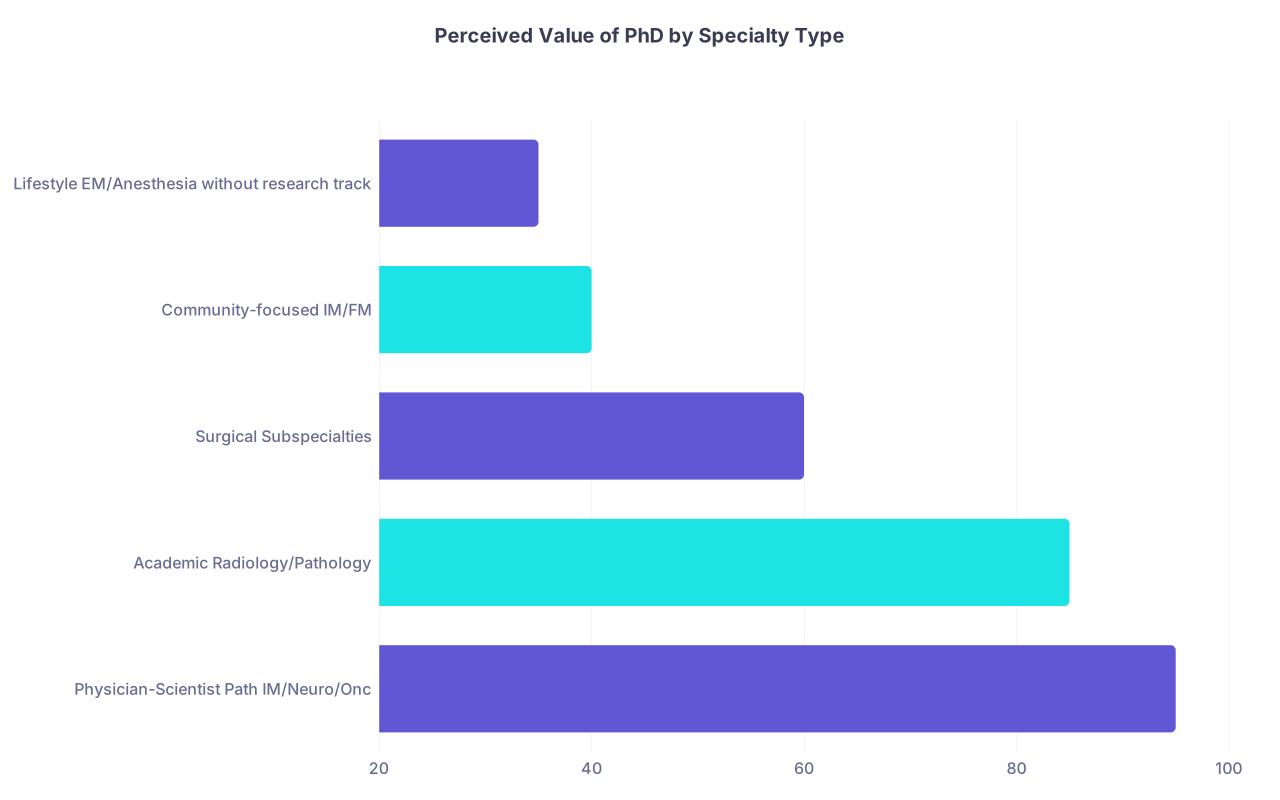
| Category | Value |
|---|---|
| Physician-Scientist Path IM/Neuro/Onc | 95 |
| Academic Radiology/Pathology | 85 |
| Surgical Subspecialties | 60 |
| Community-focused IM/FM | 40 |
| Lifestyle EM/Anesthesia without research track | 35 |
Programs that live on grants and trials—think big-name internal medicine, oncology, neurology, physician-scientist tracks—love MD-PhDs. But they still want clinical strength.
In those places, your PhD is a must-have if you’re aiming at the top tiers. In contrast, for a solid, community-heavy internal medicine or family medicine program that’s not research-focused, your PhD might look more like an odd, overqualified side quest. They’re not against it, but they’re mostly thinking, “Will this person actually be happy here?”
Surgery is its own beast. Tell a surgical PD you spent 6–7 years optimizing a mouse model and they might think:
- Positive: “Persistent, resilient, used to long hours.”
- Negative: “How do they handle time pressure and quick decisions? Or did they just repeat the same experiment for months?”
Surgical programs that are genuinely academic (plastics, neurosurgery, CT at big centers) respect MD-PhDs. But again, only if the clinical bona fides are there. Raw hands, slow OR performance, or shaky judgment will bury your PhD advantages instantly.
What PDs Secretly Love About Your PhD Years
Let me balance the cynicism with the upside, because there is a lot of it—if you understand what they’re actually looking at.
When an MD-PhD application lands on the table, PDs are quietly hopeful about a few things:
You can handle ambiguity. Research trains you to live in the gray. Good internists, neurologists, oncologists—these folks live there daily. That’s a huge plus if you can connect the dots.
You finish hard things. A completed PhD, with real output, is proof of stamina. PDs who’ve watched residents flame out know how rare long-term follow-through is.
You might raise the program’s profile. Let’s not pretend otherwise. A resident who publishes during residency, presents at national meetings, or later lands a K award reflects well on the program.
You bring a systems mindset. The best MD-PhDs see hospital workflows the same way they saw lab problems: as systems to understand, test, and improve. Those folks end up running QI, informatics, and translational projects that matter.
You want to make it as easy as possible for the PD to see that version of you, not just “the person who was gone for six years doing… something.”
Red Flags PDs Will Never Say Out Loud
There are patterns that ring alarm bells instantly. I’ve heard these dissected in selection meetings over and over.
They include:
A PhD in something completely unrelated, with zero bridge story to your chosen specialty.
“Six years in computational linguistics, now applying to orthopedic surgery.” You need a very tight explanation or people will assume poor planning.Letters that hint at conflict or difficulty taking feedback.
Phrases like “strong opinions,” “benefits from clear structure,” “responded to feedback over time” are often code. PDs know this language.A personal statement that is 90% research, 10% patients.
That screams “I’m using residency as a stepping stone to the lab.” Many PDs hate that dynamic.A CV stuffed with “ongoing” and “in preparation” but thin on actual, finished work.
That suggests trouble completing things, or over-selling.
These are all fixable in how you frame your story, but only if you realize PDs are making these inferences.
How to Reframe Your PhD So PDs See the Right Things
You can’t change your past. You can absolutely change what a PD thinks it means.
Here’s the mental reframe you want to engineer:
From:
“Long, nerdy detour away from clinical medicine.”
To:
“High-intensity training in problem-solving, resilience, and independent thinking that now powers my clinical instincts.”
That means on paper and in person you:
Tie specific PhD skills directly to clinical habits.
Example: “In the lab, I learned to systematically test hypotheses instead of jumping to conclusions. On the wards that translates into more disciplined differential diagnoses and fewer anchoring errors.”Acknowledge the rust honestly, then show the rebound.
“Coming back from the lab, my first rotation felt slower, but by mid-year I was being trusted with more complex patients and got feedback about strong clinical reasoning.”Shift your language from “my project” to “my approach.”
The project is history. Your approach is what they’re hiring.Make it very clear you chose medicine again.
“I could have stayed in the lab. I came back to the wards and chose to pursue residency in X because…” That line lands.
Putting It All Together: How PDs Actually Decide on You
If you sat at the table when your application is discussed, you’d probably be surprised by how simple the final questions are. After all the talk about your PhD, publications, and letters, it boils down to:
- Would I trust this person with a sick patient at 2 a.m. in July?
- Will they be miserable here because we’re not “researchy enough”?
- Will they add something to the program beyond just filling a call schedule?
- Are they past the “professional student” phase and ready to act like a physician?
Your PhD can help answer all of those in your favor—or it can distract from them.
The MD-PhDs who rise fast are the ones who flip the usual dynamic. They don’t walk in asking, “Do you value my research?” They walk in proving, implicitly, “You’ll never have to question my commitment to the medicine part—and by the way, I also know how to ask and answer hard questions on a systems level.”
That’s the person PDs remember when the rank list goes up on the screen.

| Step | Description |
|---|---|
| Step 1 | MD-PhD Application Arrives |
| Step 2 | Reject or rank low |
| Step 3 | Neutral or minor plus |
| Step 4 | Rank high |
| Step 5 | Rank mid or pass |
| Step 6 | Clinical strength clear? |
| Step 7 | PhD productive and focused? |
| Step 8 | Aligned with program goals? |
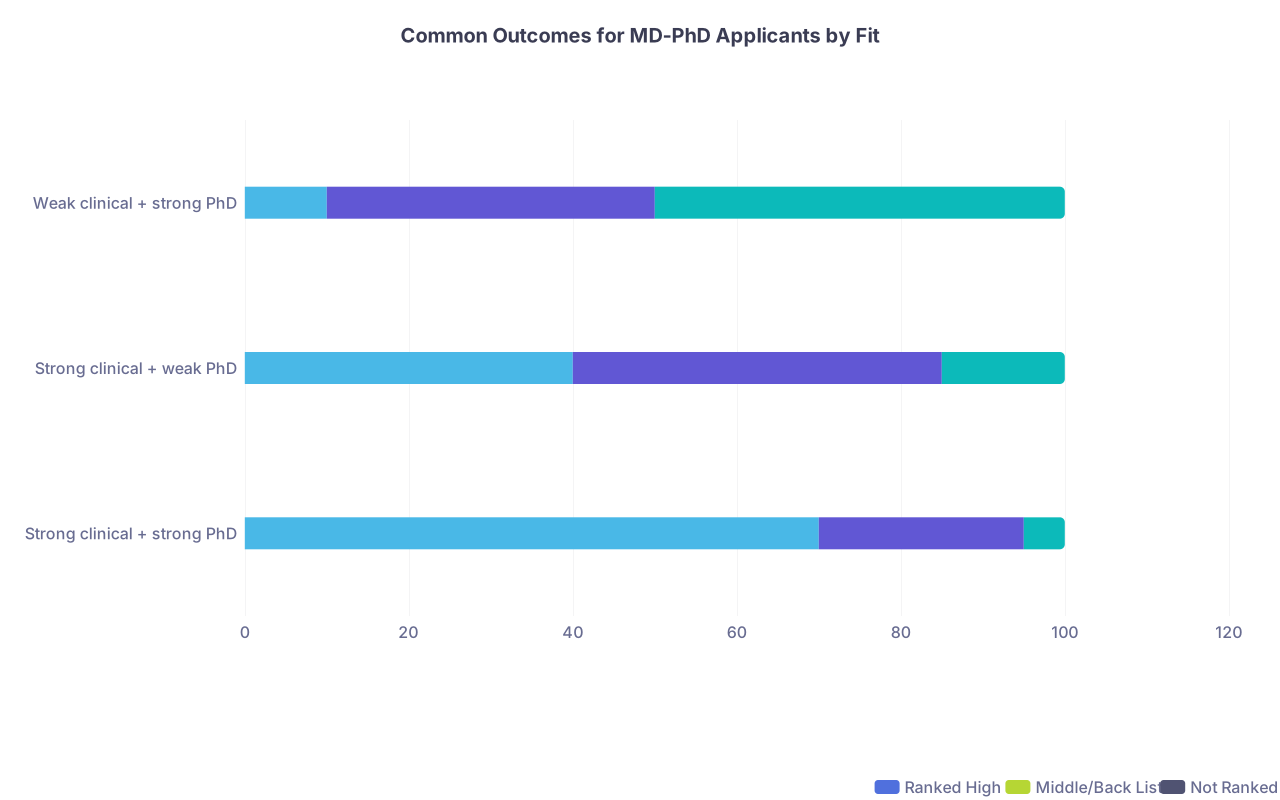
| Category | Ranked High | Middle/Back List | Not Ranked |
|---|---|---|---|
| Strong clinical + strong PhD | 70 | 25 | 5 |
| Strong clinical + weak PhD | 40 | 45 | 15 |
| Weak clinical + strong PhD | 10 | 40 | 50 |


FAQ: What Your Residency PD Secretly Thinks of Your PhD Years
Does a PhD really help me match, or can it hurt me?
It helps you if your clinical record is strong and your story is coherent. At research-heavy programs and physician-scientist tracks, a solid PhD is a major plus. At clinically focused programs or ones burned by disengaged MD-PhDs in the past, it can make them wonder about your priorities. The PhD amplifies whatever is already there—strength or weakness.How do PDs view long PhDs (7–8+ years)?
They immediately want an explanation. Long because of major life events, a clear project pivot, or genuinely ambitious work with strong output? That can be framed positively. Long with vague reasons and thin productivity looks like poor judgment or low efficiency. You have to own that timeline and show what you learned and how you changed.If my publications are mostly middle-author, am I sunk?
Not necessarily, but you lose some of the automatic “wow” factor. PDs care far more about whether you can articulate your specific contribution. A thoughtful explanation of how you drove a key part of the project can salvage a middle-author paper. But if your entire output suggests you just floated in a big lab without real ownership, that undercuts the value of the PhD.How much do PDs care about my exact research topic?
Much less than you think. Outside of very niche research-heavy fellowships, they’re not evaluating the science for scientific merit. They’re watching how you think about it: clarity, ability to simplify, understanding of limitations, and how you handle failure. They’re asking, “Does this mindset translate to better patient care and team function?”Should I downplay my research to seem more ‘clinical’?
No—but you must anchor it in medicine. If you talk as if you’d rather be back in the lab, PDs pick up on that immediately. The right move is to be explicit: “I’m serious about being a strong clinician and I plan to integrate research into that career.” Show them you chose residency and patients, you’re not just tolerating it until the next grant cycle. That balance is what convinces PDs your PhD years made you better, not distracted.
With this perspective in your pocket, you’re no longer walking into residency applications blind to what’s being whispered on the other side of the door. The next step is tactical: how you rewrite your CV, personal statement, and interview answers so the PhD years work for you instead of against you. But that’s a conversation for another night.