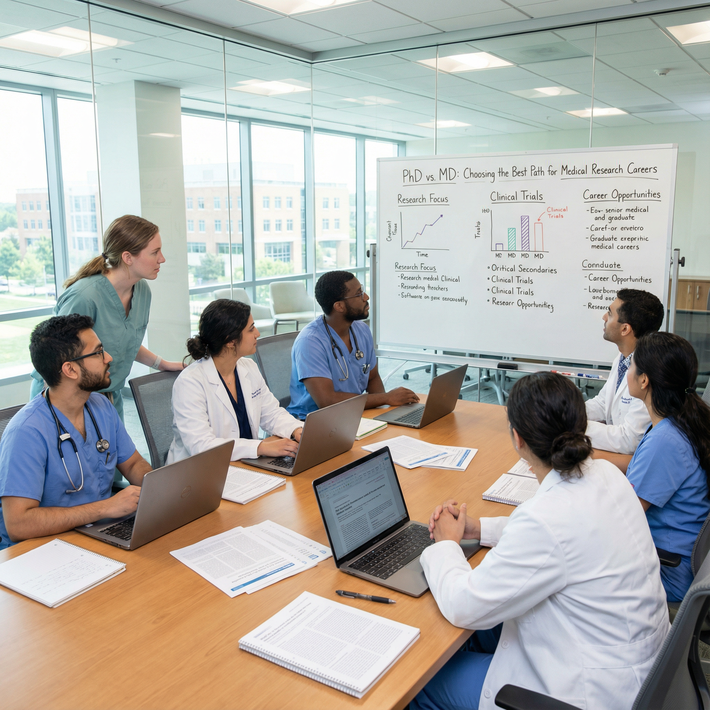
What happens when you realize you love research… and then apply to the wrong degree for the career you actually want?
Let me be blunt: a lot of very smart, research-obsessed premeds completely screw up the MD vs PhD decision. Not because they’re lazy. Because they misunderstand what each path really leads to, and they send applications that scream: “I don’t know what I want.”
If you love research and you’re deciding between MD, MD/PhD, or PhD, there are some predictable, expensive, time-wasting mistakes that I see over and over. You do not want to be the person 4 years into a PhD realizing you actually want clinic time. Or stuck in a standard MD track while secretly trying to moonlight as a full-time scientist without the right training or protected time.
Let’s walk through the landmines before you step on them.
Mistake #1: Treating “Loving Research” as Enough to Justify a PhD
You enjoy pipetting. You like your PI. You get a rush when you solve a Western blot problem at 10 pm.
That’s not enough to justify a PhD.
The biggest mistake I see: equating “I like research” with “I should get a PhD.” Those are not the same thing.
A PhD is not:
- A research badge that makes your MD application prettier
- A guaranteed ticket to academic medicine
- A generalized “I like science” credential
A PhD is:
- A 4–7+ year commitment to deep, narrow expertise
- Training to become an independent investigator
- A degree that expects you to drive your own research agenda for decades
If what you actually want is:
- To be a clinician who participates in clinical trials
- To occasionally publish case reports or quality-improvement projects
- To “stay connected to science”
…you probably do not need a PhD. You may not even need an MD/PhD.
The red flag I watch for in personal statements:
- “I love science and want to help patients, so MD/PhD is perfect for me.”
That sentence tells me nothing. Programs see that cliché twice before lunch.
The question you must answer clearly:
- “Do I want 60–80% of my long-term career to be research, with my own lab or equivalent?”
If the honest answer is “I don’t know” or “maybe not,” then blindly applying to PhD or MD/PhD is a mistake.
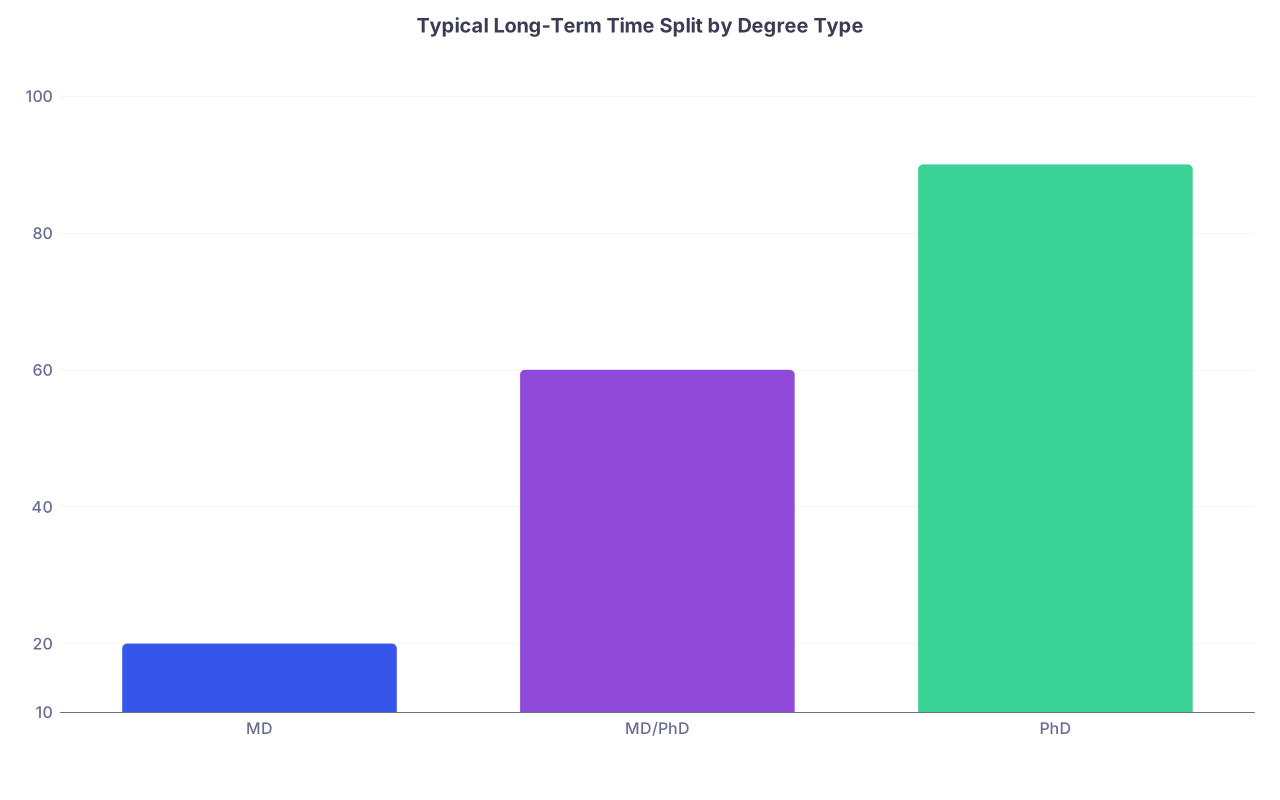
| Category | Value |
|---|---|
| MD | 20 |
| MD/PhD | 60 |
| PhD | 90 |
(Values = approximate % of time spent on research for people who stay on a research-heavy path. Reality can differ—often worse for MDs.)
Mistake #2: Confusing “Can I Get In?” with “Do I Belong There Long-Term?”
Another common error: choosing the path where your stats might look more competitive instead of where your career fit is stronger.
I’ve seen this play out like this:
- Student A: 3.9 GPA, 520 MCAT, 3 years of bench research, 1 first-author, strong letters, wants heavy research → applies MD/PhD. Fine.
- Student B: 3.5 GPA, 513 MCAT, some research, told “you’re competitive for MD but not MD/PhD” → decides, “Maybe I’ll do a straight PhD in biomedical sciences instead and then go to med school later.”
That’s how people end up miserable:
- They jump into a PhD program mostly because MD admissions felt stressful
- They hope they’ll “add a PhD to make MD easier later”
- They realize they locked themselves into years they didn’t actually need
Doing a PhD as a “booster” for med school is usually a terrible idea.
Why this is a mistake:
- Admissions committees can smell when the PhD is a backup move
- Your motivation during the hard years will tank if you never wanted that lifestyle
- You lose 4–7 years of income, training, and momentum for a credential you’re not using
If your true goal is:
- Direct patient care with some scholarly activity → MD
- Investigating disease mechanisms, maybe never touching patients → PhD
- Running a lab and also seeing patients regularly → MD/PhD (or MD with serious post-doc–level research training, but that’s harder to engineer)
Do not optimize for “easiest door to slip through.” Optimize for “door that doesn’t lead to years of regret.”
Mistake #3: Writing the Same Story for MD, MD/PhD, and PhD Programs
This one kills more applications than you think.
You cannot recycle one “I love research” essay for:
- MD-only programs
- MD/PhD programs
- Pure PhD programs
They’re looking for different primary identities:
- MD committees: “Show me a future clinician who understands patient care, with bonus points for scholarly curiosity.”
- MD/PhD committees: “Show me a future physician-scientist who can lead research and handle medical training.”
- PhD committees: “Show me a future independent scientist, period.”
If your MD/PhD essay reads like a slightly more technical MD essay, you look lost.
Common writing mistakes:
- For MD/PhD:
- 80% of the essay about shadowing and patient experiences
- One vague paragraph saying, “Research will inform my clinical practice”
- For PhD:
- Saying “I want to be a doctor-scientist” and then never clarifying that you mean PhD-level scientist, not clinician
- Spending more time on clinical volunteering than on your scientific questions
Let me be direct:
- If your PhD essay doesn’t articulate specific scientific questions or fields you want to investigate, you look like you’re just hiding from MD admissions.
- If your MD/PhD essay doesn’t clearly describe your intended blend of clinic + research, you look like you just want a “free MD.”
You need separate, tailored narratives. Not one Frankenstein essay that sort of fits everywhere and actually fits nowhere.
Mistake #4: Underestimating How Different MD vs PhD Training Feels
On paper, they all sound prestigious. In real life, day-to-day is wildly different.
Here’s where people screw up: they imagine the idea of the degree, not the lived experience.
| Aspect | MD (Med School) | MD/PhD (During PhD Years) | PhD Only |
|---|---|---|---|
| Main Output | Exams, clinical notes | Papers, experiments | Papers, experiments |
| Time Scale | Weeks (blocks, rotations) | Months–years per project | Months–years per project |
| Structure | Highly scheduled, fixed courses | Self-driven with PI oversight | Self-driven with PI oversight |
| Metrics | Grades, evals, Step scores | Publications, grants, progress | Publications, grants, progress |
| Peers | Mostly future clinicians | Mix of med + grad students | Pure researchers |
If you thrive when:
- The schedule is structured
- There’s a clear syllabus and timeline
- You know exactly what’s on the test
You might hate the long, uncertain slog of a PhD.
If you love:
- Open-ended questions
- Long projects with delayed gratification
- Troubleshooting your own ideas for months
You might be deeply frustrated by the constraint and pace of pure clinical training.
The mistake is assuming:
“I like my undergrad lab → I’ll like 6 years of full-time science”
or
“I like biology classes → I’ll enjoy medical school”
No. Those are shallow tests.
You need to honestly ask:
- Which pain do I tolerate better:
- The grind of wards, call, and clinical responsibility
- Or the grind of experiments failing for 9 months straight?
Both lives are hard. Just in very different ways.
Mistake #5: Ignoring Funding, Debt, and Time Like They’re Side Issues
They’re not side issues. They change your entire future.
Here’s how people get burned:
- They say, “I’ll just do MD, take loans, and do research later.”
- They ignore that heavy clinical debt pushes many MDs away from research-heavy, lower-paying academic paths.
- Or they say, “I’ll do PhD first, then MD, then maybe fellowship, then research” without counting the years.
For a research-loving premed, the financing and time horizon matter a lot for whether you’re actually able to do research later.
General patterns (US-based):
MD:
- 4 years
- Often $200k–$350k+ in debt
- Research time later depends heavily on residency, fellowship, funding
MD/PhD (MSTP and some others):
- 7–9+ years total
- Usually tuition-free with stipend
- Designed to protect research as part of your identity
PhD:
- 4–7 years (sometimes more)
- Funded with modest stipend
- But no clinical income later unless you add another degree
The mistake is not just choosing wrong. It’s choosing without seeing the financial and time tradeoffs clearly.
If you want a life where:
- You can afford a family
- You actually have time to write grants and papers
You need to be brutally honest about how long you’re willing to train and what income you’ll need.
Mistake #6: Misunderstanding What MD/PhD Programs Actually Expect
A lot of premeds treat MD/PhD like MD+.
It is not MD+. It’s almost a different species.
Common errors:
- Applying to MD/PhD with okay research but no depth
- Way too much focus on clinical shadowing vs. scientific independence
- Zero mention of grant-writing, hypothesis generation, or long-term research goals
I’ve been in rooms where faculty say:
- “This is just an MD applicant who stuck a /PhD on the form.”
- “Nice stats, but no evidence they can survive a PhD.”
Red flags in your MD/PhD application:
- Research experience limited to 1 summer and a couple of poster presentations with no real ownership
- You never once articulate a type of research career (e.g., translational immunology, computational genomics)
- Your letters all say you’re “hardworking” but none say you “think like a scientist”
If you’re going MD/PhD, the bar is:
- Enough research to show you understand how long and painful it is
- Enough independence that someone can credibly say, “They could run their own project”
If you don’t have that yet, your mistake isn’t “not good enough.” It’s rushing MD/PhD apps instead of taking 1–2 extra years to build a real research foundation.
Mistake #7: Overestimating How Much Research You Can Do as an MD Without PhD-Level Training
Here’s a subtle but dangerous one.
I hear this a lot:
- “I’ll just do MD, and then I’ll run a lab on the side.”
That’s… not how it usually works.
Are there MD-only physician-scientists with major labs? Yes. But they’re rare, and frankly, most of them:
- Did serious research in med school
- Took research years
- Did research-heavy residencies and fellowships
- Often did something equivalent to a post-doc
The mistake is assuming: “MD alone = easy road to 50/50 clinic/research.”
Reality:
- Many MDs who want to do research end up >80% clinical
- Clinic pulls hard; admin burdens are massive
- Without protected time and strong research training, your research shrivels to case reports and minor projects
If your real dream is:
- Leading a lab
- Writing R01-level grants
- Running big, funded projects
Then you either:
- Need MD/PhD
- Or need to intentionally engineer a research track that looks suspiciously like what a PhD or post-doc would’ve given you
The mistake is magical thinking: assuming future-you will somehow carve research time and training out of nowhere.
Future-you won’t. They’ll be tired, on call, and drowning in EMR messages.
Mistake #8: Failing to Talk to People Actually Living Each Path
I’ve noticed who makes the worst decisions: the ones who only talk to:
- Their undergrad premed advisor
- One happy MD/PhD brochure student
- One shiny attending who “does research” (translation: publishes 1 paper every 2 years between 5 clinics a week)
You need to talk to:
- A mid-career MD physician-scientist who struggles with grant funding
- A burned-out PhD who left academia and can tell you why
- An MD who wanted to do research but ended up full-time clinical
- At least one grad student in your field who’s 5+ years in and still not done
If those conversations make you more excited? Good sign.
If they make you queasy or depressed? Take that seriously.
The mistake is thinking you’re the exception who will love the pain that everyone else warns you about, without actually knowing what that pain looks like up close.
Mistake #9: Building an Application That Sends Mixed Signals
Nothing kills an application faster than confusion about your direction.
Common mixed-signal combos:
- Applying to MD-only at some schools, MD/PhD at others, and PhD programs in unrelated fields—all in the same cycle—with no coherent narrative
- Having a CV that’s 90% clinical volunteering and a tiny research section, but telling MD/PhD committees “I want a research-focused career”
- Applying to a PhD in biochemistry while writing in your statement that you “definitely plan to go to medical school later”
Programs don’t want to be the stepping stone you’re planning to abandon.
So if you:
- Apply to PhD as a med school booster
- Apply MD/PhD as a “scholarship + prestige hack”
They will sense it.
You need alignment between:
- Your experiences
- Your letters
- Your personal statements
- The degrees you’re applying for
If your story is:
“I love research and want to be deeply embedded in it for life,”
then:
- MD/PhD or PhD makes sense
- Your experiences should back that up
If your story is:
“I love patients first, and research is important but secondary,”
then:
- MD with some academic focus makes sense
- Don’t pretend to be a lab-obsessed future PI
Mistake #10: Believing There’s Only One Shot and One “Correct” Choice Forever
Final trap: panic.
You’re not choosing your entire destiny with one checkbox. But you are choosing the next 7–10 years, which is a lot.
Panic mistakes I see:
- Rushing MD/PhD apps because “I may not be competitive next year”
- Jumping into a PhD because you’re scared of a reapplicant MD cycle
- Taking any offer just to “keep moving” instead of asking, “Is this actually my path?”
Yes, there are ways to pivot:
- MD → add serious research training, sometimes a research fellowship
- PhD → post-doc in more translational work, maybe later MD (but long, painful)
- MD/PhD → lean more clinical or more research depending on how training goes
But none of those are easy.
The mistake isn’t “choosing wrong forever.”
The mistake is choosing fast and blind, instead of slow and informed.
What You Should Do Right Now (Instead of Guessing)
To avoid the worst MD vs PhD vs MD/PhD errors, do this:
Write down, in one paragraph, your ideal week at age 45.
- How many days are you in clinic?
- How many in the lab or on a computer analyzing data?
- How many teaching, writing, or in meetings about grants/trials?
Compare that to the rough reality of each path. Don’t romanticize.
Audit your experiences honestly:
- Have you done sustained research with ownership?
- Have you seen enough real clinical life beyond shadowing?
Schedule 3 conversations in the next two weeks:
- One MD-only academic physician
- One MD/PhD (resident, fellow, or junior faculty)
- One PhD in a field you’re considering
Ask all three:
“What sucks about your path that no one told you when you were premed?”
If your current plan doesn’t survive those answers, you just avoided a very expensive mistake.
FAQ (Exactly 4 Questions)
1. If I’m on the fence, should I default to MD, MD/PhD, or PhD?
If you’re genuinely 50/50 and haven’t done deep research, defaulting to MD is usually safer than jumping into a PhD or MD/PhD you’re unsure about. You can still build a research-heavy career from MD with the right mentors and protected time. What you should not do is sign up for a 7–9 year MD/PhD or standalone PhD if your commitment to living a research-first life is shaky.
2. Will doing a PhD first make it easier to get into medical school later?
Not reliably, and often not in the way you hope. Adcoms don’t give automatic “extra points” for a PhD if your stats and clinical experiences are weak. They’ll also question whether you’re using the PhD as a backup or escape hatch. You’ll be older, more in debt (opportunity cost at minimum), and they’ll expect a far more mature, coherent narrative. Doing a PhD only to boost med school odds is usually a strategic mistake.
3. Do MD/PhD programs care more about MCAT/GPA or research?
For competitive MD/PhD programs, you need both to be solid. But weaker research with stellar stats is usually worse than very strong research with slightly less shiny numbers (within reason). They’re selecting future investigators, not just test-takers. Minimal or superficial research experience is a common reason strong-stat applicants get quietly filtered out in MD/PhD admissions.
4. Can I still be involved in research as a regular MD without a PhD?
Yes, but don’t romanticize it. Many MDs do meaningful research—especially in clinical, translational, or outcomes spaces—but it requires intentional choices: research-oriented residencies, mentors, protected time, sometimes extra degrees (like an MPH or MS in clinical research). If you want to run a lab or be a heavily grant-funded investigator, you’re making your life significantly harder without PhD-level or post-doc–level training, even if it’s not literally a formal PhD.
Open a blank document right now and write out your ideal “typical workweek” at age 45—hours in clinic, hours in lab, hours writing and teaching—then compare that vision to what MD, MD/PhD, and PhD actually deliver; if there’s a mismatch, fix your application plan before you hit submit.