
A PhD will not save a weak application in derm or rad onc—but it absolutely can be a powerful edge if you use it strategically.
Let me be blunt: too many students treat “getting a PhD” as some magic golden ticket into competitive specialties. It isn’t. Program directors are not sitting around saying, “Their Step scores are mediocre and their letters are bland, but hey, they have a PhD, let’s rank them to match.”
What they are saying is more like: “If this person has numbers, strong letters, and clear specialty commitment, a PhD in a relevant field makes them very attractive—especially for academic positions.”
So the real question isn’t “Will a PhD help me match derm or rad onc?”
The real question is “Under what conditions does a PhD meaningfully help—and when is it a waste of years?”
Let’s walk through that.
1. How Much Does a PhD Actually Matter in Derm and Rad Onc?
Here’s the core truth: in derm and rad onc, your core metrics still run the show:
- USMLE (especially Step 2 now that Step 1 is pass/fail)
- Clerkship grades / honors
- Specialty-specific letters from known faculty
- Specialty-specific research output
- Performance on away rotations / auditions
- Interview performance and “fit”
A PhD sits on top of that foundation. It amplifies a strong file; it doesn’t fix a weak one.
Where a PhD does help
In dermatology and radiation oncology, a PhD tends to help most when:
Your research is directly relevant to the specialty
Example:- Derm: immunology, skin cancer biology, genetic skin diseases, inflammatory pathways.
- Rad Onc: radiation biology, cancer biology, imaging, medical physics, AI in radiation planning.
You turn that PhD into real output:
- First‑author papers in decent journals
- Presentations at major meetings (AAD, ASTRO, etc.)
- Actual grant involvement, not just “I worked in a lab”
You’re aiming at academic programs:
- Programs that care about NIH funding, physician‑scientist tracks, and tenure‑track pipelines love people who can bring in grants down the line.
Your application is already strong across the board:
- Good scores, good clinical performance, good letters. The PhD then becomes the “differentiator,” not the life raft.
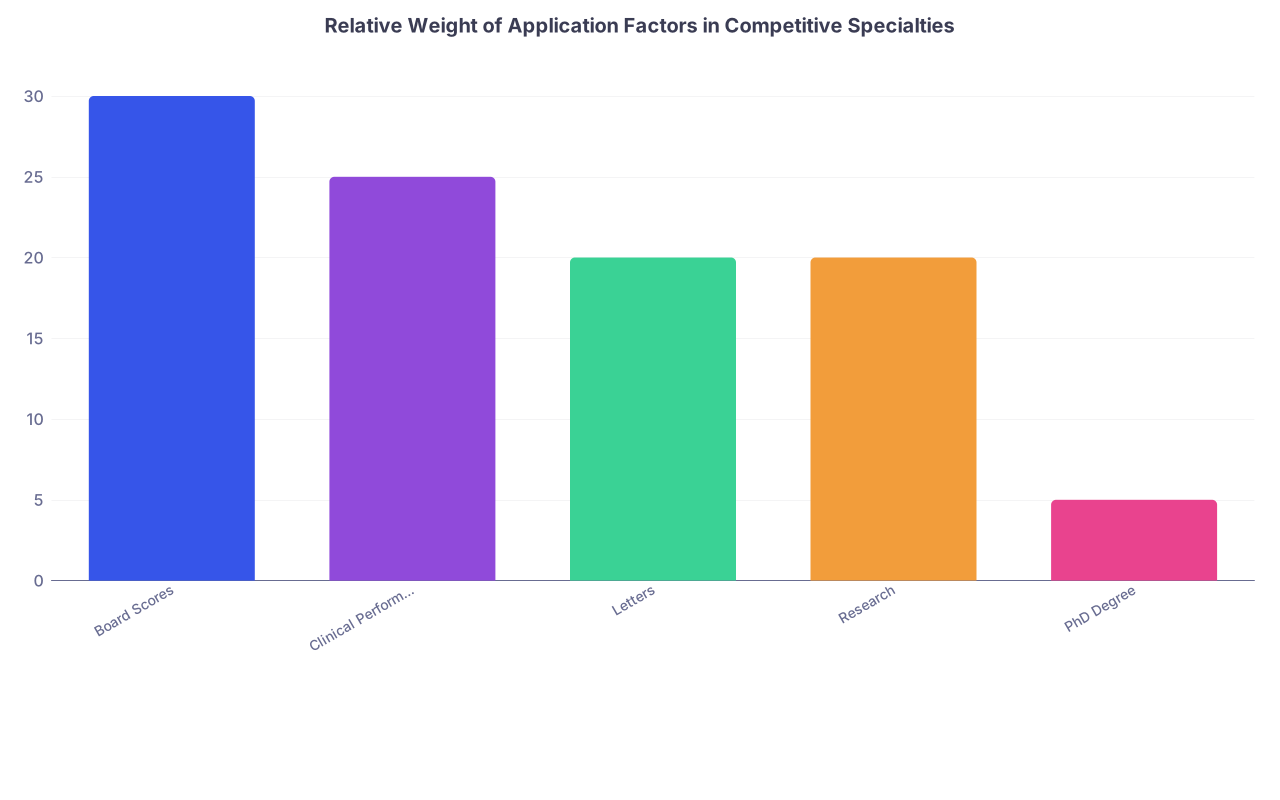
| Category | Value |
|---|---|
| Board Scores | 30 |
| Clinical Performance | 25 |
| Letters | 20 |
| Research | 20 |
| PhD Degree | 5 |
That 5% “PhD degree” bar is the uncomfortable reality. The degree itself isn’t the main driver. What you produce and who you become during the PhD—that’s where the weight comes from.
Where a PhD does not help much
- If your Step 2 is weak for the specialty range
- If you have no derm/rad onc specific exposure
- If your PhD is in something unrelated with no clear path (e.g., theoretical math with zero connection to imaging or AI)
- If your letters are generic and no one in the specialty knows you
Programs are not going to overlook all of that just because “PhD” sits next to your name.
2. How Common Is a PhD in Derm and Rad Onc?
You don’t need a PhD to match derm or rad onc. Most residents do not have one.
But you will see more PhDs in these fields than in, say, family medicine.
Rough ballpark (this varies by year and program, but gives you a feel):
| Specialty | Residents with PhD (Approx) |
|---|---|
| Dermatology | 10–20% at many academic centers |
| Radiation Onc | 15–25% at many academic centers |
| Internal Med | 5–10% |
| Family Med | <5% |
You’ll notice the pattern: competitive, research‑heavy specialties at academic centers over‑represent MD‑PhDs and PhDs. But even there, they’re still the minority.
So having a PhD helps you stand out—if the rest of your file is competitive.
3. When a PhD Is a Smart Play for Derm or Rad Onc
Let’s talk strategy. Here are situations where I’d say a PhD (or MD‑PhD) is legitimately worth considering.
Good reasons to get a PhD
You want to be a physician‑scientist, not just “someone with a few papers.” If you picture yourself running a lab, applying for R01s, or leading translational work in melanoma, immunotherapy, or radiobiology, a PhD is often the right tool.
You genuinely like research work. Not “I liked my 10‑week summer project.”
I mean: you enjoy hypothesis generation, experimental design, troubleshooting failed experiments, long cycles of data collection, and writing.You’re targeting top‑tier academic programs and want a real niche. For example:
- A derm applicant with a PhD in immunology and 5+ first‑author papers on psoriasis or atopic dermatitis.
- A rad onc applicant with a PhD in imaging physics or AI, tied to actual clinical applications.
Your PhD is paid for through an MSTP/MD‑PhD program. Getting your tuition covered and a stipend while training as a future physician‑scientist is an entirely different calculation than self‑funding a PhD and then paying for med school.
Your mentors are in the specialty and pull you into their world. This is huge. A PhD in a derm lab with a PI who is tight with residency leadership is very different from a PhD in a basic science department that’s totally disconnected from clinicians.

| Step | Description |
|---|---|
| Step 1 | Interest in Derm or Rad Onc |
| Step 2 | Consider MD PhD |
| Step 3 | MD only with strong research year |
| Step 4 | High synergy with specialty |
| Step 5 | Limited added match benefit |
| Step 6 | Dedicated research year or gap years |
| Step 7 | Love research long term? |
| Step 8 | Field specific PhD? |
If you’re in the “Yes, I actually want this life” camp and your PhD aligns tightly with derm or rad onc, the degree isn’t just match candy—it’s part of your core career identity.
4. When a PhD Is Overkill or the Wrong Tool
Now the part no one likes to hear.
A PhD is a terrible idea if you’re using it as:
- A backup plan because your scores aren’t where they should be
- A way to “buy time” and hope your competitiveness magically improves
- A prestige flex because you think more letters after your name always equals more respect
Real talk: a PhD costs you 3–6 years of your life. And those years aren’t cushy. They’re often low‑pay, high‑stress, and uncertain.
Red flags that you’re doing it for the wrong reasons
- You hate your current research rotation but still say, “Maybe I need a PhD for derm.”
- When asked what you’d want to study, you shrug and say, “Something related to skin cancer, I guess.”
- You mainly care about private‑practice income and lifestyle and have no real desire for a research‑heavy academic career.
In those cases, you’re usually far better off with:
- A 1‑year research fellowship in derm or rad onc
- A funded gap year with a specialty‑specific lab
- Building a solid publication and networking record without committing to an entire additional degree
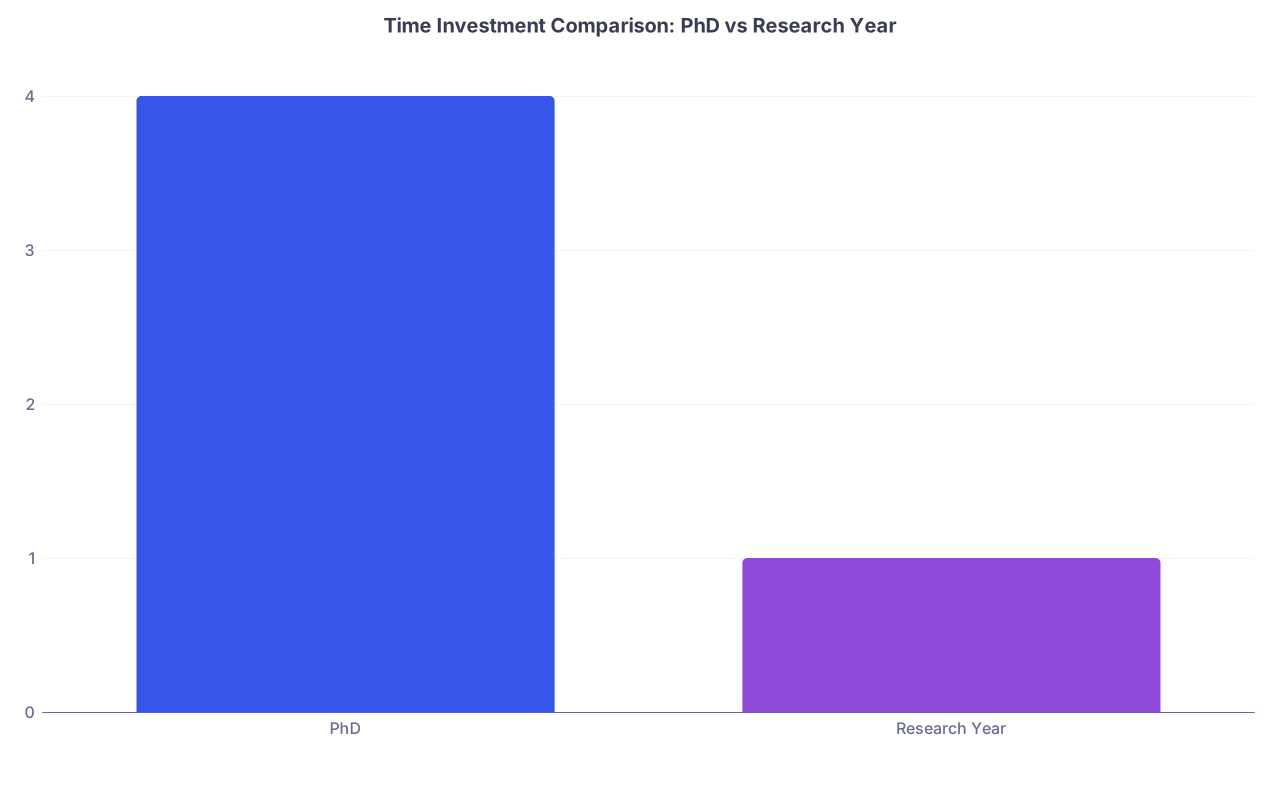
| Category | Value |
|---|---|
| PhD | 4 |
| Research Year | 1 |
That chart is the point: 4+ years vs 1 year. You’d better be getting something more than “a small bump in match chances” out of those extra 3 years.
5. MD vs MD‑PhD vs PhD-Then-MD for Competitive Specialties
You’ve basically got three structural options if you’re still early enough in training.
| Path | Pros | Cons |
|---|---|---|
| MD only | Fastest, most flexible | Less formal research training |
| MD‑PhD (MSTP) | Funded, built‑in research identity | Extra years, competitive entry |
| PhD then MD | Deep expertise, sometimes funded PhD | Longest path, no tuition for MD |
MD only
- Best if you’re not 100% sure about research as a major career pillar
- Still absolutely competitive for derm and rad onc if you:
- Do a serious research year
- Get strong mentorship and letters
- Crush your clinical work and exams
MD‑PhD
- Best if you want to be a career physician‑scientist
- Strongest when your PhD is directly tied to:
- Immunology of skin disease
- Cancer biology, radiobiology, imaging, AI in medicine
- Often well‑received by academic derm and rad onc programs, especially those with T32s or physician‑scientist tracks
PhD then MD
- Makes sense if you already started or completed a PhD before you fell in love with medicine
- You’ll see these people in rad onc fairly often (e.g., physics or engineering PhDs)
- The key is to re‑brand that PhD toward the clinical specialty through targeted projects, postdoc work, or collaborative research

6. How Programs Actually Read “PhD” on Your CV
Here’s roughly how program leadership thinks when they see a PhD applicant for derm or rad onc:
- “Does their research make sense for what we do?”
- “Do they have real productivity or just a long enrollment period?”
- “Are they someone who will help our department’s research profile?”
- “Do they still look clinically strong, or are they just lab‑locked?”
- “Will they fit with our residents, or are they going to be miserable on the wards?”
If the answers are:
- Relevant work? ✔
- Multiple first‑author papers, good venues? ✔
- Strong letters from respected investigators? ✔
- Step 2, clerkships, away rotations solid? ✔
- Actually like patients and clinical medicine? ✔
Then yes, the PhD absolutely helps.
If instead it’s:
- Vague project, no clear link to specialty
- One paper, mid‑tier, 5 years in lab
- No strong specialty letters
- Mixed clinical comments
- Not sure they like clinical work
Then the PhD becomes dead weight. A long gap in your clinical story with not enough payoff.
7. Decision Framework: Should YOU Do a PhD for Derm/Rad Onc?
Let me give you a simple stress test. Say “yes” or “no” to each.
- I can name a specific research area I’d happily spend 4–6 years on, even if I never match derm or rad onc.
- I like the process of research, not just the outcome (papers, prestige).
- I’m drawn to academic medicine and long‑term grant writing.
- I already enjoy reading dense primary literature in a niche topic and thinking about experiments.
- I understand that a PhD is not a guaranteed match booster, and I’d still want it even if it didn’t move my odds much.
If you’re not “yes” on at least 4 out of 5, a full PhD mostly for match purposes is a bad trade.
If you’re “yes” on all 5, then the question shifts from “Is a PhD worth it?” to “What’s the smartest way to structure it so it truly supports a derm or rad onc career?”
That’s where you talk to:
- Physician‑scientists in derm and rad onc
- Program directors at research‑heavy programs
- MD‑PhD directors at your institution
Ask them very direct questions:
“How do MD‑PhDs actually fare in matching derm/rad onc here? What do they do differently?”
You’ll get more honest answers than you think—if you ask.

FAQs
1. Do I need a PhD to match dermatology or radiation oncology?
No. Most derm and rad onc residents don’t have a PhD. Strong scores, strong clinical evaluations, specialty letters, and meaningful research (often through a dedicated research year) are far more universal than the degree itself. The PhD is an add‑on, not a core requirement.
2. Does an MD‑PhD significantly improve my odds for these specialties?
It can—if your PhD is relevant, productive, and backed by strong clinical performance. MD‑PhDs with high‑impact, specialty‑aligned research and strong mentorship often do very well in matching competitive academic programs. MD‑PhDs with vague projects and modest productivity don’t see much benefit.
3. Is a research year almost as good as a PhD for matching?
For pure match purposes, a well‑spent derm or rad onc research year can absolutely rival (or exceed) the impact of a non‑targeted PhD. One high‑yield year embedded in a strong specialty lab with good mentorship and 2–3 first‑author papers can move the needle more than 5 unfocused PhD years.
4. Will a PhD compensate for a low Step 2 score?
Very rarely. If your score is far below typical ranges for derm or rad onc, a PhD won’t magically override screening filters. Some research‑heavy programs might still interview you if your research is phenomenal and a faculty member advocates hard, but that’s the exception, not the rule.
5. Does the PhD field matter, or is any PhD impressive?
The field matters a lot. A PhD in immunology, cancer biology, radiobiology, imaging, or AI/ML applied to medicine is obviously more compelling for derm or rad onc than something like ancient history. Non‑related PhDs can still signal grit and intelligence but don’t carry the same weight for specialty‑specific research potential.
6. What if I already have a PhD and now want derm or rad onc?
You’re not doomed at all, but you need to re‑align your story. That means: connect your prior PhD skills to specialty‑relevant questions, do at least some targeted research in derm or rad onc, and get strong letters from clinicians in the field who can vouch that you’re not “just a scientist” but also a capable future clinician in that specialty.
7. How do I decide between MD‑only with research vs MD‑PhD?
Ask yourself two things:
- “Do I want research to be a constant, central part of my career, with grants and lab work as a big chunk of my job?”
- “Would I still want a PhD even if it had zero effect on my odds of matching a competitive specialty?”
If the answer to both is yes, MD‑PhD makes sense. If not, MD‑only with a focused research year is usually the smarter, more efficient path.
Open a blank page right now and write down two columns: “Why I want a PhD” and “Why I want derm/rad onc.” If those lists don’t heavily overlap in substance—not just in vibes—your next move shouldn’t be a PhD application; it should be a meeting with a trusted mentor to recalibrate your strategy.