
It’s 11:30 p.m. You just finished a call shift, you’re half-reading a manuscript in your inbox, and a very real question is gnawing at you:
“Did I screw this up by not doing an MD–PhD?”
Or, if you’re earlier in the game: “Do I have to do an MD–PhD if I want to be a real physician‑scientist?”
Let me answer that head-on:
You do not need formal MD–PhD training to be a successful physician‑scientist.
But skipping it does change the path, the timeline, and the amount of friction you’ll face.
Let’s go through what that actually means in the real world—promotion, grants, protected time, credibility, lifestyle—and where the MD–PhD absolutely helps vs where it’s optional.
The Core Question: Is MD–PhD Required?
Short answer: No.
Longer, more honest answer: It depends what you mean by “successful” and how much structural support you want baked in.
If your goal is:
- Run a basic science or translational lab as PI at a major academic center
- Compete regularly for NIH R01-level funding
- Have >50–70% of your time protected for research
Then formal research training (MD–PhD or serious post‑MD research training like T32s, fellowships with >2–3 years of research, or a research MS/postdoc) is almost essential. Not legally required, but practically, yes—some form of significant, structured research training is needed.
If your goal is:
- Be clinically strong
- Lead or co-lead clinical trials
- Do outcomes, QI, or implementation science
- Publish consistently, collaborate on grants, maybe hold some PI roles on smaller or clinical‑type grants
Then a straight MD with targeted research training and mentorship during residency/fellowship is more than enough.
So the real question is not “MD–PhD or bust?”
The real question is: “What type of physician‑scientist do I actually want to be?”
What MD–PhD Actually Buys You (And What It Doesn’t)
Let’s be concrete. Here is what MD–PhD training tends to give you.
| Dimension | MD–PhD Advantage |
|---|---|
| Time for research | 3–5 dedicated full-time research years |
| Technical depth | Serious expertise in a method/field |
| Early publications | Papers before residency/fellowship |
| Grant track record | F30/F31, early grant-writing experience |
| Networking | Built-in mentors and research community |
| Signaling | “Serious about research” to academics |
Where MD–PhD helps a lot:
Basic/bench science careers
If you want wet lab, mechanistic work—cell signaling, mouse models, structural biology—those years of PhD training matter. You need real technical depth and productivity.Earlier research maturity
By the time you finish med school, you’re already thinking like a scientist: hypothesis formation, study design, statistics, grant framing. That’s not a small thing.Grant credibility
For early-career NIH mechanisms (K08, K23, K99), a history of sustained research training and publications helps. MD–PhD is a neat, easily understood signal.
Where MD–PhD is not magic:
- It does not guarantee you a R01.
- It does not guarantee protected time or a lab. Those come from departmental support and your ability to secure funding.
- It does not prevent you from burning out or drifting full-time into clinical work if the system squeezes you.
I’ve seen plenty of MD–PhDs who end up 90% clinical because they never got the right mentorship or funding. The degree alone doesn’t save you.
How Far Can You Go With “Just” an MD?
Further than most people think—if you’re strategic.
Common MD‑only physician‑scientist profiles
Clinical researcher / trialist
- Runs multicenter clinical trials
- Leads registries, outcomes studies, comparative effectiveness work
- Often holds K23, U-type, or industry partnership funding
- Typical fields: oncology, cardiology, critical care, ID, neurology
Outcomes / health services / implementation scientist
- Works with big data, EMR cohorts, cost‑effectiveness, health equity
- Often adds an MPH, MS, or PhD in epidemiology/biostats later
- Lives in general internal medicine, pediatrics, psychiatry, EM, etc.
Education or QI-focused scholar
- Scholarship in curriculum design, assessment, patient safety systems
- Often holds education grants, publishes in education/QI journals
- This is still physician‑scientist work—just a different “science”
Translational / lab-adjacent investigator
- Partners with PhD scientists as co‑PI
- Contributes patient-oriented questions, access to samples, phenotyping
- May run a small lab or be a heavy clinical collaborator.
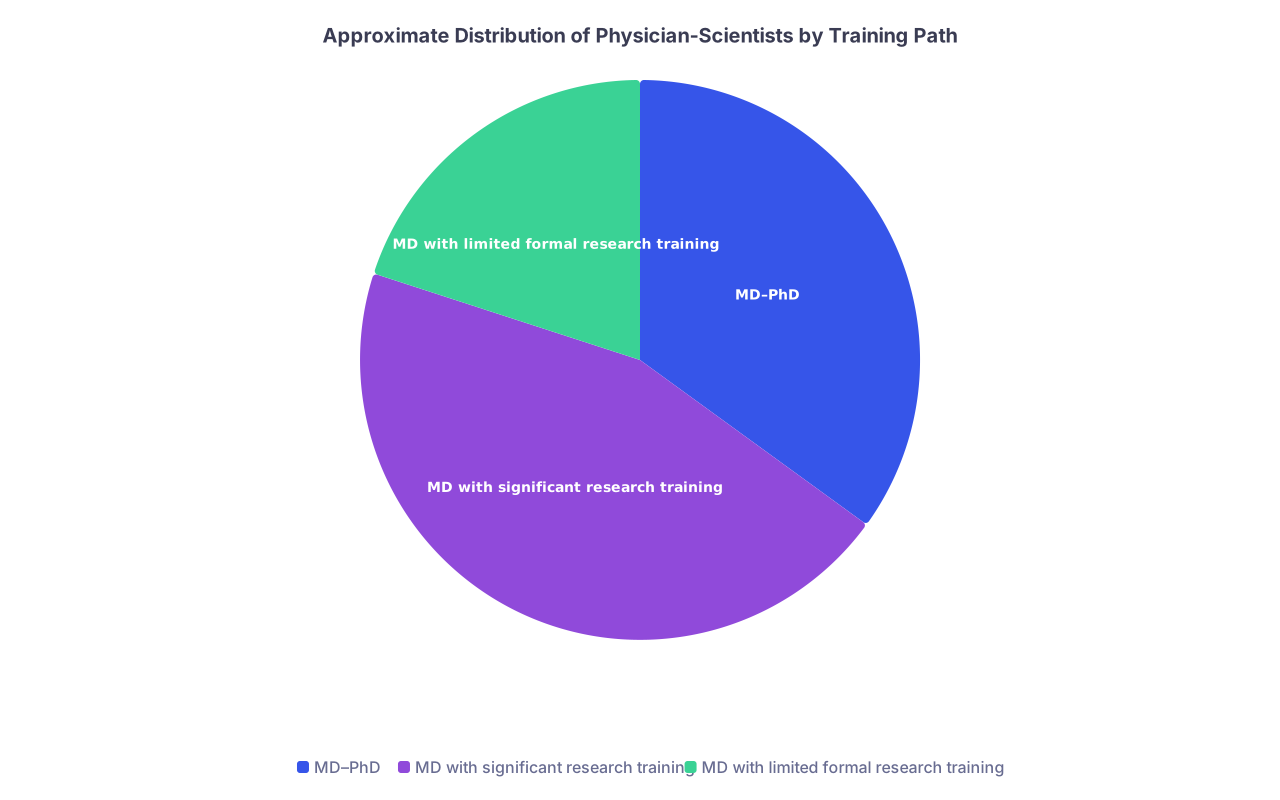
| Category | Value |
|---|---|
| MD–PhD | 35 |
| MD with significant research training | 45 |
| MD with limited formal research training | 20 |
That “MD with significant research training” group is big. It includes people who:
- Took 1–2 research years in med school
- Completed research-heavy residencies/fellowships (T32-supported)
- Did an MPH/MS/PhD during or after training
- Built serious publication portfolios without a formal dual degree
Are there MD‑only R01‑funded basic scientists? Yes, but fewer, and most of them compensated with:
- Dedicated postdoc‑like time after residency/fellowship
- Outstanding mentorship and institutional support
- Extra degrees (PhD, MS) obtained later
Paths to Becoming a Physician-Scientist Without MD–PhD
If you decide not to do an MD–PhD (or that ship has already sailed), here’s how you still build a serious physician‑scientist career.
1. Use med school to get real research time
Not 2‑week “projects.” Real time.
- Do a dedicated research year (HHMI, NIH, school-sponsored, or local mentor‑funded).
- Aim for at least one first‑author paper in a reasonably strong journal.
- Pick a mentor with a track record: grants, mentees with K awards, etc.
Treat that year as your “mini‑PhD”—learn methods, stats, and how to frame questions, not just crank out data.
2. Choose a residency/fellowship with a research culture
This is where most future physician‑scientists either accelerate or stall. When comparing programs, do not just ask “Is there research?”
Ask:
- How many residents/fellows get 6–24 months of protected research?
- How many recent grads have K awards or equivalent?
- Is there an established research track or T32?
| Signal | Strong Program | Weak Program |
|---|---|---|
| Formal research track | Yes | No |
| 12+ months protected time | Common | Rare |
| Recent K awardees | Several | None |
| T32 or equivalent funding | Present | Absent |
If they dodge specifics or talk only about “lots of opportunities” without numbers, assume the worst.
3. Stack additional training strategically
You can absolutely compensate for lack of a PhD later:
- MPH / MS in Clinical Research, Epidemiology, or Biostatistics
- Post‑residency research fellowship (1–3 years)
- T32‑funded postdoc‑style training
The trade‑off: you’re adding time later instead of front‑loading it. That means:
- You might be older when you hit true independence (K or R grant stage).
- You’ll be juggling more clinical responsibility while catching up on methods.
Still doable. Many of the best clinician‑investigators I’ve worked with took this route.
4. Be explicit about your career model
Decide approximately what research/clinical split you’re aiming for:
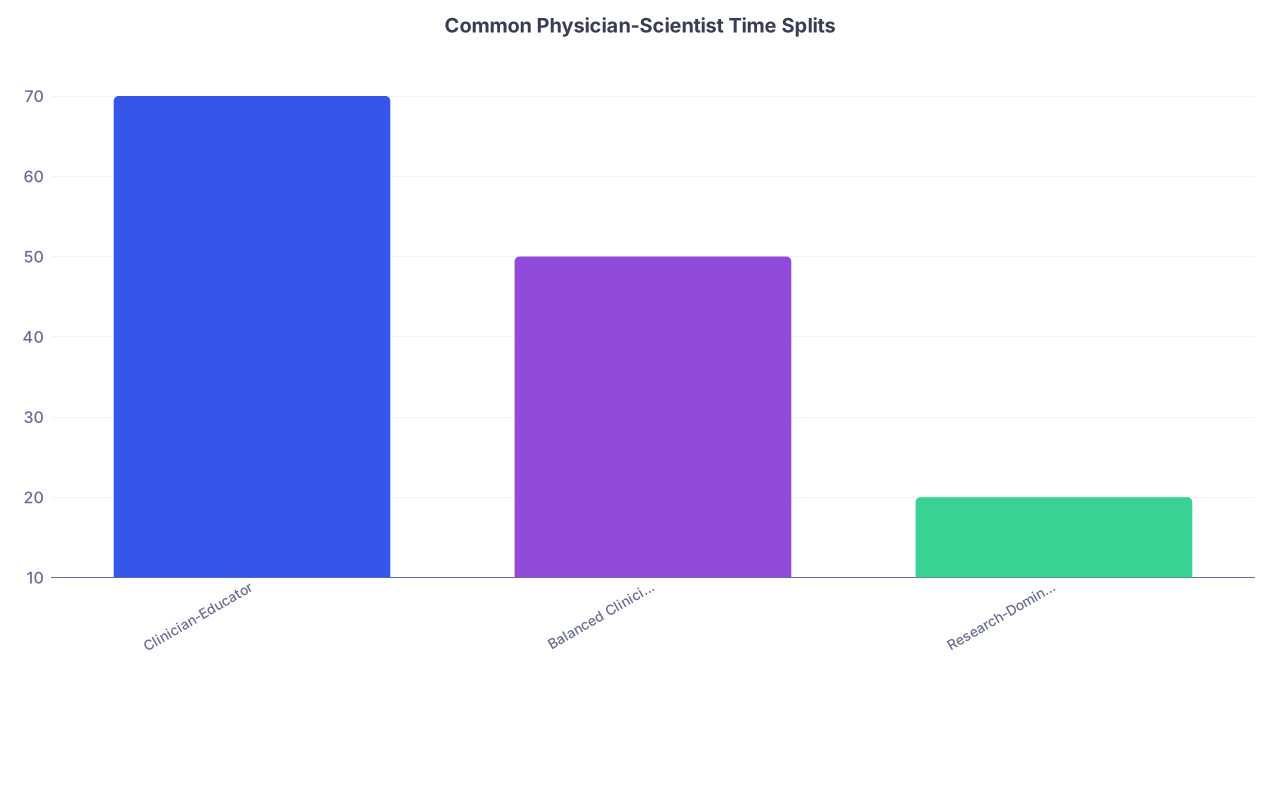
| Category | Value |
|---|---|
| Clinician-Educator | 70 |
| Balanced Clinician-Scientist | 50 |
| Research-Dominant PI | 20 |
- 70% clinical / 30% research – enough for small projects, collaborations, some grants.
- 50/50 – realistic for serious ongoing research with good support.
- 80% research / 20% clinical – this is the classic R01 PI model.
You do not accidentally end up 80% research. Without a clear plan and strong departmental backing, you will default to >80% clinical because RVUs always win.
When MD–PhD Is Probably the Better Choice
Let me be blunt. There are situations where skipping MD–PhD makes your life harder than it needs to be.
You should strongly consider MD–PhD if:
You are already deeply in love with basic science
You enjoy being at the bench. You think in pathways, mechanisms, not just clinical phenotypes. You’d happily pipette and debug experiments all day.You want independence early
MD–PhD graduates can hit faculty with a much more mature research identity at 35 than a straight MD who only gets serious about research at 32.You are targeting top‑tier physician‑scientist tracks
Programs like UCSF Physician Scientist Pathway, MGH research tracks, Hopkins PSTP etc. absolutely love MD–PhDs. MD‑only can match, but it’s an uphill climb.You want the tuition / stipend support
For U.S. MSTPs, the financial package is not trivial: no med school tuition, a living stipend, often health insurance. That’s real leverage vs $250k+ debt.
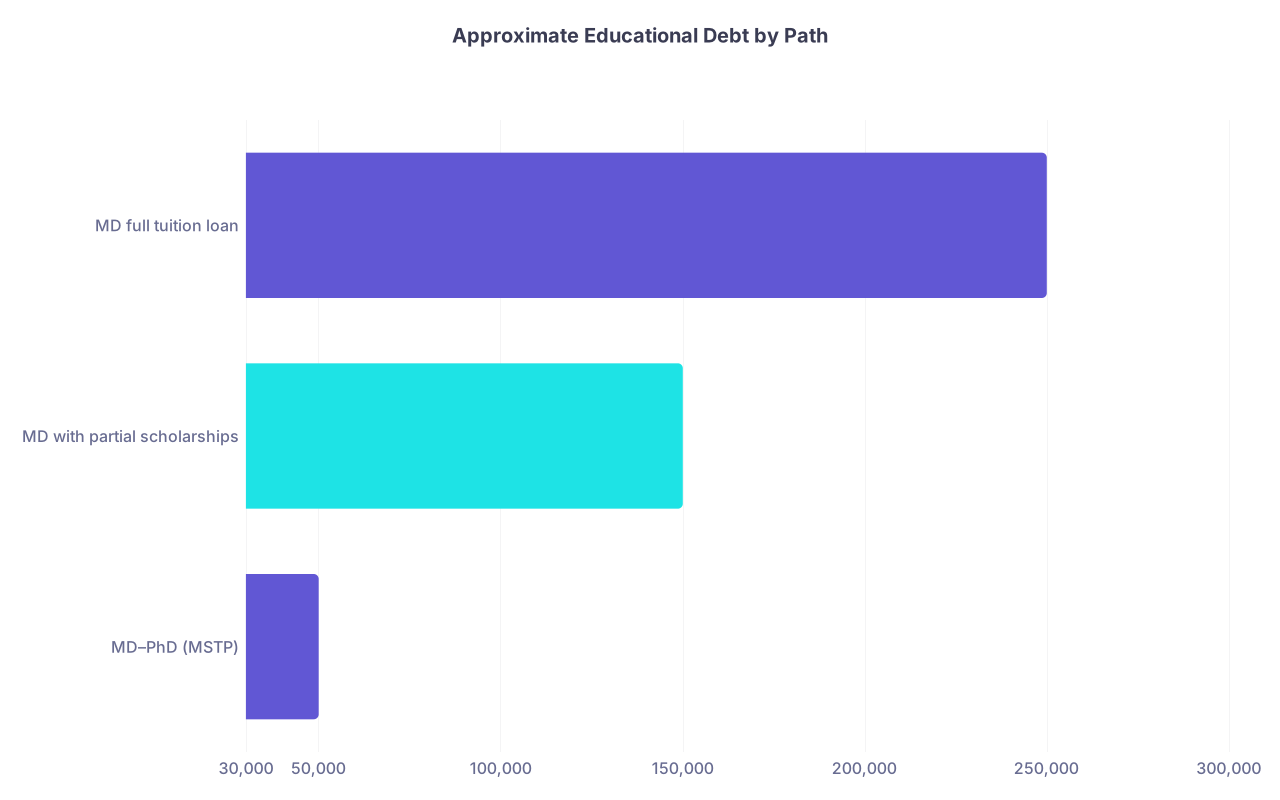
| Category | Value |
|---|---|
| MD–PhD (MSTP) | 50000 |
| MD with partial scholarships | 150000 |
| MD full tuition loan | 250000 |
If those points describe you and you’re early (pre‑med, early med school), then yes—MD–PhD is probably the smarter, cleaner path.
Common Myths About MD–PhD vs MD‑Only
Let’s kill a few persistent myths.
Myth 1: “Without MD–PhD, no one will take you seriously as a scientist.”
Wrong. People take you seriously if:
- You ask sharp, important questions.
- You produce rigorous, reproducible work.
- You publish and get funded.
I’ve seen MD‑only cardiologists leading massive NIH‑funded trials and outcomes programs with far more impact than many small basic science labs.
Myth 2: “MD–PhD guarantees more free time for research later.”
Not automatically. It just gives you earlier research training and (often) less debt. Your later research time depends on:
- Your division chief
- Your grant success
- The institutional financial environment
I’ve seen MD–PhDs stuck at 90% clinical because their division needed the revenue.
Myth 3: “If I didn’t decide by M1, I’m locked out.”
No. You can:
- Apply to MD–PhD during M1 in some programs (internal transfer).
- Add a research year.
- Add a post‑MD degree.
- Build your research identity during residency/fellowship.
What you cannot do is wait until attendinghood, stay 100% clinical, and then wonder why no one hands you a lab.
Myth 4: “Industry or non-academic careers require MD–PhD.”
Not at all. Biotech, pharma, digital health—these hires care about:
- Your skills (trial design, data analysis, regulatory experience)
- Your network and track record
- Your ability to move projects forward
A strong MD with serious research or trial experience is extremely marketable.
How to Decide: A Simple Decision Framework
Here’s a quick mental framework. Be brutally honest with yourself.
On a 1–10 scale, how much do you enjoy doing research (not the idea of it, the daily grind)?
- 8–10 and you love mechanisms and experiments → Strong MD–PhD candidate.
- 4–7 and you like questions but not bench work → Maybe MD‑only with clinical or data science focus.
- ≤3 → You probably do not want a research‑dominant career at all.
How much extra time are you willing to invest up front?
- Comfortable with 7–9 extra years before full earning? → MD–PhD is fine.
- You want to minimize pre‑attending years? → MD‑only with targeted research later.
Does debt materially change your life trajectory?
- If walking out with $250k–$400k loans will box you into high‑earning jobs you don’t want, MSTP funding is a real factor.
Do you already have strong evidence of research promise?
- Multiple pubs, sustained work with one mentor, maybe a thesis or major project → You’ll actually use MD–PhD time well.
- One summer project and no idea what you like → Consider starting MD‑only, then reassessing.
If you’re early and still split, here’s the move:
Aim for med schools where both MD‑only and MD–PhD are strong, then use M1 research exposure to decide. Internal transitions are not guaranteed, but they do happen.
FAQs
1. Can I become a PI on an NIH R01 grant with only an MD?
Yes. It’s harder without serious research training, but plenty of MD‑only physicians are R01 PIs, especially in clinical, outcomes, and translational work. The actual “requirement” is a track record: publications, preliminary data, and strong mentorship—not specific letters after your name.
2. If I’m already in medical school as MD‑only, is it too late to pursue a physician-scientist path?
No. You can add a research year, do a dual‑degree MPH/MS, join a research track in residency or fellowship, and build toward a K award. You’re not locked out. You just need to be intentional early (M1–M3) rather than waiting until you’re an attending.
3. Is MD–PhD overkill if I only want to do clinical research?
Usually, yes. For purely clinical or epidemiologic research, an MD plus an MPH/MS in Clinical Research or Epidemiology is often more efficient. MD–PhD shines when you want deep mechanistic or basic science training, not when your future is mostly trials and cohorts.
4. How much research do I need in med school if I skip MD–PhD?
Enough to show seriousness: ideally at least one substantial project with sustained involvement, and preferably a first‑author publication or major abstract. More important than the raw count is continuity with a mentor and demonstrable growth in skills (study design, analysis, writing).
5. Will not having a PhD hurt my chances at research-heavy residencies or fellowships?
It can be a disadvantage compared to MD–PhDs, but it’s not disqualifying. Strong research output (publications, presentations), good letters from established investigators, and a clear statement of research goals can absolutely offset the lack of a PhD for most internal medicine, pediatrics, neurology, and similar research tracks.
6. If I love both patient care and research, how should I split my time long-term?
Realistically: 50/50 or 60/40 (research/clinic) is sustainable and common for physician‑scientists. The classic 80/20 research‑dominant model is possible but requires grants and strong institutional support. You can adjust over time, but the key is negotiating explicit protected research time when you take your first faculty job.
Key takeaways:
You do not need an MD–PhD to be a successful physician‑scientist—but you do need serious, structured research training somewhere along the way. MD–PhD front‑loads that training and signals commitment; MD‑only requires you to build it piece by piece through research years, advanced degrees, and research‑heavy residencies/fellowships. Decide based on the kind of science you want to do, how much time you’re willing to invest early, and how much friction you’re willing to tolerate later.