
Most people asking “PhD vs MD for AI in medicine” are asking the wrong question. The degree does not lead AI—people with rare overlapping skills do.
Let me break this down specifically.
MD vs PhD in Bioinformatics: What Problem Are You Actually Solving?
AI in medicine is not one thing. It is at least four different businesses hiding under the same buzzword:
- Algorithm development and methods research
- Clinical deployment and workflow integration
- Regulatory / safety / validation
- Translation to patient outcomes and reimbursement
Where MDs and PhDs dominate is very different in each of these.
A PhD in bioinformatics is designed to produce people who can build methods, handle large-scale biological or clinical data, and publish new algorithms. A straight MD is designed to produce people who can make decisions in front of patients, under uncertainty, with liability.
In AI in medicine:
The PhD in bioinformatics usually leads on:
- Model architecture innovation
- Multi-omics + EHR fusion
- Data pipelines, annotation frameworks, and benchmarking
- Grant-funded AI methodology work
The straight MD usually leads on:
- Problem selection that actually matters clinically
- Workflow integration and clinical adoption
- Regulatory framing, risk assessment, and medico-legal reality
- Reimbursement, guideline integration, and political capital in hospitals
The people who truly “lead” this space long term? They usually have a hybrid profile: MD with serious CS/stats chops, or PhD with deep, embedded clinical collaborators and years spent in hospitals, not just on de-identified CSVs.
So your real decision is:
- Do you want to invent AI tools (bioinformatics PhD flavor)?
- Or deploy and own AI decisions at the bedside (MD flavor)?
Because those are not the same leadership lanes.
Core Skill Sets: What Each Path Actually Teaches You
| Skill Area | PhD in Bioinformatics | Straight MD |
|---|---|---|
| Statistics / ML Theory | Very strong | Weak to moderate (elective) |
| Coding / Data Engineering | Strong | Minimal (self-taught) |
| Clinical Decision-Making | Minimal | Strong |
| Patient Interaction | None | Intensive |
| Regulatory / Med-Legal | Low unless self-driven | Moderate to strong |
| Grant / Methods Papers | Core focus | Optional |
PhD in Bioinformatics: What You Actually Become Good At
Ignore the brochure language. In practice, a bioinformatics PhD that is AI-heavy turns you into a few specific things:
- Someone who can:
- Clean, link, and manage obscene amounts of data (genomics, transcriptomics, imaging, EHR logs)
- Implement and modify models (deep learning, Bayesian methods, graph models, transformers)
- Design experiments: splits, cross-validation, external validation
- Write reproducible pipelines and code that other people can run
- Survive reviewer 2 when they say “your baseline is weak and your metrics are cherry-picked”
You become the person in the room who can call out nonsense when someone inflates AUCs with data leakage. You become dangerous with:
- Python / R
- Git / containers
- HPC / cloud compute
- SQL + NoSQL data stores
- Snakemake / Nextflow / similar workflows
And if you choose your lab correctly, you get heavy exposure to:
- Multi-omics integration
- Clinical AI (risk scores, survival models, representation learning)
- Federated learning, privacy-preserving computation, and similar advanced topics
But you are not trained to:
- Admit a patient with chest pain
- Decide whether to override an AI’s recommendation
- Sign off on a radiology report or chemo regimen
- Testify in court that “this is the standard of care”
That is not a bug. It is by design.
Straight MD: What You Actually Become Good At
Medical school plus residency does one main thing: it rewires your brain for triage, pattern recognition, and risk management under uncertainty with limited data.
An MD path trains you to:
- Understand pathophysiology well enough to see when an AI suggestion contradicts basic biology
- Execute diagnostic/therapeutic decisions and be legally responsible for them
- See real workflow: who clicks what, when, on which screen, with which time pressures
- See failure modes that sound trivial in a data set but are catastrophic in a hospital:
- Alert fatigue
- Over-trust in algorithm outputs
- Silent bias against certain demographic groups
- “The patient does not match the training data even though EPIC says they do”
In the real world, MDs run:
- Clinical trials of AI tools
- Deployment committees
- Hospital IT governance and quality improvement boards
- Specialty society guideline panels (e.g., cardiology, radiology, oncology)
They usually do not write the model training code. Their “AI coding” is often:
- Writing specs
- Interpreting performance metrics
- Co-authoring papers with detailed clinical sections
- Being the “human in the loop” in prospective validation
Unless they deliberately add CS/ML training on the side.
Where AI in Medicine Is Actually Built: Academia vs Industry vs Hospital
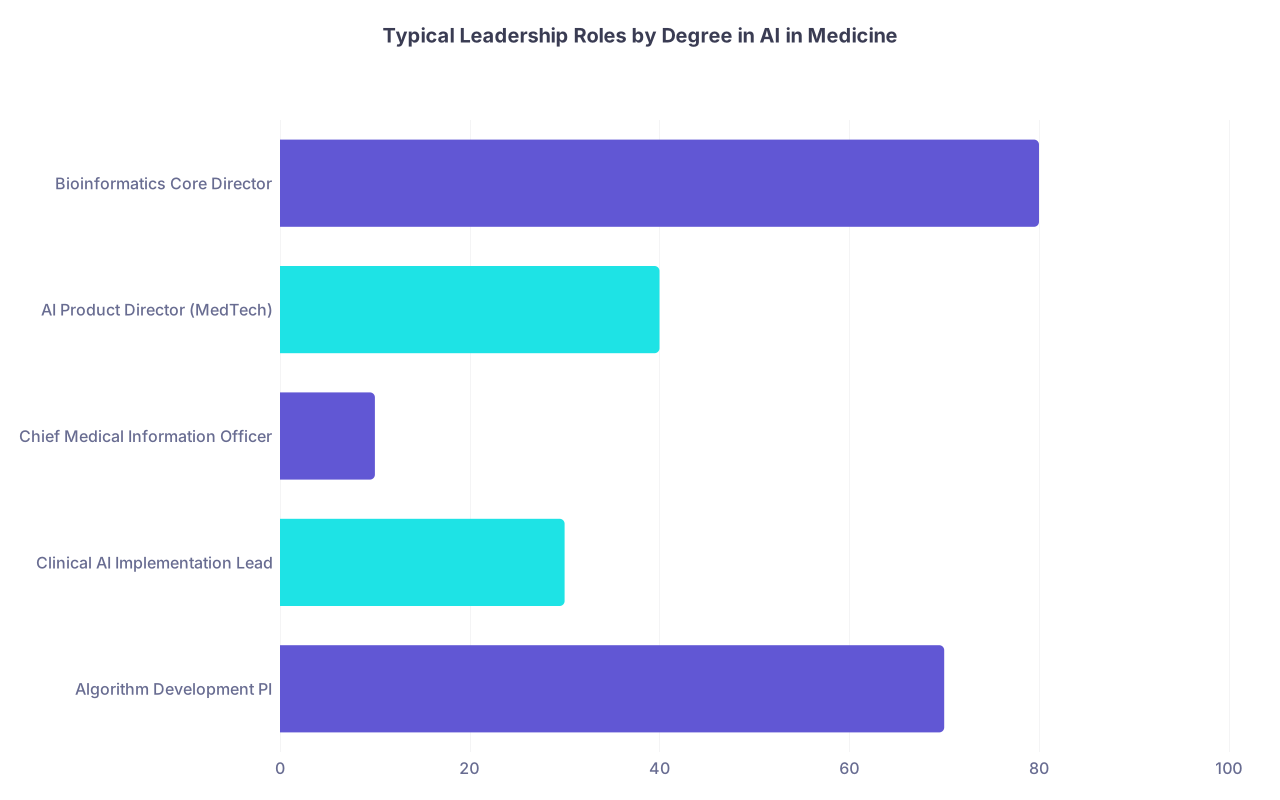
| Category | Value |
|---|---|
| Algorithm Development PI | 70 |
| Clinical AI Implementation Lead | 30 |
| Chief Medical Information Officer | 10 |
| AI Product Director (MedTech) | 40 |
| Bioinformatics Core Director | 80 |
Interpretation: For each role above, higher values favor PhD-type leadership; lower values favor MD. It is not exact, but it is directionally right from what I see in large centers.
Academia
In major academic medical centers:
Bioinformatics PhD faculty often lead:
- Methods labs
- Core facilities (genomics, data science cores)
- AI methodology grants (NSF, some NIH)
- Novel model papers in top AI conferences
MDs (sometimes MD/PhD, sometimes MD + extra training) often lead:
- Clinical AI implementation projects within departments
- Pragmatic clinical trials of AI tools
- Committee-level decisions on what gets deployed in EPIC/Cerner
- Specialty-specific AI groups (e.g. “AI in Cardiology” section)
The real power nodes: joint appointments.
Examples you see at places like Stanford, MGH, Hopkins:
- PhD in CS/Bioinformatics with a co-appointment in a clinical department, embedded in oncology or radiology
- MD in internal medicine with 2–3 years of data science postdoc / informatics fellowship, publishing both clinical and methods work
Industry (AI/ML Companies, Pharma, Big Tech Health)
Here is where degree type interacts brutally with role type.
Typical patterns:
PhD in Bioinformatics / CS / Stats:
- Lead scientist / principal ML scientist
- Director of data science / AI research
- Head of bioinformatics
- Architect for model infrastructure and algorithmic strategy
MD:
- Medical director for AI product lines
- Head of clinical strategy
- Clinical safety / medical affairs lead
- Key opinion leader liaison for external clinicians
The PhD often runs the model roadmap.
The MD often determines the “what problem are we solving and who will buy this” roadmap.
In large pharma/biotech:
PhDs run:
- Target discovery pipelines
- Multi-omics AI for drug response prediction
- Bioinformatics cores for translational research
MDs run:
- Clinical development
- Trials planning and endpoints
- Regulatory strategy and labeling that integrates AI-derived biomarkers
Hospitals and Health Systems
Inside health systems, the roles that matter most for AI uptake are:
- CMIO (Chief Medical Information Officer) – almost always MD
- Chief Quality / Patient Safety – MD or RN
- AI governance / ethics committees – usually MD-heavy, plus one or two PhDs
Bioinformatics PhDs here often sit as:
- Data science leads
- AI lab directors
- Architects for EHR data pipelines, modeling efforts, predictive analytics
Who “leads” depends on context:
- Policy, deployment, and liability: MDs lead
- Model architecture and data strategy: PhDs lead
- Program direction in integrated AI centers: usually co-leadership or MD/PhD-type profiles
Training Timeline, Pain, and Opportunity Cost
You cannot compare these paths without doing the math on time.
| Path | Typical Duration (Post-Bachelor) |
|---|---|
| PhD in Bioinformatics | 5–6 years |
| MD (US, med school + IM) | 7–8 years |
| MD + Informatics Fellowship | 9–10 years |
| MD/PhD (Bioinformatics-ish) | 8–10+ years |

| Step | Description |
|---|---|
| Step 1 | BS or BA |
| Step 2 | 5-6 yr PhD |
| Step 3 | 4 yr Med School |
| Step 4 | Postdoc or Industry |
| Step 5 | 3-7 yr Residency |
| Step 6 | Optional 1-2 yr Informatics Fellowship |
| Step 7 | Choose Path |
PhD in Bioinformatics Path
Roughly:
- 5–6 years of:
- Heavy coding
- Methodology and paper grind
- Grant-writing drafts
- Long periods where your model does not converge and your PI is “disappointed”
You come out:
- With deep ML/stats/data skills
- Zero clinical authority
- Usually in your late 20s or early 30s
- Ready for:
- Postdoc
- Data science / bioinformatics roles in industry
- Assistant professor roles (if you have a strong CV)
Financially, you are not rich (grad stipend level), but you avoid the huge US med school debt.
Straight MD Path
Roughly:
- 4 years med school (preclinical + clinical)
- 3–7 years residency depending on specialty
- Optionally 1–2 years fellowship (including informatics or AI-specific ones)
You come out:
- With full license and specialty training
- High earning potential
- Limited coding/ML unless you carved time for it yourself
- Usually early to mid 30s
Debt can be brutal in the US. But your long-term salary and autonomy are far higher than a typical single-PhD academic track.
Who Actually Leads AI in Medicine? Case Archetypes
Now let’s answer your question the way it is usually meant:
“Whose career is better positioned to lead AI in medicine – PhD in bioinformatics or straight MD?”
The honest answer: both can lead, but they lead different domains.
Archetype 1: The Algorithm Architect (PhD-Biased)
Profile:
- PhD in bioinformatics or CS with a strong biology/medicine angle
- 1–2 postdocs in AI for imaging, genomics, or EHR modeling
- 50+ publications, including top AI/ML venues and top clinical journals as co-author
Leadership arenas:
- Direct a large AI/bioinformatics core at a major academic medical center
- Run multi-million-dollar grants building new AI approaches
- Lead AI research for a major medtech or pharma company
- Be the person journals and conferences call when they want “cutting-edge methods in clinical AI”
Limitations:
- You will never be the attending of record.
- Your authority in purely clinical arguments is always second-hand.
- Hospital C-suite may listen more to MDs about risk and adoption.
Archetype 2: The Clinical AI Implementation Lead (MD-Biased)
Profile:
- MD, residency in a data-rich field (IM, cards, ICU, radiology, oncology)
- Self-taught ML plus collaboration with PhDs, or formal informatics fellowship
- Seen multiple real deployments – not just toy pilots
Leadership arenas:
- Decide which AI models get deployed at scale in a health system
- Lead clinical validation and prospective trials of AI tools
- Sit on national guideline committees shaping “AI as standard of care”
- Serve as CMIO, VP for Digital Health, or similar roles with budget and policy control
Limitations:
- Unless you put in serious extra time, you are not building novel architectures.
- In AI methodology circles, you are not the technical star.
- Your research may depend heavily on your data science collaborators.
Archetype 3: The Bilingual Hybrid (MD with Real ML, or PhD with Deep Clinical Embedding)
This is who actually dominates the future of AI in medicine.
Examples:
MD who:
- Did a CS or applied math undergrad
- Kept coding during med school
- Built and published models with real technical novelty
- Completed an informatics fellowship or a dedicated data science postdoc
PhD who:
- Spent years embedded in a clinical department
- Attends tumor boards, radiology readouts, cardiology case conferences
- Knows the guidelines, the workflow, and the human factors
- Is not just “the coder,” but a thought partner in clinical strategy
This group:
- Actually understands when an AUC of 0.82 is clinically meaningless
- Knows that 10 ms of latency vs 500 ms in an ICU alarm is the difference between usable and garbage
- Writes or co-writes both:
- Methods-heavy AI papers
- Clinically grounded outcome papers
If you want to truly lead AI in medicine, this is the direction to aim.
Choosing Your Path: How To Decide Based on Who You Want To Be
You should not pick a degree. You should pick a future day-to-day.
Ask very concrete questions:
Do you want to spend your days:
- Writing code, debugging models, tuning hyperparameters, and handling data pipelines?
- Or on rounds, in clinic, in the OR, making time-pressured decisions about humans?
When you imagine “leading AI in medicine,” is your mental image:
- Keynote at NeurIPS on a new architecture for multimodal clinical data?
- Or keynote at the American College of Cardiology about how AI changed stroke outcomes in your system?
Are you willing to sacrifice:
- Years of clinical income for a PhD with lower pay but deep technical mastery?
- Or years of coding time for med school, residency, and call nights that do not care about your latest PyTorch experiment?
If your honest answers lean:
Hard toward code and methods, minimal desire for patient care → PhD in bioinformatics is the more rational play. Stay close to clinicians, but accept you are not one.
Hard toward patient care and clinical decision ownership, with moderate interest in AI → Straight MD, then later add informatics/AI. That gives you maximum clinical authority and acceptable AI influence.
Deep interest in both, high tolerance for long training and pain → MD first with heavy CS/ML built in, or MD/PhD at a program that actually does strong bioinformatics/AI (many MD/PhDs still do wet lab, which will not help you).
Strategic Add-Ons To Whichever Path You Choose
You can rescue a mediocre trajectory with smart side decisions.
For a PhD in bioinformatics:
- Do an internship or collaboration with:
- A major hospital system’s AI group
- A radiology or oncology department doing real AI deployment
- Take at least:
- One serious ML theory course
- One software engineering course / training to avoid being a “just scripts” person
- Publish with real external validation on multi-center data. Not just your lab’s dataset.
For a straight MD:
- Learn:
- One programming language (Python recommended) to real competence
- Core ML concepts: bias-variance, calibration, ROC vs PR, survival models
- Seek:
- A clinical informatics fellowship or at least a strong mentor in clinical AI
- Involvement in hospital AI committees, pilots, or quality-improvement data projects
For both:
- Get fluent in:
- Regulatory landscape: FDA’s SaMD, EU MDR, health AI guidelines
- Bias, fairness, and explainability debates (because policy will hinge on this)
- Real-world data / registry design
These extras are what move you from “supporting role” to “leader.”
FAQs
1. If I want to found an AI-in-medicine startup, is a PhD in bioinformatics or an MD better?
For founding specifically, neither is mandatory, but the combination that works best is: technical co-founder with PhD-level skills (bioinformatics, CS, applied math) + clinical co-founder with MD and real specialty experience. If you must pick one, a PhD in bioinformatics gives you the technical credibility and ability to build a v1 product. You can rent clinical expertise as advisors. A solo MD without serious ML depth often cannot ship a credible product without relying heavily on external engineers.
2. Does an MD without residency still hold weight in AI in medicine roles?
Bluntly: far less. Without residency, you lack board certification and real-world clinical experience. For serious clinical leadership roles (CMIO, AI deployment lead, clinical trial PI), programs and hospitals prefer fully trained clinicians. In industry, a non-residency MD can hold “medical” titles, but your voice in high-stakes clinical decisions and guideline conversations is weaker.
3. Is MD/PhD overkill if I want to do AI in medicine?
Sometimes yes. Many MD/PhD programs are still optimized for classic bench science. If the “PhD” half is not genuinely in CS/ML/bioinformatics, you can end up spending extra years pipetting instead of building models. A strong MD plus a focused 1–2 year data science/informatics fellowship can be more efficient than a generic MD/PhD. If you find a program with a real track record in AI/bioinformatics PhDs integrated into clinical research, then MD/PhD can be powerful.
4. Can a pure bioinformatics PhD become a major voice in clinical AI policy or guidelines?
Yes, but not by staying in a server room. The ones who do this sit in clinical meetings, co-lead clinical trials, and co-author outcome-driven studies with strong MD collaborators. They learn the language of guidelines, regulatory bodies, and health economics. They show up in specialty society committees as the “technical spine” paired with senior clinicians.
5. If I start MD and realize I love AI more than patients, can I switch to PhD or industry AI roles?
Absolutely. You can pause after med school or after residency to do a PhD or postdoc in AI/bioinformatics. Or you can pivot straight into industry AI roles if you have built enough technical skills and a project portfolio. Having an MD gives you huge credibility for roles that bridge clinical and technical teams, even if you stop active clinical practice later.
6. So who ‘leads’ AI in medicine overall – PhDs in bioinformatics or straight MDs?
At the methods and algorithm level: PhDs in bioinformatics (and related fields) lead. At the bedside, guideline, and deployment level: MDs lead. The people who ultimately shape the field most are those who either bridge both worlds themselves or build tight, long-term partnerships across the MD–PhD divide. If you want influence, design your training so that you are indispensable at that intersection, not stuck at one extreme.
Key takeaways:
- A PhD in bioinformatics leads AI in medicine on the algorithm and data side; a straight MD leads on clinical deployment, policy, and liability.
- The most powerful careers are hybrid or tightly partnered—deep technical + deep clinical, not one without the other.
- Choose your path based on your daily work preferences (code vs clinic), then deliberately bolt on the missing half if you want to truly lead.