
Most people talking about “protected time” in academic medicine have no idea how the mechanics actually work.
If you want a serious research career as an MD or PhD, you cannot afford that level of vagueness.
Let me break this down specifically: protected time is not just a cultural promise. It is a financial and contractual structure, expressed in FTE (full-time equivalent) allocations and salary support. The MD and the PhD are playing on the same field, but with very different rules, expectations, and vulnerabilities.
This is where MD vs PhD research careers really diverge—less in “intellect” or “passion for discovery,” more in how the institution expects you to earn your salary and justify your space.
1. The Core Problem: What “Protected Time” Actually Is
Protected time is not “I get to do research on Thursdays.”
Protected time is: “X% of my paid FTE is budgeted for non-clinical work, and the department has agreed not to backfill that with RVU expectations or teaching.” That is a totally different animal.
Let’s define the pieces that matter:
- FTE (Full-Time Equivalent): 1.0 FTE is your full-time appointment. How that 1.0 is split (clinical / research / teaching / admin) is where the game is played.
- Base Salary: What the institution pays you, often benchmarked to AAMC (for MDs) or CUPA/similar (for PhDs).
- Salary Support: How much of that salary is paid from:
- clinical revenue
- institutional funds (hard money)
- grants (soft money)
- Protected Time: The fraction of your FTE earmarked for research (and sometimes teaching) that is not supposed to be filled with clinical volume.
People throw around “80% research” or “50% protected” like it’s a lifestyle description. It is actually a budget line.
Now, the MD and the PhD arrive to this system from opposite directions:
- MD: Clinical revenue is your obvious value-add. Protected time is an ongoing opportunity cost for the department.
- PhD: Research and grants are your obvious value-add. Protected time is your baseline job description; loss of protected time means you are in trouble.
Same words. Very different default assumptions.
2. Typical FTE Models: MD vs PhD, Side by Side
Let’s be concrete and a bit unflattering.
| Role Type | Research FTE | Clinical FTE | Teaching/Admin FTE |
|---|---|---|---|
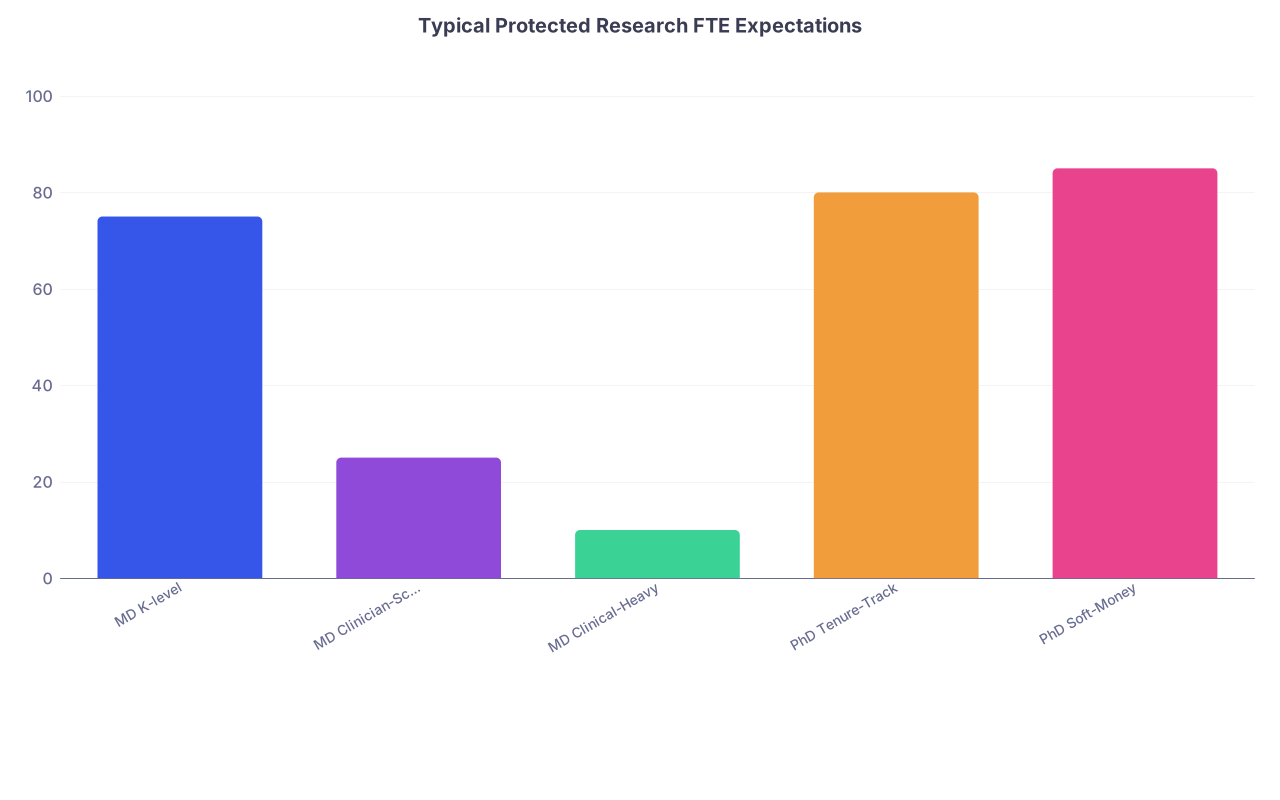
| MD – classic clinician-scholar | 20–30% | 60–80% | 0–20% |
| MD – K award‐style investigator | 70–80% | 20–30% | 0–10% |
| MD – heavy clinician w/ side proj | 10% | 80–90% | 0–10% |
| PhD – tenure-track basic scientist | 75–90% | 0% | 10–25% |
| PhD – research-track (soft money) | 80–95% | 0% | 5–20% |
For MDs, 80% research is relatively rare and usually tied to:
- a K08/K23 (or equivalent early-career award)
- startup packages in highly research-focused departments
- very explicit deliverables: grants, publications, and sometimes lab development
For PhDs, 80–90% research is the default expectation in many departments. The “unprotected” part is usually teaching and service, not clinic.
| Category | Value |
|---|---|
| MD K-level | 75 |
| MD Clinician-Scholar | 25 |
| MD Clinical-Heavy | 10 |
| PhD Tenure-Track | 80 |
| PhD Soft-Money | 85 |
What this means:
- An MD asking for 70–80% research is “special accommodation.”
- A PhD dropping below ~50–60% research is often seen as “this person is drifting away from their core role.”
The MD’s research time is constantly under clinical pressure. The PhD’s research time is constantly under funding pressure. You pick which problem you want to fight.
3. How Protected Time is Actually Funded
Forget the rhetoric. Follow the money.
MD: Protected Time Is Subsidized by Someone Else
For an MD, protected research time usually comes from some combination of:
- Departmental subsidy (chair uses discretionary or clinical margin)
- Startup package (time-limited: 2–5 years)
- Grants (K awards, foundation funding, R01s paying some % salary)
- Institutional research programs (CTSI support, cancer center funds, etc.)
The key mechanics:
- Your clinical FTE is directly tied to RVUs or other clinical productivity metrics.
- If you reduce clinical FTE to create protected time, the department loses billable revenue.
- That gap must be made up by:
- your grants, or
- the chair believing you will bring in future funding, prestige, or recruitment value.
That is why you will hear things like:
- “We can give you 0.3 FTE research for three years. After that it has to be grant-supported.”
- “If your K does not land, we need you at 0.8 clinical.”
So your “80% protected time” is often conditional and time-limited. That is not cynicism. That is the budget.
PhD: Protected Time Is the Job, But Salary Is at Risk
For a PhD researcher, protected time is assumed. The question is where the salary comes from:
- Hard money:
- portion of your salary guaranteed by the institution or department
- often tied to tenure-track lines in basic science departments
- Soft money:
- grant support (NIH R01, foundation, industry)
- institute/center project funds
Here the dynamic reverses:
- No clinic. No RVU.
- Your value is:
- external grant dollars
- publications
- training of students and fellows
- contribution to institutional research metrics
Lose your grants, and one of two things happens:
- On a hard-money line: you get pressure, reduced resources, maybe a slow marginalization.
- On a soft-money line: your job is literally at stake.
The protected time does not go away conceptually—you are still “full-time research”—but if there is no money to pay you, the theoretical FTE is irrelevant.
4. FTE Formulas and Salary Support: What the Contract Really Says
Here is where the MD vs PhD difference becomes brutally clear: how your FTE is written into real numbers.
MD Example: Assistant Professor with K Award
Typical structure I have seen multiple times:
- Base salary: $220,000 (AAMC percentile matched)
- Appointment: 1.0 FTE, Faculty of Medicine
- FTE breakdown (Years 1–5 while K is active):
- 0.75 FTE research (protected)
- 0.20 FTE clinical
- 0.05 FTE teaching/admin
Funding breakdown:
- K award: supports 75% salary up to NIH cap (say $120–150k)
- Department/institution: covers the K shortfall to your base + the remaining 25%
Mechanically, that means:
- You are “protected” to 75% research on paper.
- Your clinical targets are (in theory) aligned with 20% FTE.
- If you start creeping up to 0.4–0.5 clinical FTE because of service demands, that protected time evaporates in practice but not on paper.
PhD Example: Tenure-Track Basic Scientist
Typical:
- Base salary: $120,000
- Appointment: 1.0 FTE, Basic Science Department
- FTE breakdown:
- 0.80 FTE research
- 0.15 FTE teaching
- 0.05 FTE service
Funding:
- Hard money: 50% salary guaranteed by institution
- Grants (goal): 50% salary from external funding within 3–5 years of hire
The department expects you to use your 80% research time to secure grants that cover at least half your salary and support lab operations. The “threat” here is not that you will be pulled into clinic; it is that failure to fund yourself leads to:
- smaller lab
- lower raises
- harder tenure case
- in soft-money settings: non-renewal of contract
5. MD vs PhD Risk Profiles: Where Protected Time Breaks
Protected time fails in predictable patterns.
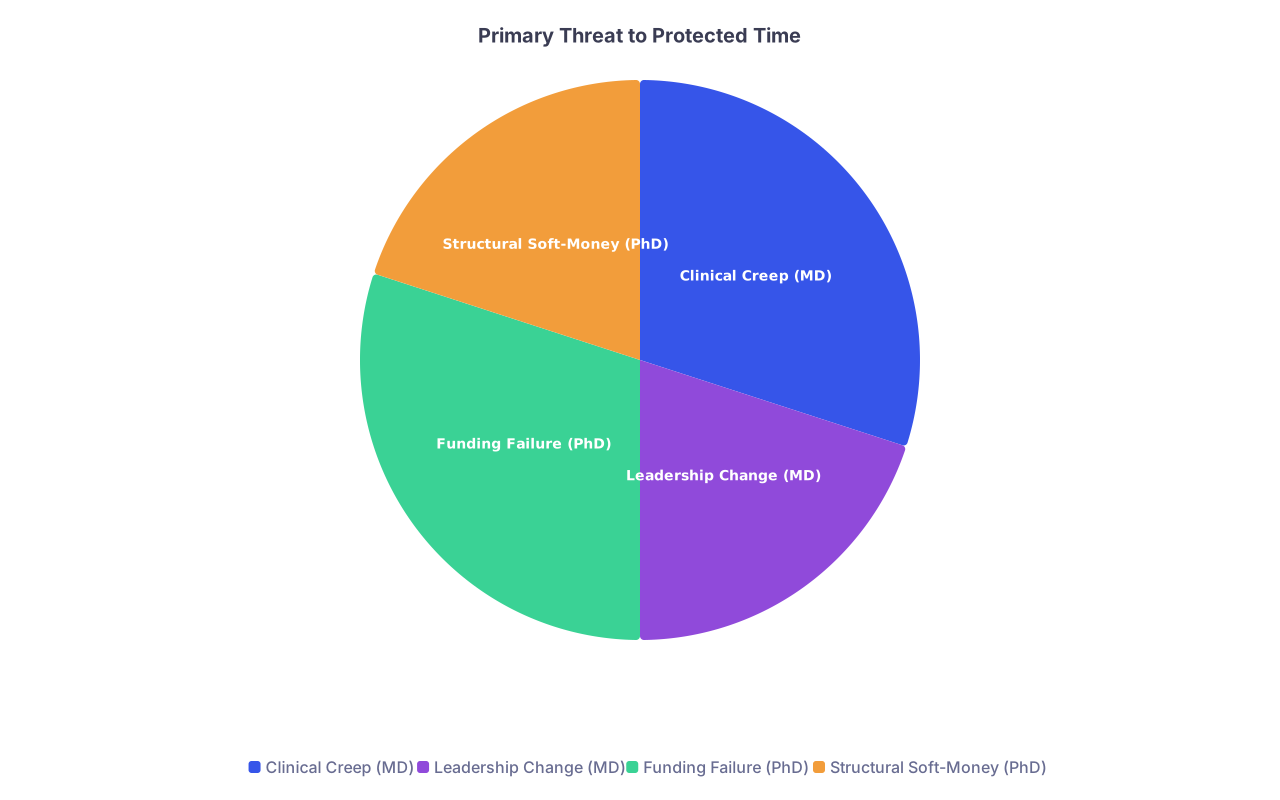
For MDs, the main threats are:
- Clinical creep: Gradual increase in clinic sessions or call coverage that “temporarily” spills into research days.
- Leadership shifts: New chair or division chief who prioritizes access and RVUs over research.
- Funding gaps: K not funded, R01 lapses, startup ends, leading to: “We need you 0.8 clinical next year.”
You know this is happening when:
- Your “research day” now starts after morning clinic.
- Admin says, “We only scheduled you 5 half-days of clinic,” but they ignore consults, inpatient requests, and messaging.
- Your annual review has a strong RVU emphasis and vague statements about “supporting your research as able.”
For PhDs, the main threats are:
- Funding failure: Loss or non-renewal of major grants.
- Mission drift of the department: Department shifting toward service/teaching/clinical ties without rethinking expectations.
- Structural soft-money: Hiring you on 80–100% grant-funded positions with no safety net.
You know this is happening when:
- You are subtly asked to “pick up more teaching” without lowering research expectations.
- Space committees start asking whether your lab footprint is justified.
- Renewal letters are one year at a time with “contingent on funding” language front and center.
| Category | Value |
|---|---|
| Clinical Creep (MD) | 30 |
| Leadership Change (MD) | 20 |
| Funding Failure (PhD) | 30 |
| Structural Soft-Money (PhD) | 20 |
The MD’s protected time dies by a thousand clinical cuts. The PhD’s protected time dies abruptly when the grant stops.
6. Negotiating FTE and Protected Time: MD vs PhD Tactics
You cannot control institutional politics. You can control how explicit your agreement is.
MD: Things You Must Pin Down in Writing
If you are an MD planning a research-heavy career, you should be borderline obsessive about:
Explicit FTE percentages
Not “some protected time.” You want:- 0.7 FTE research
- 0.2 FTE clinical
- 0.1 FTE teaching/admin
Time horizon
- “Protected research FTE guaranteed for three years conditional on satisfactory performance and effort reporting.”
- What happens in years 4–5? Is there an expectation for K/R01 funding by a specific date?
Clinical expectations
- Clinic sessions per week
- Call frequency and type
- Expectations for “urgent add-ons” or cross-coverage
Funding contingencies
- If the K does not land, what is the default FTE?
- If you obtain an R01, does that buy more protected time or just subsidize what you already have?
I have sat in meetings where the chair says, “We support your research, but everyone has to carry their weight clinically.” That is code for: if this is not nailed down, your “protected time” will be raided within a year.
PhD: Things You Must Clarify Upfront
For PhDs, different list:
-
- What % of your salary is guaranteed, and for how long?
- Is there a scheduled ramp-down of institutional support?
Expected grant coverage
- “By year 3 we expect 40–50% of your salary from external grants” is common. Is that spelled out or just implied?
Teaching load
- Number of courses per year
- Lectures vs full course responsibility
- Graduate student supervision expectations
Evaluation metrics
- Publications per year (ballpark)
- Grant submissions and awards
- Role on multi-PI or center grants
Protected time for a PhD is mostly attacked through “mission expansion”: more teaching, more admin, more committee work. The trick is that none of these come with a reduction in research expectations, so your day quietly stretches to 70–80 hours.
7. Hybrid Environments: MD-PhD and Team Science Models
MD-PhDs live inside both logics. This is both powerful and dangerous.
MD-PhD: Dual Expectations, Single Body
Typical MD-PhD early-career line in a research department:
- 0.70–0.80 research
- 0.20–0.30 clinical
The “promise” is that you function like a PhD-level PI with some clinical work. The reality:
- Clinical home expects you to be a “real doctor” with some RVUs.
- Research home expects you to publish and fund like a PhD PI.
You can absolutely make this work, but only if:
- You cap your clinical FTE hard and early.
- You treat every clinical expansion as a direct threat to your research viability.
- You lean heavily on collaborations and shared infrastructure to magnify your research FTE.
Team Science: PhD-Heavy Labs with MD Collaborators
In modern academic medicine, common pattern:
- PhD PI: 80–90% research FTE, runs the lab.
- MD collaborators: 10–30% research FTE, bring patient access and clinical insight.
Protected time mechanics here:
- The PhD’s “protected time” is structurally safer but funding-sensitive.
- The MD’s “protected time” is clinically fragile but politically powerful (departments like having MDs tied to grants).
Properly structured, this is ideal:
- PhD handles day-to-day lab, grant writing, trainee supervision.
- MD handles patient enrollment, protocol design, clinical interpretation, some writing.
Poorly structured, the MD is crushed by clinical work and becomes “the name on the IRB,” while the PhD burns out managing everything else.

| Step | Description |
|---|---|
| Step 1 | Department Chair |
| Step 2 | PhD PI 80 research FTE |
| Step 3 | MD Collaborator 20 research FTE |
| Step 4 | Lab Staff and Trainees |
| Step 5 | Clinical Trials and Cohorts |
| Step 6 | Publications and Grants |
8. Phase: Medical Education and Continuing Education – When This Starts to Matter
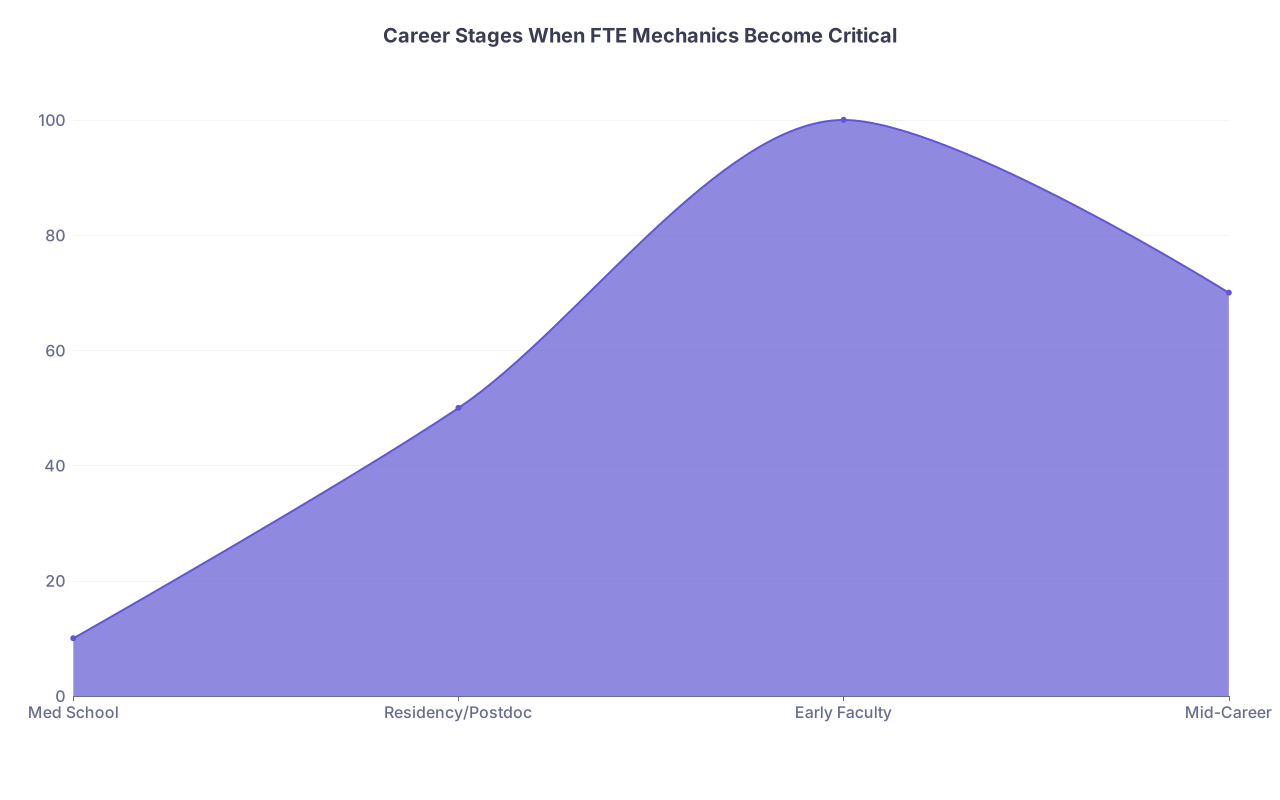
You asked in the context of “Medical Education and Continuing Education.” Translation: when in the training pipeline do these FTE mechanics actually bite?
For MDs
The critical phases:
Late residency / fellowship:
- You start hearing terms like “RVU,” “FTE,” “K award,” “protected time.”
- You must decide: pure clinician, clinician-educator, clinician-researcher, or true physician-scientist.
Early faculty (first 3–5 years):
- Startup and K-period define your trajectory.
- If you let clinical expand from 0.2–0.3 FTE to 0.5–0.6 in these years, your research career is essentially over before it begins.
Continuing education for MD researchers is not just CME. It is also:
- Grantsmanship courses (CTSI, NIH workshops)
- Research leadership programs
- Time management and negotiation training
Those are not “extras.” They are survival skills for maintaining protected time.
For PhDs
Key points:
Late PhD / Postdoc:
- You learn the actual grant ecosystem and how salary support is wrapped into R-, P-, and center grants.
- You see firsthand how PIs juggle teaching and research.
Early faculty:
- Startup package terms and % hard money decide how terrified you should be about your first R01.
- Protected time is not the question; lab viability and salary stability are.
Continuing education here looks like:
- Advanced grant writing programs
- Leadership and lab management courses
- Strategic collaboration with MD colleagues to increase translational relevance and funding options
| Category | Value |
|---|---|
| Med School | 10 |
| Residency/Postdoc | 50 |
| Early Faculty | 100 |
| Mid-Career | 70 |
The spike in “criticality” during early faculty is not an exaggeration. That is when the rhetoric of “we support your career” stops and the math starts.
9. Practical Scenarios: How This Plays Out in Real Life
A few patterns I have seen repeatedly.
Scenario 1: The MD Who Thought 0.5 Research Was Enough
They finish fellowship with a T32 / K-level training background. First job:
- 0.5 clinical
- 0.4 research
- 0.1 teaching/admin
On paper this looks “balanced.” In practice:
- The 0.5 clinical includes call, inpatient weeks, and a zer0ed-out clinic template that never respects blocked time.
- The 0.4 research gets fragmented into tiny chunks.
- Grant submissions slip. An R01 never materializes. The department gently nudges to 0.7–0.8 clinical “given service needs.”
Outcome: By year 5, they are a high-volume clinician who occasionally puts their name on multicenter trials. The window for an independent investigator career is basically closed.
Scenario 2: The PhD on 95% Soft Money
They accept a “research professor” or “research track” role:
- 0.90 research
- 0.10 teaching/service
- 5–10% hard money, 90–95% from grants
Year 1–3: They ride on their K99/R00 or foundation grants. Lab grows. Life is intense but exciting.
Year 4–5: One big grant is not renewed. Another is delayed. Suddenly:
- Their contract renewal email has “contingent on continued external funding” in bold.
- They are told the department cannot backstop salary for more than 6–12 months.
Outcome: They either land an R01 quickly or start job hunting—often to more stable, slightly lower-prestige institutions with higher hard-money percentages.
Scenario 3: The MD-PhD Who Took “Just One More” Clinic
Started with:
- 0.75 research (K award)
- 0.20 clinical
- 0.05 teaching
Then:
- A colleague leaves. “Just cover one more half-day a week for a few months.”
- Hospital wants a new clinic site. “We need a research-oriented person to anchor this.”
- Call pool shrinks. “Everyone has to take an extra weekend.”
Protected time drops in practice to ~0.5, but effort reporting and grants still say 0.75.
Outcome: Grants suffer, papers slow, K-to-R transition fails. Next annual review: “Given the funding situation, we need you closer to 0.7–0.8 clinical.” That is the end of the research-heavy part of their career.

10. How to Think About MD vs PhD Choices Through the FTE Lens
Strip away the romance and ask a brutally simple question:
Do you want your main fight to be against clinical encroachment (MD) or against funding volatility (PhD)?
MD path:
Upside:
- Clinical skills are valuable everywhere.
- If research funding dries up, you still have a job and a clear clinical identity.
- You can blend education, quality improvement, and some research.
Downside:
- Your research time is perpetually attractive to people who schedule clinics.
- You must constantly defend your protected time.
- Real 70–80% research FTE is rare and politically sensitive.
PhD path:
Upside:
- Research is the default. You do not have to apologize for not seeing patients.
- You can scale a lab and live almost entirely in the research ecosystem.
- You have clearer, research-centric metrics for success.
Downside:
- You live and die by grants and institutional budgets.
- In soft-money models, job security is fragile.
- If you burn out or lose interest in funding, there is no clinical fallback.

11. Key Takeaways
Let me cut to it.
“Protected time” is not a vibe. It is an explicit FTE allocation backed by identifiable salary sources. If you cannot see it in a budget or contract, you do not have it.
MDs lose protected time to clinical creep; PhDs lose protected time to funding failure. Pick the risk profile you want and negotiate accordingly.
Early-career FTE structure (first 3–5 years) effectively sets your long-term trajectory. Fixing a bad FTE model at mid-career is possible, but orders of magnitude harder than getting it right up front.

FAQ (Exactly 6 Questions)
1. Is 50% research FTE enough for an MD to build a serious independent research career?
Usually no. I have watched many MDs with 50% research FTE struggle to sustain an R-level portfolio. The clinical 50% expands, research time fragments, and grant writing gets pushed to nights and weekends. If you want a true investigator track, you should be aiming for 70–80% research in your first 3–5 years, even if that means fewer clinical sessions and a lower immediate RVU “value.”
2. How much hard money should a PhD researcher look for when choosing a position?
For a tenure-track role in a reasonably stable institution, 40–60% hard money is a healthy range. Less than ~30% hard money and you are in high-risk, soft-money territory where a single missed grant cycle can threaten your salary. More than 70% hard money is ideal but uncommon outside top-tier basic science departments or systems with strong institutional endowments.
3. Can an MD realistically transition from a heavy clinical role to a research-heavy FTE later in their career?
Possible, but much harder than doing the reverse (research to clinical). Departments tend to see you as whatever you have been producing: if you have been a 0.8–1.0 clinical FTE for years, you are “clinical infrastructure.” To pivot to 70–80% research, you will need: a chair strongly invested in your research, some preliminary funding or track record, and likely a change in division or even institution.
4. For MD-PhDs, what is the minimum clinical FTE that keeps skills and credentialing viable without destroying research time?
Common sustainable range is 0.15–0.30 clinical FTE. That usually translates to 1–2 clinic half-days per week plus some call or inpatient weeks. Below ~0.15 FTE, maintaining procedural skills and clinical credibility can be tricky in some fields. Above ~0.30 FTE, you will feel serious pressure on your grant writing and lab oversight unless you have exceptional support.
5. How do K awards actually “buy” protected time for MDs?
K awards pay a percentage of your salary (e.g., 75%) up to a capped dollar amount. In theory, the department then reduces your clinical FTE because they are now recovering a chunk of your salary from NIH rather than clinic revenue. In practice, this only works if your letter of support and your employment agreement explicitly state the planned FTE allocation and the department honors it. The K does not magically enforce clinic reductions; you have to defend the time the grant is paying for.
6. Are clinician-educator tracks safer than research tracks for MDs who like scholarship but hate grant pressure?
For many MDs, yes. Clinician-educator lines often have clearer expectations (teaching, curriculum work, some QI/scholarship) and more stable FTE models tied to clinical work and institutional education needs, not external grants. You will not get 70–80% research FTE, but you also will not be living and dying by R01 cycles. If you enjoy teaching and moderate scholarship more than high-intensity independent research, a clinician-educator path can be a far better fit than forcing yourself into a soft-funded research track.