It’s 1:17 a.m. You’ve got twelve tabs open: “MD vs PhD salary,” “What is an MD-PhD,” “Is PhD easier than med school,” some Reddit threads full of strangers with strong opinions and questionable credentials. Your roommate already “knows” they want to be a surgeon. You, on the other hand, are staring at dual degree program websites wondering if spending 8–10 years in training is genius… or insane.
This is where people screw up badly.
Not because MD or PhD is “wrong” in itself. But because they pick the wrong one for the wrong reasons, based on myths, ego, pressure, or straight-up misunderstanding of what these careers actually look like day-to-day.
Let me walk you through the most common, expensive, and life-shaping mistakes I’ve seen premeds make when choosing between PhD and MD. These are the traps you need to avoid.
Mistake #1: Treating MD vs PhD Like a Simple “Which Pays More?” Question
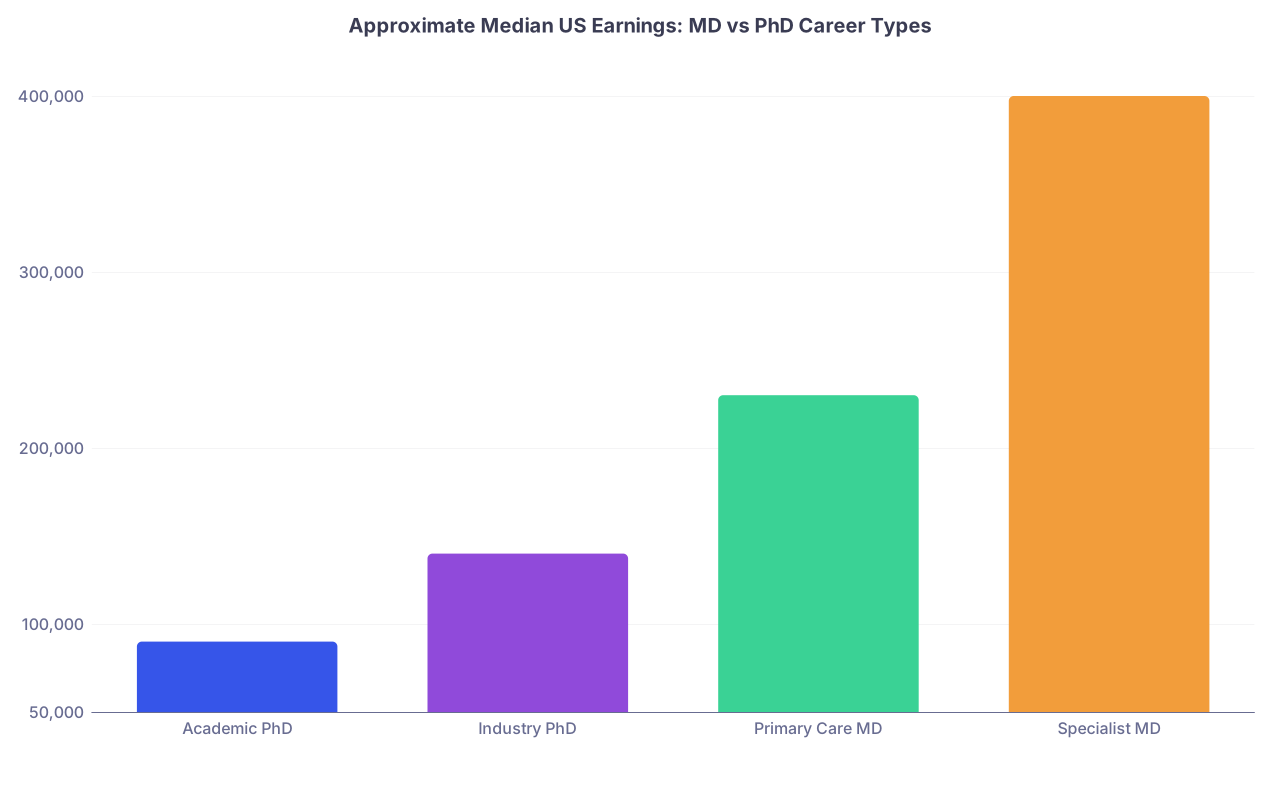
You know the script. You Google average MD salary vs PhD salary and see numbers that look like this:
| Category | Value |
|---|---|
| Academic PhD | 90000 |
| Industry PhD | 140000 |
| Primary Care MD | 230000 |
| Specialist MD | 400000 |
Then your brain jumps to: “Well that settles it. MD it is.”
Huge mistake.
Three problems with the salary-only mindset:
Those numbers are:
- Averages.
- Pre-tax.
- Ignoring debt, years of lost income, and cost of training.
The time to get there is different.
- PhD: ~5–7 years, usually with stipend.
- MD: 4 years med school + 3–7 years residency, often with massive debt before you start making attending-level money.
You’re ignoring the daily life behind those numbers.
PhD life (even in a good lab):
- Experiments fail. A lot.
- You can spend months optimizing one protocol.
- Your success depends on papers, grants, and reviews from anonymous reviewers who might be having a bad day.
MD life:
- Patients, charting, EMR, prior authorizations.
- Call nights. Deaths. Angry families. Litigation risk.
- Clinical productivity metrics hovering over everything you do.
Choosing a 30–40 year career based on a PDF of median salaries without understanding what you’re signing up for? That’s how people end up burned out, resentful, and feeling trapped.
Avoid this mistake: Ask yourself this brutally honest question:
“If the pay were exactly the same, and I had no debt, which daily life would I choose?”
If your honest answer is “clinic and patients,” lean MD.
If it’s “data, experiments, writing, and thinking deeply about one problem,” lean PhD.
Money matters. Just don’t let it be the only variable while you ignore everything that will actually make up your day-to-day existence.
Mistake #2: Using “I Like Science” As Your Only Filter
“I like science” is not a criterion. It’s the bare minimum.
Plenty of med students and residents like science. Plenty of PhDs care about human health. Liking biology in undergrad does not automatically mean you’d enjoy:
- Running the same assay 40 different ways because the control keeps failing.
- Sitting at a computer analyzing messy datasets for weeks.
- Rewriting the same manuscript three times after reviewer 2 destroys you.
I’ve watched premeds say: “I did one summer of research and liked it, maybe I should do a PhD.” That’s like doing one shadowing day and deciding you’ll be a neurosurgeon.
Here’s the line most people blur and then regret:
- Enjoying learning science (what premeds mostly do)
- Enjoying doing science (what PhDs live inside)
Medical school:
- You are consuming science: lectures, Anki, UWorld.
- Applying it in a clinical context.
- You’re not typically generating new scientific knowledge.
PhD:
- You are creating science.
- That means ambiguity, failure, long time horizons, and working on questions that might take years to answer—or never fully resolve.
Red flag: If the best part of your research experience was “presenting the poster” or “putting it on my CV,” and not the day-to-day grind in the lab or at the computer, you’re probably romanticizing the idea of “being a scientist” more than actually liking the work.
Avoid this mistake: Test yourself:
- Did you ever lose track of time in lab because you genuinely cared about the result?
- Would you still choose to do research if nobody ever gave you a publication, an award, or a line on your application?
If your answer is mostly no, be very careful about hitching yourself to a 5–7 year PhD.
Mistake #3: Assuming MD-PhD Is the “Best of Both Worlds”
This one is particularly costly.
MD-PhD gets pitched as: “Free med school, you get to be both doctor and scientist, and people will respect you more.” I’ve heard admissions reps sell it almost like a prestige package.
What you do not hear enough:
- It is not “med school + PhD.” It is its own beast.
- You are committing to:
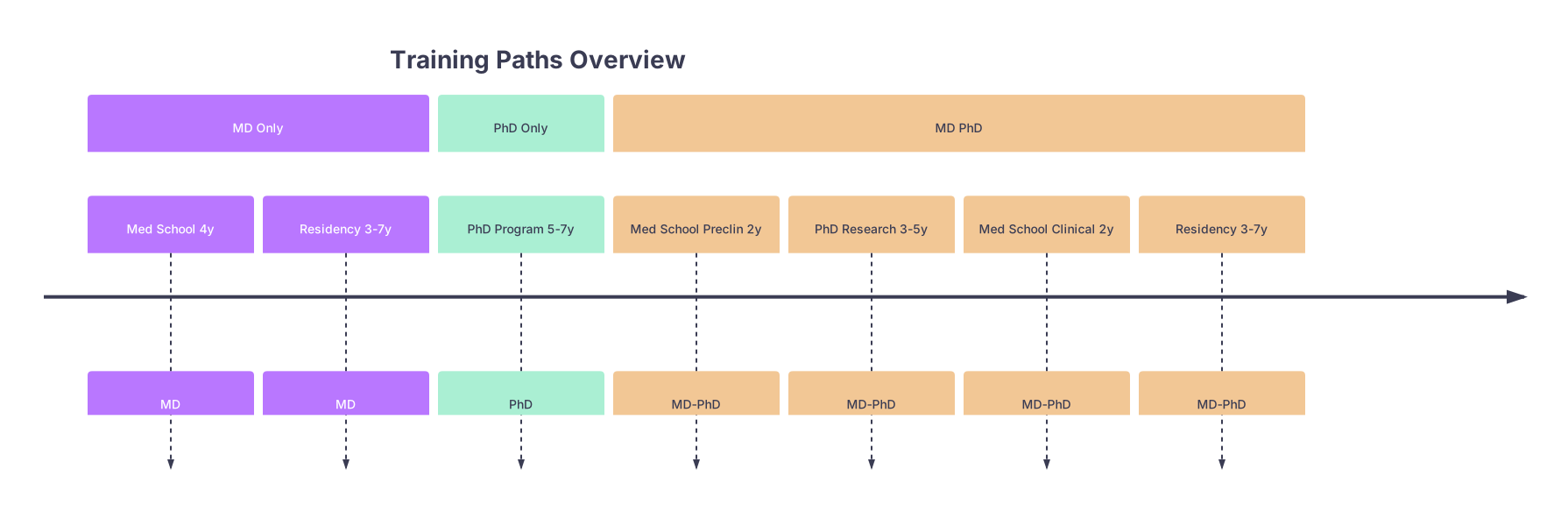
- 7–9+ years of training before residency.
- Then residency/fellowship.
- Then trying to maintain an actual research program while doing clinical work.
| Period | Event |
|---|---|
| MD Only - Med School 4y | MD |
| MD Only - Residency 3-7y | MD |
| PhD Only - PhD Program 5-7y | PhD |
| MD PhD - Med School Preclin 2y | MD-PhD |
| MD PhD - PhD Research 3-5y | MD-PhD |
| MD PhD - Med School Clinical 2y | MD-PhD |
| MD PhD - Residency 3-7y | MD-PhD |
Real MD-PhD pitfalls people ignore:
Identity whiplash.
You bounce:- Med student → suddenly the least experienced person in the lab.
- Senior grad student → then back to “MS3 getting pimped on rounds.”
Grants and funding pressure.
Physician-scientist jobs are heavily grant-dependent. If chasing NIH R01 funding sounds miserable to you, that’s your warning sign.Time cost.
Starting residency in your mid-30s is not a joke. Especially if you want a family, geographic stability, or financial security earlier.Not all MD-PhDs actually end up doing research.
A noticeable fraction end up mostly clinical because keeping an R01-funded lab + clinical work + teaching + admin is punishing. So you just burned 3–5 extra years and didn’t end up doing what the degree was for.
Avoid this mistake: Do not choose MD-PhD because:
- “It’s free med school.”
- “I want a more competitive residency.”
- “I like research and also like clinical shadowing, so why not both.”
You choose MD-PhD only if:
- You cannot imagine a future where you’re not driving your own research questions.
- You want to spend a large chunk of your career in the lab or at the computer, not just seeing patients with a side project tacked on.
- You’ve had substantial research exposure (more than a summer) and still want more.
Mistake #4: Underestimating Time, Burnout, and Life Trajectory
People obsess over “how long is training” but in a very shallow way. “Five vs eight years, whatever.” That’s not smart.
The real question is: What does your life look like during those years and immediately after?
Let’s roughly sketch typical timelines:
| Path | Degree Years | Next Step | Total To Independence* |
|---|---|---|---|
| MD | 4 | 3–7y residency | ~7–11 years |
| PhD | 5–7 | Postdoc or job | ~7–10+ years |
| MD-PhD | 7–9 | 3–7y residency | ~10–16 years |
*By “independence,” I mean attending or PI-level position, roughly.
Hidden time-cost mistakes:
Ignoring age and energy.
Training into your mid-30s or 40s changes family planning, home buying, and even basic stamina for 80-hour work weeks.Forgetting transition costs.
Switching from PhD to MD later or trying to “fix” your path mid-stream costs years and money.Assuming you’ll be the exception to burnout.
Every tired resident once said, “I’ll manage, I’m different.” Then they hit their third week of night float.
Avoid this mistake: Do a brutally honest check:
- What age will you likely finish?
- How much debt will you have by that age?
- What major life events do you want and when? (Kids, geographic stability, caregiving for aging parents.)
If your plan quietly assumes infinite energy and no curveballs, it’s a fantasy, not a plan.
Mistake #5: Not Doing Real-World Shadowing in Both Worlds
You would not choose a specialty without shadowing. Yet tons of people choose between MD and PhD having only seen one side up close.
I’ve seen:
- Students apply PhD-only with zero exposure to actual grad-school reality.
- Premeds decide on MD-PhD because they “liked” research in a very sheltered undergraduate lab that protected them from the politics, grant rejections, and long stretches of nothing working.
You need to shadow both:
- A practicing clinician (preferably in more than one setting: outpatient, inpatient, maybe primary care and a specialist).
- A real PhD researcher or postdoc in a working lab (not just dropping in for a single fun experiment).
Pay attention to:
- What time they leave at night.
- How they talk about their work when they think students are not listening.
- What frustrates them: is it patients, insurance, grants, administrators, experiments, students?

Huge red flag: If all your “exposure” comes from:
- YouTube day-in-the-life videos.
- Reddit.
- “My cousin is a doctor and said…”
That’s not exposure. That’s hearsay.
Avoid this mistake: Before you commit:
- At least 40–60 hours shadowing or scribing in clinical environments.
- At least 6–12 months of consistent research experience, ideally including:
- One full project cycle (design → data collection → analysis → presentation or manuscript draft).
- At least one serious failure.
If, after that, you still feel pulled strongly one way, you’re making a decision on real evidence, not fantasy.
Mistake #6: Ignoring Your Tolerance for Uncertainty and Failure
PhD life runs on long stretches of “this might never work,” and “we don’t know if this question is actually answerable with our tools.”
Medicine has uncertainty too, but it’s a different flavor: you still have to act, even with incomplete data. The structure is tighter: guidelines, evidence, protocols.
Big mismatch mistake:
People who are deeply anxious with open-ended, poorly defined problems signing up for a PhD because “I’m not a people person.”
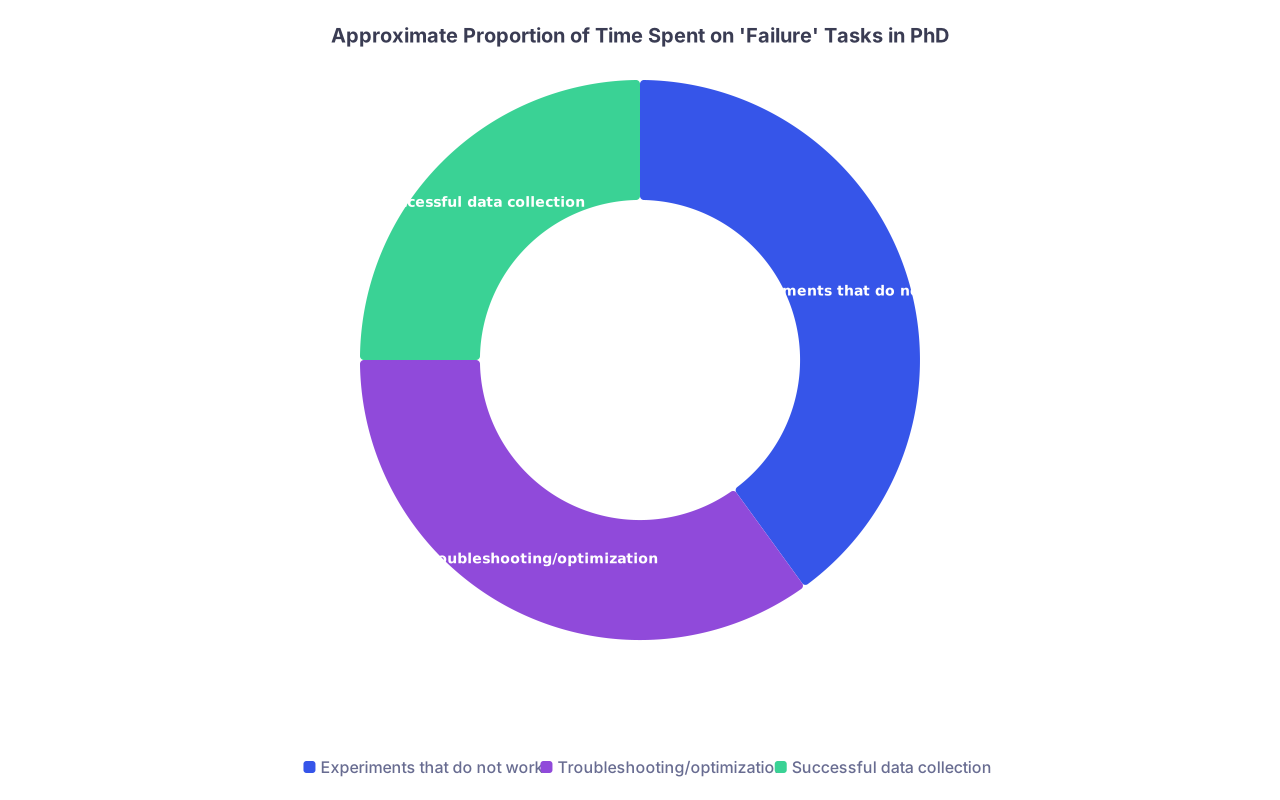
In a PhD, you can spend:
- 6 months optimizing a protocol that still fails.
- 2 years on a project that dies because another lab scooped you.
- 1+ year waiting on a paper stuck in review limbo.
This isn’t rare. It’s standard.
| Category | Value |
|---|---|
| Experiments that do not work | 40 |
| Troubleshooting/optimization | 35 |
| Successful data collection | 25 |
If the thought of spending years on something that might never clearly “work” makes you miserable, PhD life will chew you up.
By contrast, in medicine:
- You often get some closure: patient improves, deteriorates, or stabilizes.
- You will still lose patients. Misdiagnose sometimes. Have complications.
- The emotional uncertainty is: “Did I do enough? Did I do the right thing?”
So you’re choosing:
- Scientific uncertainty and slow progress vs
- Human uncertainty and moral/emotional weight.
Avoid this mistake: Ask yourself honestly:
- Does failure make me curious or panicked?
- Do I prefer problems with clearer “this is right/this is wrong” feedback, or can I tolerate ambiguous, slow feedback?
Neither answer is wrong—but each points heavily toward MD or PhD.
Mistake #7: Treating MD as the “Default” and PhD as the “Backup”
Another nasty trap: “I’ll apply MD only, and if that doesn’t work, I’ll just do a PhD.”
That’s like saying, “If I don’t get into law school, I’ll be a civil engineer.” Completely different careers.
I’ve watched applicants:
- Do a PhD they never truly wanted, thinking it would “make them more competitive for MD later,” then discover:
- They hate lab work.
- Their publication record is mid.
- They burned 6–7 years and now feel trapped or bitter.
Or the reverse:
- Students who really wanted to be scientists but felt MD was more prestigious or acceptable to family, so they applied MD only and suffered through training, then tried to pivot later, losing years.
PhD is not:
- A “waiting room” for med school.
- A glorified gap year.
- A way to “pad your CV” until MD admissions like you.
It is its own harsh, demanding path, and the job market for tenure-track academia is brutally competitive.
Avoid this mistake: If you say:
- “I could be happy with either path.”
Good. Then you need to decide which you prefer, not which others will respect more.
If your internal monologue is:
- “I’ll do a PhD if I don’t get into med school,” you’re already telling me you shouldn’t be doing a PhD.
Mistake #8: Ignoring the Job Market and Structural Reality in Academia
PhD students often get sold a dream:
- “Do what you love, get paid to think, become a professor…”
Here’s the less glamorous, more common version:
- Multiple postdocs.
- Moving cities every few years.
- Chasing a shrinking pool of tenure-track jobs.
- Soft money positions living grant-to-grant.

Is it always that bleak? No. There are:
- Industry jobs (biotech, pharma, data science).
- Government and nonprofit research roles.
- Teaching-focused positions.
But if you picture “PhD = professor,” and that’s the only version you have in mind, you’re walking into a rigged game without realizing it.
Contrast with MD:
- The job market has its own issues (geography, specialty imbalances, corporate medicine, burnout).
- But the probability of being unemployed as an MD is extremely low compared to PhD academia.
Avoid this mistake: Before committing to a PhD:
- Talk to:
- 1–2 current grad students
- 1–2 postdocs
- 1 professor who is not recruiting you
- Ask them explicitly:
- “If you had to decide again, would you still do a PhD?”
- “What percentage of people from your program get the jobs they wanted?”
If those answers make you queasy, do not ignore that feeling.
Mistake #9: Overweighting Prestige and Underweighting Personal Fit
I’ve seen people pick MD purely because:
- Family expectation (“First doctor in the family!”)
- Ego (“Doctor sounds cooler than scientist.”)
- Social recognition.
I’ve also seen people pick PhD partly because:
- They’re scared of patient responsibility.
- They think “Doctor” (MD) is too intense for them, even though their real passion is clinical work.
Prestige is loud. Burnout is quiet—until it isn’t.
You will not feel prestigious at 2 a.m.:
- Writing notes on 14 admissions.
- Repeating Western blots that keep failing.
You will feel tired. And what you actually like doing will matter more than what your relatives call you at Thanksgiving.
Avoid this mistake: Strip away labels for a moment. Picture:
Scenario A:
- You wake up, go to clinic, see patients, make decisions, talk to families, document in the EMR, maybe teach a student.
- You bear responsibility for human lives.
Scenario B:
- You wake up, go to lab/office, design experiments or analyses, meet with your PI or your team, write or revise a paper or grant, analyze data.
- Your work affects people at a distance, often years later.
Which day genuinely feels more like your kind of hard?
Pick that one. Ignore the applause.
FAQs
1. Will doing a PhD first make it easier to get into medical school later?
Sometimes it can help, but it’s not a magic key. Admissions care more about:
- Clinical exposure
- MCAT
- Overall academics
- Evidence you actually understand medicine
A PhD with weak clinical exposure and mediocre stats will not “cancel out” those issues. Doing a PhD only to boost MD chances is usually a bad trade—6+ years for a marginal, uncertain benefit.
2. Is MD-PhD always better than MD if I like research?
No. If you want to be a mainly clinical physician who occasionally does research or quality improvement, an MD with strong research involvement in med school and residency is often a better, shorter, saner path. MD-PhD is for people who want research to be a central pillar of their career, not a side hobby.
3. Can I switch from PhD to MD or from MD to PhD later?
Yes, but it’s rarely clean or quick. PhD to MD:
- You still have to do all 4 years of med school.
- Your PhD doesn’t replace core clinical training.
MD to PhD:
- Some physicians go back for PhDs or research-intensive fellowships, but it adds more years.
Switching is possible, but assume you will lose time. Better to decide carefully up front.
4. What if I truly can’t choose between them?
Then you probably haven’t had enough real exposure yet. Before forcing a decision:
- Get more clinical shadowing/scribing.
- Get deeper research experience (not just a summer).
- Talk honestly with both physicians and PhDs about their worst days, not just their highlight reel.
If you still feel torn after that, MD-only is usually the more flexible path. You can build a research-heavy career as an MD; it’s harder to bolt clinical medicine onto a PhD later.
Key things to remember:
- Don’t pick MD or PhD just for money, prestige, or as a backup plan.
- Choose based on the daily life you can tolerate and even enjoy, not the fantasy version in your head.
- Get real, unfiltered exposure to both worlds before you commit years of your life to the wrong one.