
You are sitting in the library at 11:30 p.m., surrounded by half‑finished secondary essays, a spreadsheet of MD/PhD programs, and a Reddit thread open titled “Should I Do a PhD First?” Your MCAT is… fine, not spectacular. Your GPA is… fine, not spectacular. And you keep catching yourself thinking, “Maybe a PhD will make me more competitive for med school.”
This is exactly where people make some of the worst, longest‑lasting mistakes of their careers.
Let me be direct: doing a PhD for the wrong reasons as a premed can cost you 5–8 years, tens of thousands of dollars in opportunity cost, and leave you burned out and still not in medical school. I have watched people realize in year 4 of a miserable PhD that they never wanted to be a scientist. They just wanted to be “more competitive.”
You do not want to be that person.
Below are the biggest red flags you are pursuing a PhD for the wrong reasons, how they usually show up in real life, and what to do instead.
Big Picture: What a PhD Actually Is (That Many Premeds Misunderstand)
Before the red flags, you need one harsh truth:
A PhD is not:
- A “super master’s degree”
- A structured extension of undergrad
- A glorified gap year
- An MCAT retake with pipettes
A PhD is:
- Multi‑year apprenticeship in doing original research
- Training to become someone whose main output is new knowledge, not clinical care
- Long, unglamorous, sometimes painfully slow work
- Dependent on your relationship with one PI and their funding
If that does not sound intrinsically exciting, you should already be skeptical.
Red Flag #1: You See a PhD Mainly as a “Back Door” into Medical School
The most dangerous thought pattern I see:
“I will do a PhD first. Then med schools have to take me seriously.”
No, they do not.
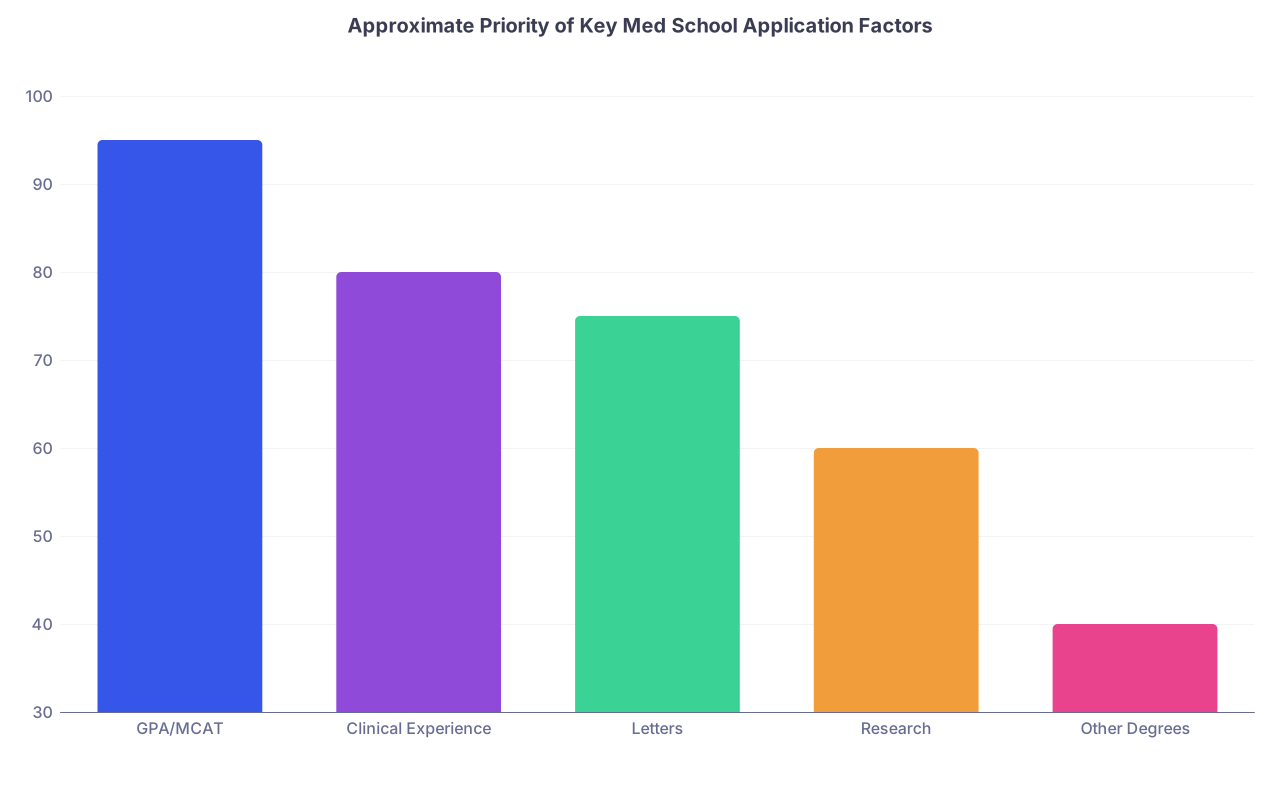
| Category | Value |
|---|---|
| GPA/MCAT | 95 |
| Clinical Experience | 80 |
| Letters | 75 |
| Research | 60 |
| Other Degrees | 40 |
Admissions committees do not treat “has a PhD” as a cheat code. I have seen PhDs rejected because:
- GPA was mediocre
- MCAT was old or weak
- Clinical exposure was thin
- Motivation for medicine was unclear
You are in trouble if:
- Your internal script is: “My stats are weak. A PhD will compensate.”
- You say things like: “I hear MD/PhD programs are less competitive than MD.”
- You are planning to “fix” a 3.1 GPA with 6 years of grad school instead of addressing the academic pattern.
Why this is a mistake:
- Med schools still want evidence you can handle medical curriculum, not just research.
- They will scrutinize your GPA, MCAT, and clinical commitment even more, because they expect maturity from a PhD applicant.
- You risk showing a scattered narrative: undergrad → long PhD → now suddenly clinical medicine?
Better alternative:
- Fix the actual problem:
- GPA issue → post‑bacc, SMP, or targeted course repair
- MCAT issue → dedicated structured prep and retake
- Weak clinical → more consistent shadowing, scribing, volunteering
- If your primary identity and long‑term work goals are clinical, keep your corrective actions short and targeted, not 7‑year detours.
Red Flag #2: You Like “Science Classes,” Not Actual Research
Another classic trap:
“I really liked biochemistry. I should do a PhD.”
Liking biochemistry lectures is not the same as liking:
- Failed experiments for three months straight
- Rewriting the same manuscript after three reviewer rejections
- Debugging code or perfecting Western blots at 9 p.m.
You are heading for regret if:
- Your only research experience is a summer project or lab class, and it felt “fine” but not energizing.
- Your favorite part of science is learning it, not creating it.
- You enjoyed having structured lab assignments, but hated the “figure it out yourself” parts.
Reality check: day‑to‑day PhD life often looks like:

| Step | Description |
|---|---|
| Step 1 | Interesting scientific question |
| Step 2 | Design experiment |
| Step 3 | Optimize protocol for weeks |
| Step 4 | Run experiment |
| Step 5 | Repeat with modifications |
| Step 6 | Analyze deeply |
| Step 7 | Write draft |
| Step 8 | Revise after criticism |
| Step 9 | Submit |
| Step 10 | Data makes sense |
Warning signs you are not research‑driven:
- You have never voluntarily picked up a primary paper outside of class requirements.
- Your strongest feelings about lab are: “It was chill,” “Good for my CV,” “The PI will write a strong letter” — not “I really wanted to know the answer.”
- The idea of spending 5–6 years focused on one very narrow question makes you feel boxed in.
If you love medicine but only “tolerate” research, you are not a PhD person. You are a clinician who may enjoy occasional research projects. That is completely fine. Just do not torture yourself for 6 years for the illusion of prestige.
Red Flag #3: You Are Using a PhD to Avoid Making Adult Career Decisions
This is more common than anyone admits.
I have heard this exact line from more than one M1: “I did a PhD because I did not know what else to do after undergrad, and it felt like staying in school was safer.”
A PhD is a terrible, incredibly expensive way to postpone adulthood.
Watch for this logic:
- “I am not ready to apply yet, so I will do a PhD.”
- “I do not know if I really want medicine. Maybe a PhD buys me time.”
- “I like being a student. Real jobs seem scary. Grad school feels familiar.”
What you are actually doing:
- Locking yourself into the most unstructured form of school
- Taking on a role where productivity is vaguely measured but consequences are real
- Losing 5–7 years of attending‑level income if you still end up in medicine
Opportunity cost matters.
| Path | Age 22-30 | Approx Outcome by 30 |
|---|---|---|
| MD Only | Med school + residency | Attending or senior resident |
| PhD then MD | PhD 5-6y + med school 2y | M3/M4 at best |
| Repair + MD (post-bacc) | 1-2y repair + med school 4y | Early resident |
If what you really need is:
- 1–2 gap years to sort yourself out
- More clinical exposure to see if medicine is real for you
- Time to mature professionally
Then do that directly:
- Work as a scribe, medical assistant, EMT
- Do a structured post‑bacc with advising
- Take a research assistant job (not a PhD) to test if full‑time research fits you
Do not sign a 5–7 year contract with an identity you are not committed to.
Red Flag #4: You Are Chasing Prestige, Not Fit
There is a quiet but very real prestige culture around “MD/PhD” and “Dr. So‑and‑so times two.”
You will hear things like:
- “Real physician‑scientists have PhDs.”
- “Top academic positions usually go to MD/PhDs.”
- “A PhD makes you more respected.”
And suddenly people who just wanted to treat patients start fantasizing about “being the triple‑boarded, NIH‑funded MD/PhD from Harvard.”
Here is the problem:
- Prestige fades fast when you are miserable.
- Committees care about productivity and fit, not how many letters follow your name.
- Many full professors in academic medicine have MD only plus good mentorship and publications.
Ask yourself, honestly:
- If the title “MD/PhD” carried no extra status, would you still want the work of a PhD?
- Are you more excited by:
- Grant writing, benchwork, basic/translational science?
- Or direct patient care, teaching, and occasional clinical research?
If the honest answer is the second, the PhD may be pure ego dressing. That wears off; the extra years do not.
Red Flag #5: You Have Almost No Realistic Picture of the Financial Tradeoffs
Too few premeds actually run the numbers. They fantasize about “free tuition in MD/PhD” without understanding the trade.
Approximate math:
- MD only:
- Debt: yes, probably large
- Timeline: 4 years school + 3–7 years residency
- Income: attending‑level starting perhaps early 30s
- PhD then MD:
- PhD: 5–7 years, stipend maybe $30–40k/year
- Then 4 years med school + residency
- Attending‑level income delayed by roughly 5–7 years
Even with “free tuition” for MD/PhD, those 5–7 additional years at low income level cost you hundreds of thousands in lost earnings and retirement growth.
You are falling into a trap if:
- The only financial reasoning you have is: “MD/PhD is free so obviously that is smarter.”
- You have not considered that you might come to hate research in year 3, but have already burned 3 years and still need med school funding.
- You are ignoring that an attending salary, even with debt, can overwhelm loan burden in a way a long stipend‑based path cannot.
I am not saying the MD/PhD is a bad deal. For a true physician‑scientist who wants 50–80% research career, it is excellent. For someone whose main dream is clinic, it is a very expensive vanity project.
Red Flag #6: You Are Ignoring All the Non‑PhD Ways to Do Research as a Physician
The myth: “If I want research in my career, I need a PhD.”
Wrong. Flatly.
Ways to do serious research as an MD only:
- Research‑heavy residencies and fellowships (think: internal medicine with research track, heme/onc, cardiology, academic surgery)
- T32 research fellowships
- Master’s degrees (MPH, MS in Clinical Investigation, etc.) during or after residency
- Dedicated research years (often funded) during med school or residency
I know MD‑only physicians who:
- Run labs
- Hold R01‑level funding
- Publish extensively
- Lead clinical trials
The difference is they built research skills and networks, not extra degrees.
Red flag version: you are deciding on a PhD solely because you “like the idea” of doing research, but:
- Have not tried more than 1–2 years of research to see if full‑time science life fits.
- Do not realize there are incremental steps (research fellowships, MS degrees) that take 1–2 years, not 5–7.
- Think “MD‑only researchers are second tier” because some grad student told you that.
Reality: If you want primarily to do clinical care and some research, MD‑only is usually cleaner, faster, and more flexible. You do not need a hammer to crack a peanut.
Red Flag #7: Your Main Motivation Is Fear — Of Rejection, Of Competition, Of “Not Being Enough”
I see this pattern constantly in anxious high‑achievers:
- “Everyone is doing something big. I need something big.”
- “If I do not get into a top‑20 MD, I failed.”
- “My application is not unique enough. A PhD will make it stand out.”
You are trying to outrun imposter syndrome with another degree.
Some signs:
- You obsess over what “they” (adcoms, peers, family) will think of your path.
- You are more afraid of appearing average than of spending your twenties in grad school.
- You are reading MD/PhD stats and trying to “engineer” an impressive narrative instead of asking what work you actually enjoy.
Here is the unglamorous truth: Most physicians are “just” MDs. Many are excellent. No one in the clinic cares that their cardiologist does not have a PhD. Patients care if you listen and know what you are doing.
If your main driver is fear that you are not enough, a PhD will not fix that. It will give you new, more elaborate ways to feel like you are failing (papers, grants, qualifying exams).
Handle the fear directly:
- Therapy or counseling to deal with perfectionism and identity tied to achievement
- Honest conversations with mentors who know both MD‑only and MD/PhD paths
- Clarifying what your version of a satisfying, sustainable career looks like — not Reddit’s.
Red Flag #8: Every Mentor Who Actually Knows You Hesitates… And You Ignore Them
Pay attention to who is encouraging the PhD idea.
Green light:
- Long‑term research mentor who knows your work says: “You think like a scientist, you are unusually persistent in the lab, I can see you leading a lab.”
- You have multiple independent mentors, in different settings, who all separately suggest you consider MD/PhD or PhD.
Red light:
- Only people pushing you are:
- Other stressed premeds
- A PI who wants cheap long‑term labor
- Random online posters
- People who know you well say things like:
- “I see you loving patient care.”
- “You are great with people and teaching.”
- “You get frustrated easily with how slow research is.”
I have watched students bulldoze through gentle warnings:
- “You might get bored in a lab full‑time.”
- “You seem much happier in clinical settings than at the bench.”
They interpret caution as “they do not believe in me” instead of what it often is: someone trying to protect them from a poor fit.
If smart, experienced mentors who like you are uneasy about you doing a PhD, take that seriously.
What To Do If You Recognize These Red Flags in Yourself
You are not doomed. You are just early enough to avoid a 6‑year detour.
Step back and:
Write down, clearly, your top 3 career priorities
Examples:- “I want to spend most of my time seeing patients.”
- “I want a high chance of geographic flexibility.”
- “I want to run a lab and secure grants.”
For each priority, ask:
- Does a PhD substantially help this?
- Or does it mostly slow me down while giving prestige points?
Get real research and clinical exposure if you do not already have both. Not a month. A year each, ideally.
Talk to:
- MD‑only academic physicians who do research
- MD/PhDs at different stages (MSTP students, residents, junior faculty)
- At least one person who regrets their PhD decision
Be honest about your weaknesses:
- If academics (GPA/MCAT) are the main issue → fix that.
- If motivation for medicine is unclear → pause applications, get clinical jobs, do not hide in grad school.

Quick Decision Snapshot: When a PhD Might Be Right vs a Bad Idea
| Situation | Likely Verdict |
|---|---|
| You love research more than clinic | PhD/MD-PhD reasonable |
| You want research options someday | MD with research > PhD |
| You are mainly fixing weak stats | Bad reason |
| You fear being "just an MD" | Bad reason |
| Multiple mentors see you as a scientist | Consider PhD/MD-PhD |
If you are not certain you want research to be a core part of your career, do not commit years of your life and earning potential to a PhD just to feel safer applying to medical school.
FAQ (Exactly 5 Questions)
1. Will a PhD significantly improve my chances of getting into medical school if my GPA or MCAT are weak?
No. A PhD does not erase a weak academic record. Adcoms still expect:
- Solid recent coursework (often via post‑bacc/SMP if undergrad GPA was poor)
- Competitive MCAT The PhD might help explain time spent and show persistence, but if your metrics and clinical exposure are not there, the degree will not rescue your application.
2. If I am truly interested in research, should I do MD/PhD or PhD‑then‑MD?
For someone genuinely committed to being a physician‑scientist, MD/PhD is usually more coherent:
- Integrated training
- Structured support for combining both identities PhD‑then‑MD can work, but you risk:
- A long gap between research training and later clinical work
- Needing to “retool” your research identity to fit medicine If you are unsure, do not default to PhD‑then‑MD. Clarify first whether you want a heavy research career at all.
3. How much research experience should I have before seriously considering a PhD or MD/PhD?
As a rule of thumb:
- At least 1–2 years of consistent, meaningful research (during undergrad plus at least one full‑time year if possible)
- Experience taking a project from early stages through some endpoint (poster, talk, paper) If your only exposure is a single summer or a lab class, you have not seen the real grind. Decide after you have done the unglamorous parts, not before.
4. Can I become an academic physician and do research with only an MD?
Yes. Many academic physicians are MD‑only. Typical routes:
- Research‑track residencies and fellowships
- Extra research years built into training
- Master’s in clinical research, epidemiology, or related field What matters more than the extra letters:
- Good mentorship
- Strong research training (which can be gained in multiple ways)
- A track record of productive projects
5. I am already partway into a PhD and realizing I actually want clinical medicine more. What now?
You are not trapped, but you need to be honest:
- Talk with your PI and grad program director about your long‑term goals.
- Decide whether finishing the PhD:
- Aligns with your genuine interest in research, or
- Is just sunk‑cost fallacy. Plenty of people leave programs early and still get into medical school with a coherent explanation. Finishing a PhD you actively dislike just to “not waste it” is how people end up burned out before they even start med school.
Two things to leave with:
- A PhD is not a status symbol or a back door; it is a commitment to a very specific kind of work.
- If the core of your dream is to be a physician, build the shortest, cleanest path to that, and use research as a tool — not as an escape hatch.