
The standard advice about “do an MD–PhD if you want to be an independent investigator sooner” is numerically wrong. The data show the opposite: it usually delays your first R01.
You want to know one thing: how many years until real independence—measured the only way that matters in academic biomedicine—your first NIH R01 as principal investigator.
Let’s treat this like a time‑to‑event problem. Three cohorts:
- MD-only
- PhD-only
- MD–PhD
And the event: first R01 (or equivalent major NIH RPG).
1. The hard numbers: age and years to first R01
NIH has published repeatedly on age at first R01-equivalent award. The exact numbers wiggle year to year, but the pattern is stable.
For the last decade or so, the national averages have hovered roughly around:
- PhD-only: first R01 at ~42–44 years old
- MD-only: first R01 at ~44–46 years old
- MD–PhD: first R01 at ~44–46 years old
On the surface, that looks like a wash. But “age at first R01” hides the educational time you took to get there. You care about elapsed time from starting training to first R01, not just age.
Let us define:
- Start = matriculation into professional/graduate program
- End = first R01 as PI
Now plug in realistic durations.
Typical timelines:
- PhD: 5–6 years (US biomedical PhDs)
- MD: 4 years
- MD–PhD: 7–8 years integrated
Then add post‑grad phases needed before you are realistically competitive for an R01:
- For PhD: 1–2 postdocs (often 4–6 years total)
- For MD: residency (3–7 years), often fellowship (2–3 years), then 2–6 years in junior faculty/postdoc-like role
- For MD–PhD: same residency/fellowship path as MD, plus longer pre‑residency training
Here is a simplified quantitative snapshot.
| Path | Training Before Faculty | Years as Faculty to First R01 | Total Years Matriculation → First R01 |
|---|---|---|---|
| PhD | 5–6 PhD + 4–6 postdoc | 3–6 | ~12–18 |
| MD | 4 MD + 5–7 GME | 3–7 | ~12–18 |
| MD–PhD | 7–8 MSTP + 5–7 GME | 3–7 | ~15–22 |
Notice the pattern: MD–PhD tends to shift the entire trajectory right by ~3–4 years, with no strong evidence of earlier R01s relative to MD-only or PhD-only when you anchor on entry point.
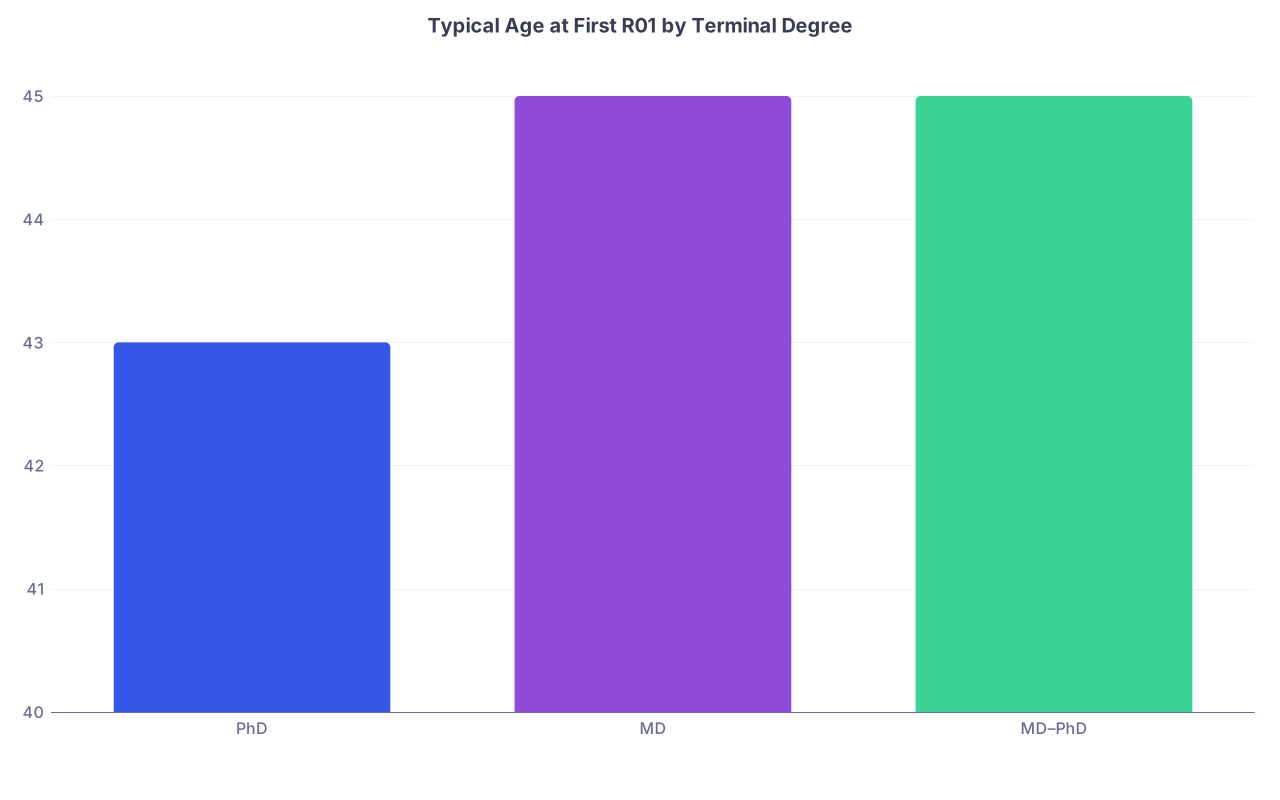
For a visual sense of how similar (or not) the ages are, but how different the path lengths are:
| Category | Value |
|---|---|
| PhD | 43 |
| MD | 45 |
| MD–PhD | 45 |
Three degrees, roughly similar ages. But you did not pay the same “time cost” to get there.
2. Step-by-step timeline by path
We need to quantify where the time actually goes. The anecdotes you hear in hallways (“MD–PhDs are ahead in research”) sound convincing, but the numbers tell a more complicated story.
PhD-only path
Starting point: undergraduate to PhD program.
Typical sequence:
- PhD program: 5–6 years
- Postdoc(s): 4–6 years (2–3 years each, sometimes more)
- First independent position (assistant professor / research track)
- Lag to first R01: ~3–6 years after faculty start
From matriculation:
- Fast scenario: 5 (PhD) + 4 (postdoc) + 3 (faculty) = 12 years
- Slow scenario: 6 (PhD) + 6 (postdoc) + 6 (faculty) = 18 years
Median reality sits somewhere in that band. The data show many first R01s in early-mid 40s for PhD PIs. If you start PhD at 22:
- 22 + 12 = 34 (very fast, not common)
- 22 + 15–17 = 37–39 (aggressive but plausible)
- 22 + 18 = 40 (normal-ish)
The PhD route is heavily back‑loaded in postdoc time. You spend most of your 20s and early 30s in training roles.
MD-only path
Now for MD. Start at 22 again.
- MD: 4 years → age ~26
- Residency: 3–7 years (3 in internal medicine, 7 in neurosurgery)
- Fellowship (subspecialty, research heavy): 2–3 years for many academic paths
- Early faculty or research instructor role: at ~33–38
- Lag to first R01: 3–7 years into faculty
From matriculation:
- Aggressive research path (shorter GME):
4 MD + 3 residency + 2 research fellowship + 3 faculty = 12 years - More typical academic path:
4 MD + 5–7 GME + 4–6 faculty = 13–17 years
So again, 12–18 years is a reasonable band. But for MD, much of that is clinical. You are also being paid more during residency and later, which matters nontrivially if you are modeling opportunity cost.
The data also show MD-only investigators are a shrinking but still essential slice of R01 PIs, often clustered in patient-oriented and clinical trial work, with a nontrivial share in translational science.
MD–PhD path
This is where the myths really diverge from data.
Start at 22.
- MD–PhD program: 7–8 years is typical in NIH MSTP programs
- 2 years preclinical MD
- 3–5 years PhD
- 1–2 years clinical MD
- Residency: 3–7 years
- Fellowship (often research-dense): 2–3 years
- Early faculty: late 30s for many people
- Lag to first R01: 3–7 years into faculty
Composite:
- Optimistic: 7 (MD–PhD) + 5 GME + 3 faculty = 15 years
- Realistic: 8 (MD–PhD) + 6–7 GME + 4–6 faculty = 18–21 years
The NIH’s own data show MD–PhD and MD-only PIs getting first R01s at similar ages, but the MD–PhD group has already spent 3–4 extra years in pre-residency training compared with MD-only.
That is the uncomfortable punchline: an MD–PhD almost never shortens your calendar time to R01. It usually extends it.
3. Comparative “time-to-independence” analysis
If we treat each path as a survival curve with the “event” being first R01, the hazard functions differ, but not in the direction people assume.
Conceptually:
- PhD: long plateau of low hazard during grad school, modest hazard during postdoc, sharp rise in early faculty years.
- MD: low hazard until at least late residency/fellowship, then steeper rise during early faculty.
- MD–PhD: low hazard for the longest time (extended dual-degree + GME), then increase similar to MD-only.
Now let us formalize approximate “median years from matriculation to first R01” based on published ages and typical start ages.
Assume start age 22 for all:
- PhD: first R01 ~43 → about 21 years
- MD: first R01 ~45 → about 23 years
- MD–PhD: first R01 ~45 → about 23 years, but with more years spent in pre-residency training vs MD-only
In practice, many start older than 22 (gap years, career changes), which pushes everything to the right.
For side-by-side comparison:
| Path | Assumed Start Age | NIH-Reported Median Age at First R01 | Estimated Years from Matriculation |
|---|---|---|---|
| PhD | 22 | 43 | ~21 |
| MD | 22 | 45 | ~23 |
| MD–PhD | 22 | 45 | ~23 |
So why did the earlier table show 12–22 years? Because that was a range from highly accelerated to slow trajectories. Here I am anchoring on median population-level ages.
What matters for decisions is not the fairy-tale “best case” stories. It is the median reality.
4. Where MD, PhD, and MD–PhD actually differ
If time to first R01 is similar in absolute age terms, what does differ strongly across paths?
Three key dimensions where the data diverge:
- Probability of ever obtaining an R01
- Type of science funded
- Percent clinical vs research time at independence
Probability of ever getting an R01
NIH and institutional tracking studies show something blunt:
- Among PhD graduates in biomedical sciences, a minority will ever obtain an R01. Depending on field and cohort, estimates hover around 20–30% of those entering tenure-track positions, and a much smaller fraction of the entire PhD cohort (most never reach a tenure-track role).
- Among MD-only physicians, a very small fraction become R01-funded PIs. Many never pursue the path seriously; they prioritize clinical careers. For those who actively aim at research careers, a significant fraction never secure R01-scale funding.
- Among MD–PhD graduates, the conditional probability of ending up as R01-funded faculty is higher than MD-only and likely higher than PhD-only on a per-graduate basis, largely because the applicant pool self-selects and is supported by structured training pipelines.
In other words, MD–PhD does not shorten the clock. It increases the odds that you end up on the R01 track at all, compared with MD-only or the full population of PhDs.
So the correct statement is:
- MD–PhD is a higher-probability but slower route to NIH-funded independence.
Type of science
The data show clear skews by degree:
- PhD PIs dominate mechanistic basic science, structure-function work, and many omics-heavy domains.
- MD PIs and MD–PhD PIs are overrepresented in patient-oriented research, clinical trials, translational imaging, and human pathophysiology.
- MD–PhDs occupy the middle: enough clinical knowledge to ask patient-relevant questions, enough PhD training to survive mechanistic expectations.
Your path should match your intended research domain. If you insist on deep human pathophysiology with ongoing patient care, MD or MD–PhD is logically superior. If wet-lab mechanism is your core, PhD is usually more efficient.
Clinical vs research time at “independence”
At first R01:
- PhD PI: 70–95% research time, depending on teaching/administration.
- MD-only PI: 40–70% research time, with heavy clinical obligations.
- MD–PhD PI: often 50–80% research time in research-focused departments or institutes.
Again, MD–PhDs tend to be more protected for research compared with MD-only PIs, but they are rarely as purely research-focused as PhDs.
5. Financial and opportunity cost: time is not neutral
Years are not equal. MD, PhD, and MD–PhD have very different cash flows across the 15–25 years before your first R01.
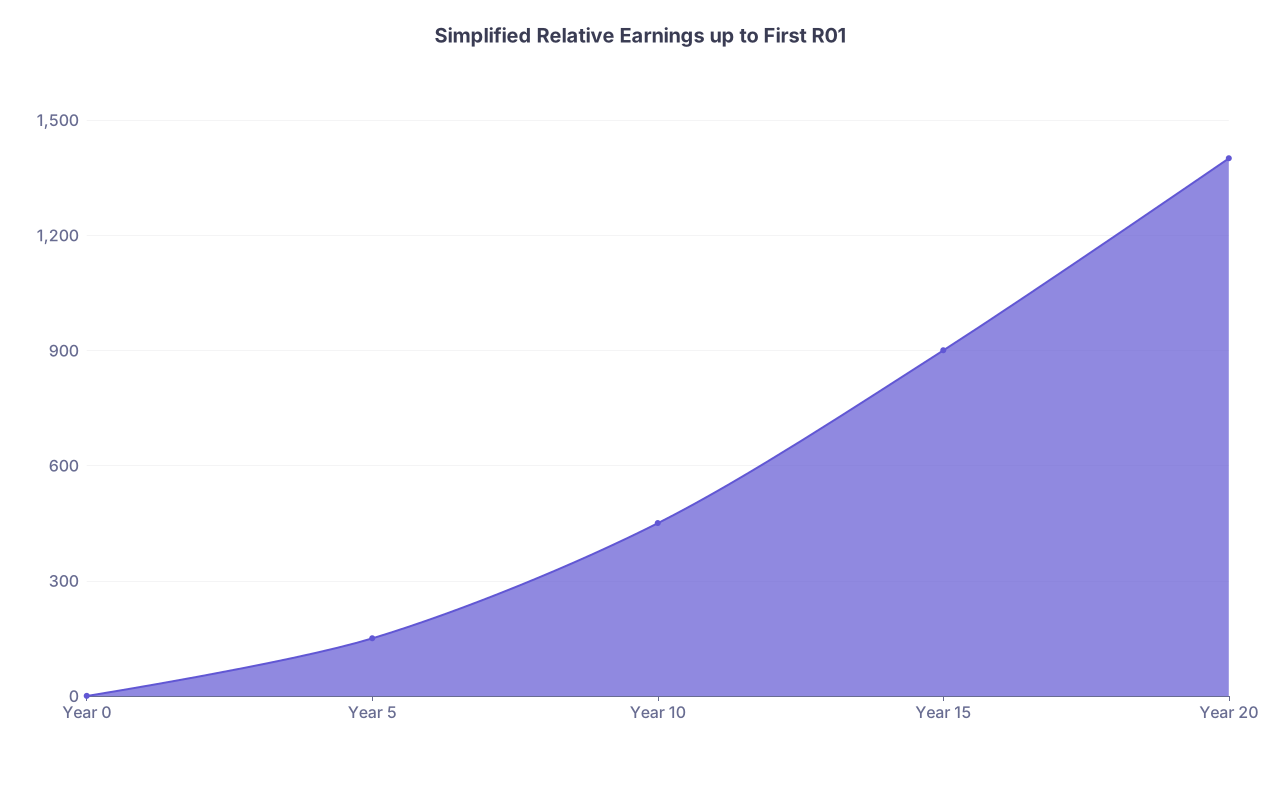
Let us sketch rough cumulative earning curves up to first R01.
We will assume typical US ballpark values:
- PhD stipend: $30–40k / year, minimal benefits
- Postdoc salary: $55–70k / year early, more later
- Resident: $60–75k / year
- Early faculty (MD): $180–300k / year, quite variable by specialty
- Early faculty (PhD): $80–130k / year, depending on institution
- MD–PhD students: similar to PhD stipend (tuition waived in MSTP)
Using these, the net financial penalty of PhD or MD–PhD vs MD-only becomes obvious.
| Category | Value |
|---|---|
| Year 0 | 0 |
| Year 5 | 150 |
| Year 10 | 450 |
| Year 15 | 900 |
| Year 20 | 1400 |
Treat that curve as conceptual: MD-only tends to have higher cumulative earnings by the time of first R01, because clinical salaries outpace stipends and postdoc wages.
PhD-only:
- Lower income during training; modest faculty salaries
- Gains: fewer total years in professional school compared to MD–PhD; no medical school tuition if funded
- Losses: no MD clinical earning potential
MD-only:
- 4 years of tuition (unless funded), then moderate income as resident, then high attending salary
- Gains: earlier transition to high earning years
- Losses: if you actually want to be a PI, you often have to cut back clinical time, which reduces income.
MD–PhD:
- Tuition typically covered; stipend during school
- But 3–4 extra years before you touch attending-level income
- At R01 time, you may have lower cumulative earnings than MD-only peers, although better than PhD peers in most cases
If you are thinking like an economist, MD–PhD is time-expensive and only makes sense if your probability-adjusted desire for a hybrid career is extremely high.
6. Strategic implications: if your goal is “R01 as early as possible”
Strip away prestige. Ask a narrow quantitative question:
“I want to be an independent NIH-funded investigator as young as reasonably possible. Which path minimizes my time-to-R01, given realistic constraints?”
Looking at the data and real career trajectories:
Fastest plausible route, on average, is a high-performing PhD-only path.
- Shorter formal education than MD–PhD
- No GME
- You can start as junior PI in your early 30s if you are very fast and in a field with shorter postdocs. That said, the median remains early-to-mid 40s for the R01 itself.
MD-only can match PhD-only time-to-R01 in years since matriculation, but you will almost never beat it.
- 4 years MD + 5–6 years GME puts you at mid-30s before faculty, if you are fast
- Then add several years for early grants (K awards, foundation support) before R01
MD–PhD is the slowest route in calendar years from college to R01.
- Extra 3–4 years pre-residency, same GME, similar faculty lag.
- It raises odds of eventually securing R01-level funding compared to MD-only, but at the cost of time.
So if you are single-minded about minimum years to independence, MD–PhD is a dominated strategy. It is chosen for its portfolio of benefits (clinical + research identity + odds of funding), not for speed.
7. How training programs can shift these curves
The depressing part is how late independence happens for everyone. Mid-40s is normal.
There are levers, and some programs are pulling them:
- Shorter PhD programs with clear 4–5 year caps.
- Structured physician–scientist tracks that integrate research from residency forward, reducing “wasted” time.
- Early R-type mechanisms (R03/R21), and stronger K mentorship that shortens the K-to-R transition.
A few centers have produced MD–PhDs who get R01s in their late 30s. Same for PhDs. But these are tail events, not medians.
The systemic reality is that first R01 in the United States is a mid-career milestone, not an early-career one, regardless of degree.
If you are deciding today, assume:
- You will be in sustained training / pre‑independence roles for at least 12–18 years.
- Degree choice primarily redistributes what exactly you do in those years—bench, patients, or both—and your probabilities, not the raw duration.
8. Practical guidance by career priority
You are making a high-stakes optimization decision. So let us make it explicit.
If your ordered priorities are:
- Earliest time-to-independence,
- Maximal percentage of time on research,
- Comfort with not practicing medicine,
then PhD-only is the rational choice. You accept lower lifetime income ceiling than a clinician, but higher research time fraction and slightly shorter overall training calendar.
If your priorities are:
- High clinical income and flexibility,
- Possibility (but not necessity) of doing research,
- Shorter training than MD–PhD,
then MD-only is more efficient. You might still become an R01 PI, but you are not betting your 20s and 30s on it.
If your priorities are:
- Being a hybrid clinician–scientist with real patient contact,
- Higher odds of a serious research career vs MD-only,
- Willingness to sacrifice several extra years of training,
then MD–PhD is rational. But do not tell yourself it is the “fast” route to independence. The datasets say otherwise.
9. Key takeaways
- MD–PhD training typically delays your first R01 by several calendar years relative to MD-only or PhD-only, when measured from matriculation. It improves probability, not speed.
- Across all three paths, age at first R01 clusters in the early-to-mid 40s, making independence a mid-career milestone rather than an early-career one.
- Your choice of MD, PhD, or MD–PhD should be driven by preferred daily work mix (clinic vs lab), risk tolerance, and income vs research tradeoffs, not the illusion that one path drastically accelerates time-to-independence.