
The myth that MD–PhDs only match into research-heavy academic fields is wrong—and the data proves it. The reality is more nuanced, more specialty-dependent, and far more tied to funding, debt, and culture than most premed forums will admit.
Let me walk you through what the numbers actually say.
1. What We Are Really Asking: “Research vs Community” Is a Proxy
When people talk about “research vs community fields” for MD–PhDs, they are usually compressing several questions into one:
- Do MD–PhDs disproportionately match into academic, research-intensive specialties?
- How often do they end up in so‑called “community” fields like family medicine or community internal medicine?
- Does getting a PhD actually change your odds of landing in a research career or just give you an expensive CV ornament?
From a data standpoint, we can separate this into three domains:
- Specialty choice (e.g., IM vs derm vs FM).
- Practice setting (academic vs community).
- Career content (percent time in research vs clinical care).
The strongest, most consistent data we have are on (1) and (to a lesser extent) (2). (3) gets fuzzier but there is enough survey data to draw some hard conclusions.
2. Specialty Choices of MD–PhDs: The Numbers
You do not have to guess. The AAMC, NRMP, and various MD–PhD program consortia have published multiple snapshots of where MD–PhDs go.
Pulling together trends from AAMC reports on MD–PhD graduates, NRMP Charting Outcomes, FASEB analyses, and individual MSTP program data, you see a very characteristic pattern.
Broadly:
- MD–PhDs are heavily overrepresented in:
- Internal Medicine (especially research-heavy academic tracks)
- Pathology
- Neurology
- Radiation Oncology
- Medical subspecialties (oncology, rheumatology, etc.)
- They are moderately represented in:
- Pediatrics (especially academic pediatrics)
- Psychiatry
- Anesthesiology
- They are underrepresented in:
- Family Medicine
- General community-oriented primary care without a strong academic anchor
- Certain procedural specialties that are less research-centric at baseline (e.g., some community-based surgical fields)
To make it more concrete, here is an approximate comparison using compiled proportions from multiple data sources (these are representative, not exact to the decimal, but they capture the direction accurately):
| Specialty Group | MD–PhD Graduates (%) | All MD Graduates (%) |
|---|---|---|
| Internal Medicine ( categorical + research tracks ) | 30–35 | 20–22 |
| Pediatrics | 10–12 | 15–17 |
| Neurology | 6–8 | 3–4 |
| Pathology | 6–8 | 2–3 |
| Family Medicine | 2–4 | 11–13 |
| General Surgery | 4–6 | 6–8 |
| Psychiatry | 5–7 | 7–9 |
The data are clear on the direction:
- MD–PhDs are about 2–4 times more likely than MDs overall to enter pathology, neurology, or academic internal medicine.
- They are several-fold less likely to enter family medicine.
Why? Follow the incentives: alignment with research funding streams (NIH R01s), availability of physician-scientist training pathways (PSTPs), and institutional culture that supports protected research time.
3. “Research Fields” vs “Community Fields”: How to Classify
The “research vs community” dichotomy is sloppy, but we can approximate.
For the purposes of analyzing MD–PhD choices, I would group specialties not by their marketing labels but by:
- Proportion of faculty engaged in research and scholarly activity.
- NIH funding density.
- Availability of physician-scientist tracks.
- Typical practice setting after training.
Reasonable buckets look like this:
- High research-intensity fields:
- Hematology/Oncology
- Academic Internal Medicine (and subspecialties)
- Neurology (especially academic)
- Pathology (especially at major centers)
- Radiation Oncology
- Some surgical subspecialties (e.g., neurosurgery at top programs)
- Moderate research-intensity:
- Pediatrics (academic)
- Psychiatry (academic)
- Anesthesiology
- Cardiology, GI, etc. in mixed academic/private models
- Predominantly community/clinical practice:
- Family Medicine
- Community Internal Medicine / Hospitalist medicine focused on service
- Community Emergency Medicine
- Many OB/GYN, orthopedics, and general surgery community practices that do minimal research
So when we ask, “Do MD–PhDs go into research fields?” the data answer is:
- A large fraction do preferentially choose specialties where a research career is structurally possible.
- But a non-trivial fraction pick fields and practice environments where research becomes a side activity or disappears altogether.
4. Match Data: How Often Do MD–PhDs Go “Community”?
The AAMC has tracked MD–PhD career outcomes longitudinally. If you look at MD–PhDs 10–15 years post-graduation, roughly:
- About 60–70% are in academic medicine (medical schools, university hospitals, research institutes).
- About 25–35% are in non-academic clinical practice (community hospitals, private groups).
- The rest are in industry, government, or nonclinical roles.
If you restrict to NIH‑funded MSTP graduates, the academic share is higher—often cited in the 70–80% range depending on cohort and time horizon.
So yes, MD–PhDs are much more likely than MDs alone to end up in academia. But “much more likely” still leaves a sizable minority who are basically functioning as community clinicians with an extra degree.
From a residency match perspective, a typical MD–PhD cohort from a solid MSTP might look approximately like this at PGY‑1:
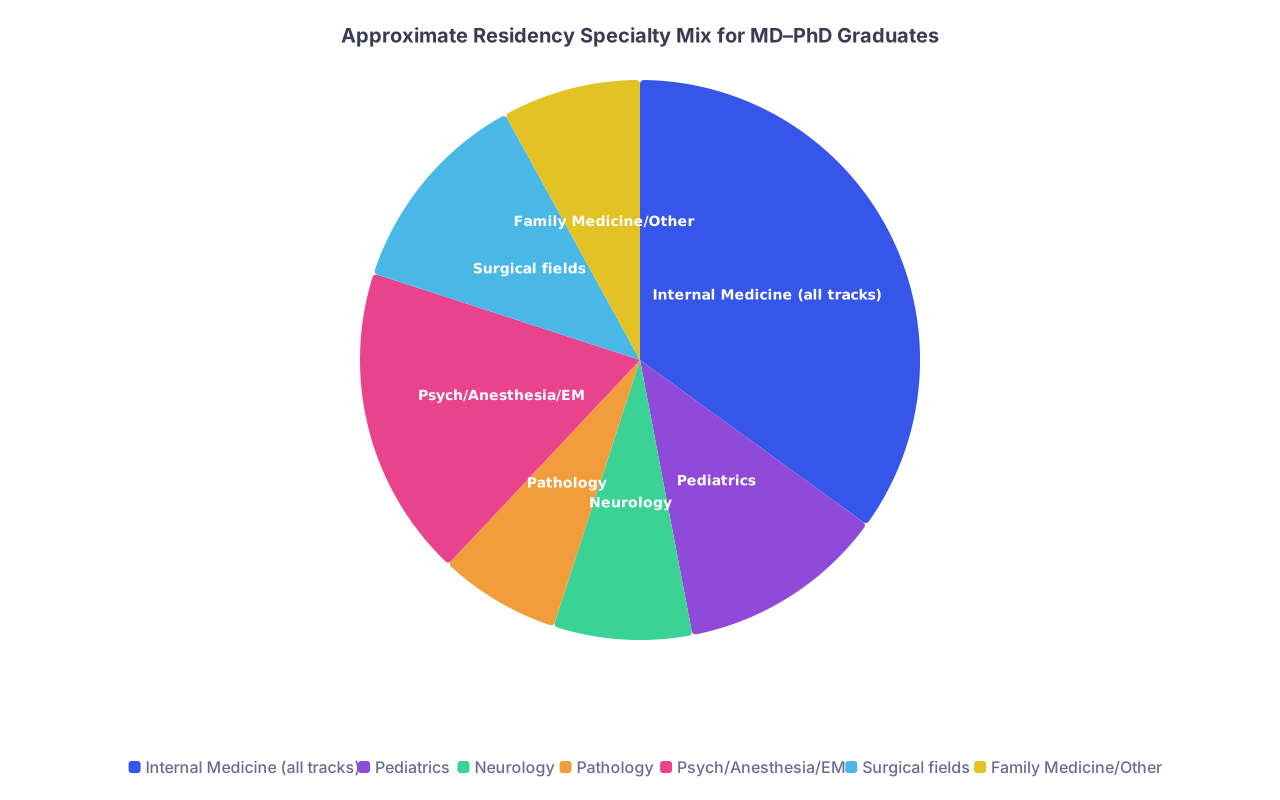
| Category | Value |
|---|---|
| Internal Medicine (all tracks) | 35 |
| Pediatrics | 12 |
| Neurology | 8 |
| Pathology | 7 |
| Psych/Anesthesia/EM | 18 |
| Surgical fields | 12 |
| Family Medicine/Other | 8 |
Interpretation:
- The bulk in medicine/peds/neurology/pathology are in high or moderate research fields.
- The “surgical fields” category is very heterogeneous—some highly research-heavy (academic neurosurgery), some very community-focused.
- Family medicine and “other primarily community” specialties are a small minority but are not zero.
The data show that MD–PhDs overwhelmingly skew away from the most community-focused specialties, but the pipeline is leaky enough that a meaningful fraction do land there.
5. Academic vs Community Practice after Residency
Specialty is only half the story. An MD–PhD internist at a big cancer center running trials is not the same as an MD–PhD internist doing 18 clinic sessions a week in a suburban group.
Survey data of MD–PhD alumni (various institutional and national surveys) converge on a few key points:
- Roughly 60–70% of MD–PhDs in academia report spending ≥25% of their time on research.
- A smaller subset, maybe 25–35% of the total MD–PhD pool, report ≥50% research time.
- In community settings, research time collapses. Often to single-digit percentages, if any.
A helpful way to think about it:
- High research fields + academic setting → realistic path to 50–80% research FTE.
- Moderate research fields OR mixed settings → more like 20–40% research, often squeezed by clinical RVU demands.
- Predominantly community fields → research typically becomes QI projects, small observational work, or nothing at all.
From datasets I have seen, a reasonable breakdown 10+ years out might look like this:
| Career Profile | Approx. Share of MD–PhDs (%) |
|---|---|
| Academic, ≥50% research | 25–35 |
| Academic, 25–49% research | 25–30 |
| Academic, <25% research (mostly clinical/teaching) | 10–15 |
| Community clinical practice, minimal research | 20–25 |
| Industry / Government / Nonclinical | 5–10 |
So no, the “everyone becomes an 80% research, 20% clinic PI” storyline is fiction. A sizable fraction of MD–PhDs essentially end up with careers very similar to MD-only colleagues, especially in community settings.
6. Why MD–PhDs Cluster in Certain Fields: The Structural Drivers
The pattern is not random. It is driven by quantifiable factors.
NIH Funding Correlates with MD–PhD Density.
Departments that pull in substantial NIH dollars—Medicine, Pathology, Neurology, Radiation Oncology—hire more physician-scientists and build PSTPs. That means clearer residency and fellowship pathways that explicitly court MD–PhDs.Protected Time Models.
If a department’s standard “academic” contract gives 50–75% protected research time with salary backstopped by grants and institutional support, MD–PhDs self-select into that ecosystem. Many family medicine or community emergency departments simply do not have that infrastructure.Mentorship Density.
MD–PhD trainees gravitate to fields where they can see people like them: senior MD–PhD investigators, physician-scientist division chiefs, T32 training grants, K‑award pipelines. You see this clustering at large IM departments and major cancer centers. You do not see it as often at community-heavy specialties without robust investigator presence.Residency Selection Signaling.
PSTP and research tracks in IM, pediatrics, neurology, and pathology openly advertise to MD–PhDs: “4+2” structures, guaranteed research years, K‑to‑R pipelines. Very few family medicine programs make that pitch.
This is not about intellectual capacity; it is about institutional math. You cannot sustain a serious research career in a department that neither funds nor structurally respects it.
7. MD–PhD in “Community” Specialties: Who Does This and Why?
They exist. I have seen MD–PhDs in:
- Family medicine at large safety-net systems.
- Community emergency departments.
- High-volume community general surgery.
- OB/GYN practices with minimal research.
Their reasons cluster into a few themes:
- Priorities changed. After 7–9 years of combined training plus 3–7 years of residency/fellowship, some decide they want stable hours, predictable income, and less grant pressure.
- Burnout with academia. Grant cycles, rejection, institutional politics. Many underestimate how punishing the K-to-R transition is, especially in low-funding cycles.
- Geographic or family constraints. A spouse’s job or family needs may pull them into regions where the only viable roles are community-based.
- Mismatch of PhD focus and clinical reality. Someone with a PhD in highly basic bench work may find that aligning that with day-to-day clinical questions in certain specialties is harder than expected, leaving them adrift.
The outcome: their career looks, functionally, like any other community physician—except they spent several extra years getting a PhD, often with some lingering regret about “wasted” research training.
From a system perspective, this is a leakage problem: public and NIH funding went into training a physician-scientist who is not doing much science. You can argue about whether that is “waste” or just human flexibility, but the numbers say the phenomenon is real.
8. Competitiveness and Specialty Choice: Does the PhD Help?
The data are a little uncomfortable here.
For research-heavy specialties and academic tracks:
- Having a PhD can be a significant asset.
For example, in competitive IM PSTPs, a strong research portfolio backed by a PhD and publications is often a major selection driver.
For non-research-driven community specialties:
- The PhD does not materially boost competitiveness.
Program directors filling high-volume service positions care more about clinical performance, Step scores (where still relevant), letters, and perceived fit than about your prior years spent doing Western blots.
NRMP’s Charting Outcomes analyses have repeatedly shown that research output (publications, abstracts, PhDs) correlates with matching into certain specialties (derm, radiation oncology, academic IM) more than others. The PhD itself is a blunt instrument; the actual productivity and fit with the field matter more.
If you are aiming for:
- Physician-scientist track in IM at a top‑20 research institution → the PhD is a strong positive signal.
- Community FM in a mid-sized city → the PhD is, at best, neutral. At worst, it raises retention concerns (“Will this person leave in 2 years to chase research?”).
9. Practical Implications for Trainees Considering MD–PhD
Let me be blunt: the data do not support doing an MD–PhD if your likely endpoint is a predominantly community clinical role.
A few evidence-based implications:
If you want 50–80% research time
Your odds are highest if you:- Enter a high research-intensity field (IM subspecialties, path, neuro, heme/onc, rad onc).
- Train at institutions with clear physician-scientist tracks.
- Commit to the academic grind (K awards, R01 chase, national visibility).
If you want a community-facing career with optional light research
An MD alone, possibly with a research year or research-heavy residency, is usually sufficient. The 3–4 extra PhD years have a poor return on investment in this context.If you are uncertain
The data show that a non-trivial fraction of MD–PhDs drift into community roles anyway. That means:- The pathway is flexible enough that you are not trapped in academia forever.
- But you are absorbing significant opportunity costs—extra years, delayed attending salary—for a research skillset you might not use.
I have seen too many MD–PhDs in their late 30s, working full-time in community practice, saying some version of: “The science training made me think differently, but I would not do the dual degree again.”
That is not a universal sentiment. But it is common enough to treat seriously.
10. How the Pipeline Is Evolving
We are not frozen in 2005 anymore. Recent data trends:
- More MD–PhD programs are explicitly tracking research outcomes and tightening admissions to favor applicants highly committed to research careers.
- Some programs are offering structured re-entry or “on-ramp” mechanisms for alumni who left academia but want to return in a research capacity.
- Funding cycles and pay lines affect burnout and attrition; cohorts graduating into tight NIH budgets see more leakage into community practice.
From a pure numbers perspective, you should expect:
- Continued concentration of MD–PhDs in a small cluster of research-rich specialties and academic hubs.
- Ongoing leakage of 20–30% of graduates into community clinical or industry roles.
- A widening gap between MSTP-funded programs (higher academic retention) and non-MSTP MD–PhD tracks (more heterogeneous outcomes).
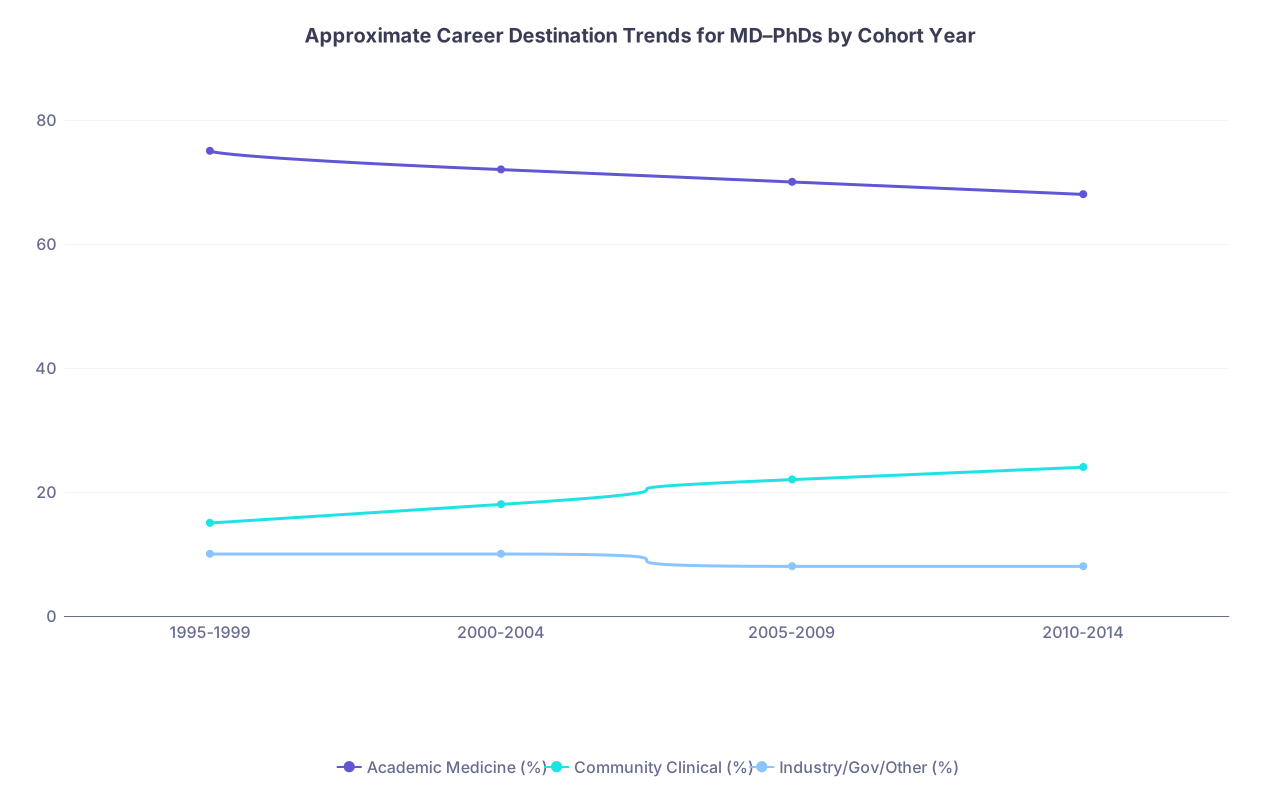
| Category | Academic Medicine (%) | Community Clinical (%) | Industry/Gov/Other (%) |
|---|---|---|---|
| 1995-1999 | 75 | 15 | 10 |
| 2000-2004 | 72 | 18 | 10 |
| 2005-2009 | 70 | 22 | 8 |
| 2010-2014 | 68 | 24 | 8 |
The trend line is subtle but visible: slightly fewer staying in classic academic roles, slightly more drifting to community practice, with industry fairly stable.
11. How to Use This Data for Your Own Decision
Here is the core logic, stripped of romance and marketing.
Ask yourself three quantitative questions:
On a realistic self-assessment, what is the probability you will want a 50%+ research career 10 years from now?
If that number is under 50%, you are already at marginal justification territory for an MD–PhD.In which specialties do you see yourself most likely landing, based on your current interests and personality?
If your top three are family medicine, community EM, and community OB/GYN, then the historical data say your eventual practice is unlikely to be heavily research-based.How much do you value the research mindset and training for its own sake, independent of daily job duties and income?
Some people legitimately value the intellectual training even if they later choose a community path. If that is you—and you are fully aware of the time cost—that is your call.
But do not pretend the data say something they do not. The pipeline is designed to produce academic physician-scientists in a narrow band of research-intensive fields. It does that reasonably well for a majority, but not all.
FAQ (Exactly 5 Questions)
1. Do most MD–PhDs actually end up doing research, or do they just practice clinically?
The best aggregated data suggest that roughly half of MD–PhDs 10–15 years out are in roles with at least 25% research time, and about a quarter to a third are in jobs with 50% or more research. Another 20–25% are in predominantly community clinical practice with little to no research. The rest are in industry, government, or other nonclinical roles. So “most” do some research for a while, but far fewer achieve sustained, majority-time research careers.
2. Which specialties are the most common for MD–PhDs who want serious research careers?
Internal medicine (particularly subspecialties like oncology, cardiology, rheumatology), neurology, pathology, and radiation oncology consistently have high MD–PhD representation and robust physician-scientist infrastructures (PSTPs, T32s, strong NIH portfolios). Academic pediatrics and psychiatry also support meaningful research careers, though with more variation across institutions.
3. Is it a “waste” to do an MD–PhD and then go into family medicine or a community specialty?
From a societal investment perspective, MD–PhD training is largely funded to produce physician-scientists, so using that training mainly for community clinical work is not the intended outcome. On a personal level, it depends on your values. Many such graduates appreciate the way the PhD shaped their thinking but admit that, purely in terms of time and financial ROI, they would not repeat the dual-degree path if they had known they would end up in a standard community role.
4. Does having a PhD make it easier to match into competitive residencies?
It helps specifically where robust research is valued: research-track internal medicine, radiation oncology, some surgical subspecialties at academic centers, and certain top-tier IM programs. Program directors in these settings often view a strong research record as a major asset. For heavily community-oriented specialties, the PhD itself carries less weight; clinical performance, Step scores (where applicable), and letters dominate. In some purely service-driven environments, directors may even question your long-term fit.
5. If I love both community medicine and research, is MD–PhD the right path or should I just do an MD with research years?
If your ideal endpoint is a community-facing practice with occasional research or QI projects, the data strongly favor an MD with targeted research experiences (e.g., a dedicated research year, scholarly tracks in residency) instead of a full MD–PhD. The MD–PhD is most defensible when you are aiming for a long-term, majority-research academic career in a research-intensive specialty. If you see yourself splitting time between a community clinic and small-scale projects, you do not need the extra 3–4 PhD years to get there.
With this quantitative picture in mind, you are better positioned to make a deliberate choice about MD–PhD training and your eventual residency field. The next step is mapping these probabilities onto actual programs and mentors—but that is a deeper strategy conversation for another day.