
The mythology about “more degrees equals more debt” is only half right. The data show something subtler, and in a few cases, the opposite of what most students expect.
You asked about three concrete pathways:
- MD only
- MD–PhD (dual degree)
- PhD first, then MD
I will treat this the way I would in a finance meeting: define assumptions, quantify debt, quantify earnings, and look at net position over time. Feelings about “loving research” are nice; they do not pay 6.5 percent interest.
Baseline data: what we actually know about debt and training length
Start with the big picture.
From AAMC and NSF data (rounded to keep this readable):
- Median medical school education debt (MD grads, 2023): about $200,000–$220,000
- About 25–30% graduate with $300,000+
- Median PhD in life sciences debt (including those with some borrowing): $25,000–$35,000, but the most common outcome is $0 debt because stipends cover living and tuition
- MD–PhD (MSTP-style) graduates: tuition almost always fully covered, and they receive stipends during the PhD years, sometimes also during MD years
- Typical reported education debt: $0–$80,000, and a large chunk have no debt at all
Training duration, typical:
- MD only:
- 4 years med school
- 3–7 years residency (use 4–5 as a realistic average for analysis)
- MD–PhD:
- 7–9 years MD–PhD
- 3–7 years residency (again, use 4–5)
- PhD first, then MD:
- 5–6 years PhD
- 4 years MD
- 3–7 years residency
Median age at completion:
- MD only: finish med school ~28, finish residency ~31–33
- MD–PhD: finish dual degree ~30–32, residency ~34–37
- PhD → MD: finish PhD ~29–30, MD ~33–34, residency ~36–38
So you trade:
- MD only: larger education debt, shorter training, earlier earning
- MD–PhD: much lower education debt, but 3–4 fewer high-earning years
- PhD → MD: likely two separate debt streams (if PhD had any), and the longest delay to attending income
Now let’s quantify the three.
Pathway 1: MD only – high debt, early earnings
The MD-only path is simple enough that you see people make lazy assumptions. “Doctors make a lot, they’ll be fine.” That is not what the amortization schedule says.
Reasonable working assumptions for MD only:
- Tuition/fees and living (4 years):
- Borrowing: $55,000 per year (middle of public/private spread)
- Total principal at graduation: $220,000
- Interest rate: 6.5% (federal Grad PLUS / unsubsidized)
- Residency: 4 years, using an IDR plan that roughly keeps up with interest but does not aggressively reduce principal
- Attending salary: two scenarios
- Primary care / general IM: $240,000–$260,000
- Procedure-heavy specialty: $450,000–$550,000+
If you simply let the loan capitalize and pay on a standard 10-year plan after residency, rough numbers:
- Balance at end of 4-year residency: Principal grows from $220,000 to about $280,000–$300,000 if payments are minimal (interest-on-interest adds up)
- Payment on $280,000 at 6.5% for 10 years: about $3,200–$3,300/month
- Total paid over 10 years: around $380,000–$400,000
So the real cost of that $220,000 principal is roughly $160,000–$180,000 in interest if you do not get PSLF and do nothing special.
You can shorten that and pay less interest by:
- Paying more during residency
- Living lean as an attending and throwing, say, $5,000/month at loans for 5–7 years
The point: MD-only gives you 4+ more high-income years than the dual-degree paths, and those years are financially powerful. But the raw debt burden is the highest of the three.
Pathway 2: MD–PhD – minimal tuition debt, delayed income
MD–PhD looks financially irrational if you only count “age when you start making big money.” But that is a lazy metric. You need to compare:
- Much lower principal debt
- Comparable lifetime earnings if you still practice clinically
- Higher probability of research-heavy, usually lower-paying academic jobs
Typical MD–PhD financial structure (NIH MSTP or equivalent):
- Med school tuition: $0 (covered)
- PhD tuition: $0
- Stipend: $30,000–$40,000 per year, 7–9 years
- Some programs cover all 7–8 years, others cover MD years partially
Actual debt outcomes from multiple program surveys and AAMC cross-tabs:
- Many MD–PhD graduates: $0 med school debt
- Common ranges: $0–$50,000
- Outliers in high-cost cities or weaker funding: $80,000–$100,000
So, let us analyze three concrete MD–PhD debt cases:
- Case A – full funding, prudent living: $0 debt
- Case B – partial borrowing for cost-of-living: $40,000 at graduation
- Case C – high-cost city, some lifestyle inflation: $90,000 at graduation
Compared to the MD-only $220,000, these are dramatically lower principals.
Assume:
- Interest: 6.5%
- 4-year residency
- Start repayment seriously as attending
If we just use the mid case (B: $40,000 principal):
- After residency with modest IDR: balance maybe $50,000
- 10-year standard payment: around $570/month
- Total paid: about $68,000 (so ≈$18,000 interest)
Compare that to the MD-only number: ≈$380,000–$400,000 total payments. You are saving about $300,000+ in cumulative payments versus the median MD-only borrower, but you delayed your attending income by ~3–4 years.
Now look at the earnings side.
Academic MD–PhDs in research-heavy roles tend to earn:
- Academic internal medicine attending: $220,000–$260,000
- Academic surgical subspecialties: $350,000–$450,000, lower than private
Meanwhile, an MD-only who goes straight through and joins private practice can easily land in the $350,000–$600,000+ range depending on specialty and geography.
So as a pure financial play, MD–PhD makes the most sense if:
- You would have studied a PhD anyway
- You prefer academic/NIH-funded tracks
- You see value in lower debt and are willing to accept lower average attending income
The data on time to “net zero”—point where your assets and income catch up to your peers—are nuanced. But rule of thumb:
- MD only: can be net-debt-free by mid-30s with discipline
- MD–PhD: likely late-30s to early-40s, depending on academic vs private mix
- But the MD–PhD may never face the psychological and cash-flow hit of $300k-plus loans
Pathway 3: PhD first, then MD – often the worst of both worlds financially
This is where the numbers get ugly for most, and you do not hear enough honest talk about it.
Typical PhD in biomedical sciences:
- Tuition waived
- Stipend $28,000–$38,000 per year
- Duration: 5–6 years
- Debt:
- Many have $0 debt from PhD itself, but
- Some carry $10,000–$30,000 from undergrad because they did not pay it off on a stipend
Then add:
- Full MD cost after PhD
- No MSTP-style tuition coverage in most cases
- Less access to subsidized perks targeted at MD–PhD tracks
So a very realistic “PhD → MD” financial picture:
- Undergrad + PhD era residual loans: $20,000–$40,000 (not paid off yet)
- MD borrowing: $220,000–$260,000
- Total education debt at end of MD: $240,000–$300,000
There are exceptions:
- If you worked industry between PhD and MD and paid everything off
- If you had strong family support
- If a school gave you major MD scholarships
But if we are talking averages, the PhD-first-then-MD path tends to resemble MD-only debt or worse, with added years where your income was a small stipend.
Let me formalize the comparison in a compact table.
| Pathway | Debt at end of MD phase | Years of training before attending income | Typical monthly payment (10-yr, 6.5%) |
|---|---|---|---|
| MD only | ~$220k principal | 4 (MD) + 4 (residency) | ~$3,200–$3,300 |
| MD–PhD (funded) | $0–$50k | 8 (avg MD–PhD) + 4 (residency) | $0–$700 |
| PhD → MD | ~$240k–$300k | 6 (PhD) + 4 (MD) + 4 (residency) | ~$3,300–$4,500 |
And to visualize it:
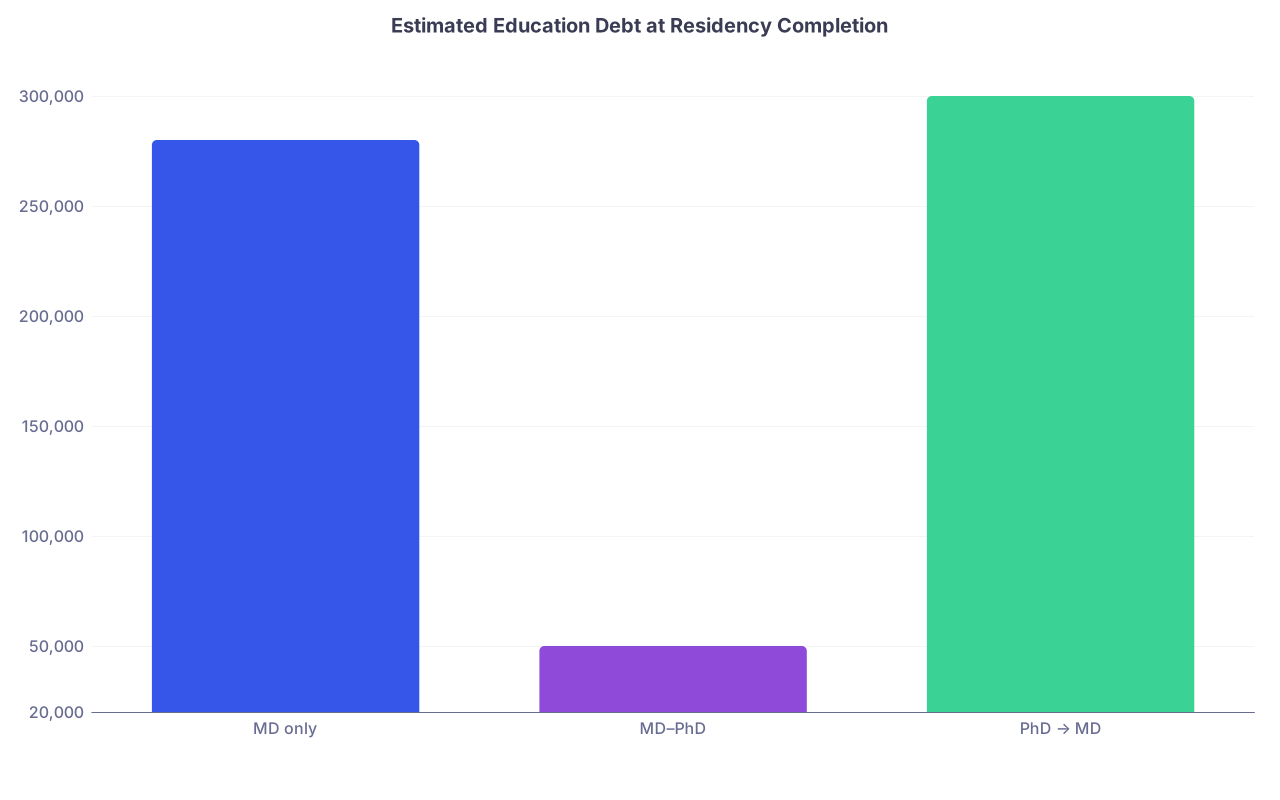
| Category | Value |
|---|---|
| MD only | 280000 |
| MD–PhD | 50000 |
| PhD → MD | 300000 |
The data show a few blunt truths:
- MD–PhD usually has the lowest debt by a wide margin
- PhD → MD usually has the highest total training time and similar or higher debt than MD-only
- PhD → MD almost never “beats” MD–PhD financially unless you had unusual scholarships or high-earning industry years that wiped out prior debt
If your goal is to become a physician-scientist, going PhD first then MD is financially dominated (worse on both years and money) by just doing an MD–PhD from the start, for the vast majority of students.
Putting numbers on the “lost years”: net worth trajectories
Debt is only half of this. The other half is time. A lost attending year is easily $150,000–$300,000 of after-tax opportunity.
Let me simplify and construct three stylized scenarios.
Assumptions (intentionally conservative and rounded):
- Resident salary: $70,000/year, minimal savings
- Attending primary-care-like income: $250,000, after-tax ~$160,000
- Attending higher-paying specialty: $450,000, after-tax ~$280,000
- Savings rate as attending: 25% of after-tax income after loan payments
- No PSLF, no inheritances
Scenario 1 – MD only, moderate debt
- Age 22: start med school
- Age 26: graduate, $220,000 loans
- Age 30: finish 4-year residency, start attending
- Age 40: 10 years of attending income accumulated
Just looking at savings (ignoring investment growth, to keep it apples-to-apples):
- Annual savings at 25% of $160,000 (primary care line): $40,000
- Over 10 years: $400,000 saved
Subtract the loan burden effect:
- Total loan payments: ≈$380,000–$400,000 over life of loan
- These payments come out of cash flow mostly in early attending years
You can think of the MD-only path as:
- 10 attending years by age 40
- Heavy loan drag early, but large gross earnings window
Scenario 2 – MD–PhD, low debt, later start
- Age 22: start MD–PhD
- Age 30: finish MD–PhD, $40,000 loans
- Age 34: finish residency, start attending
- Age 40: 6 years of attending income
Same model:
- Annual savings: still 25% of $160,000 = $40,000
- Over 6 years: $240,000 saved
Loan payments:
- Total loan payments ≈$68,000 (from earlier calculation)
Net, the MD–PhD has:
- About 4 fewer earning years by age 40
- Roughly $240,000 in direct savings (vs $400,000 for MD-only)
- But also ≳$300,000 less total loan repayment burden
If you net those crude numbers:
- MD-only: $400,000 saved – $380,000 paid = ≈$20,000 “net” in this very rough framing
- MD–PhD: $240,000 saved – $68,000 paid = ≈$172,000 “net”
That is intentionally oversimplified, but it shows why the story “MD–PhD is a financial disaster” is not supported by the raw debt data. The smaller principal can more than offset the lost earning years, especially if:
- You choose a mid-to-high earning specialty
- You do any private-practice or consulting work on top of academic salary
Scenario 3 – PhD → MD, high debt, very late start
Now the worst-case pattern:
- Age 22: start PhD
- Age 28: finish PhD (with $20,000 loans lingering)
- Age 32: finish MD ($260,000 MD loans)
- Age 36: finish residency
- Age 40: 4 years of attending
Debt:
- Start of attending: combined ~$300,000 principal (after some interest during residency) → balance maybe $360,000–$380,000
- 10-year standard payment: $4,200–$4,500/month
- Total loan payments over time: around $500,000–$540,000
Savings:
- 4 years × $40,000 savings/year = $160,000 by age 40
Net in this simplified comparison:
- $160,000 saved – ~$520,000 paid ≈ –$360,000 in this crude “net position” framing
Again, this is a stylized model, but it illustrates the general pattern: PhD → MD combines late earnings with debt loads similar to or higher than MD-only. The data consistently show that, unless you had major financial help or unusual scholarships, it is a financially dominated choice compared with integrating the degrees as an MD–PhD.
The interest drag: compounding quietly kills you
One more point people ignore: the growth of loans during training.
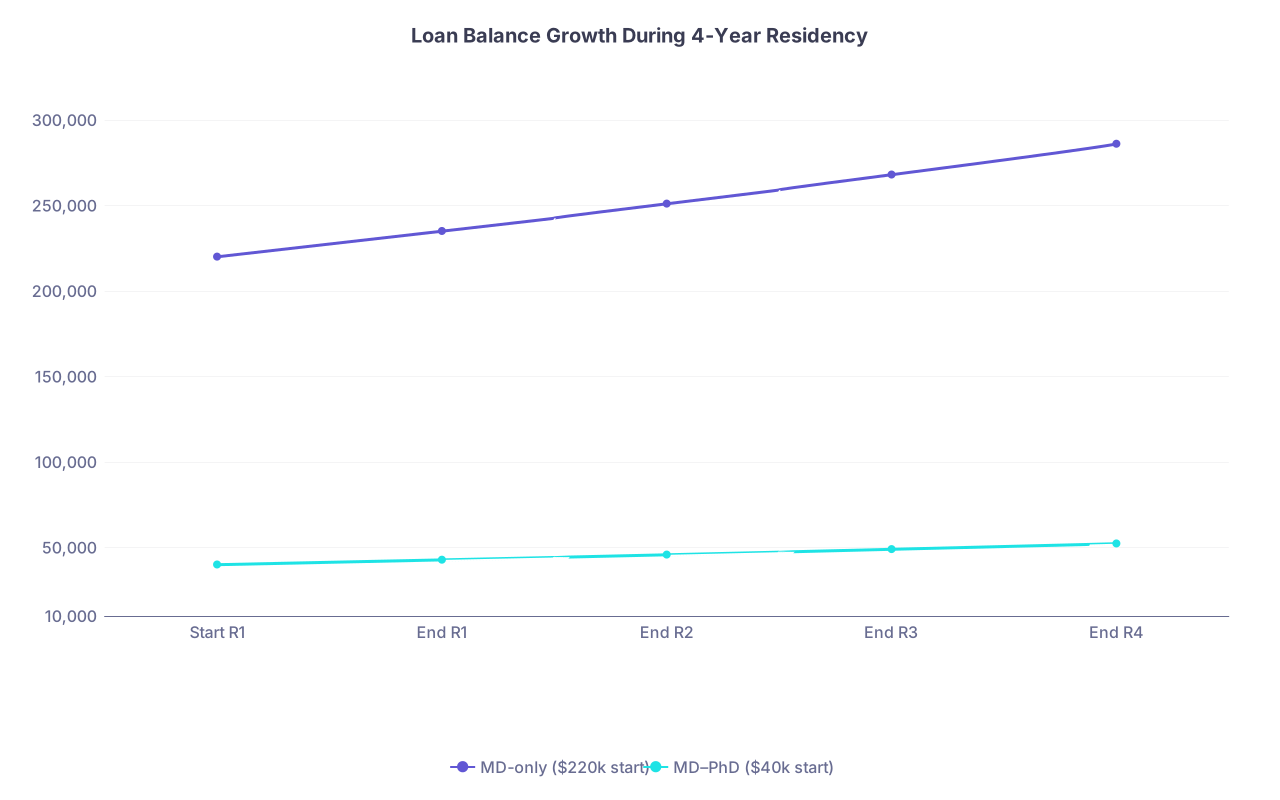
| Category | MD-only ($220k start) | MD–PhD ($40k start) |
|---|---|---|
| Start R1 | 220000 | 40000 |
| End R1 | 235000 | 42800 |
| End R2 | 251000 | 45800 |
| End R3 | 268000 | 49000 |
| End R4 | 286000 | 52300 |
At 6.5% interest:
- A $220,000 balance accrues ~$14,300 in interest per year
- A $40,000 balance accrues ~$2,600 in interest per year
So every additional year of deferment / low payment hits the MD-only borrower far harder. MD–PhD borrowers with small principals can ride IDR during residency with relatively minor damage. MD-only and PhD → MD borrowers accumulate thousands per month in extra obligations if they do not pay aggressively.
How this plays out if you aim for PSLF
Public Service Loan Forgiveness (PSLF) can change the calculus, but it changes it more for the high-debt paths than the low-debt ones.
If you:
- Do 3–7 years of residency/fellowship at a qualifying nonprofit hospital
- Then stay in academic, VA, or other 501(c)(3) settings for enough years to hit 10 years of payments
PSLF can wipe out large remaining balances tax-free.
Implications:
- MD-only with $300,000+ debt: PSLF can be a massive subsidy
- MD–PhD with $0–$50,000 debt: PSLF impact is much smaller; you may pay it off before 10 years
- PhD → MD with $300,000+ debt: PSLF again can be huge, but you are starting your PSLF meter later in life and carrying the psychological burden longer
So if you are convinced you will stay in academic medicine for 10+ years, the downside of MD-only or PhD → MD debt is blunted. But “convinced” is doing a lot of work here; residents routinely change priorities once they see real attending offers.
Qualitative but data-backed conclusions
Let me be blunt and tie the numbers together.
MD–PhD is usually the lowest-debt path of the three.
The combination of tuition waivers and stipends means many MD–PhDs finish with under $50k in education debt, while standard MDs cluster around $200k–$250k and PhD → MD paths often exceed that.PhD → MD is financially dominated in most cases.
Same or greater total debt than MD-only. More years on small stipends. Later start to attending income. You do it if you discover medicine late and cannot go back for an MD–PhD, not because it is a smart financial engineering move.MD only is the fastest to high income but carries the heaviest interest drag.
The raw principal is high and interest snowballs fast. The only reason it works is that four extra attending years are powerful; if you manage cost of living and pay aggressively, you can erase a brutal-looking loan sheet in 5–10 years.Lifetime net position is not as obviously bad for MD–PhD as people claim.
When you model both debt and earning years, an MD–PhD can end up ahead of an MD-only peer by mid-career, especially if that peer chose a lower-paying field and did not get PSLF.
If you want a hard-nosed takeaway
Three key points:
- The lowest typical debt burden belongs to MD–PhD graduates, not MD-only and certainly not PhD → MD.
- The worst overall financial trade for most people is doing a separate PhD first, then paying full freight for an MD; you add years and rarely reduce debt meaningfully.
- If you are debt-averse but research-committed, the data strongly favor MD–PhD over PhD → MD; if you are income-optimizing and indifferent to research, MD-only with disciplined repayment is the financially cleanest move.