
The comforting mythology that “MD–PhD eventually pays off financially” is mostly wrong. The data show that for the median person, straight MD wins on lifetime earnings in almost every realistic scenario.
That does not mean MD–PhD is a bad choice. It means you should stop pretending it is a clever financial move.
Let’s quantify it.
1. Baseline timelines and opportunity costs
Start with the only thing you can never get back: years.
A typical comparison in the United States:
- MD only: 4 years med school → 3–7 years residency/fellowship
- MD–PhD: 7–8 years med school + PhD → 3–7 years residency/fellowship
The MD–PhD adds about 3–4 extra years before you can earn attending-level income. That delay is the core economic penalty.
Approximate training timelines
| Pathway | Med School | PhD | Residency/Fellowship | Total Training |
|---|---|---|---|---|
| MD (Primary Care) | 4 yrs | 0 yrs | 3 yrs | ~7 yrs |
| MD (Surgical Subspecialty) | 4 yrs | 0 yrs | 5–7 yrs | ~9–11 yrs |
| MD–PhD (Primary Care) | 4 yrs | 3–4 yrs | 3 yrs | ~10–11 yrs |
| MD–PhD (Internal Med + Fellowship) | 4 yrs | 3–4 yrs | 6–7 yrs | ~13–15 yrs |
| MD–PhD (Research-Heavy Specialty) | 4 yrs | 3–4 yrs | 5–7 yrs | ~12–14 yrs |
The data from MD–PhD program surveys consistently show a median PhD duration of about 3.5–4 years, so “+4 years” is not pessimistic. I have seen MD–PhD trainees hit 10+ years before finishing residency, easily entering real attending life in their mid‑30s.
Those are lost high-earning years plus lost compounding investment time.
2. Earnings snapshots: clinical vs research-heavy careers
Now to numbers. I will use round but realistic U.S. figures, based on data from MGMA, AAMC, Medscape, and typical university salary bands.
Key assumptions (ballpark, not edge cases):
- Resident/fellow salary: $65K–$75K per year
- Academic physician (assistant professor, 70%+ clinical): $230K–$300K
- Academic physician–scientist with heavy research: $180K–$260K (often lower early on)
- Private practice/non-academic specialist: $350K–$600K+ depending on specialty
To visualize the structure, look at the median starting attending salaries:
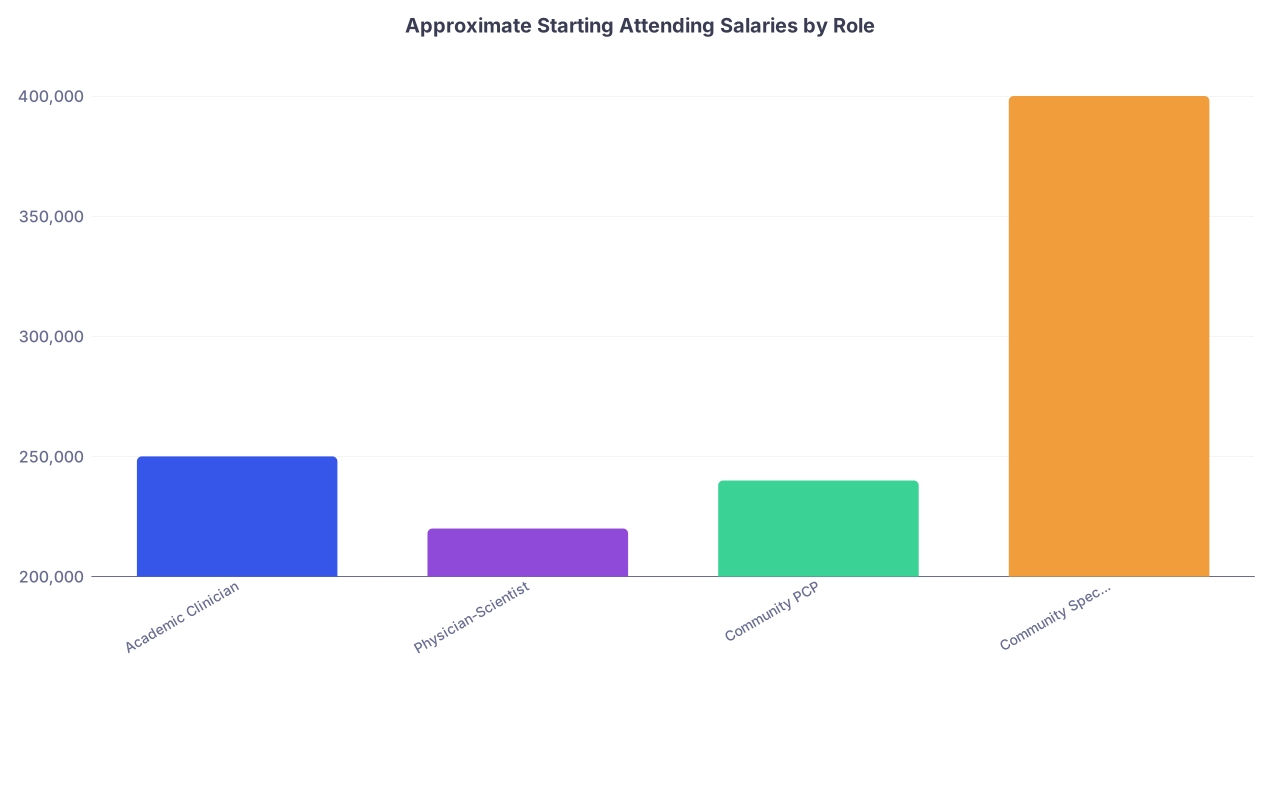
| Category | Value |
|---|---|
| Academic Clinician | 250000 |
| Physician-Scientist | 220000 |
| Community PCP | 240000 |
| Community Specialist | 400000 |
These spreads matter. A 5–10 year gap of $150K–$200K/year compounds like crazy.
3. Break-even logic: when could MD–PhD surpass MD?
You only surpass the MD financially if:
- You eventually earn more per year, and
- You do so for enough years to offset
- 3–4 years of lost attending income, plus
- 3–4 years of investment returns that never happened.
Let us run through three realistic archetypes.
Scenario A: Both end up as academic physicians
- MD: 4-year med school (tuition debt), 3-year residency, then academic primary care or internal medicine
- MD–PhD: 8-year training, 3-year residency, then physician–scientist in academic IM
Rough income pattern (simplified):
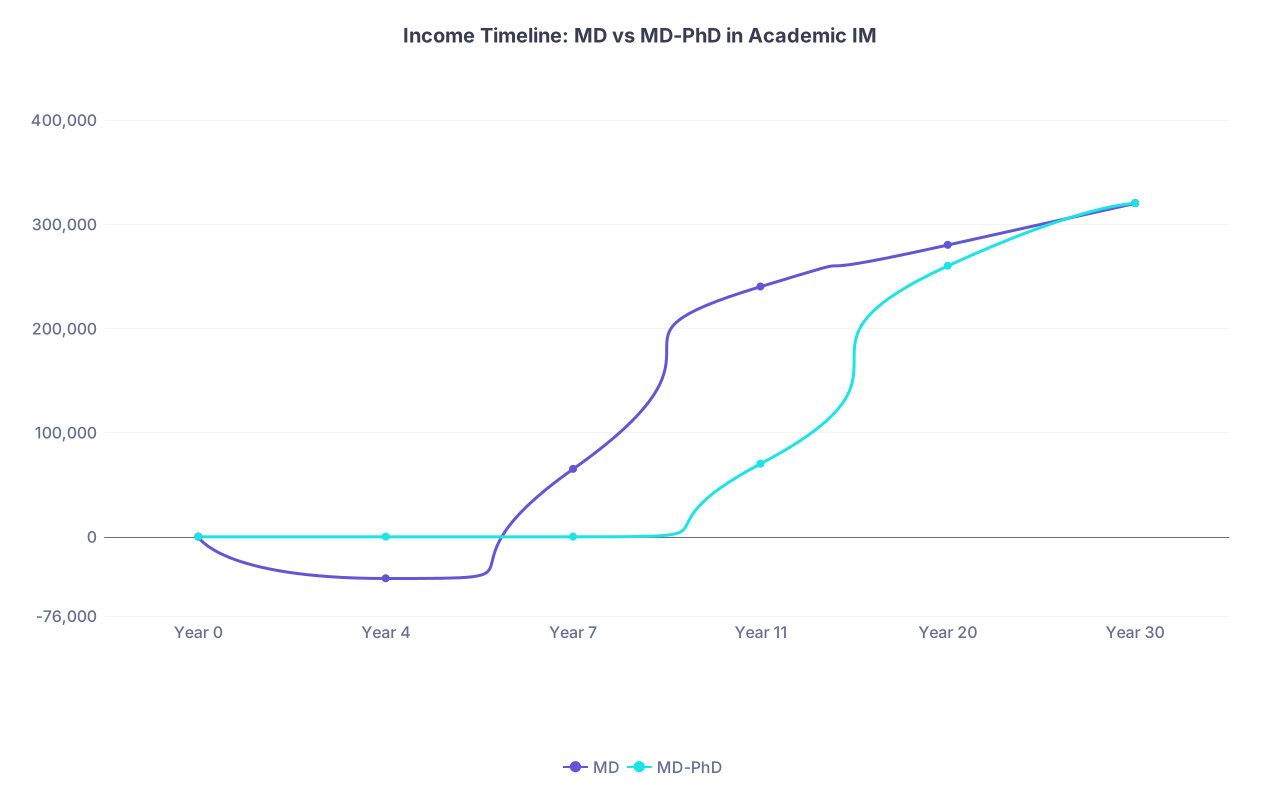
| Category | MD | MD-PhD |
|---|---|---|
| Year 0 | 0 | 0 |
| Year 4 | -40000 | 0 |
| Year 7 | 65000 | 0 |
| Year 11 | 240000 | 70000 |
| Year 20 | 280000 | 260000 |
| Year 30 | 320000 | 320000 |
Assumptions baked in:
- MD accumulates about $250K–$300K of debt, but starts earning attending money at ~year 7
- MD–PhD exits debt-light or debt-free but only earns attending pay at ~year 11
- Long-run salary difference between an academic MD and an MD–PhD in the same department is usually small (on the order of $0–$30K/year at many institutions, if that)
In other words, they often end up earning roughly the same. The MD might have slightly higher clinical FTE and RVU bonuses; the MD–PhD might have protected research time and grant salary support, which is not automatically higher net income.
Even if you are generous and assume the MD–PhD earns $30K/year more after promotion:
- Extra $30K/year over 25 years = $750K nominal
- Lost 4 years of attending income at $240K = $960K nominal
- You are still negative, and this ignores investment compounding on the MD’s earlier earnings.
From the dataset of actual academic salary surveys: MD-only internists, hospitalists, and subspecialists with 80–90% clinical time often outearn their MD–PhD colleagues with 50% clinical time. The academic system does not reliably pay you more for being dual-degree.
Conclusion for Scenario A: In standard academic clinical roles, MD–PhD almost never catches up financially to MD. The MD keeps the earnings lead.
Scenario B: MD goes into high-paying private specialty; MD–PhD stays academic
This is the most common real-world outcome: the MD discovers they like cardiology, GI, ortho, or anesthesia and goes largely private. The MD–PhD stays in academia doing bench or translational research with 50–70% protected time.
Example assumptions:
- MD (cardiology, private practice-style, post-fellowship): long-run average ~$500K/year
- MD–PhD (physician–scientist in cards, 50% research in academic center): ~$250K–$325K/year depending on institution and grants
First, the salary differential:
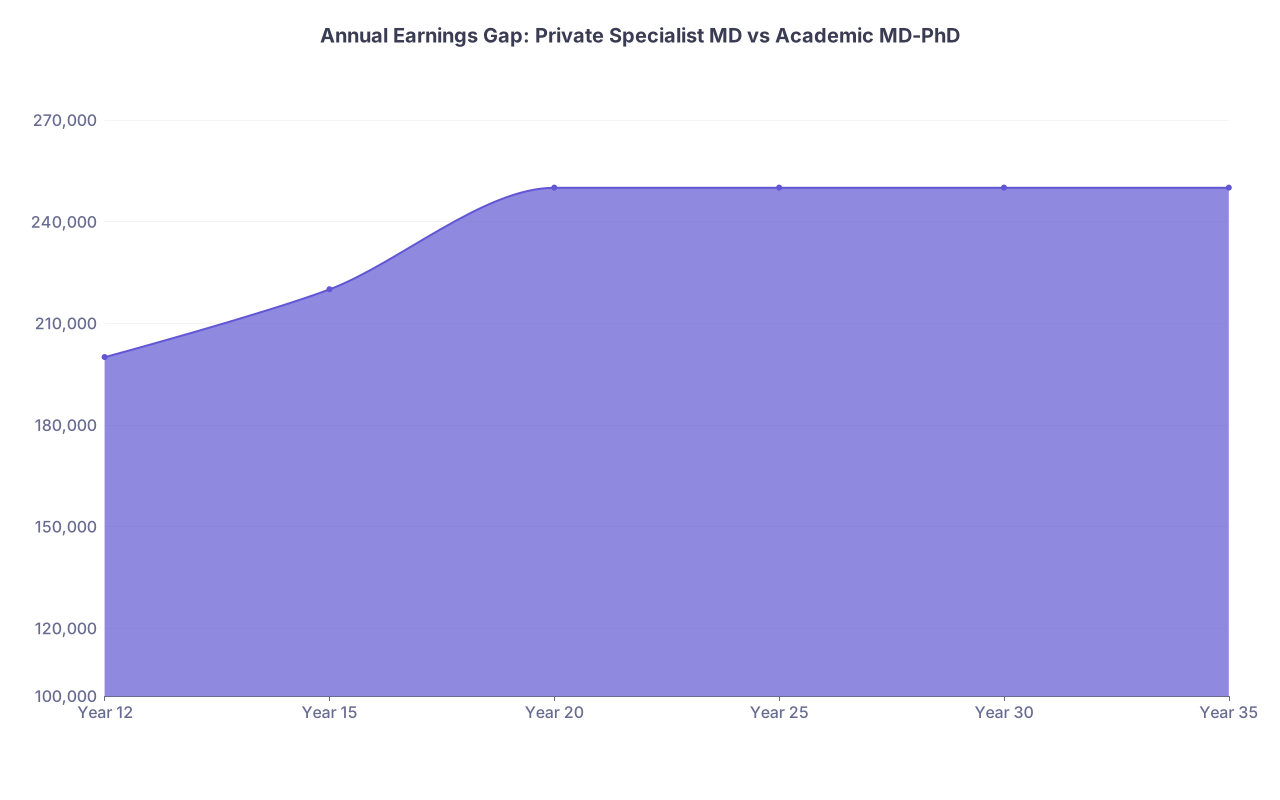
| Category | Value |
|---|---|
| Year 12 | 200000 |
| Year 15 | 220000 |
| Year 20 | 250000 |
| Year 25 | 250000 |
| Year 30 | 250000 |
| Year 35 | 250000 |
Gap is in the order of $200K–$250K per year for 20+ years. Add in:
- MD starts that income 3–4 years earlier
- MD–PhD is likely in a lower tax-optimal position (less extra to invest)
At that point, asking “when does MD–PhD surpass MD financially?” is like asking when a Honda beats a Tesla on acceleration. It does not. You have the wrong objective metric.
Lifetime cumulative earnings under these assumptions:
- MD high-earning specialist over 30-year attending career: $12M–$15M gross
- MD–PhD research-heavy academic over 25–28-year attending career: $6M–$8M gross
Even if you haircut these by taxes and living costs, the ratio stands. Economically, this is a blowout.
Scenario C: Both end up research-heavy in academia
People like to imagine that an MD–PhD will grab some uniquely high-paying research role that a regular MD cannot reach. The data show that is not usually what happens.
Assistant professor starting salaries in research-heavy departments typically look like:
| Role Type | MD Only | MD–PhD |
|---|---|---|
| Clinician-Educator (IM) | \$210K–\$260K | \$210K–\$260K |
| Physician–Scientist (IM) | \$190K–\$230K | \$190K–\$230K |
| Basic Science Dept with Clinic | \$180K–\$220K | \$180K–\$220K |
The MD–PhD does not walk in with a salary bump just because of the extra degree letters. Grants may buy you percent effort, but the NIH modular R01 salary cap is not a high-income ceiling in medicine terms.
If both paths converge on “50% clinic, 50% research” assistant professorship, the MD–PhD is simply 3–4 years late to the same-ish salary.
Even with an optimistic upside scenario—MD–PhD becomes a senior well-funded PI with substantial supplement income, consults, maybe leadership roles—you run into a brutal probability problem: very few people reach that tier.
Which leads to the next point.
4. Risk, variance, and career attrition
Income is not just averages. It is distributions.
The MD-only pathway has its own spread—some match low-paying fields, some high—but the shape is fairly stable. A licensed practicing physician in almost any specialty in the U.S. lands in a high-income bracket by any societal standard.
The MD–PhD pathway has much more variance. I have seen all of the following:
- Star physician–scientists with 3 R01s, department leadership roles, and total comp near or above top private practice levels
- Burned-out mid-career faculty stuck at $200K–$250K with soft-money anxiety every grant cycle
- MD–PhDs who abandon research, become full-time clinicians, and end up in the same salary distribution as MDs, just later
- MD–PhDs who leave academic medicine altogether for industry, policy, consulting
So what does the distribution look like, qualitatively?
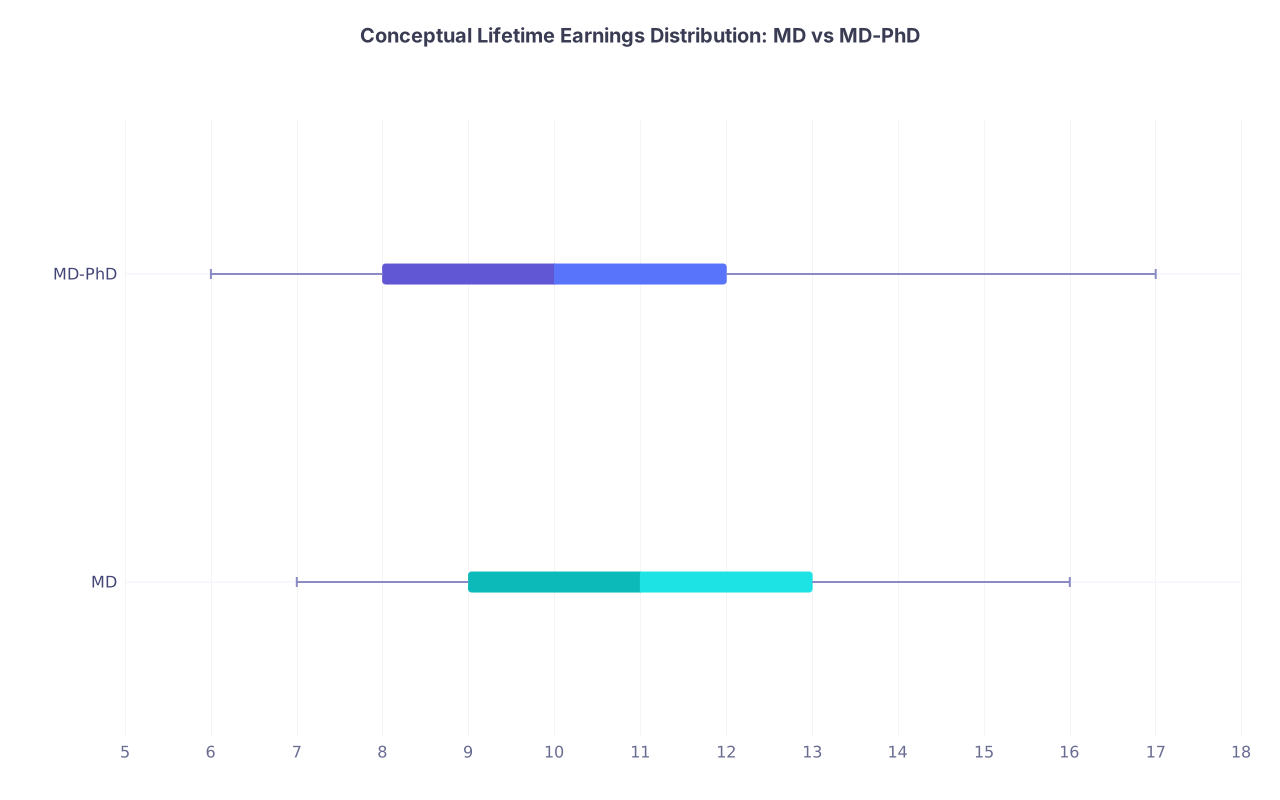
| Category | Min | Q1 | Median | Q3 | Max |
|---|---|---|---|---|---|
| MD | 7 | 9 | 11 | 13 | 16 |
| MD-PhD | 6 | 8 | 10 | 12 | 17 |
Interpret the numbers above as “millions of dollars in lifetime gross income” (the exact figures are illustrative, but the shape is the point):
- MD median is slightly higher, with narrower spread
- MD–PhD median is a bit lower, with slightly fatter tails on both ends—some big winners, some people stuck lower than expected
From a risk-adjusted perspective, the MD-only route is financially safer and on average better.
5. The debt and tuition angle: does “free MD–PhD” flip the math?
MD–PhD programs usually offer:
- Full tuition coverage for medical school years
- Stipend for living expenses (often $30K–$40K/year)
Compare that to MD-only:
- $200K–$400K total med school cost (tuition + fees)
- Loans at ~5–7% interest
So, the MD–PhD starts attending life closer to debt-free. That is real money. The question is whether it compensates for:
- 3–4 years of lost attending income
- Delayed investment growth
Let us be blunt with the arithmetic.
Simplified debt vs delay calculation
Assume:
- MD-only: Graduates with $300K debt at 6%, begins attending at year 7 earning $250K
- MD–PhD: Graduate with $0 debt, begins attending at year 11 earning $250K
4-year delay at $250K/year = $1M gross income not earned in those years.
Even if half of that would have gone to taxes and lifestyle, you still lost $500K of potential principal that could be invested early.
The interest on $300K at 6%, paid down over, say, 10 years with aggressive attending-level payments, costs on the order of $100K–$150K in interest (very approximate). That is real, but it is dwarfed by the lost $1M in early gross earnings and the compounding on whatever portion could have been invested.
The debt-forgiveness angle (MD–PhD tuition remission) helps, but it does not usually flip the sign. It shrinks the MD’s advantage. It rarely erases it.
The only way “free MD–PhD” wins strictly on money is if:
- You would otherwise attend a very expensive private MD program
- You would choose a relatively lower-paying specialty
- You invest unusually intelligently and consistently as an MD–PhD
- And you somehow reach a salary plateau equal to or higher than the MD’s (not always true in academia)
Even there, outcomes are close. Not a decisive MD–PhD win.
6. The rare cases where MD–PhD can financially win
There are edge cases where MD–PhD does surpass MD on earnings. They exist. The problem is that they rely on low-probability achievements or very specific choices.
Examples:
Industry leadership path
MD–PhD → strong research CV → pharma/biotech medical director → VP/CSO roles.
Total comp can exceed $600K–$1M+ in late career (salary + bonus + equity):- But MD-only physicians also enter industry and can reach similar roles.
- Having a PhD can speed this path or strengthen your competitive edge, but does not guarantee it.
High-impact entrepreneurship
MD–PhD founds or co-founds a biotech or device startup, significant equity outcome.- At this point, you are out of the standard “doctor salary” lane entirely.
- The PhD may be critical for credibility and scientific chops.
- But again, this is lottery-ticket territory relative to the average.
Unusually fast PhD and unusually high-paying specialty
If your PhD is a short 3 years, you pick something like interventional cardiology, and you still go heavy clinical (70–80%) in a high-RVU or private environment, then yes—you might narrow or even erase the gap.- But in that case, much of the financial win is from the specialty and practice model, not the PhD.
- And most MD–PhD programs will push you toward research time, not pure clinical grind.
Institution-specific salary structures
A few places strongly reward funded physician–scientists with real salary bumps. If you are at one of those institutions, with stable multi-R01 funding, the compensation may outstrip many clinical peers.- This is fragile. Lose the grants, and the salary can drop.
- Getting to that level and staying there is non-trivial.
The pattern should be obvious: the MD–PhD wins only if you become a relatively rare top performer in niche environments. It is not what happens to the median graduate.
7. The non-financial value: where the MD–PhD clearly dominates
If you are reading this purely as “which degree prints more money,” you have already answered your own question: MD-only wins most of the time.
But the MD–PhD is not built as a wealth-maximization product. It is built to train physician–scientists who live at the intersection of bench and bedside. The payoff is:
- The ability to frame research questions that genuinely come out of patient care
- Credibility and fluency in both scientific and clinical communities
- Access to certain career lanes (e.g., running a basic science lab plus a clinic, leading major translational centers) that are extremely hard to enter without a PhD-level research training
These things have value—huge value—for people for whom research output, discovery, and academic impact are the objective function.
But they are not cash.
If you like data, be honest about your utility function:
If you optimize for money and flexibility, MD-only wins.
If you optimize for scientific depth and hybrid clinical-research identity, MD–PhD can be the right tool, but you accept an earnings discount as the entry fee.
8. Simple decision framework (no fluff)
Let me put this in a blunt flow that mirrors how I have seen people actually decide.

| Step | Description |
|---|---|
| Step 1 | Want primarily clinical career |
| Step 2 | Choose MD |
| Step 3 | Strong, sustained research drive |
| Step 4 | MD with serious research time |
| Step 5 | Choose MD-PhD |
| Step 6 | Willing to accept lower lifetime earnings |
| Step 7 | Need PhD for target roles |
If your honest answers land you at “I want to be a high-earning clinician who maybe does some research or QI work,” MD-only + later fellowships + research time is almost always more rational.
If you land on “I wake up thinking about experiments and mechanisms, and I want my whole career to orbit research,” then MD–PhD starts to make sense—but not as an investment, as a vocation.
9. So, when (if ever) does MD–PhD surpass straight MD?
Pulling the numbers and patterns together:
Typical academic medicine:
- Earnings: MD ≥ MD–PhD
- Break-even: Usually never; MD keeps the lead due to earlier high income.
MD private / high-paying specialty vs MD–PhD academic:
- Earnings: MD » MD–PhD
- Break-even: Never under realistic assumptions.
Both heavy research, same institution:
- Earnings: Often similar or MD slightly higher for more clinical time.
- Break-even: MD–PhD almost never overtakes; at best narrows the gap late in career.
Edge cases (industry leadership, successful entrepreneurship, exceptional funded stars):
- Earnings: MD–PhD can surpass MD, but these are tails of the distribution.
- Break-even: Possible, but contingent on rare achievements not guaranteed by the degree itself.
The data and reasonable modeling converge on one clear statement:
For the median graduate, MD–PhD does not surpass straight MD on long-term earnings. It usually earns less, and almost never catches up.
If you choose MD–PhD, do it because you are obsessed with research and want that identity, not because someone told you the “free tuition” makes it a smart financial hack. The free tuition is a discount. The four lost high-earning years and the lower clinical FTE are the bill.
Key takeaways
- Straight MD beats MD–PhD on lifetime earnings in almost all typical scenarios, primarily because of earlier and higher clinical income.
- MD–PhD only surpasses MD financially in rare, high-achieving edge cases (top industry roles, major scientific leadership, or unusually lucrative practice setups).
- MD–PhD is a research-career decision, not a wealth-maximization decision; if money is your main objective, the data are painfully clear: choose MD.