
The idea that you “missed the MD–PhD train” because you didn’t decide at 19 is nonsense—and it’s also exactly what keeps people stuck.
You’re not crazy for worrying, though. The system kind of sets you up to feel behind.
The core fear: “Everyone else started earlier than me”
Let’s just say it out loud the way it runs in your head:
- “Other people knew they wanted MD–PhD in high school.”
- “They did 3+ years of undergrad research with first-author pubs.”
- “They tailored every step of their life to MD–PhD, and I… didn’t.”
- “If I decide now, I’ll be the awkward latecomer who doesn’t fit.”
I’ve watched this exact movie:
MS2 who just discovered they love research on their summer project and now thinks, “If I really liked research, I would’ve done an MD–PhD from the start. So maybe I’m just faking it.”
Or a PGY2 in IM who’s suddenly obsessed with mechanisms and trial design, and the attending half-jokes: “Should’ve done an MD–PhD,” and it burns in your chest for the rest of the week.
Here’s the blunt truth:
You are not behind.
You are just on a different entry ramp.
MD–PhD is marketed like a single highway you must join at exactly one entrance: college → MD–PhD → physician scientist. That’s just not how real careers actually look once you step outside the Instagram-graphic version.
Let me show you where you actually stand.
What “early deciders” really get—and what they don’t
People who decided at 18–20 and went straight into MD–PhD do have some advantages. I’m not going to sugarcoat that.
- They often get:
- Structured PhD funding
- Built-in mentorship in physician–scientist tracks
- A “clean narrative” that screams “I’ve wanted this forever”
But they also:
- Lock in early, often before they’ve really seen clinical life
- Lose flexibility (switching out of MD–PhD midstream is emotionally brutal and sometimes politically messy)
- Spend 7–9+ years in training before residency even starts
You’re probably visualizing them as this shiny, linear graph going up and up while you’re flatlined. Reality is closer to this:
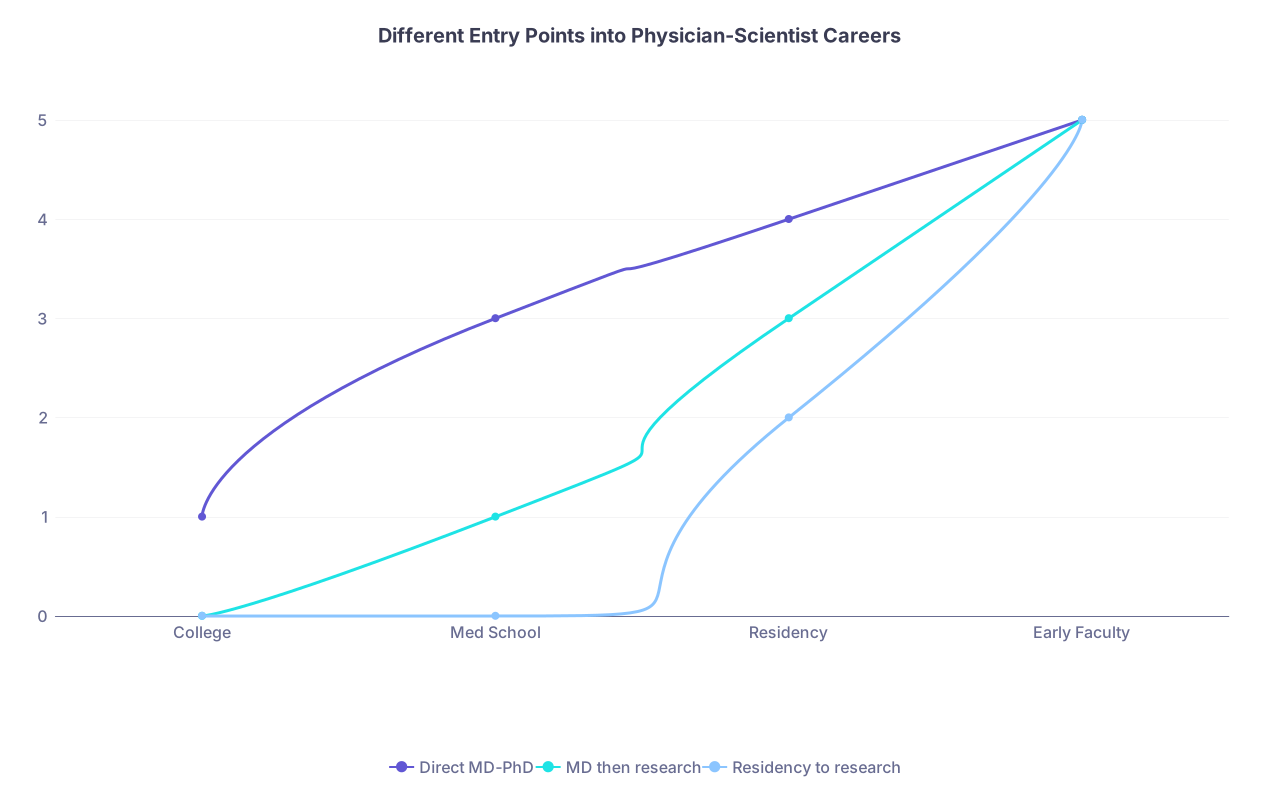
| Category | Direct MD-PhD | MD then research | Residency to research |
|---|---|---|---|
| College | 1 | 0 | 0 |
| Med School | 3 | 1 | 0 |
| Residency | 4 | 3 | 2 |
| Early Faculty | 5 | 5 | 5 |
By early faculty, the curves converge more than you think. That “head start” you’re obsessing over? It matters a little. But not in the catastrophic way your brain is framing it.
You’re not choosing between “real physician-scientist” and “fake backup version.” You’re choosing between:
- Doing more research training within a combined program
vs. - Building it through fellowships, postdocs, protected time, KL2/K08 awards, etc.
Different route, same general destination type.
The timeline fear: “If I start now, I’ll be 40+ when I’m finally ‘done’”
This one hits hard because it sounds so logical.
You start mapping it:
“I’m [x] years old now, if I:
- Finish med school → [age]
- Add PhD → +3–5 years
- Then residency + fellowship → +3–7 more Suddenly I’m ancient.”
So you spiral: Is it rationally insane to want MD–PhD this late?
Let’s put some structure to the chaos.
| Path | Added Years vs Straight MD | When You’re Mainly a Full Attending |
|---|---|---|
| MD only, core specialty | 0 | Mid 30s (ish) |
| MD + research fellowship/postdoc | +2–4 | Mid to late 30s |
| MD–PhD straight through | +3–5 | Late 30s |
| MD then *later* PhD | +3–6 | Late 30s to early 40s |
The real question isn’t “Will I be old?” You will be. We all will be.
The real question is:
Will you be doing the type of work that doesn’t make you quietly miserable for 30 years?
I’ve seen:
- People who rushed into clinical-only tracks because it was “shorter” and then spent their attending years trying desperately to carve out research time from scratch
- People who took “too long” in training by traditional standards but end up in jobs they’re actually proud of, with protected time and grants, while some of their “efficient” classmates are burned out hospitalists on their second job search
Yes, MD–PhD (or any extra research training) can stretch your path. But so does:
- Switching specialties
- Taking gap years for family
- Burning out and needing time away
- Real life happening
You’re not comparing “fast vs slow.” You’re comparing “slightly slower but more aligned” vs “faster but maybe wrong.”
MD vs MD–PhD vs “I’ll just bolt research on later”
This is where people lie to themselves the most. I’ve heard versions of this:
“I’ll just do MD now and I can always add research later. That way I avoid the risk. Best of both worlds.”
Sometimes that works beautifully. Sometimes it’s code for “I’m too scared to commit and I’m hoping Future Me feels less anxious and more magical.”
Let’s be honest about how adding research “later” usually plays out.
, Later-career MPH/PhD](https://cdn.residencyadvisor.com/images/articles_svg/chart-common-research-entry-points-after-md-2174.svg "Common Research Entry Points After MD")
| Category | Value |
|---|---|
| Residency research track | 60 |
| Fellowship research years | 45 |
| [Postdoc after residency](https://residencyadvisor.com/resources/phd-vs-md/can-i-ever-go-back-to-research-if-i-choose-straight-md-now) | 25 |
| Later-career MPH/PhD | 15 |
Those numbers are just illustrative, but the point is: there are many doors later on. And people use them.
If you’re already in med school or residency and just now realizing you love research:
You are exactly the use case for those tracks.
The trade-offs:
MD–PhD:
- Clear, formalized path
- Tuition usually covered, stipend during training
- Longer pre-residency runway
- Your whole narrative is “physician–scientist”
MD → research-heavy residency/fellowship/postdoc:
- Less structured early on
- More flexibility if your interest evolves
- No separate “PhD” on your name (unless you do one later)
- You’ll have to hustle more for mentors and funding at each step
Is one “too late”? No. But they feel very different day to day.
If what you want is:
- To think in mechanisms
- To design trials, not just enroll patients
- To write grants and lead a lab or a data group
Then you don’t have to be MD–PhD, but you do have to intentionally build in real research training somewhere. That’s non-negotiable.
“But won’t programs think I’m indecisive or fake for deciding late?”
Here’s the anxiety subtext: “If I were truly MD–PhD material, I’d have known from the beginning.”
That’s just… wrong.
Adcoms and PDs see a lot of people who say they want to do research forever but have never actually:
- Owned a project
- Struggled through months of failed experiments
- Cared enough about a question to wake up thinking about it
You, deciding late, often have an advantage: your decision is based on experience, not fantasy.
The key is whether your story makes sense:
Bad version: “I suddenly realized I like research and now I want MD–PhD because… prestige, I guess?”
Better version:
“I started med school thinking I’d be purely clinical.
Then [specific exposure: 1st-year lab rotation / summer project / QI data project / outcomes research].
I found myself:
- Staying late not because I had to, but because I wanted to see the data
- Reading papers outside what was assigned
- Asking questions no one could answer with current evidence
Over [time period], I:
- Took on more responsibility (e.g., first-author project, presented at [conference])
- Sought mentors in [field]
- Realized that the level of training I want in methods and scientific thinking is closer to PhD-level
So this isn’t a whim. It’s a late recognition of a long-term fit I hadn’t seen clearly earlier.”
Programs don’t punish late clarity. They punish incoherence and vague, generic “I like research” fluff.
Hard reality check: when it actually might be too late for MD–PhD specifically
I’m not going to pretend there are no limits.
Scenarios where MD–PhD in the formal sense is probably off the table or at least very uphill:
- You’re already pretty far into residency or fellowship at a program without any mechanism for degree integration
- You’ve got major family/financial obligations that make stepping away for 3–5 PhD years realistically impossible
- Your school/program simply doesn’t support dual-degree transitions and there are visa/loan/logistical barriers to transferring
That’s where your brain jumps to the nuclear conclusion: “Okay so I missed it. I’ll never be a real physician–scientist.”
No. That’s the trap.
There are still very real routes:
- T32-funded research fellowships
- Postdoc after residency/fellowship (yes, physicians do them)
- Master’s (clinical epi, biostats, informatics, public health) plus serious, mentored research
- KL2 / K08 / K23 career development awards that fund you to be half-clinical, half-research as junior faculty

| Step | Description |
|---|---|
| Step 1 | MD or MD in training |
| Step 2 | Clinical career focus |
| Step 3 | Residency with research track |
| Step 4 | Fellowship with research years |
| Step 5 | Postdoc or K award |
| Step 6 | Physician scientist role |
| Step 7 | Consider formal MD PhD now |
| Step 8 | Want serious research? |
Is it slightly more patched-together than a seamless MD–PhD program? Sometimes. Is it second-class? No.
The NIH does not print a different color money because you started your research path as a resident instead of an MS1.
Emotional piece: envy, regret, and watching MD–PhD classmates
The part nobody talks about: this whole question is less about structure and more about how it feels.
You see your MD–PhD classmates:
- Presenting at big conferences
- Already on a first-name basis with big-name PIs
- Having a clear “I’m a future physician–scientist” identity
And you feel:
- Imposter syndrome
- Regret you can’t time-travel and redo undergrad
- Panic that every day you don’t commit, you’re falling further behind
You’re comparing your messy, real-time process to someone else’s curated narrative. Their story looks clean because it’s told backwards:
“I always knew I wanted MD–PhD. I did X, then Y, then Z. It all lined up.”
In reality, I’ve watched MD–PhD students:
- Quietly consider dropping the PhD but feel trapped by sunk costs
- Realize they actually love patient care more and feel guilty for it
- Struggle with identity when they don’t get the K award or the R01 and end up clinically heavier than they imagined
Everyone is improvising. You’re just seeing more of your own mess than theirs.
Very practical: what you can do this year if you’re “behind”
Forget 10-year plans. Your brain can’t handle that right now. Let’s talk 12 months.
If you’re pre-med or early med student
- Get into one serious research setting. Not 5 fluff posters. One real project with ownership.
- Ask to be part of:
- Study design, not just data entry
- Manuscript drafting, not just “contributor”
- Pay attention to how you feel months in—not on day one. Initial excitement is cheap.
If you’re late MS or early resident
- Identify people in your program who actually have protected research time and grants
- Ask them very bluntly:
- “What path did you take?”
- “If you were me at my stage now, what would you do differently?”
- Look for:
- Research tracks in your residency
- Chief resident research roles
- T32 or equivalent research enrichments in fellowships you’re considering
If you’re seriously considering MD–PhD switching into it
- Talk to:
- Your MD–PhD program director (yes, actually schedule the meeting, not “someday”)
- Current students who joined late or did non-traditional routes
- Ask about:
- Formal mechanisms to enter at MS1/MS2 stage
- Funding impact
- Typical time added
- Then brutally ask yourself:
- Does this feel like a “this is who I am” decision or a “this might shut down my anxiety temporarily” decision?
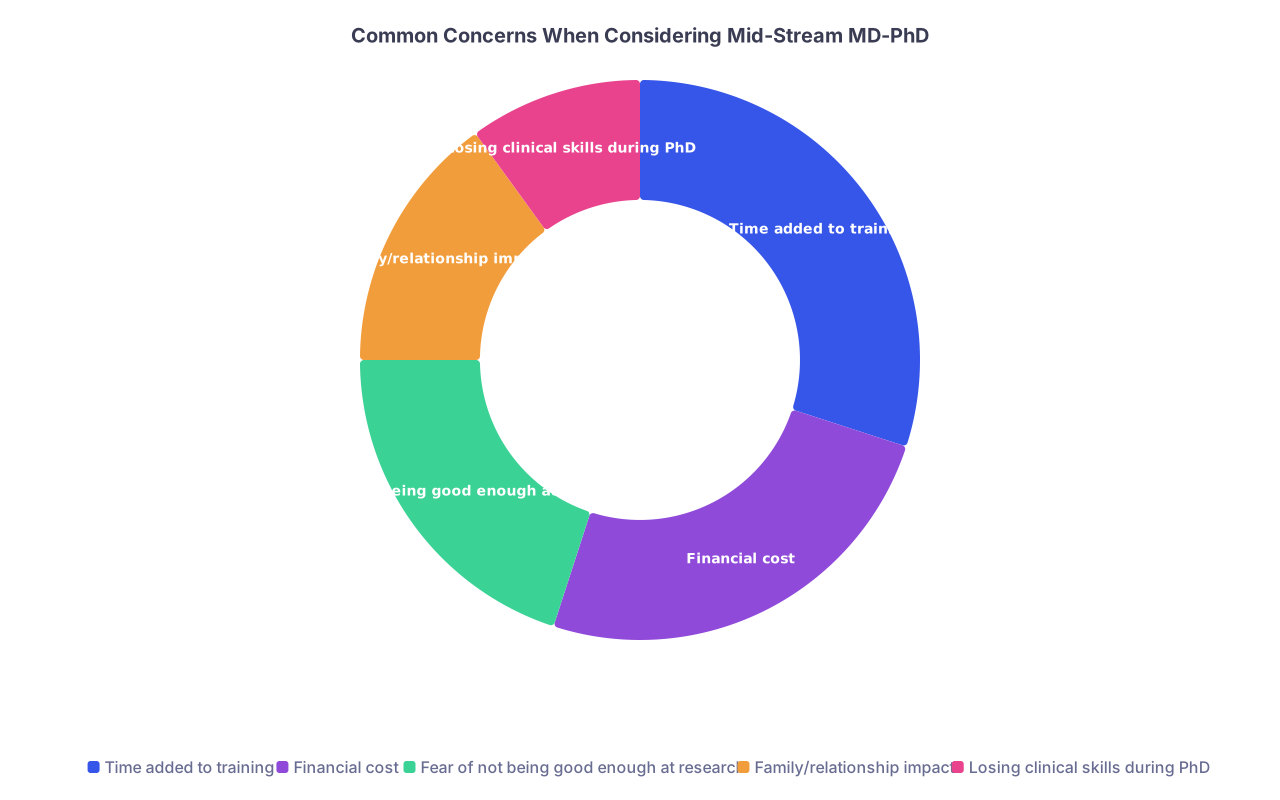
| Category | Value |
|---|---|
| Time added to training | 30 |
| Financial cost | 25 |
| Fear of not being good enough at research | 20 |
| Family/relationship impact | 15 |
| Losing clinical skills during PhD | 10 |
FAQ (the things you’re actually worrying about at 2 a.m.)
1. Will not having an MD–PhD make it harder to get grants later?
It can, a little, on optics—MD–PhD looks nice on paper. But what really matters is:
- Quality and continuity of your research output
- Strong mentorship
- Solid methods training
I’ve seen MD-only folks with monster K and R01 portfolios, and MD–PhDs who never got funded. The degree is a signal, not a guarantee.
2. If I’m already in residency, is a PhD basically off the table?
Not automatically. Some places have:
- Integrated PhD opportunities during or after residency/fellowship
- Pathways where you do a postdoc-level experience without the “PhD” title but with equivalent training
It’s logistically harder—loans, salary, life—but not impossible. You’d need realistic support (family, finances, institutional structure) to make it work.
3. Will programs judge me for changing my mind late?
They’ll judge you if your story is shallow or clearly defensive. If you can show:
- Specific experiences that changed your understanding
- Concrete steps you took once you realized (new mentors, projects, outcomes)
- A coherent explanation of why this isn’t a whim
they’re usually fine. People change direction once they see more of the world. That’s normal.
4. Is MD–PhD “worth it” financially if I decide late?
Pure $$$ ROI? Often no. Compared to MD-only who starts earning earlier, the math is usually worse.
But if what you really want is a science-heavy career with protected research time and that keeps you from hating your job later, the “worth” question stops being purely financial. If you only care about money, you probably shouldn’t be here anyway.
5. Am I just romanticizing research because clinical work is stressful?
Maybe. That’s a fair fear. So test it.
- Do sustained research work while handling at least some clinical/academic load
- Notice: does research feel like the thing you retreat to for meaning, even when it’s frustrating?
If you only like the idea of being a physician–scientist but hate the actual day-to-day grind of data, revisions, and slow progress, that’s important information.
6. What if I wait too long and then regret not doing MD–PhD forever?
You might always have a little “what if” in the back of your mind. That’s human. The goal isn’t to eliminate regret to zero; it’s to choose the regret you can live with.
- If you’ll be tormented not having the dual degree, push hard now to see if it’s realistically possible.
- If what you actually want is the work, not the letters, build a path where research is central, even if the label isn’t MD–PhD.
Open a blank document today and write one page answering this:
“If I completely ignored what would look ‘efficient’ or ‘impressive’ to other people, what mix of clinical work and research would I actually want my week to look like 10 years from now?”
Not job titles. Not degrees. Just how you spend your time.
That page will tell you a lot more about what to do next than another week of silently spiraling about being “behind.”