
Last week I watched a friend stare at her loan balance on the screen, hand over her mouth, not saying anything for a solid minute. She looked at me and said, “Maybe I should’ve done the MD‑PhD. I feel like I just signed up for financial ruin.”
If you’re even clicking on a title like this, your brain is probably already doing the same math-of-doom: “$300k in debt…interest…residency salary…will I ever be able to breathe? Is skipping a funded PhD basically financial self-sabotage?”
Let me say the scary part out loud: the numbers can look horrifying. But “I didn’t do an MD‑PhD, therefore I’m financially doomed” is just not true. It can be a bad move for some people, but for most MD-only folks, it’s not the disaster your 2 a.m. brain is imagining.
Let’s unpack this like someone who’s actually losing sleep over it. Because I am.
The Core Fear: “If I Don’t Do MD‑PhD, I’ll Drown in Debt Forever”
Here’s the nightmare version your brain is running:
- MD alone = crazy tuition + little/no income + compounding interest
- MD‑PhD = “free” tuition, stipend, extra degree, maybe better jobs
- Therefore MD-only = “congratulations, you’ve ruined your financial future”
The problem is: that’s a half-truth glued to worst-case assumptions.
Let’s put some basic numbers side by side before spiraling.
| Path | Tuition/Fees (Med) | Stipend | Years in Training | Debt at Graduation* |
|---|---|---|---|---|
| MD Only | $200k–$350k | $0 | 4 | $200k–$400k+ |
| MD-PhD | Usually covered | $25k–$40k/yr | 7–8+ | $0–$100k |
*Debt ranges depend heavily on school, cost of living, family support, and lifestyle.
On paper, MD‑PhD wins: less tuition, you get a stipend, extra degree. So why doesn’t everyone do it?
Because you’re not just trading money. You’re trading time. And in medicine, time isn’t neutral. Time is lost attending income, compound returns, career progression, and frankly…life.
The Time Trade: The Part Everyone Hand-Waves Away
You know what people love to say?
“MD‑PhD is free, so it’s obviously smarter financially.”
Except it’s not “free.” You’re paying with years of your life.
Say you do:
- MD only: 4 years med school + 3 years IM residency
- MD‑PhD: 8 years MD‑PhD + 3 years IM residency
That’s a 4–5 year difference of attending salary.
Let’s do ugly but real back-of-the-envelope math:
- Internal medicine attending (general): ~$250k–$300k/year (can be more, but let’s stay conservative)
- 4 years of delayed attending income: easily $1–1.2 million in gross earnings you’re not making
Meanwhile, your loans: maybe $300k at 6–7% when you finish MD-only. Yes, that sucks. Yes, the interest is gross. But compare those two numbers:
- Lost attending income: about $1,000,000+
- Loan principal: about $200k–$400k
Your brain keeps screaming: “MD‑PhD is free school!”
The math quietly whispers: “Yeah, but it cost you a million dollars of potential earnings.”
And that’s before you count things like:
- Retirement savings you could’ve started during those earlier attending years
- Home equity if you could’ve bought sooner
- Childcare costs vs. career timing
- Burnout from adding extra years in the pipeline
So no, skipping the PhD is not automatically a financial disaster. You just chose debt front-loaded vs. income delayed.
To make it visual:
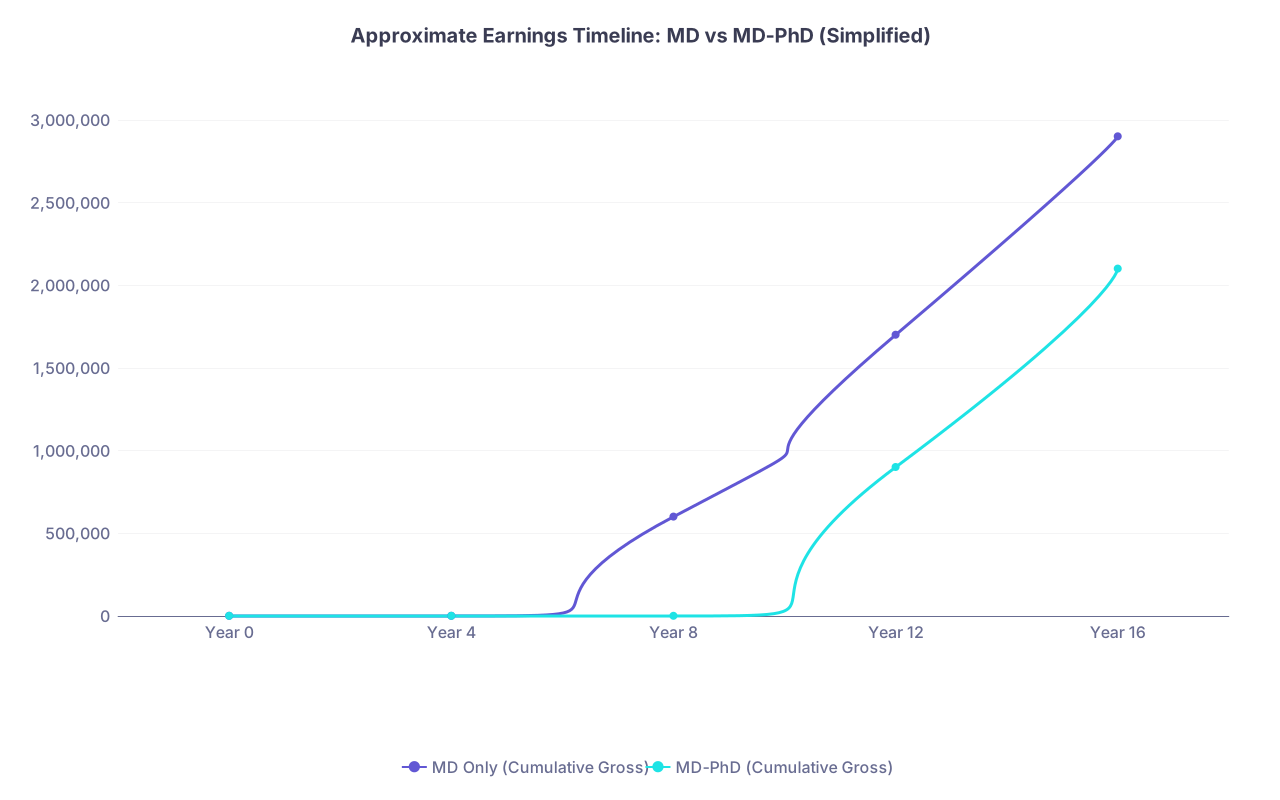
| Category | MD Only (Cumulative Gross) | MD-PhD (Cumulative Gross) |
|---|---|---|
| Year 0 | 0 | 0 |
| Year 4 | 0 | 0 |
| Year 8 | 600000 | 0 |
| Year 12 | 1700000 | 900000 |
| Year 16 | 2900000 | 2100000 |
Is this oversimplified? Of course. But the shape is right: MD-only starts earning attending money earlier. That absolutely matters.
“But What About Interest? What If My Loans Just Explode Forever?”
This is the 3 a.m. thought: “What if the interest grows faster than I can pay it? What if it’s literally unpayable and I’m trapped?”
I’m not going to gaslight you: if you borrow $350k at 6–7% and make tiny payments for years, yes, the balance can swell. That’s real.
But here’s the part people avoid saying clearly: attending income changes the game.
A typical scenario for an MD-only grad:
- Debt at graduation: $250k–$350k
- Residency payments: small, maybe IDR (income-driven repayment), maybe interest-only
- Attending salary: $220k–$500k+ depending on specialty and practice type
There are attendings who:
- Aggressively pay off loans in 5–10 years
- Take longer deliberately because they’re maxing retirement and accepting loans as “just another payment”
Both are financially workable. The disaster fantasy — “I’ll be 65 and still paying interest only” — usually comes from not understanding repayment options or from assuming you’ll live like a high-schooler forever.
If you want a cold shower of reality: yes, if you combine:
- High debt
- Low-paying specialty
- Expensive city
- No budgeting
- No plan
…you can end up feeling crushed. But that’s not because you “skipped the PhD.” It’s because you’re flying blind.
There are so many levers: Income-Driven Repayment, PSLF, refinancing, geographic choices, lifestyle inflation, side gigs, academic vs. private, etc.
Where MD‑PhD Can Make Financial Sense (and Where It Really Doesn’t)
I’ve watched people talk themselves into an MD‑PhD for all the wrong reasons:
- “I’m scared of debt.”
- “It’s free tuition; that must be smarter.”
- “It sounds prestigious.”
- “Maybe it’ll open more doors.”
Here’s the harsh part: if you don’t actually want a research-heavy career, MD‑PhD can be a terrible deal even financially.
Because the path is longer. The jobs you’re being funneled toward (physician-scientist tracks, academic jobs) often pay less than pure clinical positions. And they can be more competitive and more fragile (grant funding, soft money, etc.).
So run the scenario honestly:
If your likely future is:
- Academic salary ~ $200k–$260k
- Heavy research, grant uncertainty
- You delayed earnings 4–5 years
Versus MD-only who:
- Starts earlier
- Maybe chooses a higher-paying clinical environment or specialty
- Pays off loans over time
Sometimes the MD‑PhD actually loses financially even though it was “tuition-free.” And you’re stuck doing research you’re lukewarm about because you built your whole CV around it.
Where MD‑PhD makes more sense:
- You genuinely love research and can’t see a happy career without it
- You want to run your own lab, write grants, live in the physician-scientist world
- You’re okay with lower or slower financial upside because the work itself matters that much to you
But doing it primarily to avoid debt? That’s like signing up for an 8-year mortgage of your life to avoid a 4-year financial one. It’s not “wrong,” but it’s not automatically smart.
The Hidden Cost Nobody Talks About: Burnout and Lost Flexibility
Here’s the stuff that doesn’t fit neatly in a spreadsheet but absolutely hits your life:
- You might change your mind. A lot of MD‑PhD students do. By year 5, some realize they don’t actually want that much bench research. But you already paid in years.
- Extra years of training = extra years of stress, delayed personal life, maybe postponed family, etc. That has mental health and financial consequences.
- If you’re miserable in a long program you didn’t need, it can bleed into your performance, your relationships, your entire sense of self.
Meanwhile, as an MD-only:
- You still can do research. People forget this. Tons of MDs publish, get funded, build academic careers without the PhD.
- You have more flexibility to pivot. You can try academia, private practice, community work, industry, etc. and adjust as life evolves.
- You start solving your debt problem earlier — not because it magically shrinks, but because you’re actually earning.
“Okay, But What If I’m Already Committed to MD Only and Terrified I Screwed Up?”
Let’s say the decision is already made. You didn’t do MD‑PhD. You’re going MD-only. And your stomach flips every time someone says “tuition.”
There are ways to make this not a disaster:
1. Stop Comparing Yourself to the Zero-Debt Unicorns
Your class will have:
- People with MD‑PhD funding
- People with family money
- People with military scholarships
- People with insane merit aid
If you compare your path to the one person whose parents are surgeons and paid cash, yes, you’ll feel like you ruined your life.
Different baseline. Different reality. You’re not them.
2. Use the Tools That Actually Exist (Not the Imaginary Doom Ones)
You are not just thrown into the ocean with a cinder block of debt and told to “swim.”
You have:
- Federal income-driven repayment plans (PAYE, SAVE, etc.)
- Public Service Loan Forgiveness (10 years of qualifying payments while working at non-profit/academic/government hospitals)
- Refinancing options later as an attending if PSLF doesn’t fit you
- The ability to choose your job strategically — not just based on prestige
For example: an MD-only going into a PSLF-eligible academic hospital, on SAVE, paying based on resident/early attending income, can see a ton of that debt forgiven after 10 years. MD‑PhD isn’t the only way out.
3. Be Honest About Specialty and Lifestyle
If your heart is set on a low-paying specialty + high-cost city + expensive lifestyle + no plan? Yeah, that combination can feel awful with big loans.
But you do control more than you think:
- Where you live
- What kind of practice you choose
- How fast you inflate your lifestyle after residency
- Whether you pick up extra shifts / side gigs / academic roles
You don’t need to martyr yourself, but pretending it’s all fate is how the anxiety festers.
The Real Financial Disaster: Not the Degree, But the Denial
You know what actually sinks people?
Not making a plan. Not checking the numbers. Just letting the fear sit there like a black cloud while they avoid thinking about it.
I’ve watched residents who:
- Never log into their loan portal
- Don’t know if they’re on IBR, PAYE, SAVE, or standard
- Have no idea their hospital qualifies for PSLF
- Feel this vague, crushing dread about money without any specifics
That’s the part that wrecks you. Not “I skipped a PhD.”
Your brain is great at vague doom: “I’ll never pay this off.”
Your loans are conquered with boring specifics: “Okay, I owe X at Y%. If I do PSLF and pay Z for 10 years, here’s what’s forgiven. If I refinance and pay Q per month, I’m done in N years.”
When Worrying is Rational — and When It’s Just Self-Torture
Some anxiety is justified:
- Taking on $400k+ with zero idea how repayment works? Yeah, be worried.
- Ignoring interest capitalization? Also bad.
- Assuming physician income will magically fix everything without any planning? Delusional.
But beating yourself up for not doing MD‑PhD, as if that was the one golden ticket you threw away? That’s not rational worry. That’s self-punishment.
You didn’t miss the last lifeboat. You chose a path that almost every physician before you has taken: MD-only with loans. And guess what? The overwhelming majority of them:
- Paid their loans
- Built decent or great lives
- Were not crushed in some apocalyptic debt event
You just don’t hear as many Reddit threads titled: “Yeah, I had loans, paid them, life’s fine actually.”
One More Thing You’re Afraid to Admit: You Might Not Actually Want a PhD
I’m going to say the quiet part.
A lot of people considering MD‑PhD for “financial reasons” don’t actually want:
- 3–5 extra years of experiments, failed projects, manuscripts
- Living in grad student limbo while your MD classmates move on
- A career that requires chasing grants and running a lab
They just don’t want to feel irresponsible about debt. So they try to solve the discomfort by adding another degree.
But if deep down you know you’re more excited by patient care than pipettes, that you like research but don’t love the idea of it as the center of your career — then doing MD‑PhD to save money is like marrying someone you’re not in love with because you don’t want to pay rent alone.
It’s not a great long-term strategy.
So…Is Skipping PhD a Financial Disaster for MDs?
For almost everyone? No.
Could it be worse financially than an MD‑PhD in some very specific cases? Sure.
Could it be way better financially, especially if you pick certain specialties or practice types? Absolutely.
The “disaster” isn’t MD vs. MD‑PhD. The disaster is:
- Ignoring the financial reality
- Pretending the debt doesn’t exist
- Letting shame and fear stop you from making a rational plan
The MD-only path is not reckless. It’s the default path of thousands of successful, financially stable physicians. You’re just hyper-aware of the numbers in a way previous generations weren’t, because you can see it all in your phone at 2 a.m.
What You Can Do Today (So This Stops Playing on Loop in Your Head)
Do one tangible thing. Not ten. One.
Open a blank page and write three lines:
- Estimated total med school debt at graduation (even if it’s rough).
- Three repayment options you want to learn about (e.g., SAVE, PSLF, refinancing).
- Whether you truly want a research-heavy, grant-chasing career — yes or no.
Then commit to a 30-minute session this week to:
- Plug your numbers into a reputable med loan calculator (AAMC, White Coat Investor, or similar).
- Compare: “MD-only with loans” vs. “hypothetical MD‑PhD with delayed earnings.”
Not to torture yourself. To see that you’re not trapped. To prove to your anxious brain that this isn’t some irreversible financial catastrophe — it’s just a big, heavy, but solvable problem that you’ll chip away at with an attending salary most people on earth will never see.
Close TikTok. Open the calculator. Look at the first number. That’s where the fear starts shrinking.