
The biggest mistake trainees make is assuming a PhD thesis advisor and an MD research mentor are the same thing. They are not. The power, expectations, and consequences built into those two roles are fundamentally different.
If you treat your MD research mentor like a thesis advisor, you will get stuck. If you treat your PhD advisor like an MD “research preceptor,” you will get crushed.
Let me break this down specifically.
The Core Difference: Dependency vs Optionality
A PhD thesis advisor is structurally embedded in your degree. Your progress, funding, publications, and literal ability to graduate are tightly coupled to this single person or small advisory group.
An MD research mentor is usually optional, modular, and replaceable. Helpful, often very helpful, but not structurally mandatory in the same way. You can graduate from medical school and match into residency with weak or no research mentorship if the rest of your application is strong. It may hurt you, but it rarely blocks your diploma.
That structural difference shapes everything:
- Power dynamic
- Time horizon
- Expectations for productivity
- Emotional intensity of the relationship
- What happens when the relationship fails
Once you understand that architecture, the rest of the details finally make sense.
Structural Roles: What Each Mentor Actually Controls
| Dimension | PhD Thesis Advisor | MD Research Mentor |
|---|---|---|
| Degree dependency | Central, often gatekeeper | Usually peripheral |
| Funding control | Often controls stipend & project funds | Rarely controls salary |
| Time horizon | 3–6+ years | Months to a few years |
| Output expectations | Multiple first-author papers | 1–3 projects, sometimes no pubs |
| Formal evaluation power | Direct input on graduation | Indirect via letters / reputation |
PhD Thesis Advisor: The Center of Gravity
In a typical biomedical PhD:
- You join a lab that is effectively your academic “home base.”
- The principal investigator (PI) is your thesis advisor.
- They control:
- Your project direction
- Access to data, animals, equipment, datasets
- Often your stipend and tuition coverage (via grants)
- Your recommendation letters for postdoc, industry, or faculty jobs
If your relationship with your thesis advisor fails catastrophically, you can, in theory, switch labs. In practice, that often means:
- Losing 1–3 years of work
- Starting a new project from scratch
- Possible loss of funding
- Political fallout in the department
So students tolerate a lot. Unrealistic timelines. Shifting project goals. Papers that take years to materialize. Daily or weekly scrutiny. Because the exit cost is high.
MD Research Mentor: Architect of Optional Value
In MD training (especially straight-through MD without a PhD):
- The curriculum is clinical, not research-centric.
- Research is additive: strong for competitive specialties, academic careers, or certain fellowships, but not universally required.
- A “research mentor” may be:
- A busy clinician offering you a chart review project.
- A physician-scientist with a lab giving you a defined subproject.
- A faculty member who mostly signs off on your idea and meets occasionally.
Your degree does not hang on this person. Your clinical grades, Step scores, and dean’s letter matter more for basic graduation and matching. The research mentor becomes a value multiplier if you are aiming for:
- Derm, plastics, ENT, ortho, neurosurgery, radiation oncology, or top academic IM programs
- Physician-scientist paths (MD/PhD, PSTP, “research tracks”)
- Competitive fellowships (cardiology, GI, heme/onc at top programs)
If the relationship fails, you:
- Lose a project or a paper
- Possibly have an awkward letter situation
- But you still have a path to graduation and residency
The cost of exit is lower. Which means you should be more ruthless about walking away from deadweight mentorship. MD students often are not. They stay attached to name-brand PIs who are totally unavailable and end up with no tangible output.
Time, Contact, and Expectations: How the Day-to-Day Really Looks
Let’s get concrete.
PhD Thesis Advisor Contact Pattern
In a decently functioning PhD lab, you might see your advisor:
- Weekly or biweekly in 1:1 meetings
- Weekly in lab meeting
- Ad hoc in the lab corridor, shared office, or on Slack/Teams
They will expect:
- Detailed updates on experiments or analyses
- Evidence that you understand the literature in your niche
- Ownership of troubleshooting – not just “this did not work,” but hypotheses why
- Real progress between each meeting (new data, new analysis, revised draft)
They also often expect you to integrate into the lab ecosystem:
- Help junior students or undergrads
- Attend seminars, journal clubs, retreats
- Present at national meetings under the lab’s banner
This is apprenticeship at close range. You are being socialized into how a scientist acts, thinks, and survives.
MD Research Mentor Contact Pattern
Now compare that with a typical MD research mentor relationship.
Most medical students tell me some version of this:
“We met once at the start, he suggested a retrospective project, I did the chart review, then did not hear from him for three months. The paper is still ‘in preparation’ one year later.”
Not always that bad, but the pattern is:
- Initial meeting to scope project
- Intermittent check-ins, often driven by you
- Communication mostly via email (and mostly asynchronous)
- Sometimes their postdoc or fellow becomes your de facto day-to-day mentor
The mentor expects:
- You to be self-directed and persistent in following up
- Minimal hand-holding on basics (Excel, R, Stata, PubMed searches)
- Reasonable progress given that your primary job is being a student
There is rarely a structured expectation of seeing you every week. Some of the best physician-scientist mentors still function like PIs and run tight meetings. But plenty of clinical research mentors are barely structured at all.
Power, Evaluation, and Letters: Who Can Make or Break You
This part is non-negotiable: power dynamics shape behavior. Pretending they do not is naive.
PhD Advisors: Gatekeepers by Design
Your thesis advisor typically has:
- Direct input on your qualifying exam, thesis committee, and defense
- Strong informal influence on whether the department believes you are “ready” to graduate
- The power to delay your degree with “needs one more paper” type decisions
And for your next step (postdoc or job), most applications will require:
- A detailed letter from your PhD advisor
- Sometimes additional phone or email back-channeling between PIs
If your relationship is bad, you pay a steep price:
- Lukewarm or ambiguous letters
- Suboptimal framing of your contribution to the lab’s work
- Reluctance to introduce you to high-value collaborators or PIs
This is why healthy PhD mentoring structures usually include:
- Thesis committees with real teeth
- Program directors who check in on student–PI fit
- Formal annual reviews of progress
When those guardrails are weak, students get trapped.
MD Research Mentors: Gate Openers, Not Gatekeepers
An MD research mentor usually controls:
- A letter of recommendation (important, but not singular)
- Informal “this student is good” comments to PDs or admissions
- Opportunities: more projects, presentations, networking
You typically have:
- Multiple independent letter writers (course directors, clerkship directors, other faculty)
- The option to not use a research mentor as a primary letter, especially for non-research-heavy programs
Bad research mentorship hurts:
- If they ghost you and never submit the promised letter
- If they write a lukewarm letter that contradicts your otherwise strong narrative
- If they sit on your paper and it never gets published before ERAS opens
But it rarely blocks graduation.
The flip side: a strong MD research mentor with national name recognition can punch above their formal power. I have seen a single phone call from a big-name PI shift an entire rank list.
So you treat an MD research mentor letter as a high-yield bonus, not a single point of failure.
Research Output: Publications, Authorship, and Reality
This is where expectations between PhD and MD worlds get badly misaligned.
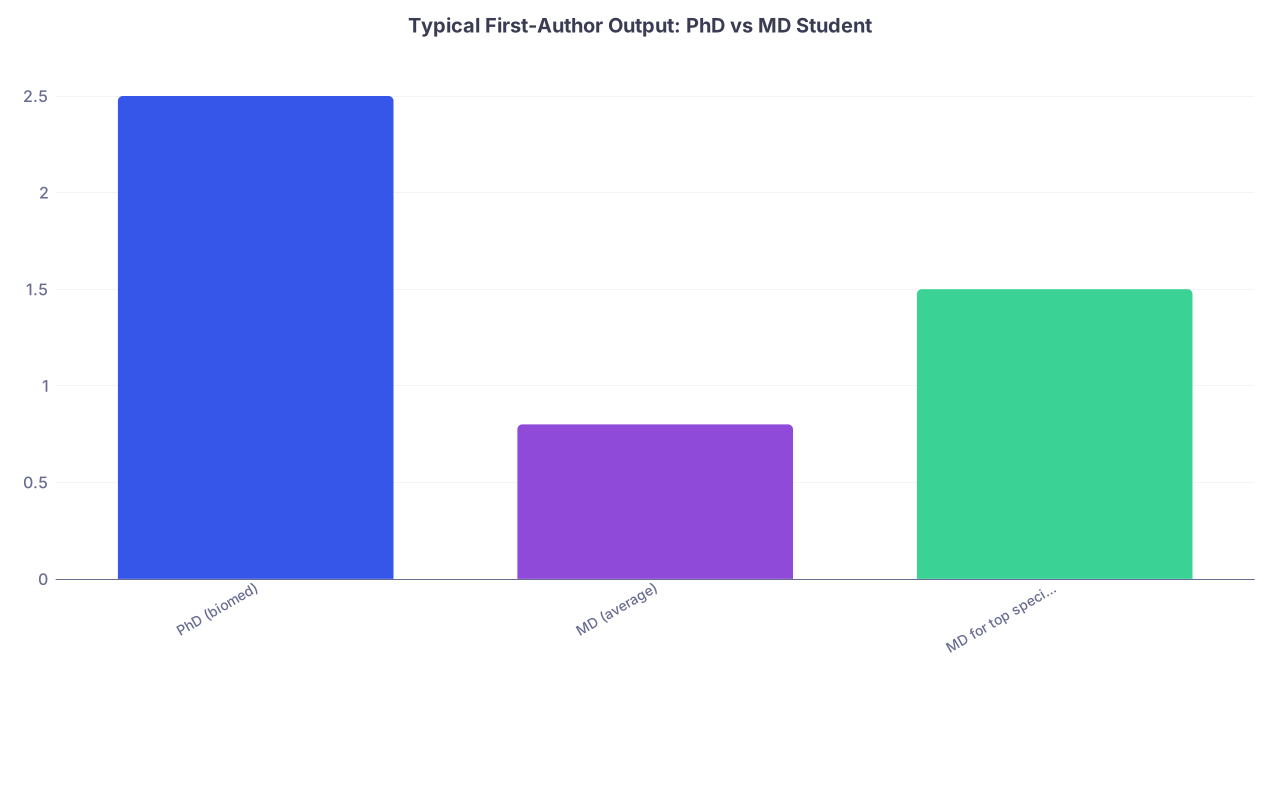
| Category | Value |
|---|---|
| PhD (biomed) | 2.5 |
| MD (average) | 0.8 |
| MD for top specialties | 1.5 |
Those are ballpark expectations I see repeatedly in biomedical sciences and US MD training, not absolute laws.
PhD Advisor: You Are the Engine of the Lab’s Output
A competent PhD student is expected to:
- Drive at least one major first-author story
- Contribute to additional middle-author papers
- Present at conferences (local, national, sometimes international)
Your thesis advisor’s reputation and grant renewal often depend on:
- H-index
- Recent publications
- Demonstrated productivity of trainees
So they will push you. Sometimes excessively. Demanding long hours, weekend experiments, rapid turnarounds on drafts.
Authorship discussions are also more complex:
- You expect first authorship on “your” project.
- They expect senior (last) authorship as PI.
- Middle authorship is negotiated based on who did what.
Unclear authorship expectations destroy lab morale. Good PIs lay it out explicitly; mediocre ones leave you guessing until submission.
MD Research Mentor: You Are an Extra Pair of Hands and a Future Colleague
As an MD student:
- Your time is fragmented by preclinical courses or clerkships.
- You enter projects midstream. Data may already be collected.
- You might only handle a slice: chart review, data cleaning, a sub-analysis, or drafting the intro/discussion.
Publications are nice-to-have, not guaranteed.
What I actually see across schools:
- Many students: posters/abstracts, but no full papers.
- A motivated minority: 1–3 first- or co-first-author papers, especially those taking a dedicated research year or dual-degree.
- Those aiming at very competitive specialties: they often seek mentors who can “feed” them multiple small but publishable projects.
Authorship in this context is tricky:
- Some mentors default to you as middle author, even if you carried the project.
- Others are generous, making you first author on reasonable work.
- Some labs funnel all first authorships to fellows/postdocs and keep students as “extra hands.”
If you assume PhD-like authorship norms as an MD student, you will be disappointed. You have to ask upfront:
- What does first-author work look like in this group?
- For this specific project, if I do X, Y, Z, what authorship is realistic?
If a mentor cannot answer that clearly, that is a red flag.
Mentorship Ecosystem: Single Point vs Network
Another huge structural difference: PhD trainees often orbit one primary advisor; MD trainees do better with a network of mentors.
PhD: Deep Vertical Mentorship
You typically have:
- Primary thesis advisor (central)
- Secondary committee members (periodic, high-level feedback)
- Possibly a postdoc or senior grad in the lab as a day-to-day coach
This is vertical. Depth with one person’s scientific niche. One lab culture. One main style of thinking.
You are essentially being trained as a “mini version” of your PI, at least for the duration of the PhD. You inherit:
- Their methods
- Their conceptual frameworks
- Their politics
That has advantages (cohesion, identity) and disadvantages (narrowness, dependency).
MD: Horizontal Mentorship Network
Strong MD trajectories, especially in academic medicine, look very different. The people who do best collect mentors like this:
- Clinical mentor in their target specialty
- Research mentor for projects/papers
- Career mentor who helps with strategy (timelines, away rotations, which programs to target)
- Sometimes a near-peer mentor (resident/fellow) who translates everything into real terms
No single person “owns” you. Which means:
- You can patch holes. A weak research mentor can be balanced by a strong clinical advocate.
- You are less exposed to one person’s neglect or burnout.
- You need to coordinate multiple relationships and keep them updated (students often fail at this).
The smart move as an MD is to avoid the “I have a famous mentor, therefore I am set” fallacy. Famous and busy often means distracted. A solid, mid-level faculty member who answers email and edits drafts beats a superstar who barely remembers your name.
Failure Modes: How These Relationships Break (and What You Do)
This is the part no glossy brochure tells you but every senior trainee gossips about in the hallway.

PhD Advisor Failure Modes
Common patterns I have seen repeatedly:
Perpetual Postponement
You keep getting “one more experiment” before they agree the story is complete. Graduation drifts from year 5 to 7.Project Cannibalization
A postdoc or senior student is put on your project halfway through, absorbs the “interesting” parts, and you are left with a side figure and a middle author slot.Advisor Checked Out
PI becomes department chair, moves institutions, or goes on endless travel. You see them once every 2–3 months; your project stalls.Misaligned Expectations
You want industry or data science; they want you to become academic faculty. They push you toward postdoc; you want to leave after PhD.
In PhD programs with decent governance, there are escape valves:
- Talking to the graduate program director
- Involving your thesis committee earlier and more forcefully
- Switching labs, sometimes with extended funding
But every option has a time and opportunity cost. You must act early; waiting until year 5 to admit the relationship is failing is brutal.
MD Research Mentor Failure Modes
Very different flavor:
Ghost Mentorship
You get a project, do months of work, then the mentor stops responding. Manuscript stuck in limbo, never submitted.Perpetual “We Will Submit Soon”
Paper sits in draft form for a year. By the time it is submitted, your ERAS application is already in.Authorship Bait-and-Switch
You were informally told you would be first author; at submission, a fellow appears as first and you drop to second or third.Letter Problems
They agree to write but delay or send a generic, two-paragraph letter that adds nothing to your application.
Because your degree and primary evaluation do not run through this mentor, your response can be more aggressive:
- You can pivot to another mentor after a few months of non-response.
- You can decide not to use their letter.
- You can focus on smaller, highly finishable projects with more responsive people rather than large, slow R01-sized beasts.
MD students often underestimate how replaceable a single research mentor is in their overall trajectory.
Matching the Structure to Your Goals
You are probably not reading an article like this for abstract sociology. You want to know what to do.
If You Are a PhD (or MD/PhD) Trainee
For the thesis advisor role, you prioritize:
- Track record of graduating students in a reasonable time
- Real publications with student first authors (not just “we are writing up…”)
- Clear authorship norms and project ownership expectations
- Evidence that the PI actually meets with students regularly
You do not pick solely based on:
- The sexiness of the science
- The PI’s big-name reputation
- The fanciness of the techniques or equipment
I have seen too many students chase Nature-level projects in chaotic labs and end up with nothing.
Your structure is long-term dependency. So the advisor’s mentorship style matters at least as much as the science.
If You Are an MD Student Targeting Academic or Competitive Fields
For research mentors, you care about three things:
Finishability
Does this person actually get students to completed, submitted work within 6–18 months?Accessibility
Do they or their delegate (fellow/postdoc) respond, edit, and meet at reasonable intervals?Alignment with Your Specialty and Narrative
Does the work make sense for where you say you are going? A single case report in nephrology is not moving the needle for a derm application.
You should almost never:
- Put all your research eggs into one massive multi-year project with a single mentor.
- Assume that a big-name PI is better than a mid-career faculty member with a track record of student pubs.
Build a small portfolio of mentors and projects. One main mentor + 1–2 side mentors is usually optimal.
Visualizing the Path: Training Flow, PhD vs MD

| Step | Description |
|---|---|
| Step 1 | Start PhD |
| Step 2 | Choose Lab |
| Step 3 | Thesis Advisor Central Role |
| Step 4 | Long Term Project 3-6 years |
| Step 5 | Thesis Defense and Graduation |
| Step 6 | Start MD |
| Step 7 | Preclinical |
| Step 8 | Clerkships |
| Step 9 | Optional Research Mentor |
| Step 10 | Publications and Posters |
| Step 11 | Residency Application |
This is the reality: in the PhD track, the thesis advisor sits directly on the main pipeline. In the MD track, the research mentor is a side channel that feeds into your application but does not define your entire path.
Final Practical Distinctions You Should Not Ignore
Let me condense the operational differences that actually change how you behave.
With a PhD thesis advisor, you are choosing a long-term boss, evaluator, and primary intellectual environment. That decision is central to whether your scientific career gets off the ground.
With an MD research mentor, you are choosing a project sponsor and potential advocate whose impact is large but not absolute. You should be more opportunistic, pragmatic, and willing to walk away.
PhD mentorship failures threaten your graduation timeline and career foundation. MD mentorship failures threaten a subset of your CV and your competitiveness for the very top or most research-heavy programs—but not your MD degree itself.
Those are the levers. Once you see that, you stop treating “mentor” as a generic label and start asking the right questions: How much power does this person have over me? For how long? And what exactly are they structurally responsible for delivering?
Answer those honestly, and you will choose—and use—your mentors far more intelligently.