
Tenure committees are not comparing MD and PhD CVs on a level playing field—and they pretend they are.
Let me walk you into that closed-door room and tell you what actually happens, not what the faculty handbook says.
The First Pass: How Your CV Gets Sorted Before Anyone “Evaluates” It
Before a single person starts pontificating about “educational mission” or “tripartite responsibilities,” there’s a quiet triage. It happens fast, often by one or two people who already have strong opinions.
Here’s the part nobody tells you: almost every committee effectively sorts CVs into three piles within minutes:
- Automatic yes / near-automatic yes
- Automatic no / near-automatic no
- The battleground
The MDs and PhDs don’t land in these piles for the same reasons.
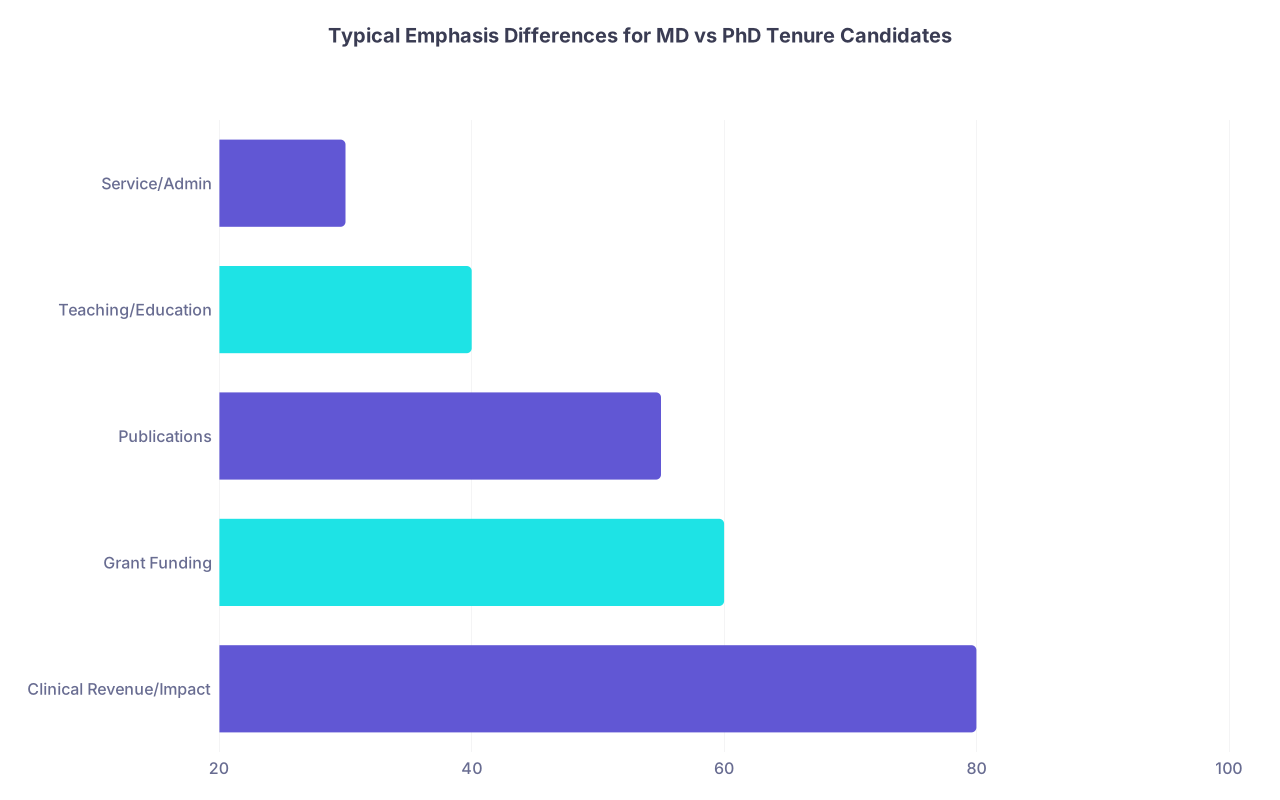
| Category | Value |
|---|---|
| Clinical Revenue/Impact | 80 |
| Grant Funding | 60 |
| Publications | 55 |
| Teaching/Education | 40 |
| Service/Admin | 30 |
That chart looks “global,” but here’s the trick: for MDs and PhDs, the interpretive lens changes.
For MDs (Clinician-Scientists and Clinician-Educators)
When your CV hits the table and you’re an MD, three questions silently get asked:
“Does this person bring in money?”
That can be grant dollars, clinical RVUs, program revenue. A well-funded clinical trialist with moderate papers will beat a prolific case-reporter every time.“Are they clinically important to us?”
You run the only advanced heart failure program in the region? You cover an ugly call schedule in a low-glam specialty that nobody else wants? That matters more than your last-authored paper in a mid-tier journal.“Are they annoying?”
Yes, really. Is this someone who constantly complains, refuses committees, or burns bridges? One or two committee members with stories about your behavior will tank you faster than a missing paper.
For PhDs (Basic/Translational/Population Science)
Different silent checklist:
“Is this person independently fundable?”
Not “have they ever been on a grant.” Are they PI (or multi-PI) on real grants, preferably R01-level or equivalent? Career development awards are seen as stepping stones, not endpoints.“Is their publication record competitive in their field?”
Nobody says it out loud, but they’re thinking: “If this CV came to us as a lateral recruit from another R1, would we be excited?”“Do they have a clear trajectory, or are they just busy?”
Tenure committees smell “busy-work science” a mile away: endless mid-tier papers, no coherent story, no distinct niche.
Same process, totally different underlying standards, even though the official criteria sound identical.
The Currency: What Actually “Counts” For MDs vs PhDs
Forget the promotional brochures. Tenure is driven by a small set of currencies. They’re not the same for MDs and PhDs, even when institutions pretend otherwise.
| Role Type | #1 Currency | #2 Currency | #3 Currency |
|---|---|---|---|
| MD Clinician-Scientist | Grants (PI/MPI) | Publications | Clinical niche value |
| MD Clinician-Educator | Educational leadership | Local reputation | Teaching products |
| PhD Scientist | Grants (R01+ equiv) | Publications (1st/last) | National reputation |
| PhD Educator/Methodologist | Publications | Collaborative grants | Institutional role |
How Committees Read MD CVs
Let me give you a typical internal dialogue I’ve heard:
- “Okay, cardiology MD, promoted to associate five years ago.”
- “Grants?”
- “Co-I on two industry trials, site PI on a few.”
- “Any R01?”
- “No.”
- “But he runs the LVAD program, insane RVUs, mentoring fellows, directs a major clinical program.”
- “Alright, this is a clinical mission case, not a research one.”
For MDs, committees mentally put you into a track, even if your official title is fuzzy:
Clinician-Scientist vs Clinician-Educator vs Pure Clinician with “academic” window dressing.
They then judge you within that track.
For Clinician-Scientists (MD)
The hidden threshold:
At most academic medical centers that pretend to be research-intensive, tenure for an MD clinician-scientist without at least one significant PI-level grant is dead on arrival.
People will perform elaborate rhetorical gymnastics to justify it, but in the room, the skeptics just keep repeating: “Who’s paying for their lab in three years?”Co-I and “contributing investigator” roles are treated as fluff unless you’re clearly the intellectual driver. That “fifth author” on a huge NEJM trial is worth less than you think if your role is unclear.
Industry and foundation money is a double-edged sword. Committees like the cash but quietly worry you’re not competitive for federal funding.
The repeated killer question:
“Has this person demonstrated they can compete successfully for external funding as an independent investigator?”
If the answer is no, your glowing teaching and clinical comments are suddenly “nice but not dispositive.”
For Clinician-Educators (MD)
Here’s where many MDs get blindsided.
They think:
- Lots of teaching hours + good evals + some small education grants = safe for tenure.
The committee thinks:
- “Do they have educational scholarship, not just teaching?”
That means peer-reviewed outputs: curriculum development papers, educational research, national workshops, maybe edited textbooks. - “Are they known outside this institution?”
Talks at national meetings, roles in national organizations, guideline committees, exam writing committees.
A typical critique I’ve heard word-for-word:
“She’s beloved by students and residents, but her CV looks local. I don’t see evidence that she’s influencing education beyond our own walls.”
If your “education” CV looks like a service CV with some lectures, you’re in trouble.
How Committees Read PhD CVs
For PhDs, the conversation is colder and more metric-driven.
Real example dialogue in a basic science tenure case:
- “How many first/last author papers since appointment?”
- “Five, three in solid specialty journals, two in mid-tier, plus a couple of collaborative Science papers as middle author.”
- “Grants?”
- “One R01 as PI, a U01 as co-I, K award in the past.”
- “National presence?”
- “Invited talks at two major national meetings annually, one international; on review panels now.”
- “External letters?”
- “Very strong, people say ‘rising leader’ and ‘innovative’ a lot.”
Everyone nods. That CV is going to be fine.
What’s lethal for a PhD CV:
- A long list of small internal grants but no external PI funding
- Being perpetually a middle author on other people’s big papers, and only first/last author on low-impact journals
- External letters using phrases like “solid contributor,” “team player,” “reliable” instead of “leader,” “innovator,” “pioneer”
The subtext is simple: tenure is about future bets. Committees are asking, “Will this person still be an asset in ten years, or will they drift into ‘permanent soft money liability’ status?”
External Letters: Where MD and PhD Cases Live or Die
Most candidates obsess over their publication list. The committee often obsesses over the letters.
And those letters are read differently for MDs vs PhDs.
For MDs
For an MD, letters can save a borderline CV if they:
- Emphasize unique clinical expertise: “She essentially created the regional stroke system; we pattern our protocols after hers.”
- Confirm national reputation: “He’s one of a small handful of go-to experts nationally when complex valve cases come up.”
- Frame scholarship as impactful even if not glamorous: “His quality improvement work has changed national practice in ICU sedation.”
What hurts MDs:
- Faint praise disguised as compliments: “Hard-working,” “dependable,” “very nice colleague.”
- Letters that repeatedly say “excellent clinician” but never “leader in the field” or “innovative scientist.”
When a letter about an MD spends three paragraphs on bedside manner and one sentence on scholarship, the committee notices. And not in a good way.
For PhDs
PhD letters are dissected like pathology slides.
They’re looking for:
- Comparisons: “She is in the top 5% of investigators at her career stage.”
- Future potential statements: “I fully expect him to be a thought leader in X within the next 5–10 years.”
- Independence language: “Her work is clearly distinct from her mentors and has opened a new line of inquiry.”
Red flags that I’ve seen sink people:
- “He is a valued collaborator” with no mention of intellectual leadership.
- “Much of her work has been in partnership with senior colleagues,” without clarifying her unique contribution.
- Any hint that the field is moving past their area: “While the field is becoming more competitive, her work continues to contribute.”
The MD can sometimes hide behind clinical necessity or education mission. The PhD cannot. For a PhD, tepid letters are usually fatal.
The Hidden Scorecard: How They Actually Weigh Your CV
Despite all the talk about “holistic review,” tenure discussions often devolve into an informal scorecard. People won’t admit it, but you’ll hear things like:
- “He’s a strong B+ on funding, A- on teaching, C on national presence.”
- “She’s an A for education, B for scholarship, B+ for service. Is that tenure-worthy here?”
If you want to know how MD vs PhD CVs are silently graded, here’s the rough, unspoken matrix I’ve seen in multiple institutions:
| Domain | MD Clinician-Scientist | MD Clinician-Educator | PhD Scientist |
|---|---|---|---|
| External Funding | Very High | Low–Moderate | Very High |
| Publications | High | Moderate | Very High |
| Teaching/Education | Moderate | Very High | Moderate |
| Clinical Impact | High | High | N/A |
| National Reputation | Moderate–High | High | High |
| Service/Admin | Low–Moderate | Moderate | Moderate |
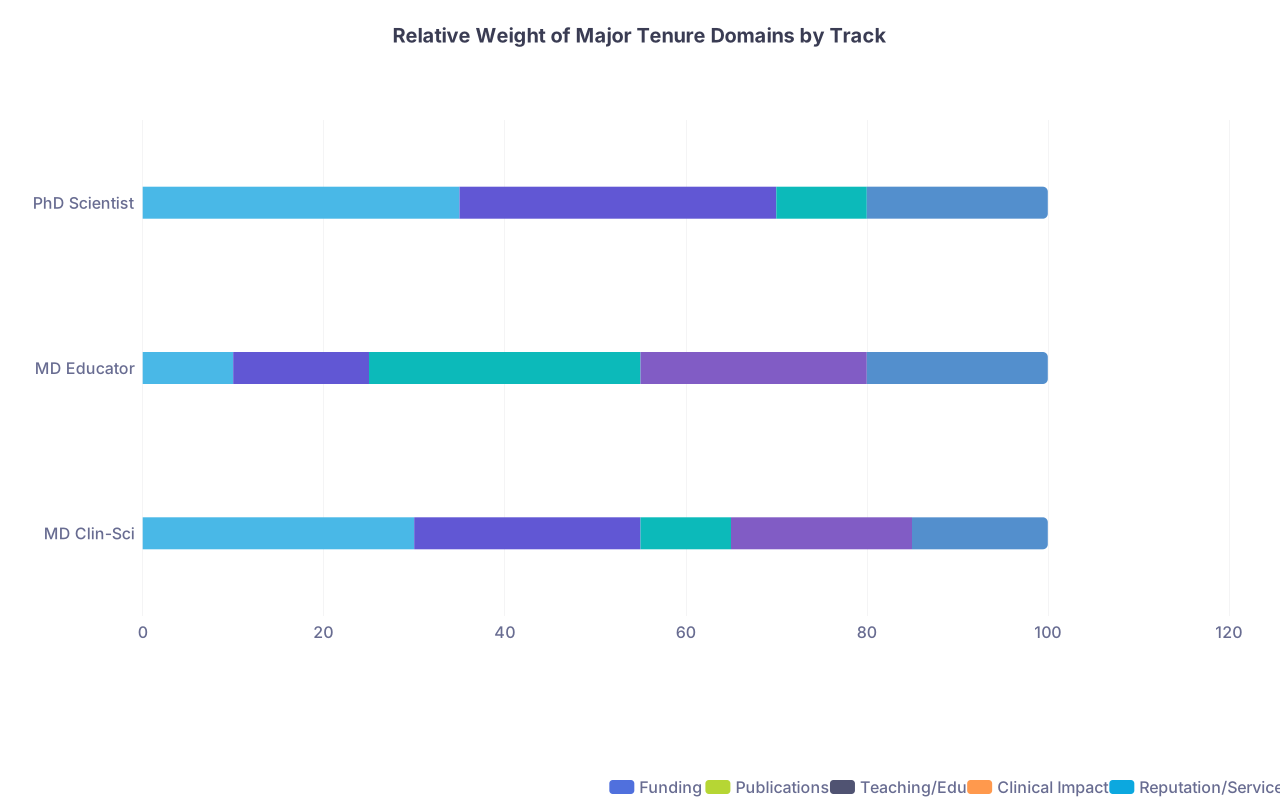
| Category | Funding | Publications | Teaching/Edu | Clinical Impact | Reputation/Service |
|---|---|---|---|---|---|
| MD Clin-Sci | 30 | 25 | 10 | 20 | 15 |
| MD Educator | 10 | 15 | 30 | 25 | 20 |
| PhD Scientist | 35 | 35 | 10 | 0 | 20 |
And here’s the part most junior faculty don’t fully internalize:
You don’t get “average” your way to tenure. You need at least one domain where people at the table say, “That’s unquestionably strong.”
If every part of your CV is “fine,” you’re in danger unless you’re at a very non-competitive institution.
The Politics: Who Speaks For You (and Against You)
Tenure decisions are not just about your CV; they’re about who’s willing to spend political capital on you.
Here’s the ugly, honest version.
MD Candidates
For MDs, your safety nets look like this:
- Division Chief / Department Chair who can say: “If we lose her, this service line will collapse. She’s indispensable clinically. We need to reward and retain her.”
- Powerful senior clinicians who like working with you enough to argue your case.
- Institutional priorities: if your work aligns with a current strategic push (population health, AI in medicine, rural outreach), you get more leeway.
I have seen MDs with weak publication records get tenure because they were mission-critical clinicians and nobody wanted to risk losing them. The official language will dress it up as “excellence in clinical service and teaching,” but in the room, it’s: “We cannot afford to have her walk.”
On the flip side, MDs who are clinically replaceable and not compelling academically are the easiest “no.”
PhD Candidates
PhDs live or die by a different political economy:
- Grant portfolios are their shield. Strong funding makes chairs defensive of you—because losing you damages their department’s numbers.
- Scientific reputation becomes the bargaining chip: “She’s one of the few people working in this cutting-edge area; we’d look foolish letting her go.”
- Graduate program roles matter: reliable thesis advisor, key methods person, major role in core facilities.
I’ve watched tenure cases where a marginal PhD candidate survived because the chair knew their grant renewal was likely and did not want to backfill that F&A loss.
But if your funding is weak and you’re “nice to have” instead of “need to have,” the committee is much colder. Sympathy doesn’t usually translate into tenure votes for unfunded PhDs.
How To Build a Tenure-Ready CV (With the Real Criteria in Mind)
Let’s be direct: if you’re already up for tenure, this is damage control, not strategy. But if you’re three to seven years out, you can still steer the ship.
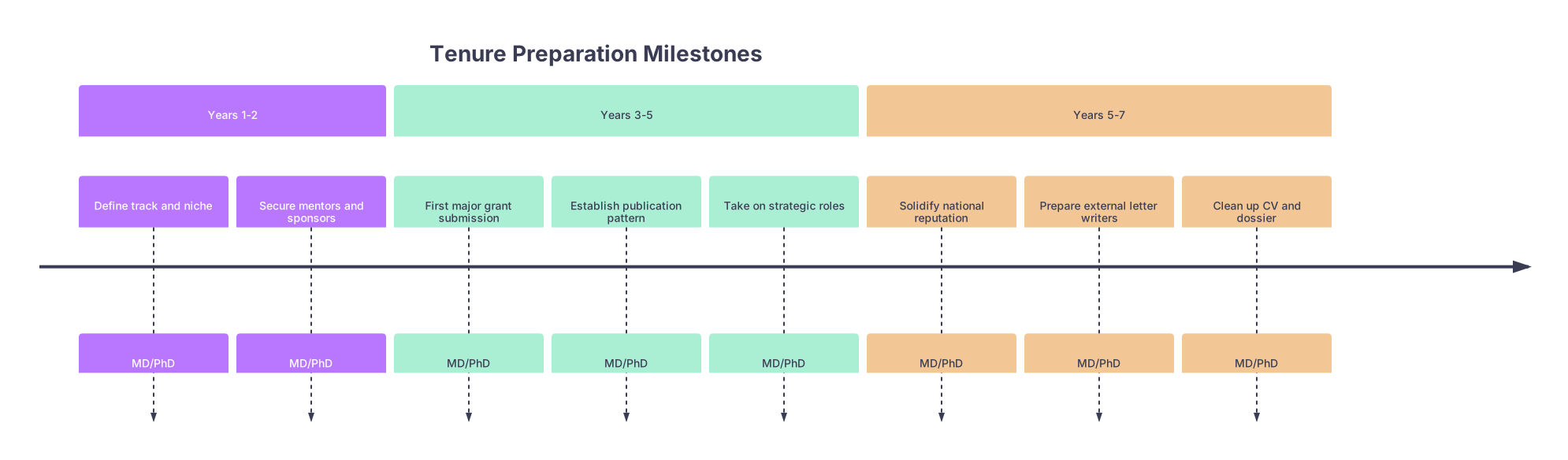
| Period | Event |
|---|---|
| Years 1-2 - Define track and niche | MD/PhD |
| Years 1-2 - Secure mentors and sponsors | MD/PhD |
| Years 3-5 - First major grant submission | MD/PhD |
| Years 3-5 - Establish publication pattern | MD/PhD |
| Years 3-5 - Take on strategic roles | MD/PhD |
| Years 5-7 - Solidify national reputation | MD/PhD |
| Years 5-7 - Prepare external letter writers | MD/PhD |
| Years 5-7 - Clean up CV and dossier | MD/PhD |
If You’re an MD Clinician-Scientist
You need to behave, on paper, like a slightly underfunded PhD with clinical leverage.
- Anchor everything around one or two central research themes. Committees love coherence. “She owns this subfield.”
- Push hard for at least one PI-level external grant. It doesn’t have to be an R01 if your institution is realistic, but you need something where you’re clearly the driver.
- Use your clinical niche strategically. Build a clinical program that feeds your research, then highlight that synergy clearly in your personal statement and CV.
Do not hide behind clinical load as an excuse. In the room, people say: “If their clinical FTE is truly that high, why are we pretending this is a research tenure case?”
If You’re an MD Clinician-Educator
You must stop thinking of teaching as standing in front of a room. Tenure committees reward documented, disseminated innovation, not just time spent.
On your CV, you should be able to point to:
- Named educational roles: course director, program director, curriculum lead.
- Products: curricula adopted by others, educational modules, simulation programs, online courses.
- Scholarship about your teaching: even if in lower-impact journals, the content is what matters here. Design-controlled educational studies when possible.
And you need a national footprint that’s more than going to one annual meeting. Serve on exam committees, accreditation site visits, national curriculum groups. That’s the kind of line a committee reads and nods at.
If You’re a PhD Scientist
Stop hiding in collaboration.
You need three things blindingly obvious on your CV:
- Your intellectual niche (what problem you own).
- Your independent funding associated with that niche.
- Your first/last author papers that tell a coherent story across time.
Everything else—teaching, service, mentoring—should support, not dilute, that central spine.
Teach, yes. But do not spend your best years chairing committees nobody reads minutes from. I have seen more than one promising PhD die of “death by committee” well before the tenure vote.
The MD vs PhD Double Standard (That Everyone Denies)
Here’s the uncomfortable truth you already sense.
- MDs can sometimes trade clinical indispensability and heavy education footprints for weaker research profiles and still get tenure—especially at clinically focused schools.
- PhDs almost never get that trade. Their core bargain with the institution is research productivity and funding. If that craters, everything else becomes background noise.
No committee will say this out loud. Official documents enshrine a tripartite mission: research, teaching, service. But walk into the room after five back-to-back cases and listen.
For a marginal MD, the debate sounds like:
“Can we afford to lose this clinician-educator?”
For a marginal PhD, the debate sounds like:
“Can we justify tenure given their funding and publication record?”
Different questions. Different thresholds.
Once you see that, the rest of the process suddenly makes a lot more sense.