
The biggest mistake ambitious students make about “PhD first, MD later” is assuming more letters after your name automatically means more options. It often means more traps.
If you’re thinking about doing a PhD now and “getting the MD later,” you’re playing with one of the most expensive sequencing problems in education. The order matters. The timing matters. And a lot of well-meaning mentors will give you bad advice here.
Let’s walk through the hidden credential timing mistakes I’ve watched people make—and how you can avoid wrecking a decade of your life.
1. Treating “PhD Then MD” as a Flexible Backup Plan

The biggest lie you’ll hear: “Do the PhD now, you can always come back for the MD later.”
That’s not a flexible backup. That’s a 12–18 year commitment if you follow through. And most people don’t.
Here’s the typical fantasy sequence:
- College
- PhD (5–7 years)
- MD (4 years)
- Residency (3–7 years)
- Fellowship (0–3+ years)
Now here’s what actually happens in real humans, not brochures:
- They finish a PhD at 30–32.
- They’re tired. Often burned out.
- They may have a partner, kids, debt, or a specific city they’re anchored to.
- The idea of starting another 7–10+ years of training becomes… less romantic.
The mistake: assuming your 21-year-old self and your 32-year-old self want the same life.
What usually kills the “MD later” plan:
- Age + burnout: The longer you stay in training, the harder it is to keep sacrificing salary, autonomy, and geography.
- Life inertia: Partner’s job, kids in school, aging parents. These are real constraints, not excuses.
- Opportunity cost: Walking away from a stable research job/industry salary to go back to debt and call nights is not trivial.
If you’re thinking “I’ll just see how I feel after the PhD,” you’re already in dangerous territory. That’s not a plan; that’s procrastination disguised as strategy.
Safer thought process:
Ask yourself right now: If I got into an MD program this year, would I take it?
- If the honest answer is yes, doing a PhD first is likely backwards.
- If the honest answer is no, you probably don’t want an MD enough to survive 10–15 more years of training after a PhD.
2. Ignoring How Admissions Committees Read Your Timeline
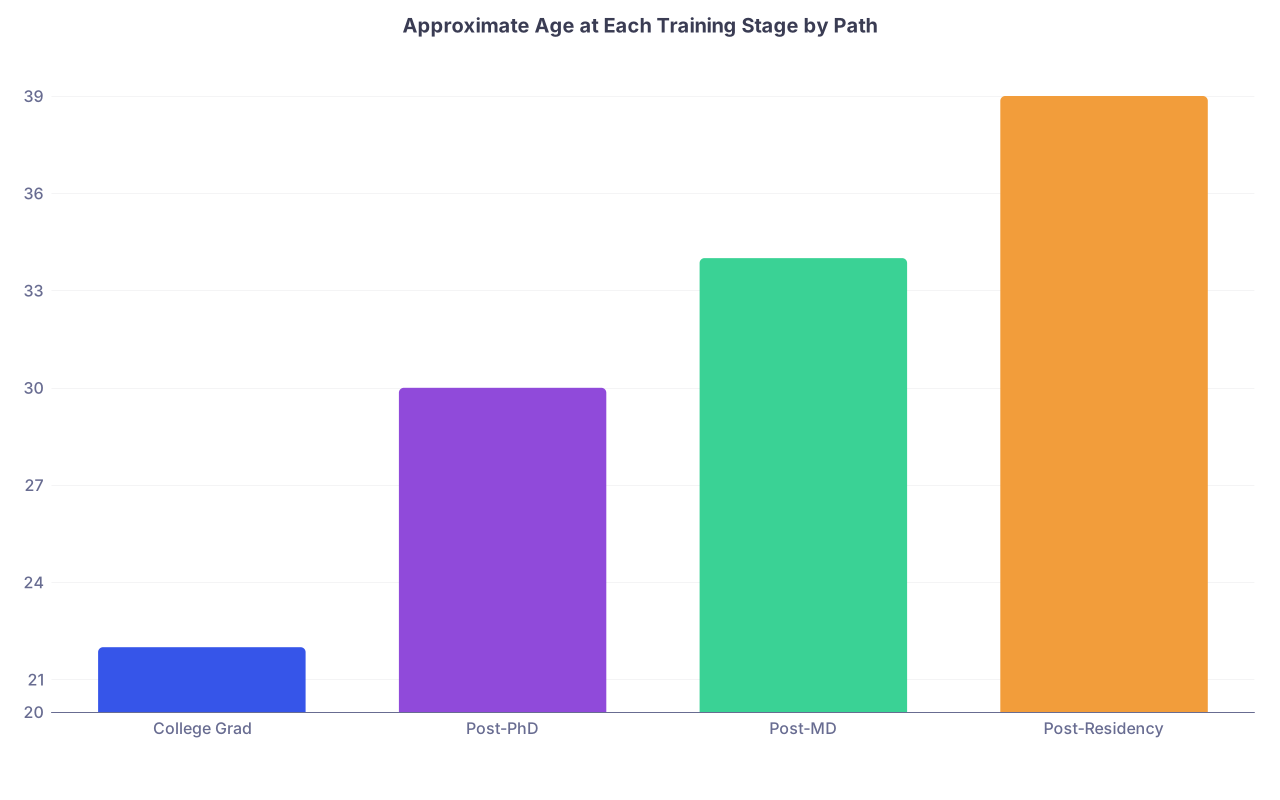
| Category | Value |
|---|---|
| College Grad | 22 |
| Post-PhD | 30 |
| Post-MD | 34 |
| Post-Residency | 39 |
Here’s a mistake I see constantly: applicants assume admissions committees will be impressed by a PhD on an MD application, no questions asked.
Reality: they’re impressed and suspicious.
The unspoken questions every committee member has when they see PhD → MD:
- “Why didn’t this person do an MD/PhD?”
- “Why now? Why not earlier?”
- “Are they running away from research because it was hard?”
- “Are they chasing prestige or do they actually want clinical work?”
- “Will they actually finish this marathon, or burn out halfway through residency?”
If your timeline looks like:
BS → 6-year PhD in molecular biology → postdoc → now applying to MD at 35…
you will be grilled on this. Hard.
The mistake: assuming “more degrees = automatic upgrade.” No. More degrees = more explaining to do.
Fix this early by:
Clarifying your endpoint now. Not “I like science and medicine.” That’s vague. Be specific:
- “I want to run a translational immunology lab and see patients with autoimmune disease 1–2 days a week.”
- Or: “I want to be a clinician who can critically interpret research, not necessarily lead a lab.”
Matching the degree order to that endpoint:
- Heavy research + some clinical → MD/PhD often better than PhD then MD.
- Clinical first, maybe some research later → MD first, then targeted research training (fellowship, MPH, MS, postdoc-like work).
A PhD before MD can make sense. But only when the story is coherent and the timing doesn’t scream “I had no idea what I wanted, so I collected degrees.”
3. Underestimating the Financial Damage of Doing This Out of Order
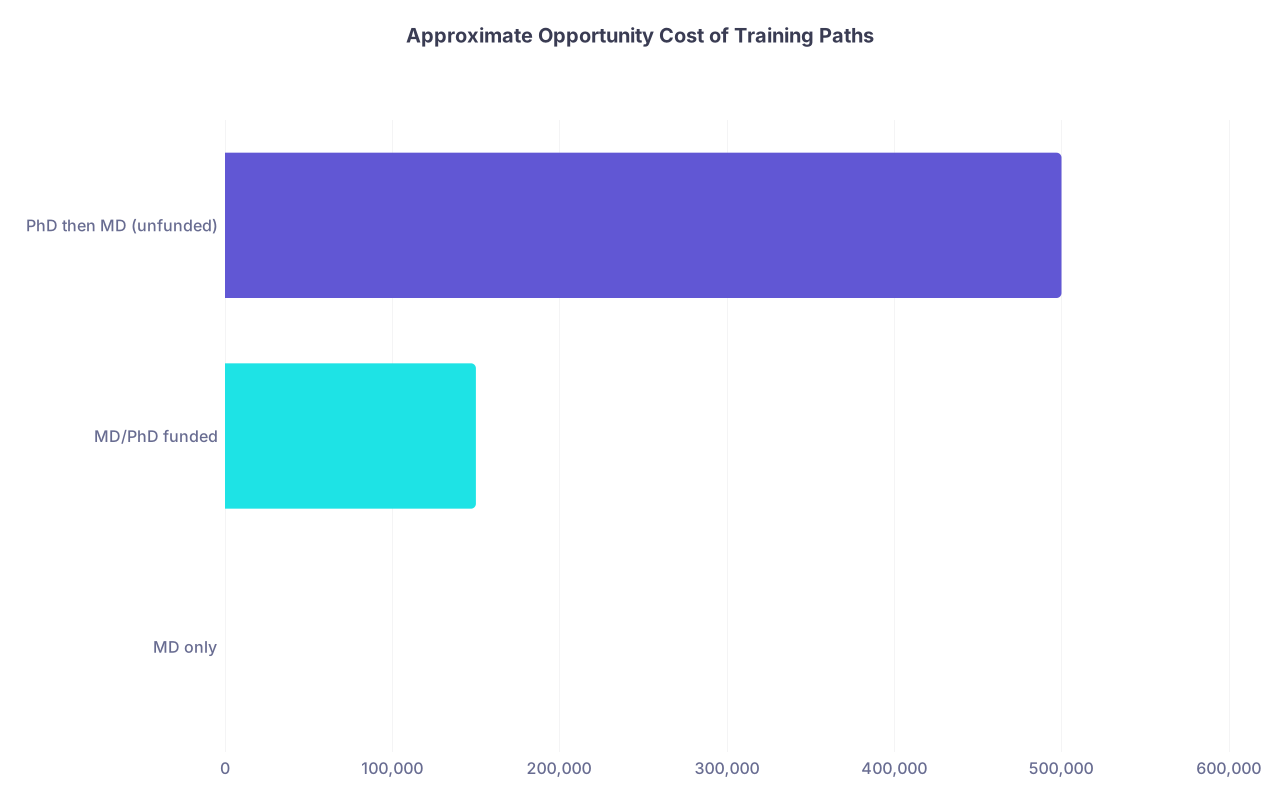
| Category | Value |
|---|---|
| MD only | 0 |
| MD/PhD funded | 150000 |
| PhD then MD (unfunded) | 500000 |
If you’re not running the numbers, you’re making a massive mistake. Degrees aren’t abstract achievements. They’re extremely expensive time blocks.
Let’s say:
- PhD: 6 years, stipends maybe $30–40k/year.
- MD: 4 years, often tuition + living costs → debt of $200–$400k is common in the US.
- Residency: You get paid, but $60–75k/year is not “doctor money,” especially if you’re in a high cost-of-living city.
The expensive sequencing mistake is simple:
- Doing a stand-alone PhD that doesn’t meaningfully reduce your MD cost or shorten training.
- Then paying full MD tuition instead of doing a funded MD/PhD or choosing an MD path that fits your goals faster.
Compare three rough paths:
| Path | Training Years | Med School Tuition | Stipend/Income During PhD |
|---|---|---|---|
| MD only | 4 + residency | High (often full) | None |
| MD/PhD (funded) | 7–9 + residency | Often covered | Yes, during PhD |
| PhD then MD (separate) | 10–11 + residency | PhD maybe funded | Yes during PhD, none during MD |
Rough rule: PhD → MD is usually the most financially punishing route unless:
- You’re doing it in a system where tuition is minimal (some European countries, etc.), or
- You’re unusually funded/supported (military scholarships, national programs, etc.), or
- Your goal is so niche that the separate PhD truly matters (e.g., advanced computational work long before you knew you wanted medicine).
Common financial timing mistakes:
- Starting a PhD “to boost your MD application” instead of fixing MCAT/GPA or getting meaningful clinical exposure. That’s like using a sledgehammer to swat a fly.
- Assuming debt “will work itself out” because doctors make good money. No. That math can haunt you when you’re 40, still paying loans, trying to buy a house, and raising kids.
If you haven’t done a rough 10–15 year financial projection, do it. On paper. Yes, now.
4. Choosing the Wrong PhD Topic for a Future MD

Another mistake: treating any PhD as equally helpful for a later MD.
They’re not.
If your true endpoint is physician-scientist or academic medicine, some PhDs integrate nicely with that. Others make your path harder.
Better-aligned PhD topics (if you insist on doing it first):
- Biomedical sciences (immunology, cancer biology, neuroscience)
- Biostatistics / epidemiology
- Bioengineering with clear translational applications
- Health policy / outcomes research, if you’re serious about academic health systems work
High-risk misalignment (for MD later):
- Purely theoretical disciplines with no clinical tie-in (abstract math, theoretical physics, etc.), unless you’re laser-focused on a tiny niche like medical imaging algorithms or radiation physics—and can explain that.
- Humanities PhDs done primarily out of interest, with a vague “I’ll go to med school later and be a more well-rounded doctor.”
I’ve seen people do a beautiful PhD in something like Victorian literature, then try to pivot to MD at 33. Their application is not “better.” It’s just more confusing.
Admissions committees don’t say it out loud, but they think: “Why med school after this path? Did something fail? Are they using med school as escape?”
If your PhD topic doesn’t build a coherent story for your future clinical work or research, you’re just adding years and questions.
5. Misreading the MD/PhD Option Completely

| Step | Description |
|---|---|
| Step 1 | Interested in patient care? |
| Step 2 | PhD only |
| Step 3 | Also serious about leading research? |
| Step 4 | MD only |
| Step 5 | Competitive stats? |
| Step 6 | Consider MD PhD |
| Step 7 | Strengthen application first |
Huge mistake: ignoring MD/PhD because “I’ll just do them sequentially.”
Sequential almost never beats integrated if you already know you want both.
Why MD/PhD can be smarter timing-wise:
- You usually get funded tuition and a stipend during the PhD years.
- Programs are designed around sequencing: 2 years preclinical MD → PhD → final clinical years.
- You come out with a much clearer physician-scientist identity. The story writes itself.
Why people incorrectly skip it:
- “I don’t think I’m competitive.” So they hide in a PhD first then apply later with the same weak stats plus age and burnout.
- “I’m not sure I really want patient care.” Then they do a PhD hoping it clarifies things. It rarely does. It just postpones the MD decision and fills the time with something that looks like progress.
If you’re even considering MD/PhD, at least talk to:
- Current MD/PhD students
- Program directors
- Residents who did MD/PhD and are now in the specialty you think you want
Skipping this step and just “deciding” on a PhD first is a timing error you can’t easily undo.
6. Overvaluing Titles, Undervaluing Daily Life
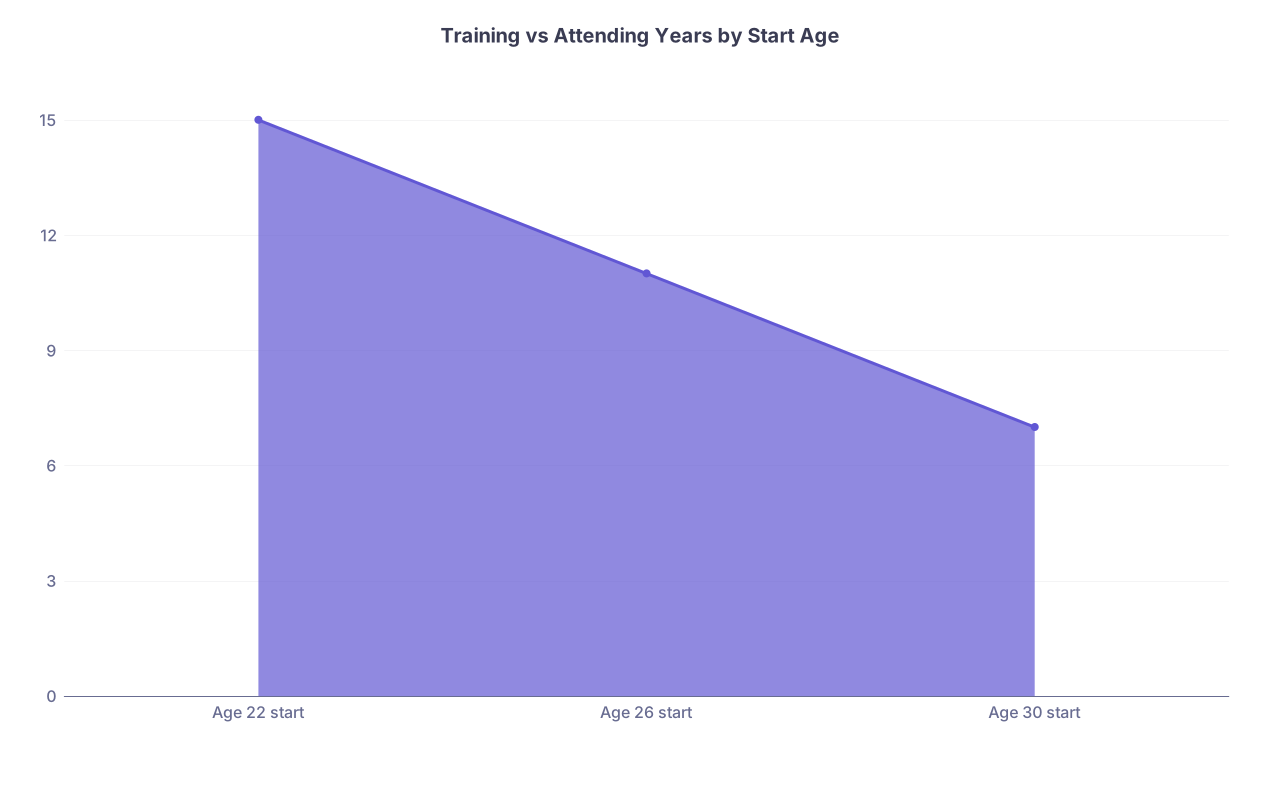
| Category | Value |
|---|---|
| Age 22 start | 15 |
| Age 26 start | 11 |
| Age 30 start | 7 |
Another trap: thinking in letters (PhD, MD) instead of lifestyles.
Degrees are not just credentials. They’re pipelines into how you will spend your days.
If you do:
- PhD first: 5–7 years of grant writing, failed experiments, paper rejections, and a lot of “this might never work.”
- MD later: 4 years of exams, clerkships, and then residency with call, night shifts, and very little control over your schedule.
Many people imagine the peak identity—“physician-scientist at a big academic center”—and ignore that they’re signing up for 15+ years where they’re low on the totem pole, working long hours, moving cities, and being evaluated constantly.
The sequencing mistake is this:
- You front-load your life with the hardest parts of both research and medicine, then expect yourself to magically still have energy and enthusiasm at 35+ to build a career from scratch.
Stop thinking “MD vs PhD vs both.” Start thinking:
- “Do I want to spend most days in a clinic, an OR, a lab, an office, or some mix?”
- “How many years am I truly willing to delay stable income and geographic control?”
- “Am I trying to fix uncertainty about my identity by grabbing more degrees?”
If you don’t answer those honestly, you’ll misuse the sequence.
7. Time-Blocking Your Life Wrong: The Hidden Age Traps

You don’t need to be 25 and done with everything. But you do need to be realistic about time.
Typical sequencing mistake: pretending age doesn’t matter at all.
Here’s what I’ve seen go wrong:
- Someone does BS → 6-year PhD → 2-year postdoc. They’re 32.
- Then they start MD at 33. Graduate at 37.
- Start residency at 38. Finish at 41–45 depending on specialty and fellowship.
Can this work? Yes. I’ve seen 40-year-old interns.
But you must be honest:
- Will you be okay doing 24–28 hour calls at 40? Not some hypothetical version of you. You.
- Will your partner be okay with another 7–10 years of your training paycheck and brutal schedule?
- Are you okay starting retirement savings in your 40s?
People make bad timing decisions because they treat “future me” like a superhero.
You don’t have to fear age. But you do have to respect it. Especially if you’re voluntarily adding 6–8 years of extra training (a PhD) before an MD you’re not yet sure about.
8. Using a PhD to Avoid Fixing the Real Problem
One more brutal but necessary point.
A lot of “PhD first, MD later” plans are actually avoidance strategies:
- GPA is low → “I’ll get a PhD to prove I’m smart, then it’ll be easier to get into med school.”
- MCAT is weak → “Research is my strength, so I’ll lean into that first.”
- No clinical exposure → “Lab work feels familiar, I’ll start there and figure out the rest later.”
Here’s what happens when you do that:
- You spend 5–7 years not actually fixing the real gap (academics, MCAT, clinical clarity).
- You age out of the most flexible window to address those weaknesses.
- Then you apply to MD programs as someone older, with a long track record… and the same original weaknesses.
MD admissions committees don’t magically ignore a 3.2 undergrad GPA because you have a PhD. They ask why you didn’t address it directly when you realized medicine mattered to you.
If your real issue is:
- Poor study skills → Fix that now.
- Weak test performance → Attack MCAT or class performance now.
- Uncertainty about loving patient care → Shadow, scribe, volunteer. Actually test the career.
Do not hide in a PhD.
9. When “PhD First, MD Later” Actually Makes Sense
Let me be clear: I’m not saying this path is always wrong. I’m saying most people choose it for the wrong reasons and wrong timing.
It can make sense if:
- You started a PhD genuinely committed to a research path, with no real thought of medicine.
- During that PhD, you get focused and prolonged exposure to clinical problems (e.g., working closely with clinicians, seeing your work’s direct clinical impact).
- That exposure changes your career goal → you now want significant patient care in addition to research.
- You’re willing to accept the age, financial, and lifestyle costs with eyes open, not fantasy.
Or:
- You’re in a system with low/no tuition, strong support, and integrated pathways between PhD → MD that don’t duplicate effort needlessly. (Some European or Canadian contexts fit this better than the US.)
In those cases, the test is: Does the story hold up to harsh questioning?
If a cynical admissions dean asked you, “Why should we invest four years of MD training in you, on top of your PhD?”—can you answer in a way that’s:
- Specific
- Coherent
- Grounded in real patient/clinical experiences
If not, your timing is probably off.
Your Next Step Today
Open a blank page and write two things:
- Your ideal day 10–15 years from now. Hour by hour. Where you work, what you’re doing, who you’re helping, how much research vs patient care vs teaching vs admin.
- Your honest training path to get there, with ages and years next to each step: college, PhD, MD, residency, fellowship.
Then ask yourself one uncomfortable question:
If I already knew I wanted that future day, would I still choose “PhD first, MD later”—or is that just the path I drifted onto?
If the answer makes you uneasy, listen to that feeling now. It’s a lot cheaper to correct your path today than 7 years into the wrong degree.