It’s 10:30 p.m. You’re staring at your CV and a spreadsheet of programs. You’ve either already got, or are seriously considering, a PhD, an MPH, or at least a research year. And the question pounding in your head is blunt:
“Do program directors actually care more about a PhD, or would they rather see solid, dedicated research time on my application?”
Let me answer the core question first, then I’ll break it down by specialty, program type, and your actual goals.
The Short Answer: They Value Productive Research Time More Than the Letters
If you’re looking for a single sentence: most program directors care far more about what you did (research output, skills, trajectory) than what degree you collected (PhD vs MD-only with a gap year).
A PhD is:
- Very valuable in some contexts
- Overkill or even irrelevant in others
- Never a magic ticket on its own
Dedicated research time (a year out, T32, HHMI, etc.) that produces strong, relevant work is often just as impressive—and sometimes more practical—than a PhD for residency applications.
Now let’s get specific.
How Program Directors Actually Think About PhD vs Research Time
Most PDs are not sitting there ranking PhDs above everyone else by default. They look at three things:
- Does this applicant fit our program’s mission (clinical vs academic)?
- Can they handle the clinical workload?
- Will they add value to our academic reputation (papers, grants, conference presence)?
A PhD is a signal—but it’s noisy. Some PhDs are high-output, independent, deeply analytical. Some are seven-year detours with minimal tangible product.
Dedicated research time during or after med school is also a signal. It usually says: “I deliberately focused on research for X months/years. Here’s what I produced.”
- Peer-reviewed publications (especially first-author or impactful journals)
- Consistent story: research aligned with your stated interests and specialty
- Evidence you can start and finish projects
- Strong letters from recognizable researchers who actually know your work
- Some sign you won’t crumble when the pager goes off 40 times in a night
If you’re MD-only with a strong research year and clear output, you are not inherently behind an MD/PhD. In many programs, you’re on equal or better footing.
Where a PhD Really Matters (and Where It Barely Moves the Needle)
Here’s where people get confused. Not all specialties or programs care the same way.
| Specialty Type | PhD Advantage | Strong Research Year Advantage |
|---|---|---|
| Physician-scientist tracks (IM, Neuro) | Very High | Very High |
| Academic-heavy fields (Rad Onc, Med Onc) | High | High |
| Competitive surgical (Neurosurg, ENT) | Moderate | High |
| General IM, Peds, OB at academic centers | Moderate | Moderate |
| Purely community programs | Low | Low–Moderate (if clinical impact) |
Programs that love PhDs
- Physician-scientist tracks (PSTPs/ABIM research pathways in Internal Medicine, Neurology, etc.)
- Radiation Oncology, certain Hem/Onc-oriented Internal Medicine programs
- Top-tier academic places that explicitly market “research careers” (think MGH, UCSF, Penn for certain tracks)
In these environments, a PhD can:
- Make PDs think: “This person can get K awards / R grants.”
- Put you in the “serious academic” bucket before you walk in.
- Align perfectly with their NIH-funded, lab-heavy culture.
But even there: if your PhD is in a totally unrelated field with weak publications, and the MD-only applicant has multiple first-author clinical papers in the specialty, the MD-only can absolutely be more attractive.
Programs where a PhD is “nice but not critical”
Most categorical Internal Medicine, Pediatrics, OB/GYN, Anesthesia, standard Neurology tracks at academic centers fall here.
PDs will think:
- “Cool, a PhD—can they still function clinically?”
- “What did they actually do?”
- “Are they aiming for faculty work with protected time or are they done with research?”
In these places, a well-used research year, strong clinical performance, and clear fit often matter more than letters after your name.
Programs where a PhD barely matters
Many community-based programs, or programs that are clinically heavy with minimal research infrastructure, will not care that much that you did a PhD. They respect it, but they’re not building an NIH empire.
They care more about:
- Can you staff the wards without constant supervision?
- Are you pleasant to work with?
- Do your letters show reliability, work ethic, and basic competence?
A PhD in computational biology with zero clinically relevant output won’t push you past an MD-only with strong clerkship grades and good Step scores here.
Dedicated Research Time: Why PDs Often Like It More
If you ask many PDs privately, they’ll say roughly this: “I prefer an MD who chose targeted, productive research time in my field to someone who spent 5–7 years on a PhD that barely touches what we do.”
Here’s why.
It’s focused and relevant
When you do:
- A funded research year (HHMI, Doris Duke, Sarnoff, T32)
- A masters-year with heavy research
- A dedicated research block in your home or outside institution
You usually pick projects that line up directly with your specialty goal: neurosurgery, derm, IR, oncology, etc.
That tells PDs:
- You know what you’re getting into
- You’re plugging into their world (journals, societies, attendings)
- You’re more likely to hit the ground running on day 1 of residency
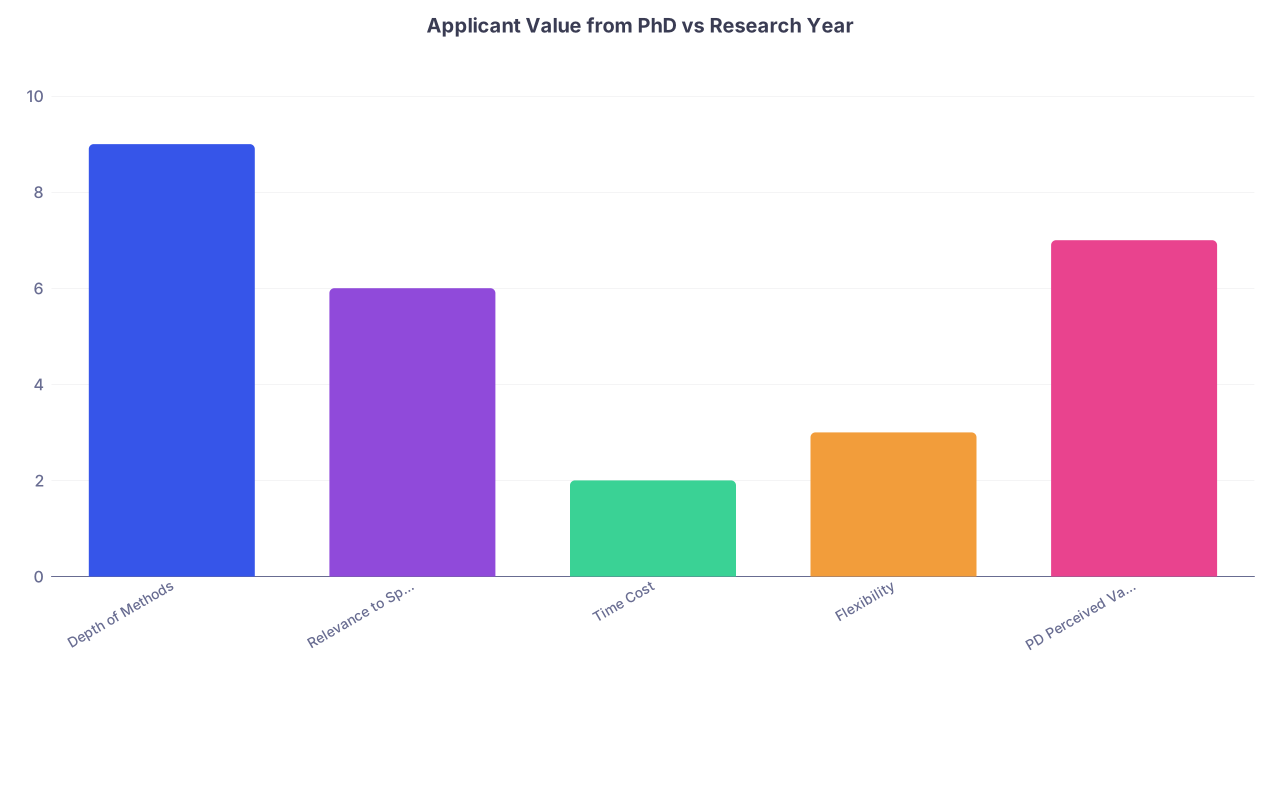
| Category | Value |
|---|---|
| Depth of Methods | 9 |
| Relevance to Specialty | 6 |
| Time Cost | 2 |
| Flexibility | 3 |
| PD Perceived Value | 7 |
(For comparison: PhD = depth 10, relevance 5–8, time cost 1, flexibility 2, PD perceived value 7–9 depending on program. The point: tradeoffs.)
It’s evidence of intentional career planning
Choosing a research year says:
“I saw a gap. I took structured time to fill it. And I produced something.”
That kind of intentional, time-limited commitment reads very well. Especially if you come back with:
- 2–4 papers (even if some are middle-author)
- Posters and oral presentations
- A strong letter from a PI who is known in the field
That’s often more clinically persuasive than a ten-year gap between college and residency with a PhD in a tangential area.
MD/PhD vs MD + Research Year: When One Beats the Other
Let’s put them side by side in the context PDs actually use.
| Factor | MD/PhD | MD + Research Year |
|---|---|---|
| Time investment | 7–9 extra years total | 1–2 extra years |
| Typical research depth | Very high | Moderate–high |
| Specialty alignment | Variable | Usually high |
| Grant potential signal | Strong | Moderate |
| Flexibility | Lower (lock-in to research path) | Higher |
| PD signal | Serious academic potential | Serious interest + balance |
When MD/PhD is clearly better:
- You’re aiming at PSTP / research pathways in IM, Neuro, Peds, etc.
- Your PhD is directly relevant to your planned field (e.g., cancer biology → Hem/Onc or Rad Onc).
- You actually published well and can talk methods at a high level.
- You want 50%+ research time as an attending.
When MD + research year is equal or better:
- You’re shooting for surgical fields where outcomes research, imaging, or clinical trials matter more than bench work.
- Your research year is within the exact department you’re applying to.
- You have multiple concrete outputs and a killer letter from a big-name attending.
- You’re not interested in a heavily grant-funded career and don’t need the PhD overhead.
How Different Types of Programs Weigh This
Now let’s break it down by program style, which is honestly more predictive than raw specialty.
1. Research-heavy, top-tier academic programs
Think: top 10–20 university hospitals with high NIH funding.
They value:
- PhDs who actually published in decent journals
- MDs with robust research years and specialty-specific output
- Any sign you can bring in future grants
PhD vs research year here is a tie-breaker, not an automatic win. A weak PhD doesn’t trump a strong research year.
2. Mid-tier academic programs
These programs want some research, but they’re not living or dying on NIH rankings.
What matters most:
- A clear trajectory: “I like cardiology, here’s my research in cardiology, here are my mentors”
- Maybe a first-author paper, maybe not—just consistent effort
They will not punish you for not having a PhD. Many PDs here actually prefer people who want to be strong clinicians with side research, not career grant writers.
3. Community programs with light research
Here, both PhD and research year are “extras.” The hierarchy for them:
- Clinical performance and letters
- Fit and communication
- Board scores / in-training potential
- Research / degrees way down the list
If you have a PhD but seem cold, disengaged, or uninterested in bread-and-butter clinical work, you’ll drop. Same with someone who did a big fancy research year but can’t explain a simple patient case clearly.
Red Flags PDs See Around PhDs and Research Time
Here’s the part nobody likes to talk about.
For PhD applicants
Common PD worries:
- “Will this person be unhappy with the clinical grind?”
- “Are they going to vanish into the lab and fight us about clinic days?”
- “Do they expect special treatment?”
- “Is this a 35-year-old trainee who might struggle with call, long shifts, or re-adapting to clinical work?”
You fix this by:
- Showing strong, recent clinical performance
- Having letters that explicitly say you are clinically solid and team-oriented
- Talking concretely about balancing research with clinical responsibilities
For applicants with a research year
Red flags:
- A “research year” with almost no output or unclear role
- Multiple “almost done” projects and nothing published or submitted
- No strong letter from a PI who actually supervised you
- A story that sounds like: “I just needed to fill the time.”
The PD interpretation: poor follow-through, low productivity, fuzzy goals.
If You’re Deciding: Should You Do a PhD or Just Research Time?
Here’s the decision logic I give students.

| Step | Description |
|---|---|
| Step 1 | Want research as major part of career? |
| Step 2 | Skip PhD, maybe short research |
| Step 3 | Want 50 percent or more research as attending? |
| Step 4 | Strong research year or masters |
| Step 5 | Field supports PSTP or grants? |
| Step 6 | Research year plus networking |
| Step 7 | Consider MD PhD or postdoc route |
Times when a PhD starts to make sense:
- You’re early (college or pre-med) and truly love experimental work.
- You want a physician-scientist job where promotion depends on R01s.
- You’re okay sacrificing years and money now for that trajectory.
Times when a research year is clearly smarter:
- You’re already in med school and late to the game.
- You want competitive clinical fields (e.g., ortho, derm, IR) where targeted research produces more value than a generic PhD.
- You want options, not a locked-in research-heavy identity.
How To Present Whatever You Have So PDs Actually Care
Whether you have a PhD, a research year, or just scattered projects, the way you package it matters.
Three rules:
Tie everything to your intended specialty
Don’t just list “10 papers.” Make them a narrative: “I’ve focused on outcomes in spine surgery…” or “My work centers on biomarkers in breast cancer…”Highlight skills, not just titles
Examples: “designed and powered a retrospective cohort study,” “implemented a data pipeline,” “ran survival analyses,” “managed a multi-site registry.”Have one or two anchors
A big first-author paper, a notable poster, or a letter from a known name in the field. PDs remember anchors, not laundry lists.

Quick Specialty Examples
To make this concrete, here’s how this plays in a few real scenarios.
Example 1: Internal Medicine, wants Hem/Onc academic career
- MD/PhD in cancer biology, 3–4 good papers, plus one oncology-focused research year: gold.
- MD-only with a strong oncology research year, couple of papers, and a clear plan to join a research track: very competitive, often on par at most programs.
- PDs here value product + trajectory. Degree is secondary.
Example 2: Neurosurgery
- PhD in basic neuroscience with weak clinical tie-ins vs MD-only with a focused neurosurgery research year, multiple clinical neurosurg papers, letters from neurosurgeons.
- Most neurosurgery PDs will gravitate to the second applicant. Relevance dominates.
Example 3: Community IM program
- PhD vs MD-only with no research but stellar clinical comments, strong Step 2, and great interpersonal skills.
- The second applicant often wins. They fill the program’s actual needs.

FAQ: PhD vs Research Time for Residency
1. Does having a PhD guarantee I’ll match at a top academic program?
No. A PhD gets attention, but you can still fall flat with mediocre clinical performance, poor interview skills, or weak letters. I’ve seen MD-only applicants with focused, high-quality research beat MD/PhDs for the same spots, especially when their work was more relevant to the specialty.
2. If I already have good board scores, is a research year still worth it?
If you’re targeting competitive specialties or top academic centers, yes, it often is—if you can get real output and meaningful mentorship. Scores open the door; research often determines where you land along the academic–community spectrum in that specialty.
3. Do program directors see MD/PhD applicants as “too academic” for community programs?
Some do. Not all, but enough that it matters. Community PDs sometimes worry you’ll be unhappy without research infrastructure. You can counter this by clearly stating you value clinical work as your primary focus and by showing strong, recent, hands-on clinical performance.
4. Is a masters degree (MPH, MS, MHS) plus research time almost as good as a PhD?
For many residency applications, yes. Especially if your master’s and projects are tightly linked to your specialty. An MPH + serious outcomes research can look incredibly strong for IM, EM, surgery, OB, etc., without the time sink of a PhD.
5. If I can only choose one, should I prioritize a publication or a prestigious research fellowship name?
Prioritize substantive output. A big-name fellowship with zero tangible products looks hollow. A solid first-author paper in a decent journal, tied to your specialty, plus a strong letter from a good (not necessarily famous) mentor is more persuasive to most PDs than a shiny line on your CV with no results.
Key points to remember:
- Program directors value productive, relevant research more than they value a PhD as a standalone label.
- A targeted research year with real output can absolutely rival—and sometimes beat—a PhD for residency purposes in many fields.
- Match your path (PhD vs research time) to your long-term career goals, not just what looks impressive on ERAS.