
You’re not “lucky.” You’re stuck at a fork in the road that can reshape the next 10–15 years of your life.
If you’ve been accepted to both MD and MD–PhD programs, and you feel like you do not have enough information to choose, you’re in a very specific, very real situation. People will give you vague lines like “follow your passion” and “you can always do research later.” That’s lazy advice.
Here’s the reality: both choices can be excellent, but they are not interchangeable. And making this decision on vibes alone is a bad idea.
I’m going to assume this is roughly your situation:
- You have at least one straight MD acceptance.
- You have at least one MD–PhD (likely MSTP or similar) acceptance.
- You’re not 100% sure you want to be a physician–scientist long term.
- The programs are giving you glossy brochures and vague promises, not hard data.
- You’re worried about money, time, and closing doors.
Good. Let’s treat this like a real decision, not a personality quiz.
Step 1: Get Brutally Clear on What You Actually Want Day-to-Day
Forget titles. Forget prestige. Focus on what your Tuesday looks like 10 years from now.
Picture three concrete futures:
Mostly clinical:
- You see patients 4–5 days a week.
- You maybe help with QI projects or a small clinical study.
- Your success is measured in good care, efficiency, clinical outcomes.
True split:
- 60–80% research, 20–40% clinic.
- You’re writing grants, running a lab, dealing with IRB, mentoring trainees.
- Clinic days are intense but limited; research is your “main job.”
Mostly research:
- You run a lab, maybe see patients 0–1 day a week or only on special consults.
- You’re deep into R01s, papers, conferences, and admin.
Now ask yourself two hard questions:
- Which of these three futures feels like a good trade for your 30s and 40s?
- Which one could you tolerate even on a bad week?
If your honest answer is:
- “I have no idea, they all sound hypothetical” → you’re not alone; move on to the next steps.
- “Definitely mostly clinical” → strong argument for MD.
- “I want research to be central, not a side hobby” → strong argument for MD–PhD.
- “Somewhere between pure clinical and heavily research” → either can work, but which path makes that easier where you matched?
Step 2: Understand the Real Tradeoffs (Time, Money, Risk)
Let’s put some structure around the decision. This isn’t just “more degrees = better.”
| Factor | MD Only | MD–PhD |
|---|---|---|
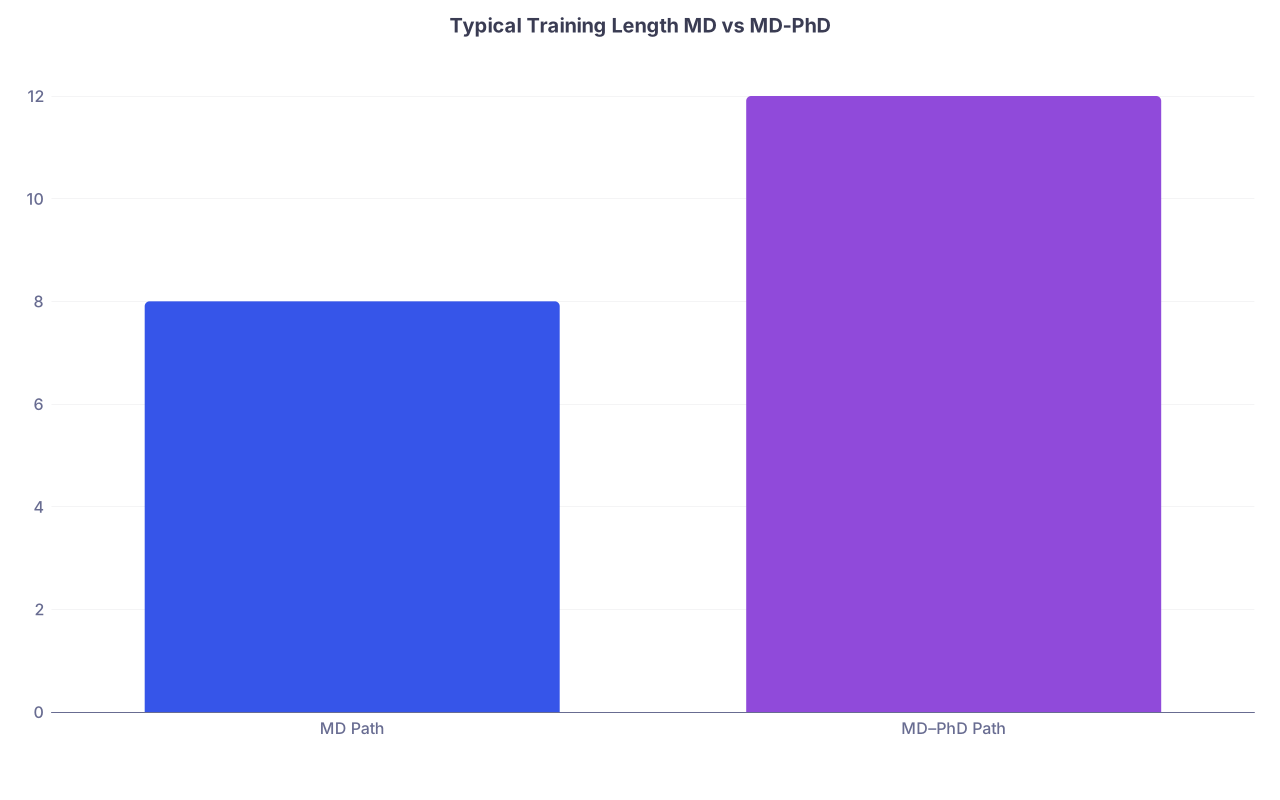
| Training length | ~7–9 years (MD+res) | ~10–13 years (MD–PhD+res) |
| Tuition | Usually pay | Usually funded + stipend |
| Debt | Often high | Often much lower |
| Research time | Optional/variable | Built-in, 3–5+ PhD years |
| Career flexibility | Broad clinical options | More geared to academia |
Time vs debt: the uncomfortable math
You’ll hear, “MD–PhD saves you so much money.” Sometimes. But it costs you years.
Rough, simplified example:
MD only:
- 4 years med school, maybe $250–350K debt.
- Start residency at ~age 26–28.
- Start attending salary at ~32–34.
MD–PhD:
- 7–8 years MD–PhD with tuition covered and ~$30–40K/year stipend.
- Start residency at ~29–32.
- Start attending salary at ~35–38.
| Category | Value |
|---|---|
| MD Path | 8 |
| MD–PhD Path | 12 |
The PhD “saves” you med school tuition, but you earn an attending salary several years later. Whether that’s a good trade depends on:
- How much debt your MD option truly means (not list price, but scholarships, family help, PSLF possibilities).
- Whether you actually want to use the PhD (protected research time, grants, academic career) or just like the idea of it.
If you would be completely miserable without substantial research in your life, the extra years are not “lost time.” They’re part of building the career you actually want. If you’re lukewarm on research, that 3–5 year PhD is a very long detour.
Step 3: Extract Maximum Signal from Limited Program Data
You’re saying you have “limited data.” Honestly, that’s partly because schools are terrible at giving the data that actually matters. So you have to go hunt for it.
Here’s how, quickly and aggressively.
1. Ask for outcomes, not slogans
Email or call the MD–PhD program director or administrator. You want numbers:
What percentage of your MD–PhD graduates in the last 10 years:
- Are in tenure-track or equivalent physician–scientist roles?
- Hold significant research time (≥50%)?
- Ended up primarily clinical with minimal research?
Average time to degree (MD–PhD only, not what’s on the website from 15 years ago).
Typical residency matches (specialties and programs).
Same for the straight MD side if you’re considering research from that path:
- How many MD grads go into research-heavy fellowships or obtain KL2 / K awards?
- Do you have a physician–scientist track for MDs in residency?
If a program dodges these questions or sends fluff copy, that’s data: they either do not track outcomes or are not proud of them.
2. Talk to current students at both programs
Not the handpicked ambassadors only. Ask specifically for:
- 1–2 MD–PhD students in years 1–2 (preclinical).
- 1–2 in their PhD years.
- 1–2 in their returned-to-clinic phase.
- 1–2 MD-only students who are research-oriented.
Ask each of them variations of:
- “If you had to choose again knowing what you know now, would you still pick MD–PhD / MD here?”
- “What is the worst part that nobody talks about?”
- “Do people actually get the type of careers that were advertised on interview day, or do they drift into full-time clinical?”
- “How protected is research time really, for grads?”
Take notes. You will start seeing patterns—especially around:
- Burnout during the PhD years.
- How painful the transition back to clinic is.
- How many grads realistically stay in research.
Step 4: Weigh Your Own Research Track Record Honestly
You’re not a blank slate. Your past behavior around research matters.
Ask yourself, with zero romanticizing:
- How many sustained research experiences have you had (1+ year)?
- Did you push projects forward when nobody was watching, or did you only work when a PI emailed you?
- Did you enjoy:
- Reading dense literature and picking it apart?
- Failed experiments, troubleshooting?
- Writing abstracts and manuscripts? Or did you just enjoy the “accepted poster” rush?
Here’s the uncomfortable truth: if you hated the process but loved the line on your CV, you’re not a great MD–PhD candidate in terms of long-term fit. You can still become an excellent clinician who occasionally does research.
If you:
- Kept showing up to lab when nothing was required.
- Took ownership: new ideas, reanalyzing data, drafting.
- Felt intellectually hungry, not just compliant.
Then you’re the kind of person who might actually use an MD–PhD the way it’s intended.
Step 5: Compare the Specific Offers You Have (Not Hypothetical Ones)
Stop thinking in abstractions like “MD vs MD–PhD.” You don’t have those. You have:
- MD at School A (with X debt, Y location, Z support).
- MD–PhD at School B (with different realities).
Or maybe both at the same institution, which is another beast.
Let’s outline a simple comparison grid you should literally fill out:
| Factor | Your MD Offer | Your MD–PhD Offer |
|---|---|---|
| School / program | ||
| Total estimated debt | ||
| City / support system | ||
| Research infrastructure | ||
| MD-only research track? | N/A | |
| Time to degree | ||
| Match history (researchy?) |
You want to look not just at “is MD–PhD free” but:
- How strong is the research ecosystem at each place?
(Top-tier basic science? Clinically-oriented projects only? Funding?) - Where did recent grads go? Are they landing the kinds of roles you think you might want?
- If you chose MD only, would you have genuine access to good mentors and research projects?
Step 6: Deal with the Fear of “Closing Doors”
This is the anxiety that traps most people:
- “If I don’t do the MD–PhD, I’m shutting myself out of research forever.”
- “If I do the MD–PhD and later want to be mostly clinical, I wasted my 20s.”
Reality:
If you choose MD now
You can still:
- Do a research year in med school (HHMI, Sarnoff, institutional programs).
- Join a research-focused residency or PSTP (physician–scientist training program).
- Get a PhD or master’s later (more painful, but absolutely possible).
- Build a portfolio of clinical research that’s meaningful and substantial.
What is harder as a pure MD:
- Competing for some basic science-heavy, lab-based faculty spots where a PhD is effectively expected.
- Getting deep protected time and large grants without prior research track record.
If you choose MD–PhD now
You can still:
- Decide during or after training to emphasize clinic more than research.
- Join community or private practice (yes, plenty of MD–PhDs do).
- Shift from bench to translational or clinical research.
What is harder as an MD–PhD:
- Avoiding the sunk-cost feeling if you realize mid-PhD, “I don’t like this.”
- Swallowing the opportunity cost of entering earning years later.
| Category | Value |
|---|---|
| Primarily Clinical | 55 |
| Balanced Clinician-Scientist | 30 |
| Primarily Research | 15 |
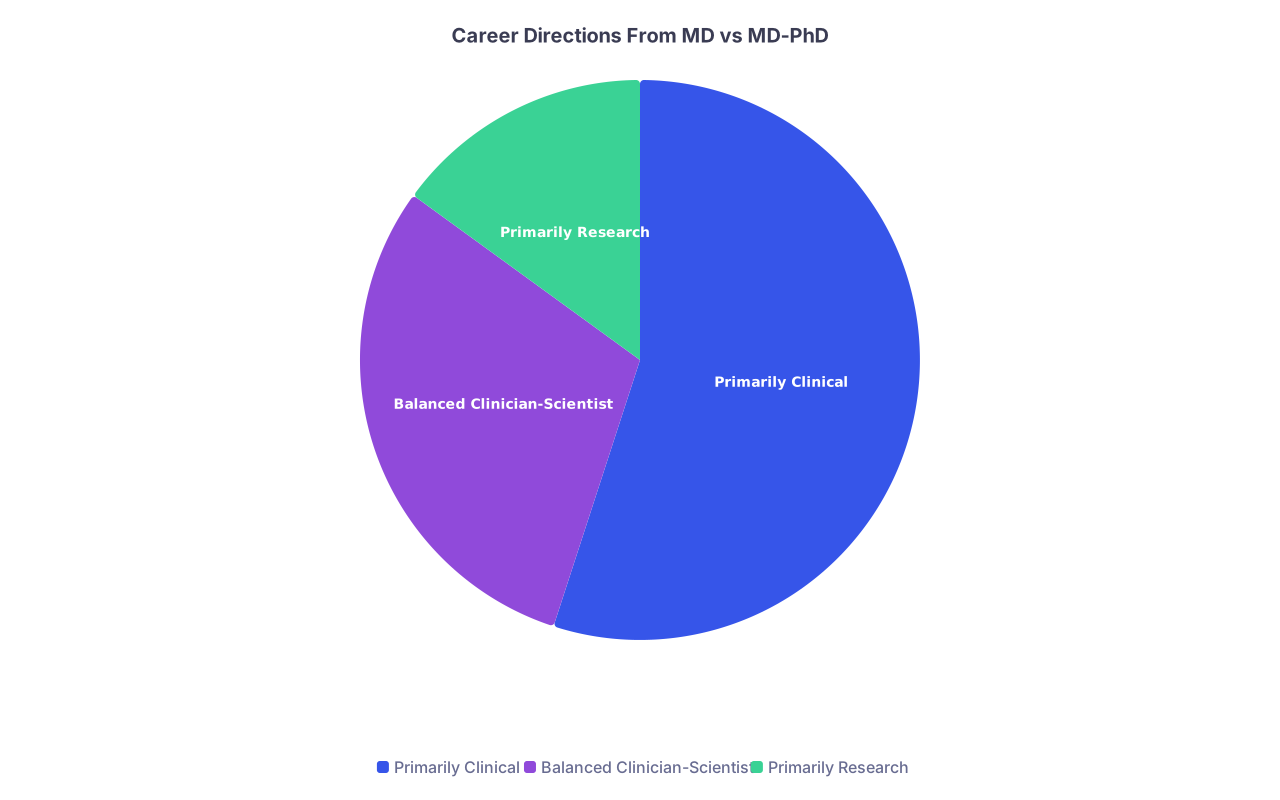
(By the way, those numbers are illustrative, but if your MD–PhD program can’t tell you theirs, that’s telling.)
Here’s the key truth:
Neither path fully “locks” you out of the other world. But each one makes certain futures easier and others more uphill.
Step 7: A Simple Decision Framework You Can Actually Use
Let me give you a crude but useful mental model.
Path A: You should lean MD–PhD if most of these are true
- You’ve done 2+ years of serious research and liked the process, not just the outcomes.
- You can name specific research questions or areas you’d be excited to work on for 5–10 years.
- The MD–PhD program you got into has a strong track record of grads in real physician–scientist roles.
- You’re genuinely okay with starting real attending life several years later in exchange for built-in research training and no tuition.
- The MD alternative would saddle you with heavy debt and weaker research opportunities.
Path B: You should lean MD if most of these are true
- Your research has been mostly checkbox-driven or lukewarm, and you’ve never deeply loved the grind.
- You feel much more energized envisioning clinic days than grant-writing days.
- The MD school you’re choosing has solid research opportunities and decent support for residents/fellows who want to develop as physician–scientists.
- You’re unsure to strongly doubtful that you want research as the main pillar of your career.
- The MD–PhD would lengthen your path substantially, and the specific program’s outcomes are mediocre or unclear.
Step 8: What to Do This Week If You’re Still Paralyzed
Here’s a concrete, 3–4 day action plan if you have deadlines coming.

| Step | Description |
|---|---|
| Step 1 | List your offers |
| Step 2 | Fill comparison table |
| Step 3 | Email programs for outcomes data |
| Step 4 | Talk to 3-5 current students |
| Step 5 | Write your 10-year Tuesday scenarios |
| Step 6 | Lean MD-PhD |
| Step 7 | Lean MD |
| Step 8 | Which future fits better? |
Day 1:
- Fill out the personal MD vs MD–PhD comparison grid with actual numbers.
- Send outcome-focused emails to both program offices.
Day 2–3:
- Talk to at least 3–5 students across phases (as described above).
- Ask them what they regret, what they’d repeat, and what surprised them.
Day 3–4:
- Revisit your imagined 10-year Tuesday.
- Then do this: write down, on paper, “I choose MD because…” and “I choose MD–PhD because…” and see which paragraph feels like you’re lying.
Do not crowdsource your identity on Reddit or group chats. They don’t live your life. You do.
Step 9: Special Situations You Might Be In
Scenario 1: Same school, accepted to both MD and MD–PhD
This is actually simpler:
- Research environment, city, med school quality are controlled.
- The main differences are:
- Time to degree.
- Debt vs stipend.
- Structured PhD vs flexible MD research.
Here, ask:
- Can MD students at this school do substantial research and get into PSTP-style residencies?
- Do MD–PhD students here actually land strong physician–scientist roles, or mostly end up clinical?
If the MD research ecosystem is robust and you’re uncertain about research, MD + heavy research may be cleaner than locking into MD–PhD. If the MD–PhD program has a killer track record and you are research-driven, lean toward MD–PhD.
Scenario 2: MD–PhD at a weaker med school vs MD at a stronger one
This one’s thorny. You’ll see it framed as “low-ranked MSTP vs high-ranked MD.” Here’s how I’d think:
- Look at where the MD–PhD grads from the “weaker” school actually match for residency and where they end up for faculty. If they routinely place at solid academic centers, rank matters less.
- If the “stronger” MD school has phenomenal research and an explicit support structure for aspiring physician–scientists, that can be more powerful than a name-only MSTP.
Don’t pick a shaky MD–PhD just for the letters. Better to be at a strong MD program with good research than stuck in a poorly supported MD–PhD that burns you out.
Scenario 3: You’re drawn to very competitive specialties (derm, ortho, plastics, etc.)
Here’s the blunt version:
- An MD–PhD doesn’t guarantee anything in these fields.
- But it can help if you produce strong research, especially specialty-specific.
What matters more is:
Does the program you choose (MD or MD–PhD) have a consistent match record and strong mentors in that specialty?
If you’re dead set on a hyper-competitive specialty and only your MD school has the track record, don’t sabotage that just to add a PhD that may not fit into that specialty’s culture.
Step 10: The Emotional Piece Nobody Talks About
You’re allowed to care about:
- Being done sooner.
- Not losing your 20s entirely to training.
- Where your partner or family can live.
- The idea of “being a scientist” feeling sexy versus what the day-to-day actually is.
What you’re not allowed to do, if you want to make a good decision, is:
- Choose MD–PhD purely because “it’s free” when you have zero internal pull to do research long term.
- Choose MD purely because you’re scared of the extra years, when you know in your gut you’ll be miserable without research baked into your identity.
You will always have a little FOMO. That’s normal. The goal is not a perfect choice; it’s a coherent one.
| Category | Value |
|---|---|
| Love of research process | 9 |
| Desire for early attending income | 7 |
| Tolerance for long training | 6 |
| Value placed on academic career | 8 |
| Fear of debt | 5 |
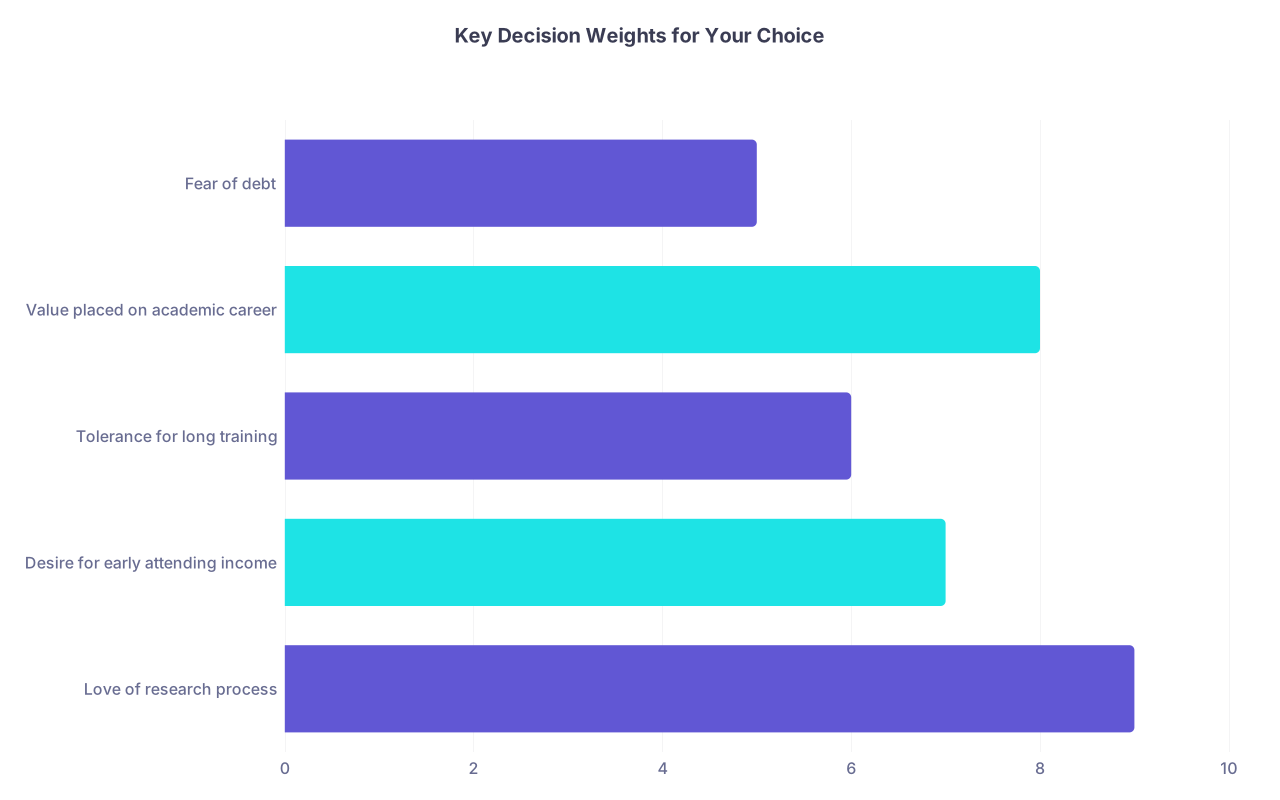
Adjust those “weights” in your head. Your numbers will look different. But be honest about them.
FAQs
1. If I do MD only, can I still become a serious physician–scientist?
Yes, but it’s steeper. You’ll need to seek out:
- Heavy research in med school (including possible research year).
- Research-heavy residency/fellowship or PSTP.
- Strong mentorship and often formal career development awards (K-type).
Plenty of top physician–scientists are MD-only. But they all have one thing in common: they treated research as a second full-time job for years, not a side hobby.
2. What if I start an MD–PhD and realize during the PhD I don’t want to be in research long term?
This happens. More than programs like to admit.
Options usually are:
- Finish the PhD, accept that you’ll probably lean more clinical and treat the PhD as intellectual training that shapes how you think, not necessarily your job description.
- In rare cases, leave the PhD and continue MD only (depends heavily on school policy; may affect funding and may cause tension).
That’s why you should not enter MD–PhD lightly “just because it’s free.”
3. Is an MD–PhD necessary if I want to do translational or clinical research rather than bench work?
Not strictly. For clinical research (trials, outcomes, epidemiology), an MD plus methodologic training (e.g., MPH, MS in clinical investigation, strong mentorship) can be more than enough.
An MD–PhD becomes more critical if you want:
- Independent lab-based basic science research.
- To be competitive for some basic/translational R01-level roles where a PhD is the norm.
4. How much should prestige/ranking matter in this decision?
Less than Reddit tells you, more than schools will admit. Here’s the honest take:
- For academic careers, being in a strong research environment with high-functioning mentors and funding matters more than the exact USNWR rank.
- For competitive specialties, a program’s match history matters more than its brochure prestige.
- If you’re choosing between a famous name with weak support and a lesser-known place that reliably produces physician–scientists, take the latter.
5. What if my family is pushing hard for MD–PhD because it’s “free” and sounds more impressive?
They’re optimizing the wrong variables. They don’t live your workdays.
You can say something like:
“I understand why it sounds better, but my decision has to be based on the kind of work I’ll be doing for the next 30–40 years, not just tuition numbers. I’ve spoken with current students and looked at outcomes, and the path that fits how I actually want to practice is ____.”
You’re the one who will be in clinic or lab at 8 p.m., not them.
Bottom line:
- Choose based on the kind of work you want to be doing, not just titles, tuition, or bragging rights.
- Squeeze real data out of your specific programs: outcomes, match lists, student experiences—not brochure slogans.
- Accept that there’s no risk-free option. Pick the path whose tradeoffs you can live with on your worst days, not just your best imagined ones.