You close your lab notebook, stare at the clock, and feel it again—that tug that says, “I should have gone to med school.” You are not 22, you have a PhD, a publication list, maybe even a grant. But you are seriously considering starting over for an MD, and you are wondering if admissions committees will think you’re brilliant…or out of your mind.
Let me be blunt: Having a PhD does not automatically make you an attractive MD applicant. It can help you, or it can sink you. It depends entirely on how you handle this.
Here is how to approach this if you already have a PhD and now want an MD.
1. First Reality Check: Are You Sure You Want An MD?
I have to start here, because admissions committees will. If your “why medicine” isn’t brutally clear and believable, they’ll toss your file in 30 seconds.
They have seen the vague answers:
- “I want to be more clinically relevant.”
- “I want to translate my research to the bedside.”
- “I’ve always loved science and helping people.”
These are weak for someone with a doctorate and years of training.
Your reasons need to be:
- Specific (what exactly do you want to do as a physician?)
- Chronological (when and how did this shift happen?)
- Cost-aware (you understand the sacrifice in time, money, and position)
Ask yourself, and write this down:
- What exact role do you picture in 10–15 years? Clinician-scientist? Full-time clinician? Academic physician?
- Could you reach that role another way—without an MD? (e.g., stronger collaboration with clinicians, clinical research roles, industry, MPH, etc.)
- When did the “I should do medicine” idea stop being a fantasy and turn into a serious plan? What changed?
If you can’t answer those clearly today, hit pause on applications. This isn’t about “knowing yourself” in a vague self-help way. It’s tactical: if you can’t explain this, an adcom will not buy it.
2. How Schools Actually View PhD → MD Applicants
You need to understand what you look like from their side of the table.
They see a PhD applicant and think:
Upside
- Proven ability to handle intense, long-term work
- Comfort with scientific reading, evidence-based thinking
- Potential future clinician-scientist, leader, educator
- Maturity (if used correctly)
Red flags
- Are you “fleeing” a failed research career?
- Are you chasing status/letters rather than a real clinical calling?
- Are you a poor teammate? (PhD environments can sometimes reward lone-wolf behavior)
- Will you burn out financially and emotionally after 4–7 more years of training?
- Are you going to do an MD then just go back to a research-only role and “waste” a clinical seat?
Your entire application has one job: turn the PhD from “interesting but suspicious” into “massive asset with a credible clinical plan.”
3. Fix Your Timeline and Prerequisites (No, Your PhD Does Not Replace Them)
If your PhD is in molecular biology and you finished last year with a 3.9 undergrad science GPA and recent courses, great. If you have a 10-year-old engineering degree and zero biology since then, different story.
Here’s the honest breakdown.
| Background Situation | Typical Next Step |
|---|---|
| Recent life sciences PhD, strong undergrad GPA | MCAT + clinical experience, apply in 1–2 cycles |
| Older PhD (>7–10 years since undergrad), weak science GPA | Formal post-bacc or DIY coursework before applying |
| Non-bio PhD (e.g., physics, engineering, humanities) | Complete core premed prereqs + MCAT |
| International PhD, non-US undergrad | US/Canadian coursework + careful school list |
Core questions to answer:
Prereqs
Do you have, on a transcript:- 1 year gen chem w/ lab
- 1 year orgo w/ lab (sometimes biochem can help)
- 1 year biology w/ lab
- 1 year physics w/ lab
- Some math/stats, English/writing
Many schools are more flexible now, but you still need a coherent science foundation.
Grades
- Is your undergrad GPA competitive today?
- If you have a weak undergrad GPA but a stellar PhD performance, some schools will be flexible, others won’t.
- If your undergrad is a mess (<3.3), you likely need fresh, A-level science coursework to show you’re not the same student.
MCAT
Your MCAT is non-negotiable. You do not get to say “but I have a PhD in X.” They’ll say “great, take the MCAT.”
If you are more than ~5–7 years removed from undergrad science or never took the core prereqs, plan on:
- 1–2 years of post-bacc or DIY university-level science coursework
- Then MCAT
- Then application the following cycle
This is annoying. Do it anyway. Weak science recency is one of the fastest ways to a quiet rejection.
4. The Big Three You’re Missing: Clinical, Shadowing, Volunteering
Here’s where PhD applicants almost always screw up. They send in an application with:
- 10 pubs
- 3000 hours in the lab
- 0–20 hours of actual clinical exposure
Then they write, “I know I want to be a physician.” No, you don’t. Not in a way that convinces anyone.
You need:
- Longitudinal clinical exposure
- Shadowing across at least a couple of specialties
- Some non-clinical volunteering that shows you can interact with humans not named “postdoc”
Aim for roughly (not a rule, but a good target):
- 150–250+ hours of direct clinical exposure (scribing, MA, EMT, hospital volunteer with real patient contact, hospice, etc.)
- 40–60+ hours of shadowing, with at least one primary care or internal medicine doc
- 100+ hours of service, ideally with underserved populations (food banks, shelters, tutoring, crisis lines, etc.)
And not all crammed into 3 months. You’re an adult. You know what commitment looks like. Show continuity over 6–18 months.
This is where most PhD-to-MD people realize: Oh, this is a real career pivot, not just an extra degree. Good. It should feel that way.
5. Telling a Coherent Story: Why You’re Switching, Not Failing
The main essay and interviews will revolve around one question: “Why now, and why medicine?”
Here’s the skeleton you want to hit:
- Origin – When medicine first appeared on your radar, realistically.
- PhD phase – What you gained from the PhD that actually helps medicine (not generic “critical thinking”).
- Inflection point – The concrete experiences that shifted you from “academic scientist” to “I need clinical training.” Usually clinical exposure, patient-related work, or hitting ceilings as a non-clinician.
- Test of commitment – What you have already done to test this decision: shadowing, clinical roles, lifestyle sacrifices, conversations with physicians in your target path.
- Future vision – A believable, grounded picture of your life as an MD 10–15 years from now.
What you must avoid:
- Trashing your PhD: “I realized I hate research.” That reads as impulsive and resentful.
- Sounding like you discovered medicine last month.
- Acting like MD is the obvious next “promotion” from PhD. It isn’t. It’s a sideways and backward move in many ways.
You want: “My PhD was valuable. It clarified that I want different responsibilities and direct patient responsibility, which I then tested thoroughly before deciding on an MD.”
6. MD vs. MD/PhD vs. DO: Pick the Right Target
You already have a PhD. So the MD/PhD question comes up quickly.
Here’s the blunt answer:
- You almost never need a second PhD. Dual-degree programs exist to train people in both rigorous research and clinical medicine. You already did one half.
- A few programs occasionally take “MD only” applicants with prior PhDs and give them MSTP funding or special tracks, but this is not common and not something you count on.
So, what makes sense?
If you want heavy research + clinical:
- Target MD programs with strong physician-scientist tracks, research years, or fellowship opportunities.
- Think: Harvard, UCSF, Penn, UWash, etc. But also mid-tier schools with strong research departments where a PhD-holding MD will be gold.
If you want mostly clinical practice:
- Apply MD focused, including schools that like “non-traditional” applicants.
- Consider DO schools as well, especially if your undergrad numbers are weaker. DO schools can be quite open to older applicants with strong life experience.
Don’t randomly apply to MD/PhD dual-degree programs just because you like stipends. Most will not take someone already holding a PhD; they’ll see it as redundant and a misalignment of goals.
7. Age, Debt, and Training Length: The Stuff No One Likes To Say Out Loud
If you’re 30 with no kids and minimal debt, different ballgame than being 39 with a mortgage and two kids.
You have to run the math, and admissions committees know you should have thought about this.
Rough, conservative numbers:
- 4 years med school
- 3–7 years residency depending on specialty
- You may not be an attending until late 30s/40s if you’re starting in mid-30s
Financially, you’re often:
- Giving up academic/industry salary for years of med school debt
- Betting on long-term earning and fulfillment
This doesn’t mean “don’t do it.” It means:
- Be ready to demonstrate you’ve considered this.
- In interviews, you want to be able to say how you and your family (if applicable) have discussed and prepared for this.
If you’re worried about “too old,” most US MD and DO schools accept applicants well into their 30s and even early 40s. The question is not chronological age. It’s: does this make sense as a career move for you?
8. Letters of Recommendation: Use Your PhD Right
Your letters are where your PhD can shine—or where people quietly end your chances.
You need:
1–2 strong letters from PhD mentors/supervisors who can speak to:
- Work ethic
- Intellectual rigor
- Resilience under pressure
- Team skills and communication (huge)
- Any patient-facing or collaborative work with clinicians
1–2 letters tied to your clinical or service experiences:
- Physician you’ve shadowed extensively
- Clinical supervisor (scribe lead, volunteer coordinator, etc.)
- Someone who can say, “I have seen this person with patients; they belong here.”
If schools require committee letters or undergrad science faculty letters and you’re far removed from undergrad, email or call those schools. Many have specific policies for non-traditional/graduate applicants and will accept grad faculty letters instead.
Do not:
- Use only research letters that say nothing about interpersonal skills, empathy, or maturity.
- Use letters from famous names who barely know you. A generic “Dr. X is smart” from a Nobel laureate is worse than a detailed letter from a mid-level PI who actually supervised you.
9. Application Strategy: Where and How Broad To Apply
You’re not a traditional applicant. Treat this like a career pivot, not a college application.
Use a strategy like this:
MCAT anchored
- Your MCAT will drive the upper limit of schools you can realistically target.
- High 510s–520+ opens a wide range. Below ~505, MD becomes tougher; DO remains realistic, especially with strong life experience.
School types to prioritize
- Schools that explicitly value non-traditional students
- Public schools in the state where you’re a resident (huge advantage typically)
- Schools with strong research ecosystems that like scientist-physicians, even in MD programs
- A few stretch schools that align with your specific research/clinical interests
Avoid assumptions
- Do not assume “Top 10 love PhDs so I’ll be fine.” They still care about MCAT/GPA and comprehensive exposure.
- Do not ignore mid- and lower-tier schools that would love a PhD-trained future clinician who can teach and lead.
A realistic number for many PhD-to-MD applicants:
- 20–30 MD programs + 5–10 DO programs (adjust based on stats and finances)
10. Interview Season: How To Answer the Hard Questions
If your application is good, the interviews will be…direct. Expect questions like:
- “Why didn’t you go to med school first?”
- “What changed?”
- “You have a PhD already. Why not stay in research or industry?”
- “How will you handle going back to being a student, often supervised by people younger than you?”
- “What will you do if you realize you like research more again?”
You answer these with:
- Concrete stories
- Evidence you’ve already tested this path
- Acknowledgement of trade-offs, not pretending there are none
Example structure for “Why not stay in research?”:
- Briefly acknowledge what you liked and learned in your PhD.
- Describe real moments where the lack of clinical role limited your impact or left you dissatisfied.
- Mention specific clinical experiences that confirmed you prefer being in the room with the patient, owning decisions.
- End with a mature statement about long-term career vision as a physician (with or without research).
What impresses committees here is not a perfect script. It’s that your answers sound like you’ve sat with this decision for years, not weeks.
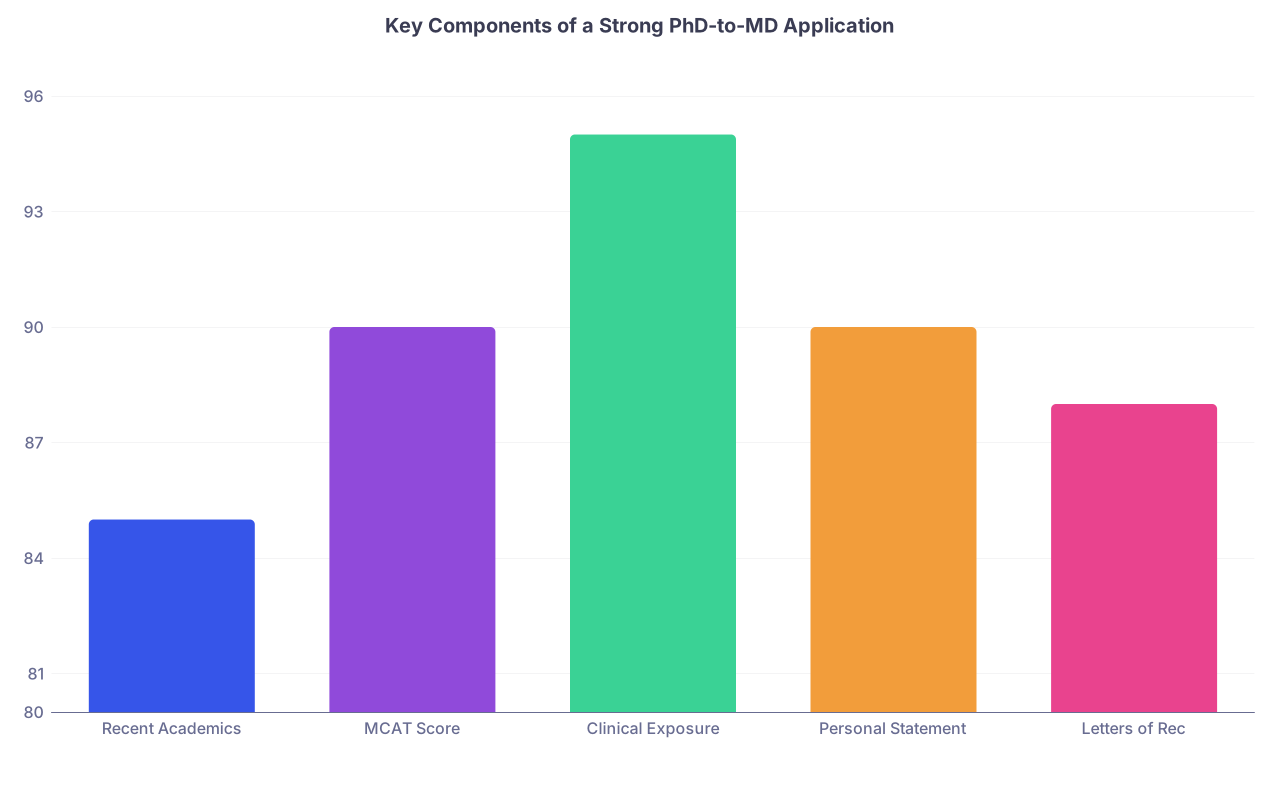
| Category | Value |
|---|---|
| Recent Academics | 85 |
| MCAT Score | 90 |
| Clinical Exposure | 95 |
| Personal Statement | 90 |
| Letters of Rec | 88 |
11. Common Mistakes PhD Applicants Make (And How To Avoid Them)
You are at higher risk for a few specific errors:
Overemphasizing research
You submit an AMCAS that reads like a postdoc CV with a side of shadowing. Fix: limit research activities to what’s relevant and translate them into skills useful in medicine (teamwork, communication, long-term problem solving).Underestimating clinical experience
You think being in a hospital-based lab counts. It doesn’t. Fix: get real patient-facing roles.Arrogance or defensiveness in tone
Phrases like “I’ve already proven myself” or “Medical school will be easy compared to my PhD” are fatal. Fix: respect the training, show humility.Vague career goals
“I want to bridge bench to bedside” means nothing if you can’t name a specialty or realistic pathway. Fix: talk to practicing physicians in fields you’re considering, and be specific.Not starting early enough
You’re used to long projects but underestimate application lead times. Fix: start building clinical exposure and MCAT prep 1.5–2 years before you want to start med school.
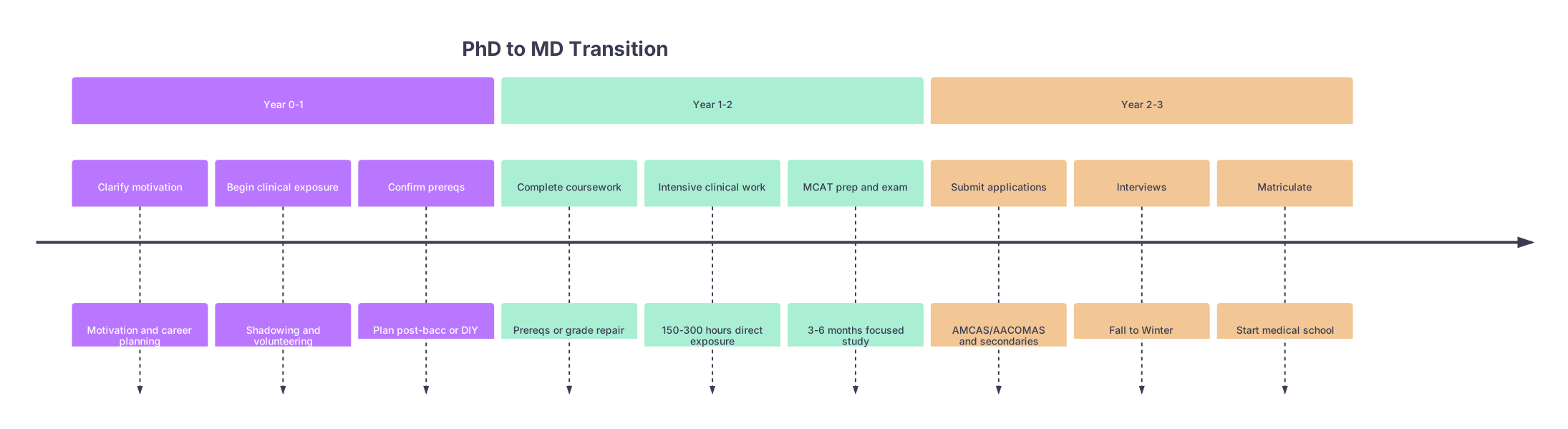
| Period | Event |
|---|---|
| Year 0-1 - Clarify motivation | Motivation and career planning |
| Year 0-1 - Begin clinical exposure | Shadowing and volunteering |
| Year 0-1 - Confirm prereqs | Plan post-bacc or DIY |
| Year 1-2 - Complete coursework | Prereqs or grade repair |
| Year 1-2 - Intensive clinical work | 150-300 hours direct exposure |
| Year 1-2 - MCAT prep and exam | 3-6 months focused study |
| Year 2-3 - Submit applications | AMCAS/AACOMAS and secondaries |
| Year 2-3 - Interviews | Fall to Winter |
| Year 2-3 - Matriculate | Start medical school |
12. What To Do This Month If You’re Serious
You’re reading this because this isn’t just a random thought. So here’s a blunt, 30-day action plan.
Week 1–2:
- Audit your academic record: list every science course, grade, and year taken.
- Map out which prerequisites you’re missing or are too old/weak.
- Look up 5–10 schools you’re interested in and check their requirements for non-traditional applicants.
Week 2–3:
- Set up 3 conversations:
- One with a physician in a field you think you like
- One with a physician-scientist or academic doc
- One with a trusted mentor who will be honest about your strengths and blind spots
- Start a log of clinical opportunities in your area: scribe jobs, hospital volunteer programs, hospice, free clinics.
Week 3–4:
- Apply to at least one clinical role or long-term volunteer position.
- Register for a class/post-bacc if you need recent science coursework.
- Start reading an MCAT review book or doing a diagnostic if you’re within 12–18 months of applying.
If you do those things, you go from “I’m thinking about maybe doing an MD” to “I’ve started the transition.”
FAQ (Exactly 3 Questions)
1. Will medical schools think I “wasted” my PhD if I switch to an MD?
No, not if you frame it correctly. You need to show that your PhD:
- Gave you tools and perspective that will make you a better physician
- Clarified what kind of work doesn’t satisfy you long-term
- Led you directly (through real experiences) to clinical medicine
What they will judge harshly is if you dismiss your PhD as a mistake, or act like you’re bailing on a career at the first sign of difficulty. Make the PhD look like a completed chapter that set you up for a more focused, better-informed next chapter, not a detour you regret.
2. Can I get any advanced standing in medical school because I already have a PhD?
Almost always, no. A few schools may let you skip or modify certain research requirements or scholarly projects, and your background can help you in future residency or fellowship selection. But the core MD curriculum—pre-clinical and clinical years—is required for everyone. You should plan on the full length and cost of medical school without expecting shortcuts. Your advantage is in how quickly you may grasp certain content and how ready you are to engage in research or academic work alongside your training.
3. If my undergrad GPA is mediocre but my PhD record is excellent, do I still have a chance?
Yes, but you need a strategy. A strong PhD performance and publications do not erase a poor undergraduate GPA in AMCAS calculations. What they can do is soften the concern if you:
- Show recent A-level work in rigorous science courses (post-bacc or grad-level)
- Score solidly on the MCAT to prove current academic ability
- Present a mature, coherent story about how you’ve grown since undergrad
Many schools are more flexible with non-traditional applicants, especially if your academic trend is sharply upward. But if your GPA is significantly below ~3.3, plan on doing focused coursework to create a fresh academic track record before you apply.
Open a blank document and write, in one paragraph, your honest answer to: “Why am I willing to restart my training for an MD?” No polishing, no admissions-speak. If that paragraph feels thin, spend the next 3–6 months strengthening the reality behind it—through clinical work, conversations, and coursework—before you worry about crafting the perfect application.