
You are three years into medical school. Your classmates are talking about Step 2 scores and away rotations. You are staring at an email from the MD–PhD program director saying, “We would be happy to review an application for you to add the PhD.”
Everyone around you nods like this is obviously smart. “Free tuition.” “Prestige.” “You like research anyway.”
Here is the problem: adding a PhD to your MD can absolutely backfire. I have watched it stall careers, trap people in roles they hate, and quietly wreck earning potential. Not because MD–PhD is “bad,” but because people walk into it for the wrong reasons and with zero understanding of the traps.
Let’s walk through the seven biggest ones. And how not to be the cautionary tale.
Trap 1: Misjudging the Time Cost vs. Real Career Benefit
The first mistake is thinking “It is just a few extra years.” That is how people talk about it in hallways. Casual. Dismissive. Wrong.
For most MD–PhD paths:
- MD alone: 4 years
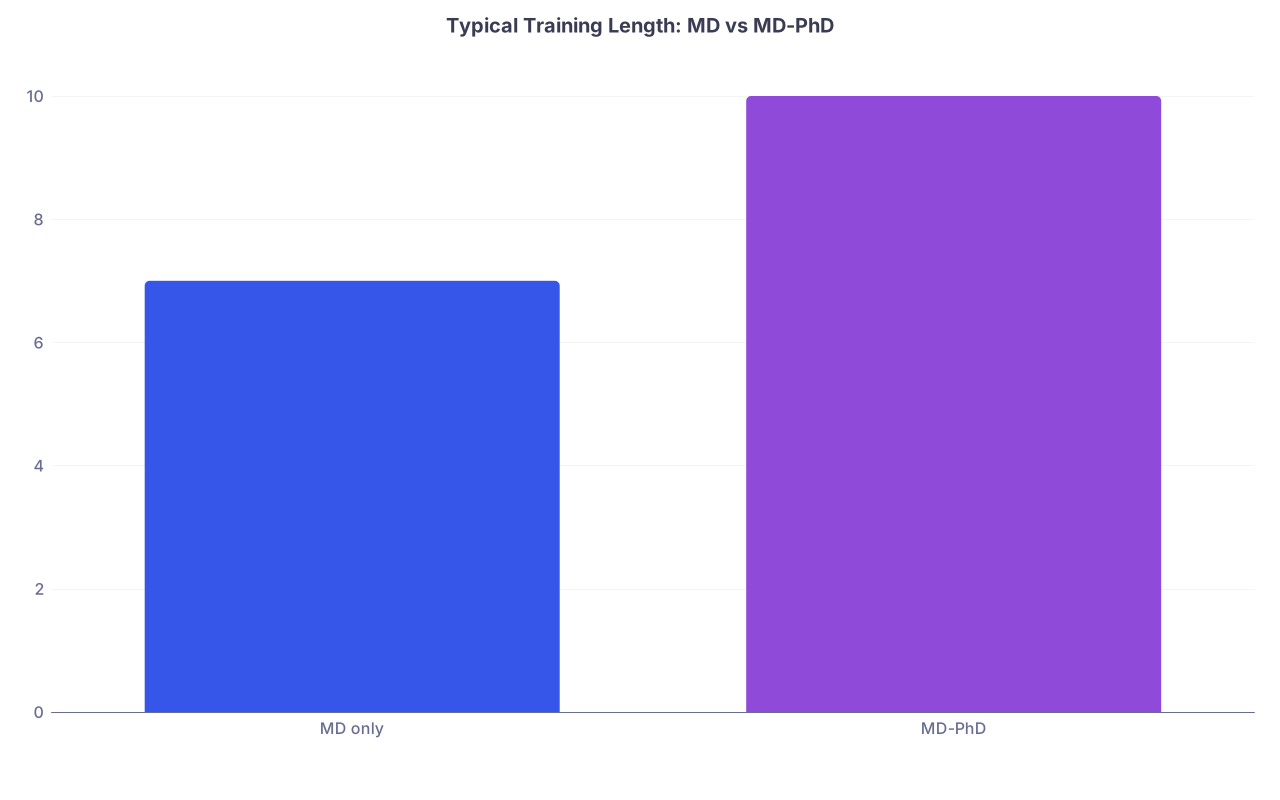
- MD–PhD: 7–9+ years total before residency
That is 3–5 extra prime years before you even start residency.
| Category | Value |
|---|---|
| MD only | 7 |
| MD-PhD | 10 |
(Years above = 4 med school + 3-year IM residency, versus 4 + 4 PhD + 3 residency. Many PhDs are longer.)
Here is where people lie to themselves:
- “I will make it back with higher salary.”
- “I will have more options.”
- “It won’t feel that long.”
Reality:
- Academic physician-scientist salaries often do not exceed private-practice MD salaries.
- Those extra years are not neutral.
They are:- Lost attending-level income
- Additional geographic instability
- Delayed family plans
- Physical and emotional wear
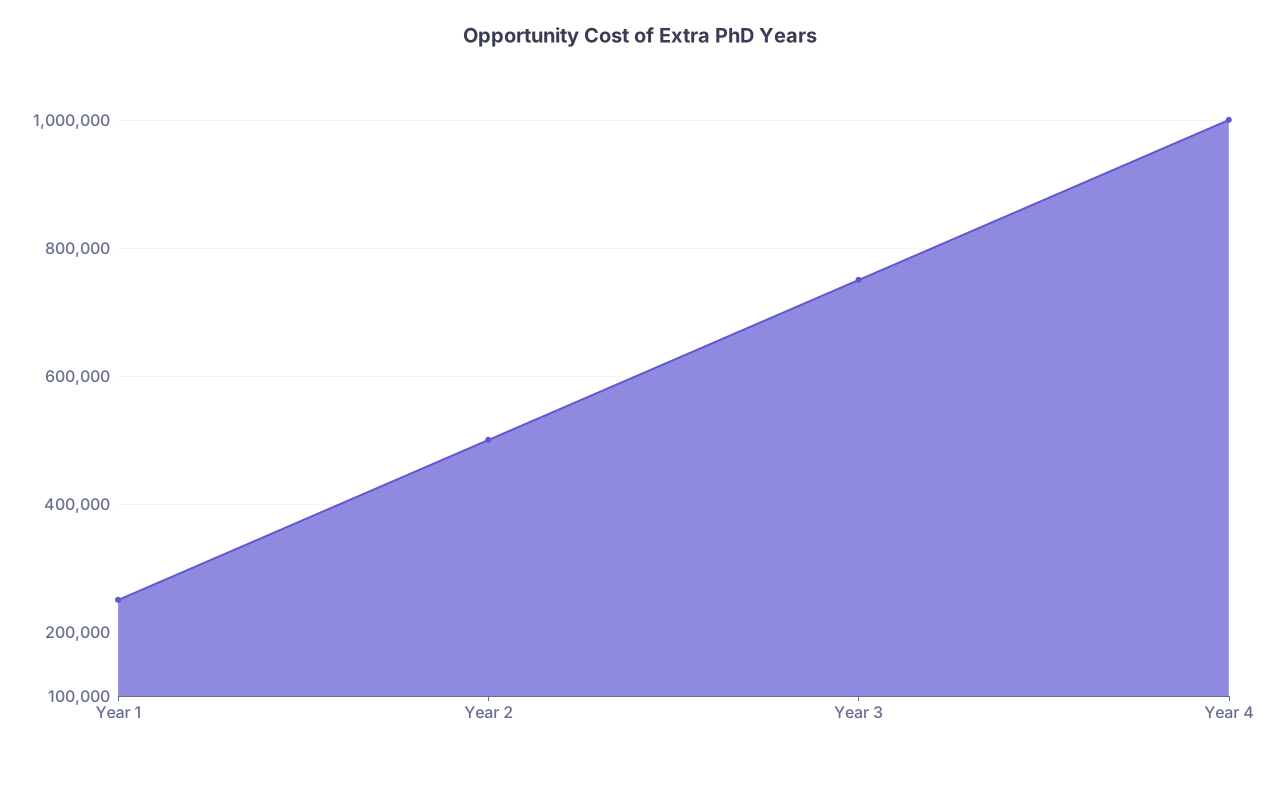
If you spend 4 extra years in a PhD instead of as an attending making, say, $250–350k/year, that is seven-figure opportunity cost. You are not getting that back with a slightly higher academic salary at age 45.
The mistake:
Treating those years as “free” because tuition is waived.
The fix:
Before you touch an MD–PhD application, do a simple calculation:
- What specialty are you realistically aiming for?
- What does a typical academic salary in that field look like at 10, 20, 30 years out?
- What would a non-research MD path in the same specialty pay over that same timeline?
If you cannot articulate exactly what the PhD buys you that you could not get with:
- A research year
- A post-doc
- A K-award or physician-scientist track
…then you are signing up for a multi-year delay “because it sounds good,” not because it makes sense.
Trap 2: Overestimating How Much the PhD Protects Your Academic Career
Another common fantasy: “If I get a PhD, academic medicine will always want me.”
No. I have watched MD–PhDs struggle to get:
- Tenure-track roles
- Startup packages
- Protected research time
Why? Because now you are judged like a full scientist, not a “clinician who dabbles.” That bar is higher, not lower.
| Path | Research Expectation | Teaching Load | Clinical Time |
|---|---|---|---|
| MD only | Modest to moderate | Moderate | High |
| MD-PhD | High (grants/papers) | Moderate | Moderate |
The trap is subtle:
- As an MD with some research, it is often “nice” if you publish, but your main value is clinical work.
- As an MD–PhD, especially at R1 institutions, you are expected to bring in grants, publish consistently, and build a lab.
If you do not:
- Your “protected time” shrinks.
- Your promotion stalls.
- You quietly become a frustrated full-time clinician who wasted 4+ years.
I have met too many MD–PhDs who are essentially doing the job of a regular MD but carrying the guilt and frustration of an abandoned research identity.
The fix:
- Talk to mid-career MD–PhDs (associate professors, 10–15 years post-residency), not just program directors. Ask:
- “How many of your MD–PhD classmates are still doing meaningful research?”
- “How many feel their PhD actually made their life better, not just different?”
- Look for the unspoken answer in their face. The hesitation. The “well… depends what you mean.”
Trap 3: Confusing “Enjoying Research” With Wanting a Research Career
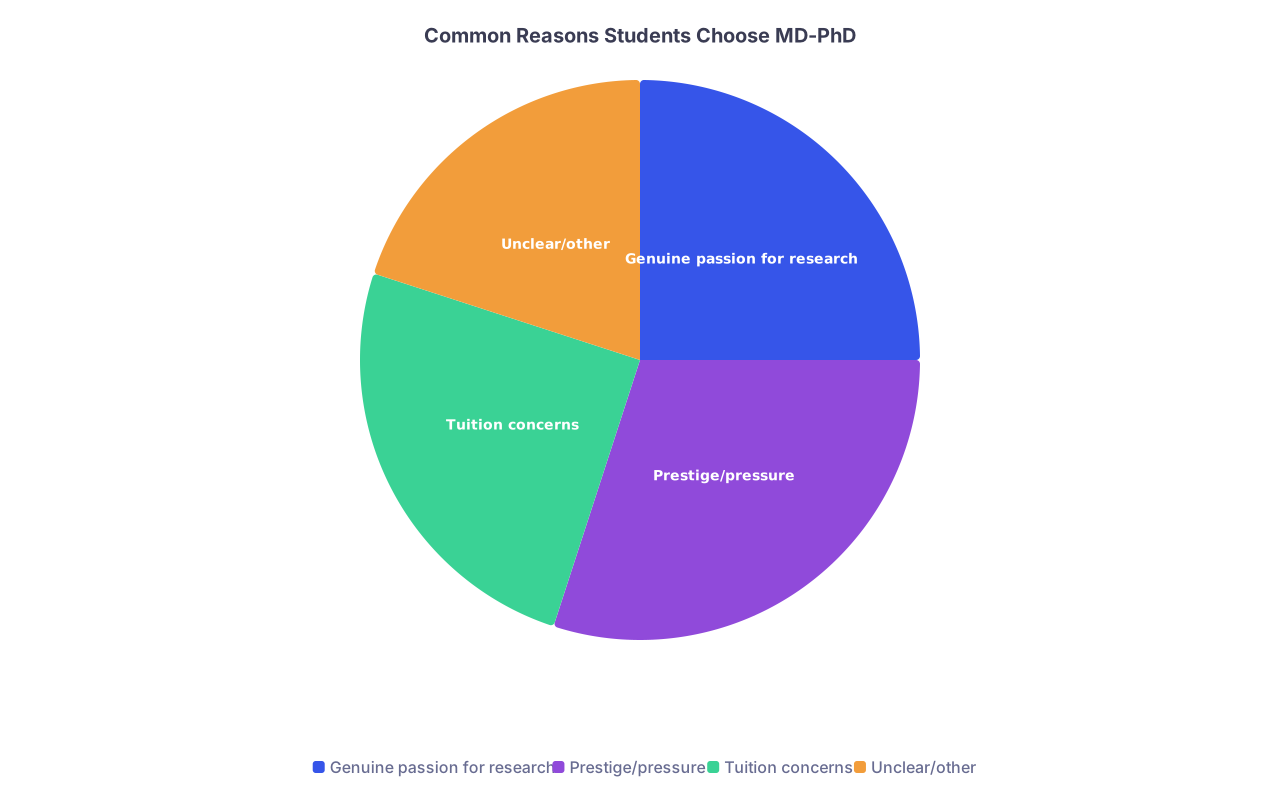
Liking research as a med student is not proof you should lose several years to a PhD.
I have seen this pattern dozens of times:
- Student works in a basic science lab during undergrad.
- PI and residents praise them: “You’d be great as an MD–PhD.”
- Student internalizes that as destiny.
- Student discovers during PhD:
- They hate repetitive bench work.
- They are miserable writing grants.
- They crave direct patient care.
They did not want a research career. They wanted:
- Intellectual challenge
- Curious colleagues
- Something to talk about on applications
You can get all of that with:
- 1–2 dedicated research years
- Robust scholarly work in residency or fellowship
- Clinical research training (e.g., MPH, MS in Clinical Investigation)
You do not need a PhD to present at conferences, lead trials, or publish papers. I know pure MDs with more publications than multiple MD–PhDs combined.
| Category | Value |
|---|---|
| Genuine passion for research | 25 |
| Prestige/pressure | 30 |
| Tuition concerns | 25 |
| Unclear/other | 20 |
The mistake:
Equating “I like research” with “I should anchor my entire career identity to it.”
The fix:
Do a brutally honest check:
- Have you actually led a project from idea → data collection → analysis → manuscript submission?
- Did you enjoy the process, not just the praise?
- Can you see yourself fighting with reviewers and grant committees for decades?
If the answer is lukewarm, do not chain yourself to a PhD.
Trap 4: Underestimating Burnout and Identity Whiplash During Training
MD–PhD training is not just “two degrees.” It is multiple identity shifts:
- Preclinical med student →
- Full-time PhD student (while classmates move to wards) →
- Back to clinical clerkships years later, often rusty and older than peers
This can get ugly.
Common things I have heard from MD–PhD students re-entering clinics:
- “I feel behind everyone.”
- “My classmates all matched already; I am starting rotations.”
- “I have forgotten half my Step 1 material.”
- “I am 31 and still being pimped like a 24-year-old.”
Burnout risk skyrockets when you:
- Watch peers advance while you stall in training
- Jump between completely different cultures (grad school vs. med school)
- Lose the tight peer group you started with
And there is another brutal part nobody advertises: you can end up feeling like you are failing both identities.
- In the PhD years: “I am not as hardcore as the pure PhDs.”
- In the MD years: “I am not as clinically sharp as my MD peers.”
The fix:
- Before committing, talk to current MD–PhD students specifically about:
- Transitions between phases
- Mental health support
- Attrition (how many left the program?)
- Ask for numbers, not vibes.
If a program shrugs when you ask about burnout, that is a red flag. You are not special enough to be the exception.
Trap 5: Believing the PhD Guarantees Better Jobs or Security
People overestimate how much “MD–PhD” on a CV actually changes their market value.
Here is the uncomfortable truth:
- Private practice cardiology group in a mid-size city? They do not care if you have a PhD.
- Community hospitalist role? Same story.
- Many academic departments are desperate for clinicians first, scientists second.
Where the PhD does help:
- Competing for basic/translational research roles at top research institutions
- Securing early-career grants (F, K awards)
- Earning credibility in certain research-heavy niches (e.g., immunology, systems neuroscience)
Where it does not magically save you:
- Funding droughts
- Department politics
- Toxic division chiefs
- Clinical productivity expectations

I know MD–PhDs who:
- Spend 80%+ of their time seeing patients because grants dried up
- Have less schedule control than private practice MDs
- Are still on soft money at mid-career
The mistake:
Assuming a PhD is a shield against instability. It is not. It is another axis on which you can fail to meet expectations.
The fix:
- Look up real salary ranges and job postings for your target specialty:
- Pure clinical academic roles
- Clinician-educator roles
- Physician-scientist roles
- Notice how often “PhD required” actually appears. It is usually rare outside certain niches.
If you cannot find multiple realistic future jobs that explicitly favor or require dual training, think very hard before paying for it in years of your life.
Trap 6: Letting “Free Tuition” Dictate a Decade of Your Life
Here is the sales pitch you will hear nonstop: “But the MD–PhD is funded. No tuition. Stipend.”
On paper, that sounds unbeatable. You avoid $200–300k+ in debt. You get a (modest) check each month. Win, right?
Not always.
Look at the math as an adult, not as a scared 23-year-old:
MD only path:
- Finish med school with, say, $250k debt
- Start residency at 28
- Become attending at, maybe, 31–33
- Start earning full income earlier
MD–PhD path:
- Finish at 32–35 with little/no med school debt
- Start residency much later
- Delay savings, retirement contributions, buying a home, etc.
| Category | Value |
|---|---|
| Year 1 | 250000 |
| Year 2 | 500000 |
| Year 3 | 750000 |
| Year 4 | 1000000 |
(That area is approximate lost attending-level earnings if you spend four extra years in training.)
The mistake is looking at:
- Debt total instead of:
- Net worth over time
- Lost earning years
- Career flexibility
A heavily indebted MD:
- Can still pivot into higher-paying work to crush loans
- Can refinance, use PSLF, or change employers
An older but debt-free MD–PhD:
- Cannot get those lost years back
- May be locked into academic tracks that pay less
- May find it harder to change course with family, kids, geographic constraints
The fix:
- Run a side-by-side projection:
- Age at completion of training
- Expected annual income at different life stages
- Total net income by age 45 or 50 on each path
If you have no clue how to do that, sit with someone who does. A financially literate attending. Or even just a spreadsheet friend who likes numbers more than you.
Do not sell 4–5 years of your life for the psychological comfort of “no loans” without realizing what you traded.
Trap 7: Ignoring How Narrow Some MD–PhD Training Really Is
A PhD is not generic. It is narrow. That can be good or terrible.
Imagine:
- You do an MD–PhD in molecular oncology.
- Ten years later, you fall in love with palliative care.
- Your PhD? Now mostly irrelevant to your new daily work.
Or:
- You train in high-level electrophysiology research.
- Your future job is mostly clinic and basic EP procedures.
- Your PhD becomes a distant line on the CV, not an active tool.

The trap is thinking “I love cardiology” or “I love neurology” is the same as being certain about a research niche in that field for decades.
Those are very different commitments:
- Specialty choice → 3–7 years of training
- PhD focus → a research identity that shapes:
- Who hires you
- What grants you chase
- Which conferences you attend
If you pick the wrong niche early, you can end up:
- Overqualified for work you no longer want
- Under-experienced in the research area you do want later
- Stuck explaining why your PhD is not really what you do anymore
The fix:
- Do not start a PhD unless:
- You can describe a research area you care about with painful specificity.
- You have already worked in that field long enough to see the boring parts.
- You still want it.
“Signal transduction is interesting” is not good enough. That is how people get trapped.
When an MD–PhD Does Make Sense (So You Do Not Misread This)
MD–PhD is not a scam. It is just misused by a lot of people.
It can make sense if:
- You are certain you want:
- To run a lab
- To spend 50–80% of your career on research
- To live in academic medicine long-term
- You already:
- Have multiple-year research experience
- Understand publications, grants, and failed experiments
- Still enjoy research despite its worst days
- You can name:
- Specific mentors who do the job you want
- Departments that actually support that kind of career
- At least a rough plan for K/R grants (not detailed, but not fantasy either)
If that is not you, forcing an MD–PhD often backfires. You end up with the obligations of a scientist and the workload of a clinician, and the joy of neither.
A Quick Reality Check Flow Before You Apply
Use this as a sanity filter.

| Step | Description |
|---|---|
| Step 1 | Interested in MD PhD |
| Step 2 | Do 1-2 full research years first |
| Step 3 | Skip PhD - pursue MD with research |
| Step 4 | Strongly reconsider MD PhD |
| Step 5 | Gain more focused research exposure |
| Step 6 | Talk to 3+ mid career MD PhDs |
| Step 7 | Choose MD only or alt path |
| Step 8 | Apply MD PhD with clear eyes |
| Step 9 | Led full research project? |
| Step 10 | Enjoyed full research process? |
| Step 11 | Want majority research career? |
| Step 12 | Know specific research field? |
| Step 13 | Still convinced? |
If you fall off that flowchart at any point, that is not failure. That is you avoiding a bad fit.
Your Next Step Today
Do one concrete thing now, before you let the idea of “MD–PhD” harden in your mind.
Open a blank document and write two short paragraphs:
- Why I think I want a PhD added to my MD
- What my life looks like at age 45 with vs. without the PhD
Then, send that document to one attending and one resident or fellow who actually does research.
Ask them one pointed question:
“Based on what I wrote, do you think an MD–PhD is the best route for me, or are there safer ways to get where I want to go?”
If you are afraid of their honest answer, that is exactly why you need to hear it.