
The Pitfall of ‘Free Tuition’ Logic in MD–PhD vs Straight MD
Are you seriously considering an MD–PhD mainly because you heard “the tuition is free” and “they pay you to go to school”?
That’s the exact thought process that traps a lot of very smart people in a decade-long commitment they did not actually want.
Let me be blunt: choosing MD–PhD primarily for the “free tuition” is one of the most expensive “money-saving” decisions you can make in your career. Not in dollars this year. In lifetime opportunity, time, and satisfaction.
Let’s walk through the mistakes people make here and how to avoid them before you lock yourself into 7–9 years of training you might hate.
Mistake #1: Treating MD–PhD as a Financial Hack Instead of a Career Decision
The classic faulty script I hear from applicants goes like this:
“Medical school is crazy expensive.
MD–PhD is fully funded, and they pay you a stipend.
So I’ll do the MD–PhD, save hundreds of thousands, and come out ahead.”
Sounds clever. On a napkin. With no numbers and no real understanding of what MD–PhD life actually looks like.
Here’s the real problem: you’re treating MD–PhD like a coupon, not a career.
An MD–PhD is fundamentally:
- A physician–scientist track
- A research-heavy career path
- A long-term commitment to generating and leading science, not just practicing medicine
If your internal monologue sounds like:
- “I like research enough to do it for free tuition.”
- “I don’t hate lab.”
- “I want to keep my options open.”
You’re already on shaky ground.
MD–PhD makes sense if:
- You cannot imagine your future career without research playing a central role
- You’re energized, not drained, by years of slow, incremental progress
- You want your identity to be “physician–scientist,” not “clinician who did some research once”
If instead you:
- Love patient care much more than pipettes and grants
- Only kind of enjoyed your undergrad research
- Are mostly looking for a way to dodge loans
Then you’re using the wrong selection criteria.
You don’t pick a surgical specialty because the residency food is free.
You don’t pick MD–PhD because the tuition is.
Mistake #2: Ignoring the True Cost of Time
The biggest lie in the “free tuition” narrative is what it doesn’t mention: time.
You are not “getting med school for free.”
You are paying with 3–5 extra years of your life.
Let’s be specific.
Typical timelines:
| Path | School Years | Residency/Fellowship* | Total to Independent Practice |
|---|---|---|---|
| MD | 4 | 3–7 | ~7–11 years |
| MD–PhD | 7–9 | 3–7 | ~10–16 years |
*Varies widely by specialty and fellowships, but you get the point.
Those extra 3–5 years?
- You’re not an attending.
- You’re not making attending-level income.
- You’re not building real clinical seniority.
- You’re not buying a house, aggressively investing, or paying off loans early like a straight-MD attending might.
Let’s actually put numbers on it
Say:
- Attending physician (non–research heavy) makes $250k–350k/year early on (lowballing many specialties).
- MD–PhD stipend: $30k–40k/year during PhD years.
- Extra MD–PhD training time: 4 years (very common).
Those 4 “free tuition” years cost you:
- $250k–350k/year of lost attending income
- Instead, you’re getting $30k–40k stipend
- Loss per year conservatively: ~$220k–320k
- Over 4 years: roughly $880k–1.3M in gross lost potential earnings
You “saved” $200k–350k in tuition. You burned close to a million (or more) in delayed income.
That is not a financial win.
It’s a trade-off. And pretending it isn’t is how people make very bad decisions.
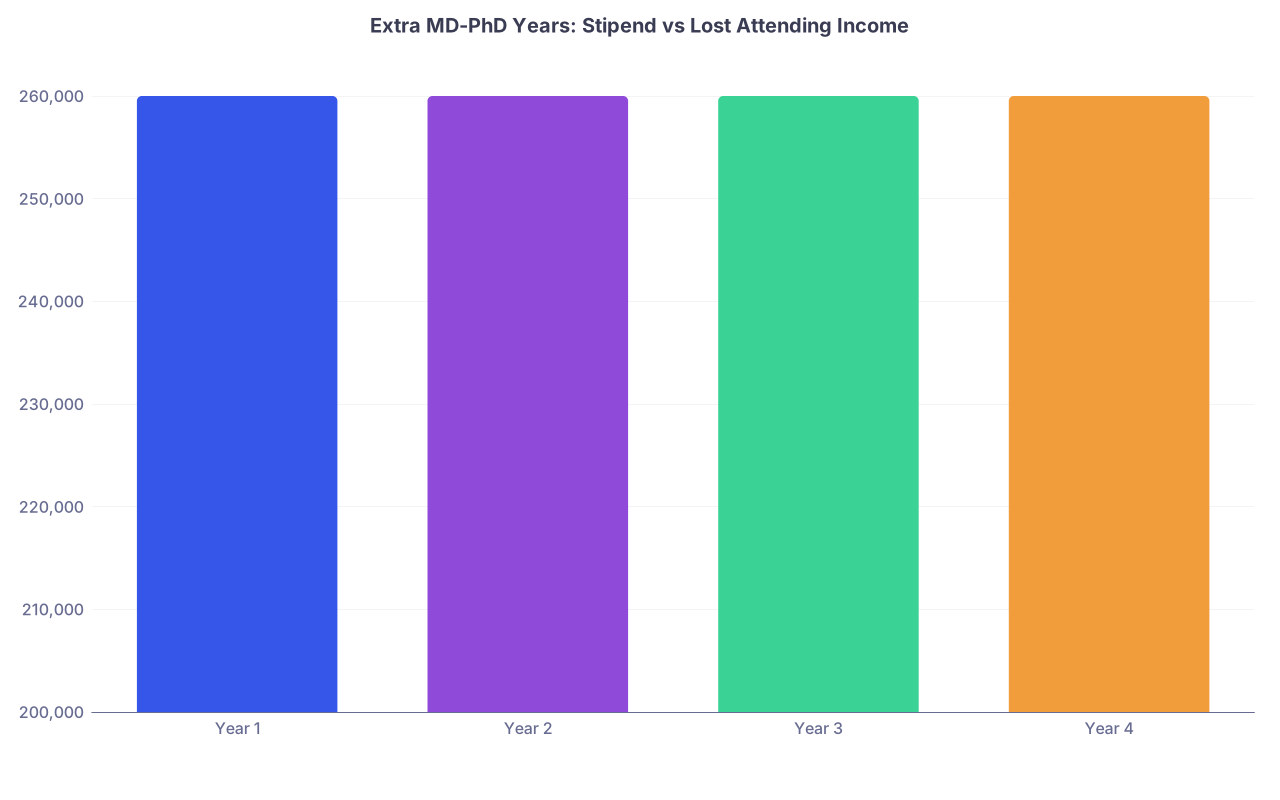
| Category | Value |
|---|---|
| Year 1 | 260000 |
| Year 2 | 260000 |
| Year 3 | 260000 |
| Year 4 | 260000 |
(Think of each bar as approximate net lost earning per year vs being an attending. It adds up fast.)
Someone will say, “But loan interest!” Sure. But over a 30–40 year career, the dominant financial factor is how many years you’re at attending income and how fast you build net worth, not whether you had tuition waived at age 24.
Do not confuse cash flow relief during school with better lifetime financial outcome.
Mistake #3: Romanticizing “Research” Based on a Summer Project
Another trap: overestimating your love for research because you liked:
- A 10-week summer project
- A poster presentation at a regional conference
- An abstract you barely understood but your PI praised you for
MD–PhD research is not that. It’s:
- Multi-year projects that fail. A lot.
- Experiments that don’t work for weeks.
- Papers that take years to get published.
- Rejection from journals. Then more revision. Then maybe acceptance.
- Learning to write and rewrite grants. Then getting those grants rejected.
If your only experience is:
- One undergrad lab where the grad student did most of the thinking
- A basic project where you followed a protocol
- A “research experience” that was basically data entry and PowerPoint
You don’t actually know yet whether you want a career that leans heavily on research.
I’ve seen MD–PhD students hit their 3rd or 4th PhD year and say, off the record:
“If I’d really known what day-to-day research was like, I’m not sure I would’ve done this.”
That’s not a fun realization when you’re already:
- 6 years into a dual-degree program
- Deep into a thesis project
- Socially and professionally embedded in the MD–PhD identity
If you’re leaning MD–PhD mostly because research was “interesting” or “I like solving problems,” that’s not enough. You need to have already tasted:
- Real ownership of a project
- Repeated failure in the lab
- Long stretches of ambiguity where you’re not sure if the experiment or the idea is broken
If that didn’t scare you off. If it actually made you want more. Then you might be MD–PhD material.
Mistake #4: Misunderstanding What MD–PhD Careers Actually Look Like
The fantasy version of MD–PhD some applicants hold:
- 50% clinic, 50% lab
- Tons of time with patients
- Tons of time with experiments
- Well-funded lab, stable grants, respected at your institution
- Flexible schedule and academic prestige
The reality is usually more tangled.
Many MD–PhDs:
- Spend majority of their time in research/academic roles, not clinic
- Fight constant pressure to bring in grant money
- Juggle admin, teaching, and clinical time with lab demands
- Get squeezed clinically (RVUs, call, coverage) while still expected to produce papers
You’re signing up for a career where:
- Grants are central.
- Publications are currency.
- Academic politics matter.
- Clinical time is often something to protect, not your entire job.
If what you deeply want is:
- 4 days a week in clinic
- A clear, predictable clinical role
- Stable, non-grant-dependent income
- The ability to move to private practice if you want
Then straight MD (with or without some academic involvement) is usually a cleaner path.
MD–PhD is not “MD plus bonus PhD.”
It’s a different career track with a different set of pressures and expectations.

Mistake #5: Ignoring Alternative Ways to Reduce MD Debt
The “free tuition” logic usually assumes a false binary:
“Either I pay full MD tuition or I do MD–PhD for free. Those are my only options.”
That’s just wrong.
There are multiple ways to reduce or neutralize MD debt without committing to a PhD:
Service-based loan repayment
- National Health Service Corps (NHSC)
- Indian Health Service (IHS)
- State or regional loan repayment programs for underserved work
Military scholarships
- HPSP (Health Professions Scholarship Program)
- USUHS (Uniformed Services University)
Academic and institutional scholarships
- Many med schools offer partial or full-tuition merit or need-based packages
- Some lower-ranked schools will give stronger offers to competitive applicants
Public Service Loan Forgiveness (PSLF)
- Academic and nonprofit hospitals
- 10 years of qualifying payments and employment
Living frugally + attending salary
- Yes, you graduate with loans
- But a motivated attending can crush those loans in 5–10 years with discipline
| Strategy | Trade-Off | Who It Fits Best |
|---|---|---|
| NHSC / IHS | Geographic / population limits | Primary care, underserved |
| HPSP / USUHS | Military commitment | Comfortable with service |
| School Aid | Limited spots, competitive | Strong applicant stats |
| PSLF | 10+ years nonprofit work | Academic / hospital careers |
| Pay It Down | 5–10 yrs aggressive repayment | Higher earning specialties |
MD–PhD should not be your first-line solution to “med school is expensive.”
It should be your solution to “I want to be a physician–scientist and build my career on research.”
Finances matter. But they should not be your only, or even primary, driver here.
Mistake #6: Underestimating How Much You Can Evolve During MD Alone
Another bad assumption:
“If I don’t do MD–PhD now, I’ll never do serious research later.”
Not true.
Plenty of straight MDs:
- Build research careers
- Get MPH, MS, or even PhDs later
- Become PIs, lead clinical trials, and run centers
And many MD–PhDs… end up doing mostly clinical work anyway.
There’s enormous churn between “what you think you want at 21” and “what actually fits at 35.” MD–PhD locks you into a much narrower lane earlier.
MD alone gives you a lot of room to:
- Discover whether you really like academia or hate it
- Find out if you enjoy clinical research, outcomes research, or QI more than bench work
- Decide whether you’re willing to trade income + flexibility for grant-driven life
If you are genuinely torn and not already deeply in love with research, defaulting to the shorter, more flexible path (MD) is usually safer. You can add research. You cannot easily subtract a PhD you wish you never started.
Mistake #7: Believing You “Owe It” to Use Your Stats for MD–PhD
Another subtle trap: guilt and ego.
You crushed the MCAT. You have a 3.9 GPA. Multiple first-author pubs. Your PI says:
“You’d be perfect for MD–PhD. It’d be a waste to ‘just’ do an MD.”
So now, instead of asking, “Do I want this life?” you’re thinking:
- “Am I wasting my potential if I don’t do MD–PhD?”
- “Am I disappointing mentors?”
- “Am I playing it safe if I ‘just’ go MD?”
Here’s the truth: there is no moral obligation to maximize your academic yield.
You don’t owe your PI a future R01.
You don’t owe your MSTP director dreams your entire 30s.
If you would be:
- A happier clinician
- A better doctor for your patients
- A more balanced human being
by not doing the PhD, that is not a waste. That’s healthy self-knowledge.
The worst mistake here isn’t “leaving money on the table.”
It’s sacrificing 4–5 extra years of your life to a path you didn’t truly want because someone made “MD-only” sound like a consolation prize.
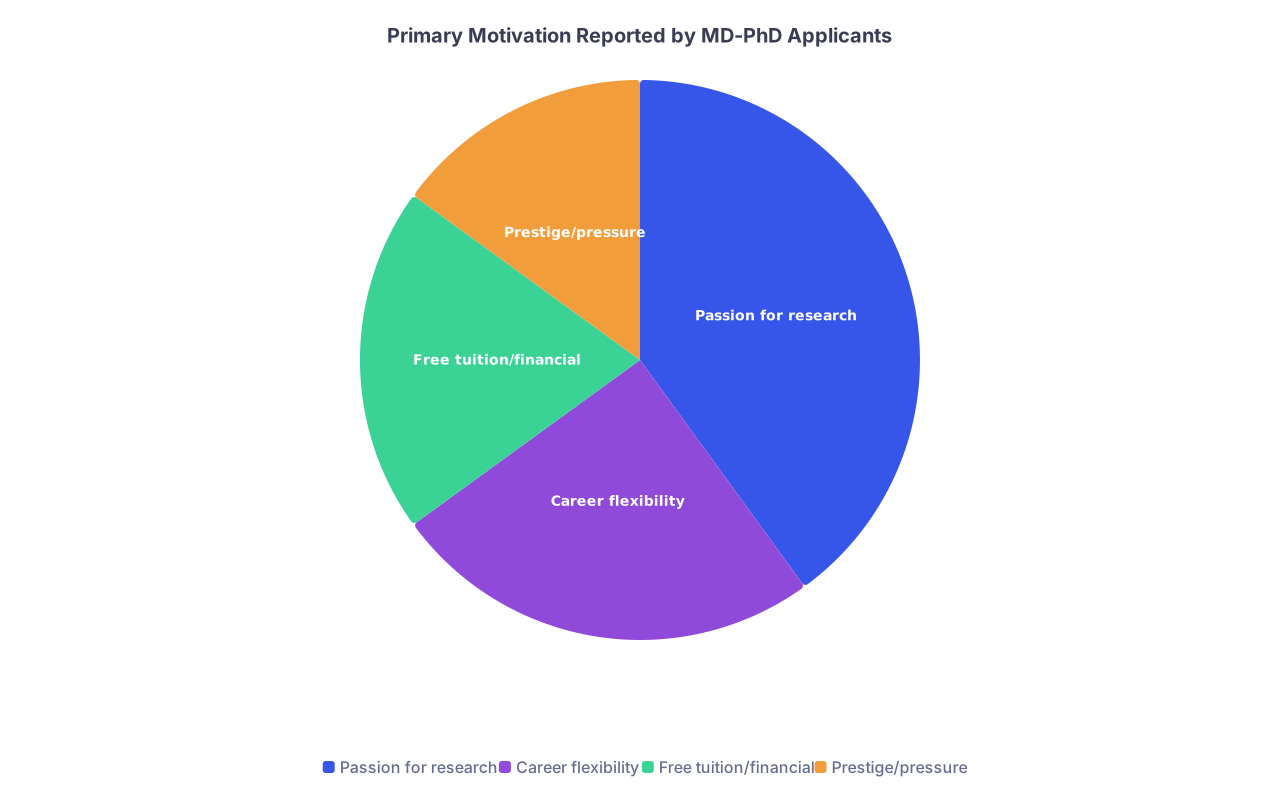
| Category | Value |
|---|---|
| Passion for research | 40 |
| Career flexibility | 25 |
| Free tuition/financial | 20 |
| Prestige/pressure | 15 |
(That ~20% who cite finances as a primary driver? That’s who I worry about most.)
How to Avoid the ‘Free Tuition’ Trap – A Sanity Checklist
If you’re on the fence, don’t rely on vibes. Do a hard check.
Ask yourself:
If MD–PhD had zero financial advantage over MD, would I still apply?
If the answer is no, that’s a red flag.Have I done enough research to know what multi-year, uncertain, often frustrating research actually feels like?
Not just a summer. Real ownership.Do I have at least one MD–PhD or physician–scientist mentor I’ve talked to honestly about their day-to-day life?
If you’re going in without hearing the unfiltered version, you’re playing blind.Am I willing to delay attending salary by 3–5 years without resenting it?
If the delay scares you more than the loans, pay attention to that.Am I okay with a career where my success partly rides on grant funding and publications?
If you hate that idea, MD–PhD is probably not for you.
If you’re mostly excited about:
- Having letters after your name
- The idea of “free tuition”
- Prestige or pressure from others
Pull back. Hard.
Two or Three Things to Remember
- MD–PhD is not a financial shortcut; it’s a fundamentally different, longer career path built around research.
- “Free tuition” can cost you years of attending-level income and flexibility you’ll never get back.
- If you wouldn’t choose MD–PhD without the financial perks, you probably shouldn’t choose it at all.