
MD Residents Considering a PhD: Financial Mistakes to Dodge
What if your “I’ll just step out for a PhD and come back stronger” plan quietly costs you $500,000–$1,000,000 over your career—and you don’t realize it until your co-residents are attendings buying houses while you’re still comparing stipends?
If you’re an MD resident thinking about adding a PhD, your risk is not that you’re naïve or incapable. It’s that you’re smart enough to justify almost any decision. I’ve watched residents talk themselves into financially disastrous PhD detours because it felt intellectually right and they never did the math.
Let’s walk through the mistakes that do the real damage—and how to avoid being the cautionary tale your juniors whisper about in the call room.
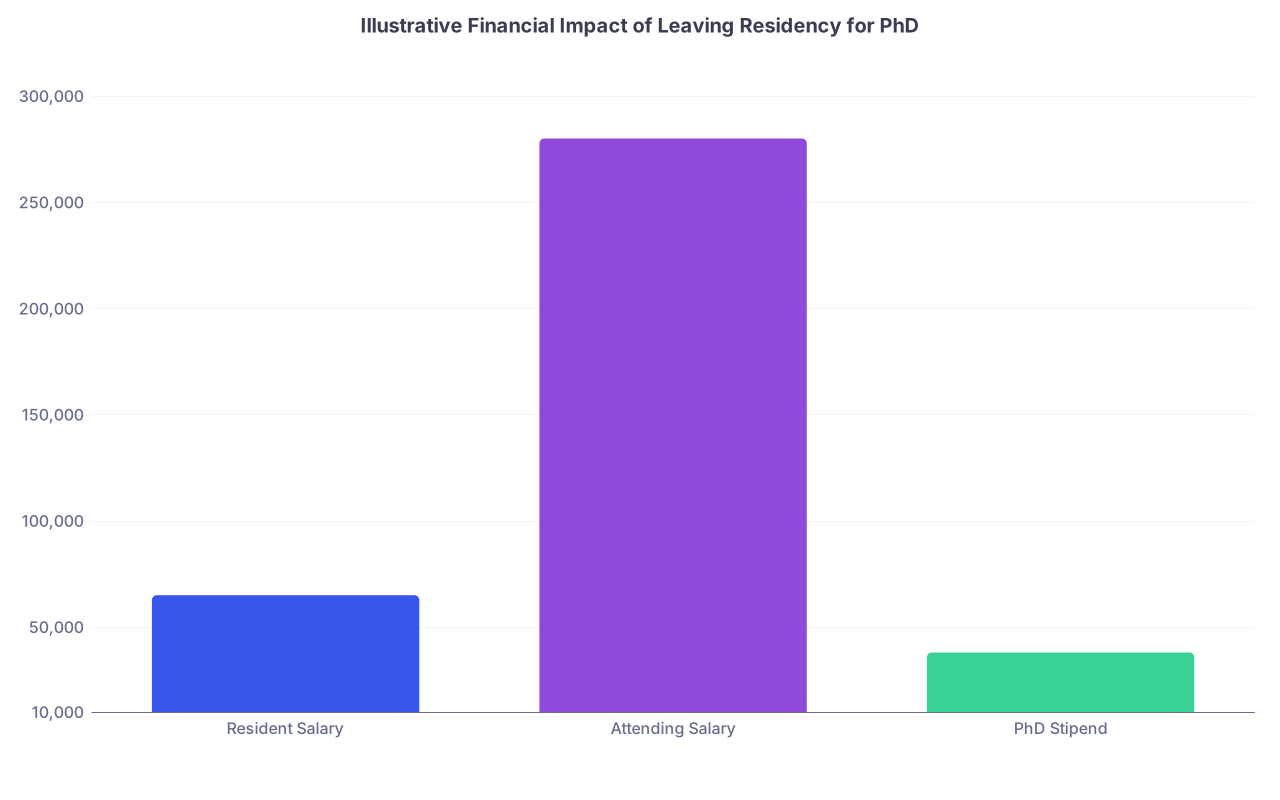
| Category | Value |
|---|---|
| Resident Salary | 65000 |
| Attending Salary | 280000 |
| PhD Stipend | 38000 |
Mistake #1: Ignoring the Opportunity Cost of Walking Away from Attending Income
The biggest mistake is the quietest one: pretending time is free.
You know this intellectually. But most residents I talk to vastly underestimate the financial hit of adding 4–6 years of PhD training.
Let’s frame it.
- Final years of residency/fellowship: maybe $65–75k per year
- Attending in many fields: $220–400k+ per year (often higher in procedural specialties)
- PhD stipend: usually $30–45k per year, sometimes with partial or no benefits
You’re not just “earning a bit less while doing research.” You’re:
- Delaying attending-level income
- Keeping your retirement contributions low or nonexistent
- Pushing back when loans are aggressively paid down (or paid at all)
- Sacrificing compounding growth on money you never earn
Over 4–6 PhD years, you could be missing:
- 2–3 years of attending income
- Extra years of higher retirement contributions and compound interest
- Bonus and moonlighting opportunities
Rough example (very conservative):
- Attending pay: $280,000
- After-tax take home: say ~$170,000 (varies wildly, I know)
- PhD stipend: $40,000 (taxed) → maybe ~$32,000 after tax
Difference in take-home: roughly $138,000 per year
Over 4 years? ~$550,000.
Over 6 years? ~$825,000.
That’s before we even talk about:
- Employer retirement matches you never get
- Investment growth you never see
- Promotions or productivity-based raises delayed or lost
How to not screw this up:
Do not even consider a PhD without a simple spreadsheet showing:
- Projected attending income timeline without PhD
- Projected income timeline with PhD
- Difference in cumulative earnings at ages 40, 50, 60
If you look at those numbers and still want the PhD? Fine. That’s informed risk. But don’t go in blind and call it “following my passion” when it’s really “I never ran the numbers.”
Mistake #2: Treating All PhD Programs as Financially Equivalent
Another trap: thinking, “A PhD is a PhD, I’ll just pick the best research fit.”
No. Financially, PhDs are not created equal. You can wreck yourself by ignoring the differences.
Some things I’ve seen residents miss completely:
- Tax treatment of stipends (some institutions handle this badly; you end up with surprise tax bills).
- Health insurance quality (some PhD plans are worse than your current residency coverage).
- Hidden fees: student fees, “mandatory” insurance, parking, technology fees.
- Local cost of living (a $40k stipend in NYC is not the same as $40k in the Midwest).
Here’s what people forget: as an MD resident, your baseline isn’t “broke student.” Your baseline is:
- Salaried
- Decent benefits
- Sometimes union support
- Some predictability
Most PhD programs are a step down financially, not a sideways move.
Use this kind of comparison before saying yes:
| Factor | Final-Year Resident | PhD Program A |
|---|---|---|
| Annual pay | $70,000 | $40,000 |
| Health insurance | Strong, family ok | Basic, higher OOP |
| Retirement plan | 403(b) w/ match | Often none |
| Cost of living index | 95 | 125 |
| Fees (annual) | Minimal | $1,500 |
You don’t need perfect precision. You do need order-of-magnitude awareness.
How to not screw this up:
- Ask current students: “What’s your actual take-home pay after taxes and fees?”
- Ask: “How much did you pay out of pocket last year in student fees, health costs, and random charges?”
- Price out rent in walking distance vs realistic commuting options.
If you can live reasonably on the stipend, fine. If you’re already planning to dip into savings or add more debt just to survive? That’s a giant red flag.

Mistake #3: Hand-Waving Student Loans and Interest Accrual
This one is brutal. I’ve watched residents shrug at another 4–6 years of loan accrual like it’s background noise.
If you have $200k–400k in federal loans (which many do), your interest isn’t cute. Pause residency, take a lower-income PhD stipend, and this happens:
- Interest keeps growing (even in income-driven plans, your principal may not budge).
- Refinancing may be off the table while you don’t have attending income.
- Public Service Loan Forgiveness (PSLF) progress may stall or derail, depending on employer status.
Some PhD programs are at hospitals or universities that qualify for PSLF counts. Some aren’t. People assume. They don’t check. They regret.
Run a rough scenario:
- Starting balance: $300,000 at ~6.5%
- Interest per year: ~ $19,500
- Over 5 years of PhD with minimal payments: that’s nearly $100k in additional interest alone.
If you’re planning to do PSLF, but your PhD institution:
- Isn’t a qualifying employer, or
- Won’t classify you correctly as full-time eligible for PSLF
You may lose those 4–6 years of qualifying payments. That could mean:
- 4–6 extra years of loan payments as an attending
- Tens of thousands more repaid out of higher-taxed attending income
How to not screw this up:
- Call your loan servicer. Ask specifically about your employment type and PSLF eligibility during the PhD.
- Confirm in writing from the PhD institution: Will you be a W-2 employee of a qualifying employer? Full-time?
- Use a loan simulator (federal StudentAid site has one) to compare:
- Finish residency → PSLF track
- Interrupt for PhD → PSLF track
- Private refinance later
If your plan is “I’ll figure the loans out later,” that’s not a plan. That’s setting a trap for future you.
Mistake #4: Overestimating the Financial Payoff of the PhD
This part makes academics uncomfortable, but I’m going to say it plainly:
A PhD usually doesn’t pay for itself financially for an MD.
Intellectually, maybe. Career-satisfaction-wise, maybe. Prestige-wise, sure.
But financially? Often not.
Common misunderstandings I hear from residents:
“With an MD-PhD, I’ll be a more competitive attending and earn more.”
Not typically. Most hospital systems don’t pay more just because “PhD” is on your badge.“I’ll get huge grants and that will justify it.”
Grant money rarely translates straight into your personal income. It funds your lab, staff, and overhead. Your salary is often capped by institutional structures.“I’ll be promoted faster in academia.”
Possibly. But academic salaries for MDs are often lower than private practice or community jobs—even with the added degrees.
Sometimes the PhD even locks you into:
- Lower-paying academic tracks
- Heavy research requirements that limit moonlighting
- Grant-writing responsibilities that don’t pay extra
Are there exceptions? Yes. There are MD-PhDs in leadership roles, biotech, pharma, or major academic positions who do very well. But you know what they also have?
- Political skill
- Networking
- Strategic institutional moves
The degree alone didn’t do it.
How to not screw this up:
Before you commit, talk to:
- 2–3 MD-only faculty in your target field
- 2–3 MD-PhD faculty in your target field
Ask them specific numbers, not vague vibes:
- “What’s the realistic salary range for someone 5 years into attending life in this path?”
- “Did the PhD increase your pay directly?”
- “If you could go back, would you do the PhD again, financially speaking?”
You’ll hear a mix. Pay attention to the regret, especially from people who are too far in now to change course.
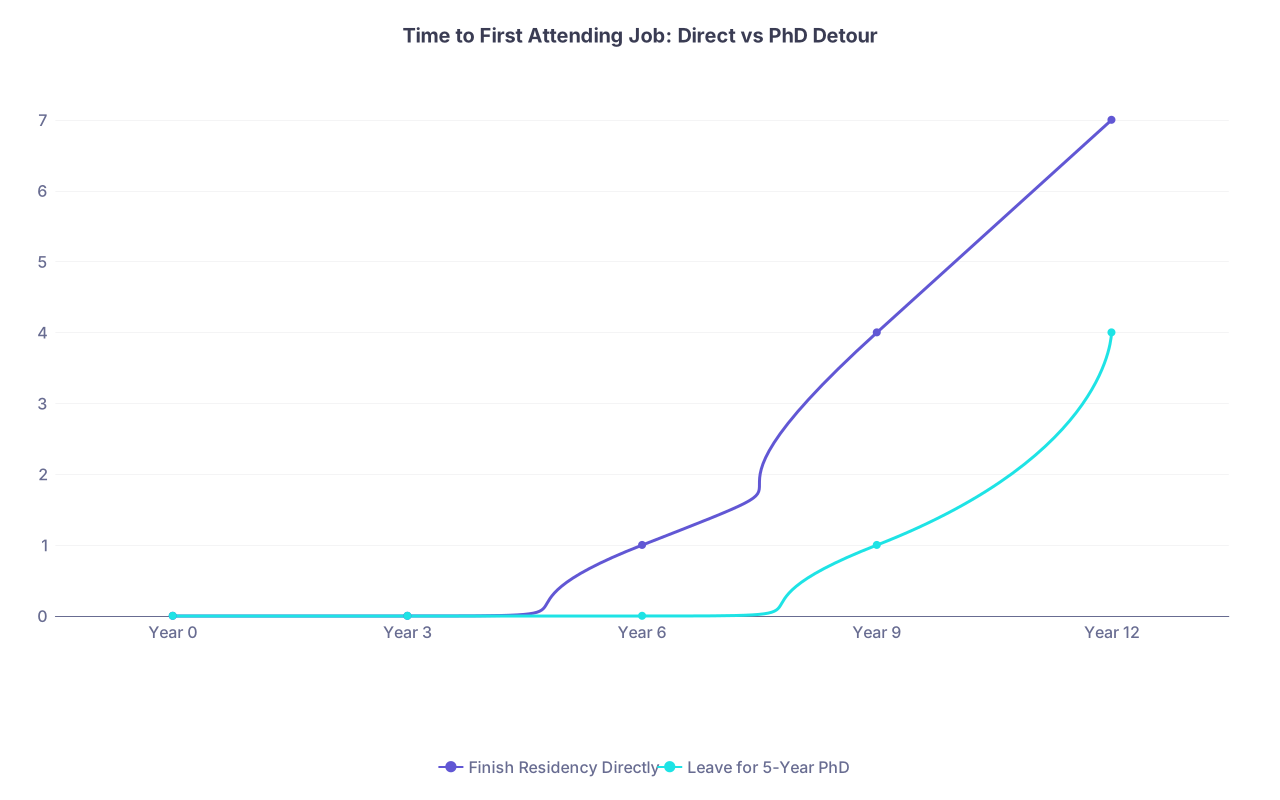
| Category | Finish Residency Directly | Leave for 5-Year PhD |
|---|---|---|
| Year 0 | 0 | 0 |
| Year 3 | 0 | 0 |
| Year 6 | 1 | 0 |
| Year 9 | 4 | 1 |
| Year 12 | 7 | 4 |
Mistake #5: Underestimating Lifestyle Creep and Burnout Risk
You know what’s hard? Going from PGY-4 income and independence to “I’m basically a grad student again.”
I’ve seen this wreck people more than any spreadsheet ever could.
You may suddenly:
- Move from your own apartment to sharing housing again
- Delay family plans because of financial insecurity
- Say no to conferences, opportunities, or networking because you can’t afford the travel
- Pick up random side gigs (tutoring, consulting) to survive—on top of PhD work
Financial stress plus academic pressure is a nasty combination. And burnout has a cost:
- Longer time to degree because you’re dragging
- Mental health costs (therapy, meds, time off—often not fully covered)
- Decision fatigue leading to worse financial choices (high-interest credit cards, short-term fixes)
Remember: burnout during a PhD doesn’t just cost you feelings. It adds time to the journey. Every extra semester is more interest, more lost attending income, more delayed stability.
How to not screw this up:
Before you sign on:
- Build a year-by-year budget on the actual stipend amount. No fantasy.
- Ask yourself: “Can I live like this for 5–6 years without resenting it?”
- If you already feel “I’m tired of being underpaid” as a resident, be honest about how you’ll handle going backward financially.
If the only way the PhD works is “assuming I’ll tolerate being broke and stressed for another 6 years”, that’s not a plan. That’s self-punishment dressed up as academic ambition.
Mistake #6: Not Considering Cheaper Ways to Get the Same Career Benefits
A PhD is one tool. It’s not the only one. And it’s definitely not the cheapest.
I’ve seen residents chase a PhD when what they actually needed was:
- 1–2 years of research fellowship
- A Master’s (MPH, MS, MBI, MEd) with a shorter, cheaper path
- Stronger mentorship and protected research time as a junior faculty
- Collaboration with PhD scientists, rather than being one
Common pattern:
- Resident wants to be an academic clinician with some research
- Feels insecure around “real scientists”
- Thinks a PhD fixes that
- Loses half a decade and hundreds of thousands of dollars to gain skills they could’ve built in a post-doc or fellowship
Ask yourself honestly:
Do you need to be PI on major basic science grants, or do you just want:
- Enough research skill to be competitive
- To understand methods deeply
- To collaborate intelligently with statisticians and PhDs
If it’s the second list, you may not need the full PhD detour. You might be chasing a sledgehammer solution to a scalpel-sized problem.
How to not screw this up:
- Write down your ideal job ad 10 years from now. Title, duties, percentage of clinical vs research, rough salary.
- Show it to 2–3 people who already have that job (or close). Ask:
- “Did you need a PhD to get here?”
- “What’s the most efficient path for someone in residency now?”
If multiple people say, “Honestly, a good research fellowship would be enough,” take that seriously.
Mistake #7: Forgetting to Protect Your Future Flexibility
Biggest under-discussed issue: you might change your mind mid-PhD.
I’ve seen this:
- Resident starts PhD
- Two years in, hates the work or advisor or culture
- Realizes they’re boxed in by:
- Visa issues
- Funding obligations
- Institutional policies
- Fear of “wasting time”
Financially, this can get messy:
- You might need to scramble to re-enter clinical training
- You may have geographic constraints now (partner, kids, mortgage)
- Your earning timeline is already delayed, and now it’s delayed and detoured
How to not screw this up:
Before you enroll, ask:
- “What happens if I decide to leave after 2 years?”
- “How many people have left early in the last 10 years, and what did they do next?”
- “Will my previous residency spot be protected or not?” (usually not, but ask)
You want escape routes that do not destroy you financially:
- Ability to convert to a Master’s and return to clinical training
- Clear pathway back into some form of residency/fellowship without total reset
If the only way this works is “I must love it for 5–7 straight years with no deviation or else everything implodes,” you’re loading a lot of pressure onto a single decision.
Mistake #8: Not Making a Written Financial Plan Before You Commit
The last mistake is almost comical in its consistency: people make a massive financial and career move without writing anything concrete down.
If your “plan” is a vague story in your head, you are setting yourself up to rationalize anything. You’ll move goalposts. You’ll ignore warning signs.
Minimal due diligence looks like this:
A one-page financial snapshot:
- Current debt
- Current assets
- Current income
- Expected PhD stipend and benefits
A timeline:
- Current PGY level and finish date if you don’t do PhD
- Projected PhD start and end
- Projected return to residency/fellowship and finish
- First year as attending in each scenario
A simple Earnings vs Debt Projection:
- Total earnings to age 40 with/without PhD
- Total debt at age 40 with/without PhD
Written criteria for “this is worth it”:
- “This is acceptable financially if by age X, I have Y:
- Role: …
- Salary at least: …
- Debt less than: …”
- “This is acceptable financially if by age X, I have Y:
If you can’t even tolerate doing this on a Sunday afternoon, ask yourself why you’re comfortable risking an extra decade of your financial life.
Your Next Step (Do This Today)
Open a blank document or spreadsheet and do one thing:
Write down two timelines side by side:
- Path A: Finish residency/fellowship → first attending job
- Path B: Leave for PhD → return to training → first attending job
Include years, rough salary at each stage, and your loan balance trajectory.
Don’t obsess over exact numbers. Get within 10–20%. That’s enough to see whether the PhD is a controlled risk… or a financial landmine dressed up as “more education.”
Once you see those two paths in front of you, in your own words and numbers, you’ll have a much clearer sense of whether this is a brave move—or a very expensive way to avoid facing the next stage of your career.