The idea that you must complete a formal MD–PhD to become a serious physician‑scientist is outdated and, frankly, lazy thinking.
You can absolutely design a robust, respected, research-heavy career as a physician without ever touching an MSTP application. But you cannot do it by drifting, “seeing what happens,” or waiting for some mythical research-friendly job to fall into your lap. You need a deliberate architecture for your career.
This is the blueprint I wish more residents and early faculty had been handed on day one.
Step 1: Get Very Clear On What “Physician–Scientist” Actually Means For You
“Physician–scientist” is not one job. It is several different models that all get lumped together. If you do not pick a model, the system will pick one for you. And you probably will not like it.
At a high level, there are four defensible targets you can build toward without an MD–PhD:
- Clinical Investigator (Trials‑Focused)
- Translational Collaborator (Bench‑Adjacent)
- Outcomes / Health Services Researcher
- Clinician with Significant Scholarly Output (10–20% research)
You need to decide which one you are aiming at because the training and tradeoffs differ.
| Model | Typical Research Time | Funding Reliance | Core Skills Needed |
|---|---|---|---|
| Clinical Investigator | 40–60% | Moderate–High | Trial design, stats |
| Translational Collaborator | 30–50% | High | Team science, lab basics |
| Outcomes/HSS Researcher | 40–80% | High | Methods, programming |
| Clinician–Scholar (20% RSCH) | 10–30% | Low–Moderate | Project mgmt, writing |
Concrete action for the next 7 days
- Write down which model fits you best right now.
- For that model, answer three questions in a half-page:
- What kind of problems do I want to work on? (examples: sepsis prediction, sickle cell disparities, implant failure mechanisms)
- Am I willing to take a pay cut and slower clinical ramp‑up to protect research time?
- Do I enjoy methods and data enough to spend nights fighting with R/Stata/Python… again and again?
If you dodge these questions, you are building on sand.
Step 2: Exploit Every Research Opportunity in Medical School (Without Wasting Time)
You do not need an MD–PhD, but you do need a research narrative by the time you apply to residency. Not a “collection of posters.” A narrative.
You want your CV to say: “This person can take a clinical question, find a mentor, learn methods, and complete projects to publication.”
What you should actually do in med school
Pick a lane early (M2 at the latest)
- Choose 1–2 areas that are:
- Method rich (plenty of data, methods to learn)
- Staffed by people who publish regularly
- Clinically plausible for your future interests
- Example lanes:
- Sepsis and ICU outcomes
- Health equity in cardiology
- Neuroimaging in epilepsy
- Implementation science in primary care
- Choose 1–2 areas that are:
Find productive mentors, not just “nice” ones
- Look for:
- 3+ first/senior‑author papers in the last 2 years
- Active grants (K award, R01, foundation grants)
- Trainees on their papers (med students, residents, fellows)
- Red flags I have seen derail people:
- “I have great ideas but just need someone to write them up.” Translation: you will ghost‑write 10 projects and watch 0 get published.
- “Things are a bit hectic this year but…” Translation: they will be hectic forever.
- Look for:
Stack methods, not just lines on your CV You want to exit med school with at least one of these skill clusters:
- Clinical / Observational Methods
- Chart review design
- Regression basics (logistic, Cox)
- Familiarity with REDCap, basic R/Stata/SPSS
- Clinical Trials Exposure
- Consent processes
- Data collection / monitoring
- Awareness of GCP, IRB processes
- Outcomes / Health Services
- Large database handling (NSQIP, SEER, MIMIC, administrative claims)
- Propensity scores, difference‑in‑differences, etc.
- Basic or Translational Lab
- One or two core techniques (e.g., Western blot, PCR, flow cytometry, cell culture)
- Understanding of controls, replication, data integrity
You do not need all. Pick one cluster and become reasonably competent.
- Clinical / Observational Methods
Use formal structures: research tracks, scholarly concentrations, dual degrees If your school offers:
- Scholarly concentration in clinical research/public health/data science
- 1‑year research fellowships (HHMI, Doris Duke, Sarnoff)
- MD–MS or MD–MPH…
…seriously consider them. These are your “poor man’s MD–PhD” equivalents, and they are often more efficient.
Med school protocol: how to not flail for 4 years
M1–early M2:
- Join one research group.
- Get on one clearly defined project that can finish in ≤12 months.
- Learn the group’s methods (do not just “help collect data”).
Late M2–M3:
- Aim for at least 1–2 first‑author abstracts/posters.
- Push to convert at least one into a manuscript before residency applications.
(Related: Love Research but Want Patients? How to Structure an MD-Centered Path)
- M4:
- Do an away or sub‑I at a research‑active program in your target specialty if possible.
- Make your research interest explicit in your personal statement and interviews.
If you do this well, you can show up to residency as “the person who already knows how to get research done,” which is the person programs want to invest in.
Step 3: Use Residency as Your Real “MD–PhD”
If med school is your warm‑up, residency is where you either lock in a physician‑scientist trajectory or you lose it.
The critical mistake: treating residency like a black box where research interest “will somehow survive.” It will not. The clinical grind will eat it unless you deliberately protect it.
Choose your residency like a physician–scientist, not just a clinician
When evaluating programs, you should care less about the cafeteria and more about:
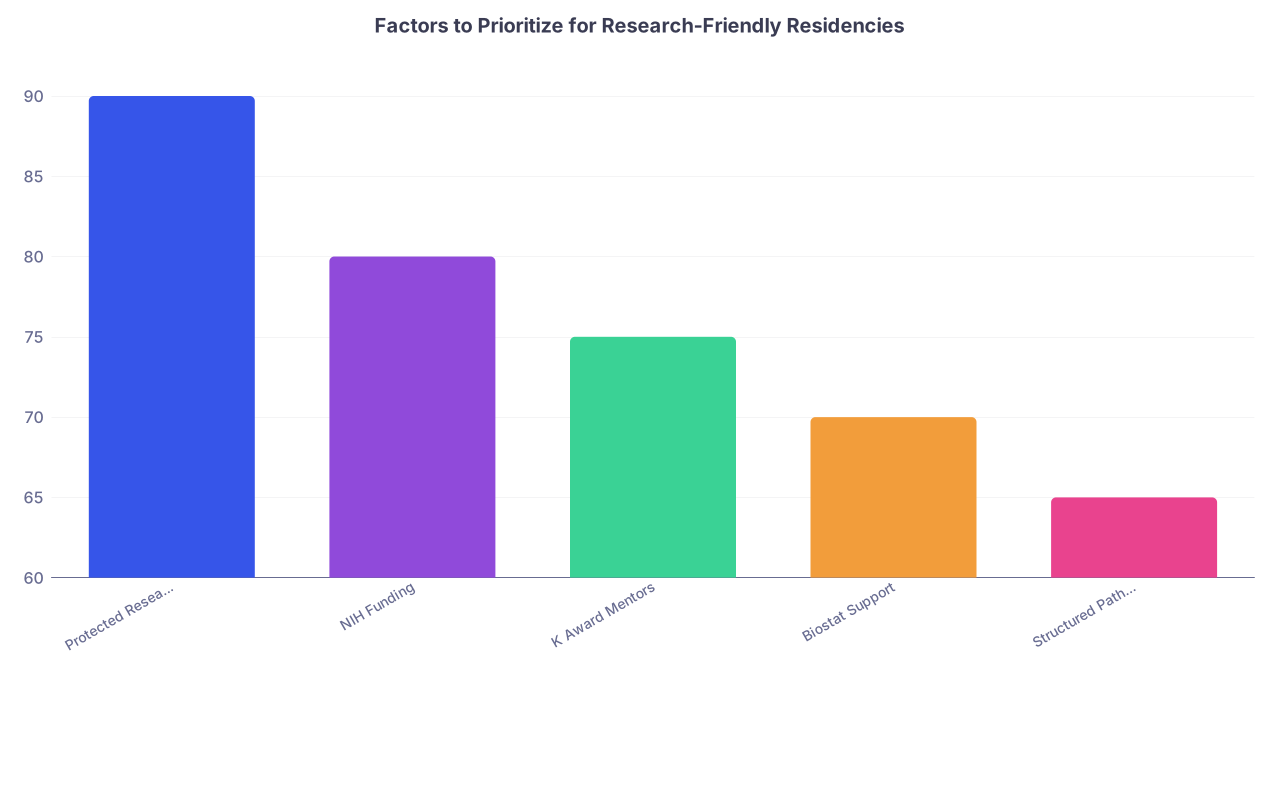
| Category | Value |
|---|---|
| Protected Research Time | 90 |
| NIH Funding | 80 |
| K Award Mentors | 75 |
| Biostat Support | 70 |
| Structured Pathways | 65 |
Ask programs (and current residents) directly:
- How many residents completed ≥6 months of protected research in the last 5 years?
- How many residents in the last 5 years:
- Matched into research‑heavy fellowships?
- Got K awards or equivalent?
- Do you have:
- An official Physician–Scientist / Research Track?
- A research director who actually answers email?
- Internal pilot grants for residents?
If they dodge or cannot produce specific examples, believe them. The infrastructure is not there.
Build a residency research plan year‑by‑year
PGY‑1: Establish survival and signal
Goals:
- Become clinically solid enough that attendings trust you.
- Signal early that you are serious about research.
Actions:
- Within first 3 months, meet:
- Program Director
- Research/Scholarship Director
- At least 2–3 potential research mentors in your area
- Pick one low‑risk, small project to complete within year 1:
- Case series
- Retrospective chart review with simple methods
- Quality improvement with a publishable angle
Non‑negotiables:
- Learn your institution’s IRB process cold.
- Identify at least one biostatistician and one research coordinator you can email by name.
PGY‑2: Carve research time and methods training
PGY‑2 is where people either level up or vanish into the call schedule.
You should:
Negotiate formal protected time if your program allows
- Even 0.5–1 day/week is life‑changing if protected properly.
- Put it in writing. Email confirmation. Schedule block named “Research”.
Start formal training if you are serious Options:
- Part‑time MPH, MS in Clinical Investigation, or similar.
- Certificate in clinical research or biostatistics.
Design at least one “real” project Characteristics of a “real” project:
- Clear primary question and hypothesis.
- Pre‑specified analysis plan.
- Sufficient sample size to answer that question.
- Realistic 1–2 year timeline.
Aim for manuscripts, not just posters. Posters pay you in pizza and lanyards. Papers pay you in jobs.
PGY‑3 and beyond: Start acting like junior faculty
If you are in IM, Peds, Psych, Neuro, etc., PGY‑3 (and fellowship) is where you should start:
- Writing at least one first‑author paper per year.
- Co‑mentoring students or juniors on smaller projects.
- Presenting at national meetings in your niche.
(See also: How Physician-Scientists Are Actually Hired for more details.)
If you are in surgical fields, your heavy research period is often a dedicated research year or two during residency. If your program offers this:
- Take it.
- Treat it like a full‑time postdoc:
- Clear schedule.
- Specific output expectations (papers, grants, degrees).
- Regular meetings with mentors and statisticians.
Step 4: Acquire the “Missing Pieces” MD–PhDs Usually Get
MD–PhD programs give structured exposure to three things:
- Deep methods training
- Serious mentorship and lab culture
- A track record of funded, hypothesis‑driven work
You can replicate all three, but you have to be deliberate.
4.1 Methods training: stop relying on “the statistician will handle it”
If you want a durable physician–scientist career without a PhD, you must stop being afraid of methods.
You do not need to be a full‑fledged biostatistician or bench PI. You do need:
- Comfort reading primary methods sections.
- Ability to design studies with correct basic methods.
- Enough literacy to know when your analysis is garbage.
Concrete ways to get there:
Formal degree or certificate
- MS in Clinical Investigation / Translational Science
- MPH with quantitative emphasis
- MS in Epidemiology / Biostatistics
Short, high‑yield courses
- NIH “Introduction to the Principles and Practice of Clinical Research”
- Society‑sponsored courses (e.g., ATS Methods in Epidemiologic, Clinical and Operations Research; AHA clinical trial methods courses)
- University biostatistics short courses
Self‑driven skill stack
- Learn one statistical software: R or Stata.
- Learn one reproducible workflow: RMarkdown, Quarto, or equivalent.
- Set up a private Git repo for your analytic projects (even if you are the only member).
If the thought “I will just send my data to stats and they will figure it out” crosses your mind, you are not yet functioning as a physician–scientist. You are functioning as a contributor. That is fine temporarily. Not fine long term.
4.2 Mentorship architecture: do not rely on a single “guru”
Strong MD–PhD programs surround trainees with overlapping mentors. You should copy that.
Build a mentorship team, not a single hero.
Your team should include:
Primary scientific mentor
- Deep in your topic area.
- Active funding or realistic path to it.
- Clear track record of trainee success.
Methods mentor
- Biostats, epidemiology, data science, or lab methods.
- Someone who will push you on rigor, not just “get the p‑value.”
Career mentor
- Usually an older clinician in your specialty.
- Helps negotiate clinical time, promotion, politics.
Peer mentor(s)
- 1–3 people within 3–5 years of you career‑wise (senior fellows, junior faculty).
- You copy what works for them and avoid what did not.
Set a cadence:
- Primary mentor: every 2–4 weeks when in active projects.
- Methods mentor: at project design and analysis planning stages, not just at the end.
- Career mentor: 2–3 times per year, especially around contract negotiations and major decisions.
Step 5: Use Fellowships and Early Faculty Jobs to Lock in Research Time
The most important contract of your career is not your first attending salary. It is your first attending job description.
Fellowship: the soft landing between resident and investigator
In research‑heavy specialties (cardiology, heme/onc, pulm/crit, GI, academic IM, etc.), fellowship can be your real “PhD‑equivalent” years.
Your targets during fellowship:
At least 50% research time in your later years if you are serious.
One of:
- K‑grant submission (K08, K23, KL2, VA CDA, etc.), or
- Strong equivalent (foundation career award, major society award).
A definable niche. Not “I do research on heart failure.” Something like:
- “Risk prediction and implementation of remote monitoring in HFpEF”
- “Health systems interventions to reduce sepsis mortality in safety‑net hospitals”
- “Genomic predictors of response to immunotherapy in GI malignancies”
If a fellowship does not give you protected research blocks, access to mentors with grants, and support to write your own grants, then it is not a research fellowship. It is just cheaper labor with a fancy title.
First faculty job: design it, do not just accept it
When you negotiate your first faculty position:
Demand clarity on percent effort
- Example of a bad offer:
- “We really value research; you can do some on the side.”
- Example of a useful offer:
- “0.6 clinical, 0.3 research, 0.1 teaching/admin for the first 3 years, with explicit RVU and grant expectations.”
- Example of a bad offer:
Ask these exact questions
- How many junior faculty in the last 5 years:
- Got promoted on research tracks?
- Renewed or obtained K or R funding?
- How is protected time enforced?
- What happens if clinical volume surges?
- Is there bridge funding or startup for new investigators?
- How many junior faculty in the last 5 years:
Put deliverables in writing
- For example:
- Year 1–3 expectations:
- Submit ≥2 first‑author manuscripts/year.
- Submit at least one career development grant by end of year 2.
- In return:
- 40–50% protected research time.
- Access to biostatistical support and grant editing.
- Year 1–3 expectations:
- For example:
If the department “cannot” put research time in writing, they are telling you clearly: your research is optional decoration. Believe them.
Step 6: The Non‑Negotiable Skills MD–PhD Alternatives Must Master
There are four operational skills that separate real physician–scientists from clinically busy people who occasionally appear on manuscripts.
You will not get them automatically. You have to work toward them.
6.1 Project management
You need a personal system for:
- Tracking each project’s:
- Aim
- IRB status
- Data collection status
- Analysis status
- Writing/submission status
- Scheduling regular check‑ins with collaborators.
- Pushing projects through the final 20% (which takes 80% of the pain).
I have seen brilliant people sit on completed analyses for years because “I need to find a weekend to write it up.” They never do.
Establish:
- A simple spreadsheet or Trello/Notion board for projects.
- A rule: if a project has not moved in 30 days, you either:
- Move it intentionally, or
- Declare it dead and free up that mental space.
6.2 Writing quickly and repeatedly
You cannot outsource your writing career. You must be able to:
- Draft a full first version of a paper in 1–2 weeks of focused work.
- Respond to reviewer comments without melting down.
- Crank out grant drafts on real deadlines.
Practical protocol:
- Set 2–3 standing writing blocks per week (90–120 minutes, phone off, email closed).
- During those blocks, you write. No reference formatting, no data cleaning. Writing only.
- Use a template folder for each manuscript:
- /figures
- /tables
- /supplement
- /analysis scripts
- /drafts
6.3 Saying “no” without burning bridges
When people realize you are productive without an MD–PhD, you will become the default collaborator for everything under the sun. Most of these opportunities are traps.
You must filter with a harsh lens:
- Does this project align with my niche?
- Is my role clearly defined and substantive?
- Is there a realistic path to publication within 12–18 months?
- Will I get first or senior authorship if I am doing the heavy lift?
If not, say:
- “This looks interesting, but I would not be able to give it the attention it deserves right now. If you need quick advice on X, I am happy to help, but I cannot take on a formal role.”
Polite. Clear. Boundary‑preserving.
6.4 Long‑term funding awareness
You do not need to become a grant‑writing machine on day one. You do need to be aware of the ladder:
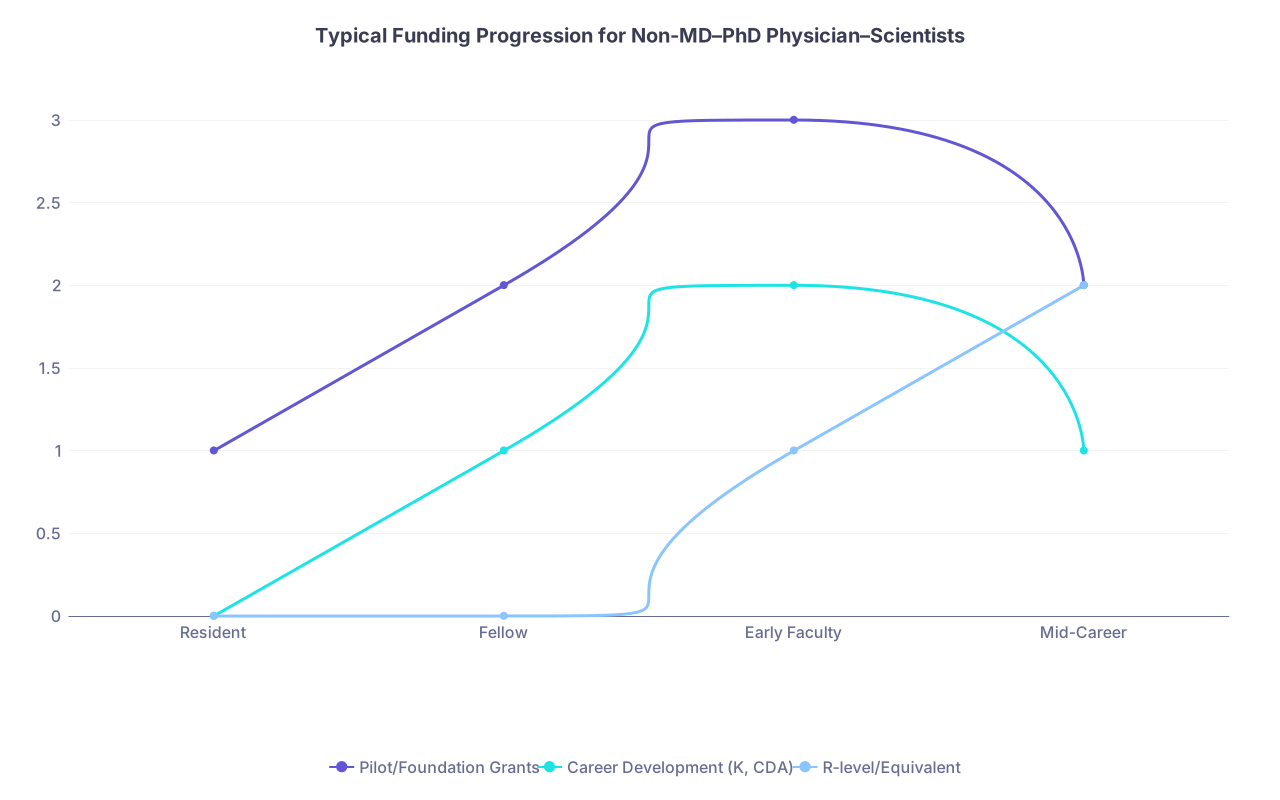
| Category | Pilot/Foundation Grants | Career Development (K, CDA) | R-level/Equivalent |
|---|---|---|---|
| Resident | 1 | 0 | 0 |
| Fellow | 2 | 1 | 0 |
| Early Faculty | 3 | 2 | 1 |
| Mid-Career | 2 | 1 | 2 |
Rough ladder:
Starter:
- Institutional pilot grants ($5k–50k)
- Society young investigator awards
- Departmental seed funding
Bridge:
- Career development awards (K08, K23, KL2, VA CDA, foundation CDAs)
- These are your “PhD funding” equivalents in terms of protected time and mentoring plan.
Destination:
- R‑series grants (R01, equivalent), PCORI funding, large foundation grants.
Your goal:
- By late fellowship or early faculty, submit at least one serious career development grant. Even if it fails, the process will expose your weaknesses and force you to formalize your mentoring team and research plan.
Step 7: Reality Check – Tradeoffs You Cannot Dodge
Designing a physician–scientist career without formal MD–PhD training is absolutely possible. I have watched plenty of colleagues do it. Some are chairing departments now.
They all paid real costs:
- Lower early‑career income compared with full‑time clinicians.
- More time in “invisible work”: IRBs, grant revisions, rejections.
- Slower clinical ramp‑up: they were not the ones grabbing every extra clinic session.
- Navigating skepticism: “So you are trying to be a researcher without a PhD?”
What they gained:
- Control over their clinical schedules.
- The ability to build and lead entire programs.
- Careers that age better than pure RVU treadmill work.
- The satisfaction of seeing ideas move from scribbles to actual patient impact.
You can do the same, but you must treat it as a deliberate design problem, not a vibe.
Your Immediate Next Step
Do one focused thing today:
Open your CV and add a one‑sentence “Research Focus” line at the top. Then list the 3–5 concrete skills you still need (methods, writing, mentors, degrees) to make that focus real.
Once that list exists, you can start solving it item by item.
Until it exists, you are just another busy clinician who “likes research.”