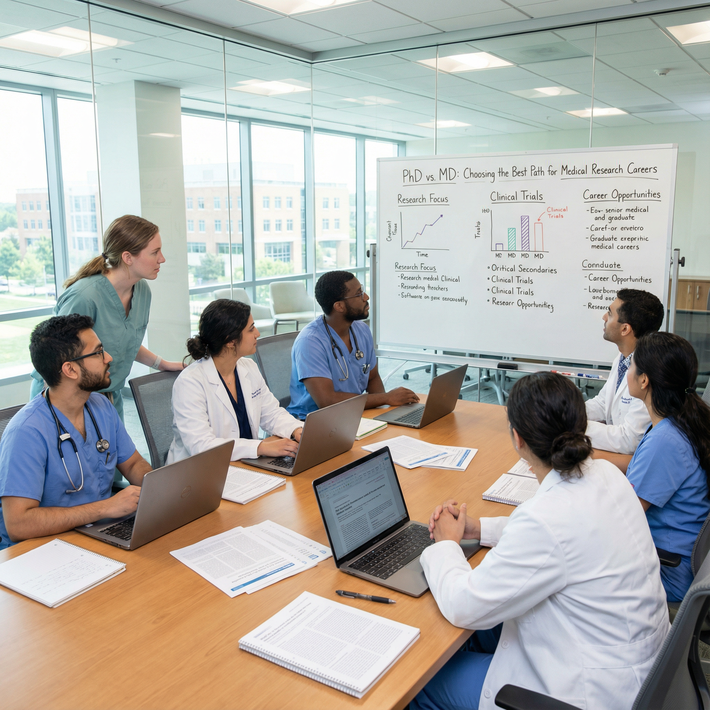
The common belief that you must get a PhD to be taken seriously in academic medicine is wrong.
You can absolutely build a serious research career as an MD (or DO) without ever doing a formal PhD—if you use research fellowships strategically instead of randomly “doing a gap year for research.”
This is not about avoiding hard work. You will work just as hard (sometimes harder) than many PhD students. The difference is you will be targeted, time‑bound, and specialty‑aligned rather than wandering through a 5–7 year PhD that you may not need.
Let me lay out how to do this like an adult, not like a panicked MS2 grabbing whatever fellowship happens to have a stipend.
1. Get Clear On What You Actually Need From “A PhD”
People go after PhDs in medicine for three main reasons:
- Prestige / credibility
- Skills / training to be an independent investigator
- Time and structure to build a research track record
You do not always need a PhD to get those. But you do need to replace what is functionally missing if you skip it.
Here is what a strong PhD usually gives someone headed for academic medicine:
- 3–6 first- or co–first-author papers
- Real statistical and methods training
- A defined niche (“I am the sepsis biomarkers person”)
- Strong letters from established investigators
- Experience designing studies, writing grants, mentoring juniors
- A reputation in at least one national research community
Your research fellowships must be designed to hit the same outputs in a shorter, more clinical‑aligned trajectory.
If the following are true, you probably can and should skip a PhD:
- You want to be primarily clinical with 20–50% research
- You are aiming for specialties where MD-only researchers are common (IM subspecialties, EM, anesthesia, peds, many surgical fields)
- You are willing to stack 1–3 years of intense research time (fellowships, postdocs, “research tracks”) at strategic points
If this is you, the game is: use research fellowships as your “modular PhD.” Each block adds specific skills, credibility, and output.
2. Map Your Path: Where Fellowships Can Replace a PhD
You cannot just “fit in research somewhere.” You need a roadmap that competes with the structure of a PhD.
Here are the main windows where MDs can plug in research fellowships:
| Stage | Typical Duration | Main Goal |
|---|---|---|
| Post‑M2 / Pre‑clinical break | 1 year | Entry into field, basic skills |
| Post‑M4 (before residency) | 1–2 years | Boost for competitive match |
| During residency (research) | 1–3 years | Deep niche, heavy output |
| Post‑residency (postdoc) | 1–3 years | Grant readiness, independence |
The PhD-equivalent approach is not “do one year somewhere.” It is this:
- One early exposure year (optional if you already have research)
- One heavy output research block linked to your target specialty
- Possibly one advanced postdoc‑style block if you are going for R01‑level independence
Think in terms of stacking.
Example Path: Future Academic Cardiologist, No PhD
- MS1–MS2: 1–2 small projects, poster or two, enough to show interest
- Dedicated research year after M3: NIH‑funded cardiovascular lab, 2 first author papers, 2–3 co‑author
- Residency: Choose IM program with 2+ years protected research track. Use that as “mini‑PhD” to develop niche (e.g., heart failure outcomes, advanced echo imaging)
- Fellowship: Pick academic cardiology program that expects and supports grant submissions (K‑award, foundation funding)
Total: 3–4 concentrated research years. Functionally equivalent to a PhD for most academic IM departments.
No wasted years doing coursework you will never use, no random lab work not linked to your eventual career.
3. Choosing the Right Kind of Research Fellowship (Not All Are Equal)
A “research year” can be anything from “I updated a database and never published” to “I walked out with 4 first-author papers and a K‑award draft.”
You want the latter.
Here is how I categorize research fellowships for MDs:
Name-brand, grant-funded fellowships
- NIH intramural research training awards (IRTA)
- HHMI Medical Research Fellows
- Doris Duke Clinical Research Fellowship
- Sarnoff, Fulbright, etc.
Institution-specific research tracks / scholar programs
- T32-funded slots during residency/fellowship
- Hospital/university “research scholar” appointments
- Structured 1–2 year programs with coursework, mentorship, and expectations for output
PI-funded gap years / lab-based fellowships
- You work directly for a PI on their grants
- Titles vary: “Clinical Research Fellow,” “Postdoctoral Scholar,” “Research Associate”
Industry, NGO, or think-tank research years
- Less traditional academia, more policy/implementation, pharma trials, or outcomes work
Your goal: combine these so that by the end you look at least as strong on paper as the MD/PhD next to you.
Priority order if you do not know where to start:
- Structured national programs (Doris Duke, HHMI, NIH IRTA)
- T32 or other institutional research tracks tied directly to your residency/fellowship
- High-output PI‑funded fellowships with a PI who actually graduates successful clinician‑scientists
4. How to Evaluate a Fellowship Like a Future Academic, Not a Desperate Student
Most people choose fellowships the wrong way:
- “It pays a little more.”
- “They seemed nice in the email.”
- “It’s local.”
That is how you waste a year.
You want to evaluate a fellowship with the same ruthlessness you would a PhD program. I use a checklist like this.
A. Track record of past fellows
Ask specifically:
- How many prior fellows have matched into strong academic residencies/fellowships?
- How many are publishing first-author work?
- Names. Programs. PDFs of actual CVs if you can get them.
If they “do not track that,” red flag. Good labs and programs brag about their alumni.
B. Expected output in 12–24 months
I ask PIs directly (and you should too):
- “If I work hard and things go reasonably well, what kind of publication output do you expect your fellows to have after one year? After two?”
Real answers that give me confidence:
- “Most one‑year fellows get 1–2 first‑author papers and 3–4 co‑author papers.”
- “Two‑year fellows often have 3–4 first‑author papers, sometimes a K‑award submission by the end of residency.”
Vague nonsense like “It depends” or “We prioritize learning over numbers” often translates to “we cannot promise you productivity.”
C. Protected time and boundaries
You are replacing a PhD, not signing up to be free labor.
Look for:
- Clear statement of percent time on research vs. clinical / scut
- No bait-and-switch (“you will help with chart review” is fine; “actually we need you full‑time on the floor” is not)
Ask prior or current fellows privately what actually happens. They will tell you.
D. Mentorship structure
I do not care how famous the PI is if you will never see them.
Ask:
- Who will be my day‑to‑day mentor?
- How often will I meet with them?
- Who helps with statistics, programming, IRB, and writing?
You want at least three levels:
- A senior PI with name recognition
- A mid‑career or senior co‑mentor actively working with you
- A postdoc / senior fellow who can show you the ropes daily
E. Training and skill-building
You are replacing the “coursework and methods” portion of a PhD. You should leave with better skills than the average MD.
Look for options to gain:
- Formal coursework in epidemiology, biostatistics, clinical trials, or health services research
- Hands-on experience with R, Stata, Python, SQL, REDCap
- Experience leading your own project from IRB to publication
5. Design Your “Modular PhD”: A Concrete Blueprint
Let me spell out a realistic “PhD replacement” plan over time.
Phase 1 – Foundation (Early Med School or Pre‑Residency)
Goal: get started in a field and prove you can publish.
What you should accomplish:
- 1–2 first‑author case reports/retrospectives
- 2–3 co‑author projects
- Basic comfort with data, manuscripts, IRB, and presenting
Good moves:
- One structured pre‑clinical research year (Doris Duke / HHMI / NIH IRTA)
- Or 12–24 months between M4 and residency in a lab matched to your intended specialty
Avoid:
- Pure bench research if you know you want clinical outcomes research only
- Pure chart review mills that never lead to manuscripts with your name in front
Phase 2 – Deep Niche (Residency Research Track or Post‑Residency)
Goal: become “that person” for a specific topic.
What you should accomplish:
- 2–4 first‑author original research papers in your niche
- At least one national presentation (oral if possible)
- A clear research story: same clinical problem, multiple angles
This is where a T32 research track in residency or fellowship is gold. You can treat 2 years of 80% protected research as the heart of your “modular PhD.”
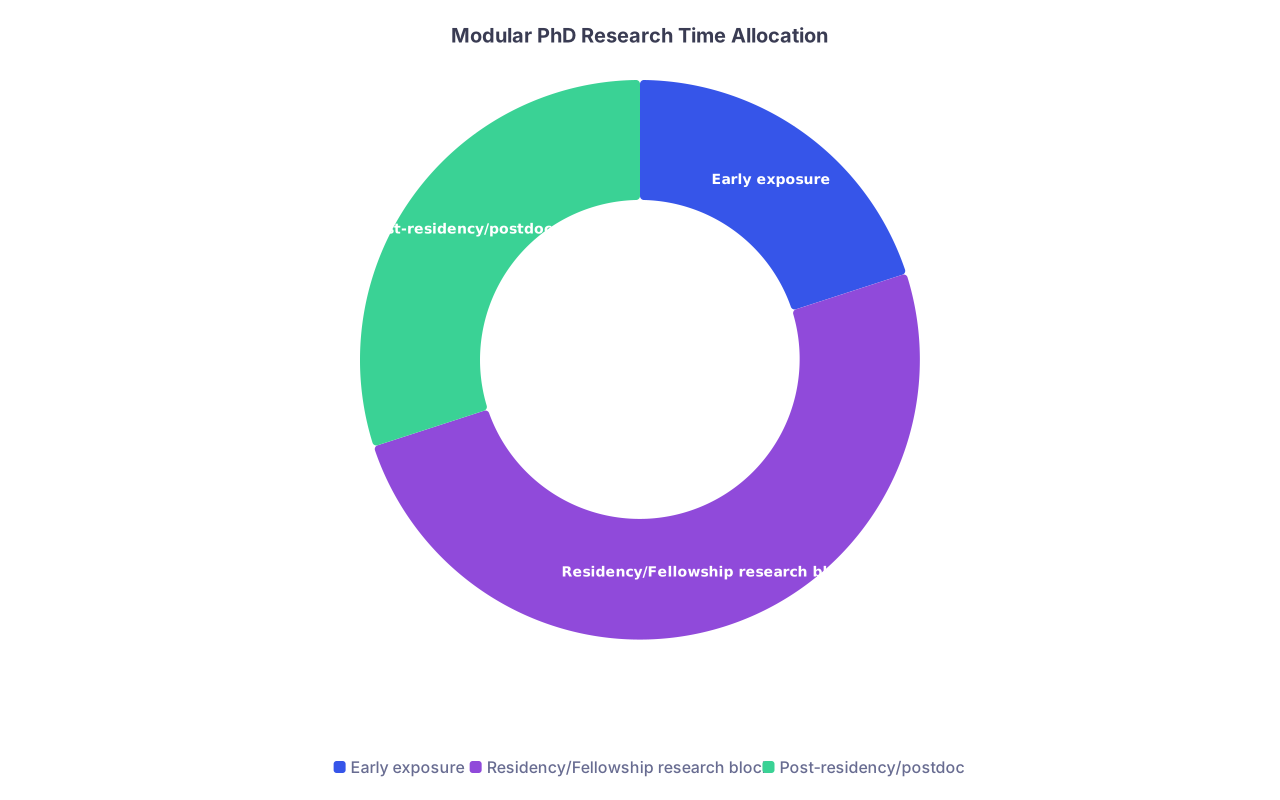
| Category | Value |
|---|---|
| Early exposure | 20 |
| Residency/Fellowship research block | 50 |
| Post-residency/postdoc | 30 |
Phase 3 – Independence (Late Residency, Fellowship, or Early Faculty)
Goal: replace the “R01‑ready” expectation that a PhD often fills.
What you should accomplish:
- A coherent research agenda you can describe in 2–3 sentences
- Participation in grant writing (ideally as co‑I or K‑award PI)
- Strong letters from known investigators saying you are ready for independence
This may be:
- An additional “instructor” or “research fellow” year post‑fellowship
- An early‑career faculty slot with heavily protected research time
You are not chasing more random years. You are deliberately closing the remaining gaps left by not doing a PhD.
6. Skill-Building: What You Must Actively Replace From a PhD
Skipping a PhD means you do not get certain formal structures automatically. You must add them intentionally.
Here is the checklist I use for MDs aiming at serious research careers without a PhD:
A. Methods and Statistics
What you need:
- Comfort designing clinical studies
- Ability to discuss basic and intermediate stats without sounding lost
- Familiarity with at least one statistical software (R, Stata, SAS, or Python stack)
How to get it:
- Take a formal course (certificate in clinical research, MPH coursework, evening biostats classes)
- Ask your fellowship to pay for courses or degrees (many T32s will fund an MS in Clinical Research)
- Work directly with biostatisticians, but actually learn, not just hand off data
B. Project Leadership
PhD students learn this through pain. You will too, but faster.
You must:
- Run at least 1–2 projects where you are the primary driver from idea → IRB → data → analysis → manuscript
- Learn to manage timelines, delegate tasks, and push collaborators
If your fellowship has you just “helping” with others’ projects, you will not grow into independence.
C. Communication and Grants
Research without funding is a hobby. If you want a stable research career, you will have to be competitive for:
- K‑awards (K08, K23, foundation career development awards)
- R-series grants (eventually)
Use fellowships to:
- Co‑write at least one small grant (pilot, foundation, society grant). Even a $10K pilot counts as training.
- Attend institutional grant‑writing workshops.
If a program has a track record of K‑awardees coming out of their fellows, that is a major green flag.
7. How Competitive Is This Compared To a PhD?
Here is the uncomfortable truth: some departments and chairs still reflexively prefer MD/PhDs for certain research-heavy tracks.
But in actual hiring discussions I have sat in, I see this pattern:
- If the MD‑only candidate has 8–15 solid papers, a clear niche, and a K‑award (or strongly competitive application), they are treated as completely equivalent to MD/PhDs.
- Weak MD/PhDs (yes, there are many) with 2–3 mediocre papers and no clear agenda are not automatically favored over strong MD‑only candidates with a “modular PhD” path.
So what matters?
- Output and trajectory. Not the letters “PhD” after your name.
A simple way to think about it:
| Factor | Typical MD/PhD Grad | Well-Executed Modular Path |
|---|---|---|
| First-author papers | 3–6 | 4–10 |
| Methods training | Formal, structured | Courses + mentored projects |
| Grant experience | Variable | Must be built deliberately |
| Clinical training | Delayed but strong | Integrated with research |
If you design your path well, you can actually surpass the average MD/PhD in readiness by early faculty stage.
8. Common Failure Modes (And How To Avoid Them)
I have seen MDs try to replace a PhD with research years and fail. The patterns are predictable.
Failure Mode 1: Random Scattered Projects
You have:
- One oncology case report
- One ortho retrospective
- One QI project in ED throughput
- One nutrition poster from undergrad
This looks like noise, not a career.
Fix:
- Starting with your first real research year, pick a clinical problem, not a specific dataset or technique. Example: “perioperative outcomes in older adults.” Make 70–80% of your work relate to that.
Failure Mode 2: Fellowships With Minimal Mentorship
You sit in an office, cold-email clinicians for chart review, and nobody is really responsible for your development.
Fix:
- Before accepting, pin down: “Who, by name, will meet with me monthly to track my progress and help me prioritize projects?” If they cannot answer, do not go.
- During the fellowship, demand a written project list with timelines and roles. Yes, written. People take you more seriously when you make them commit.
Failure Mode 3: Overweighting Quantity Over Quality
You crank out 20 case reports and 15 low‑impact abstracts. When you apply for grants, reviewers shrug.
Fix:
- Aim for at least 2–3 substantive first‑author papers (original research, not just case series) in good journals.
- Use smaller projects (letters, case reports) to fill gaps, not as the foundation.
Failure Mode 4: Never Building Real Methods Skills
You push everything to the biostatistician and never learn to read a regression output.
Fix:
- Commit to one software and one track of formal learning.
- Force yourself to write at least part of the methods and results sections yourself, then get feedback.
9. Sample Timelines: What This Actually Looks Like
Let me give you concrete scenarios.
Scenario A: MS2, Wants Academic Neurology, No PhD
- MS1–MS2: Summer research in stroke outcomes. Poster at AAN.
- After M3: 1‑year Doris Duke fellowship in vascular neurology lab. 1 first‑author retrospective, 2 co‑author projects, basic R skills.
- Residency (neurology): choose program with NIH‑funded researchers in stroke. Year 3–4: 50–70% protected research. 2–3 more first‑author papers, co‑author on multicenter registry paper.
- Fellowship: Vascular neurology with T32 research track. Take advanced clinical research methods course. Draft K23.
Result: 3–5 years total research, strong niche, competitive for K‑award and early academic faculty. No PhD.
Scenario B: Finished IM Residency, Realizes They Love Research, No PhD
- Immediate plan: 2‑year clinical research fellowship in hepatology at large academic center (T32 funded).
- Year 1: Method courses, start 2–3 projects, present at AASLD.
- Year 2: Submit 2 first‑author manuscripts, co‑write small grant, begin K‑award planning with mentor.
- Transition to instructor position with 70% protected research; submit K08.
Result: In 3–4 years they look indistinguishable on paper from many MD/PhDs—sometimes better, because all their work is tightly clinical and highly relevant.
10. How To Decide If You Actually Do Need A PhD
Sometimes, yes, you should get a PhD. I am not anti‑PhD. I am anti‑unnecessary‑PhD.
You probably need or strongly benefit from a PhD if:
- You want to do highly technical basic science or computational work at a level where you will be competing with pure PhDs all the time
- You are drawn to heavy theory/method development (e.g., advanced biostatistics, economic modeling)
- You have no interest in significant clinical time and want a mostly research‑heavy identity
But if your dream job looks like:
- 50–70% clinical
- 30–50% clinical or translational research in one or two disease areas
- Teaching residents and fellows
- Possibly running a clinical trials program or outcomes lab
Then a well-structured series of research fellowships will get you there just fine.
11. Action Plan: What You Should Do This Year
You probably want something you can act on immediately. So here is the checklist.
If You Are Pre‑Clinical (MS1–MS2)
- Identify 2–3 faculty in your rough area of interest. Email with a specific ask to join one ongoing project.
- Apply for competitive summer research and, if possible, a 1‑year research fellowship (Doris Duke, HHMI, NIH).
- Aim for 1–2 tangible products (poster + manuscript) before clinical clerkships.
If You Are Clinical (MS3–MS4)
- Decide now whether you will take a research gap year. If yes, target programs within your hoped-for specialty.
- Talk to current or recent fellows (not just PIs) at each program to confirm mentorship and output.
- Begin aligning projects under a single clinical theme.
If You Are In Residency
- Ask program leadership directly about research tracks, T32s, and how prior residents used them.
- If none exist, look externally for 1–2 year post‑residency research fellowships at bigger centers.
- Start thinking about what your 2–3 sentence research identity will be.
If You Are In Fellowship or Early Faculty
- Audit your CV for gaps: methods training, first‑author original research, grant experience.
- Consider a 1–2 year “instructor with 80% research” role if offered, especially if it comes with mentorship and grant-writing support.
- Pick one grant to prepare within 12–18 months (society, foundation, or K‑series).
12. The Bottom Line
You do not need a PhD to have a serious, respected academic career in medicine.
You do need:
- A deliberate, modular plan of 2–4 intense research years, not scattered side projects.
- Strategically chosen fellowships with mentorship, methods training, and real output—treat them as pieces of your “build‑your‑own PhD.”
- A coherent niche and trajectory so that by the time you hit the job market, people can say in one sentence what kind of researcher you are.
If you get those three right, the letters after your name matter far less than the work you have actually done.