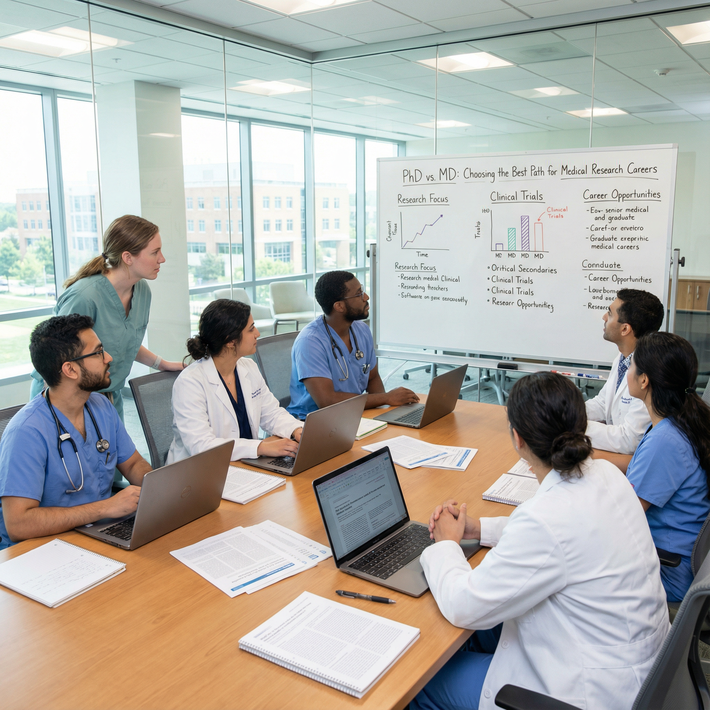
Most of what you have heard about “needing a PhD” for a serious research career is exaggerated or flat-out wrong.
If you already hold (or are pursuing) an MD, you are much closer to a research-heavy career than you think. The problem is not your degree. The problem is that no one ever gave you a concrete roadmap for how to build a research identity, get funded, and get hired into research roles without going back for another 4–6 years.
I will. Step by step.
Step 1: Get Clear on What “Research-Heavy” Actually Means
“Research-heavy” is vague. People use it to mean everything from “a few papers per year” to “NIH-funded lab head who barely sees patients.”
You cannot plan a pivot until you define the destination. Here are the common research-heavy endgames for MDs without PhDs:
| Role Type | Clinical Load | % Time in Research |
|---|---|---|
| Physician-Scientist (NIH R01) | 0–30% | 70–100% |
| Clinical Investigator (trials) | 20–50% | 50–80% |
| Industry Physician (R&D) | 0–10% | 80–100% |
| Outcomes/Health Services Researcher | 10–40% | 60–90% |
| Med Ed Researcher | 20–60% | 40–70% |
Ask yourself, bluntly:
- Do you still want regular patient care, or are you fine with almost none?
- Do you care more about:
- Basic/translational mechanisms?
- Clinical trials and interventions?
- Big data / outcomes?
- Drug / device development in industry?
- Medical education and pedagogy?
Write down a target like:
“I want to be a clinical investigator at an academic center with ~30% clinic, 70% trials and outcomes research, funded by grants and industry contracts.”
Now you have a specific bullseye. Everything else in this article is about reverse-engineering that.
Step 2: Drop the Myth That You “Need a PhD”
Let me be direct: I have seen:
- MD-only PIs running multi-million-dollar NIH R01s.
- MD-only faculty leading phase III industry-sponsored trials.
- MD-only directors of outcomes research units and informatics cores.
- MD-only VPs of Clinical Development at pharma and biotech companies.
Do some hiring committees like the look of MD/PhD? Sure. But a PhD is one signal of research training, not the only one.
What actually matters:
- Track record of productivity
- Publications where you are first or last author.
- Visible contributions (not 12th author on a bloated case series).
- Methodologic depth
- Can you design a solid study?
- Can you justify your analytic plan?
- Do you understand limitations and bias without resorting to clichés?
- Funding awareness
- Do you know what mechanisms exist (K awards, foundation grants, industry contracts)?
- Have you at least helped write sections of grants?
- Mentorship and affiliations
- Are you attached to a serious research group with a track record?
- Do people with names in the field vouch for you?
- Time protection
- Can you carve out blocks of protected time that make you credible as more than a hobbyist?
A PhD is one way to build these. It is not the only way, and for an MD already in (or post-) training, it is often the worst way in terms of opportunity cost.
Your task is to replicate the outputs of a PhD—skills, papers, grants—without the formal degree. That is doable.
Step 3: Choose a Research Lane That Actually Fits an MD-Only Path
Some lanes are more forgiving to MD-only researchers. Others are more politically dominated by PhDs.
Best-bet lanes for MDs without PhDs
Clinical Trials / Clinical Investigation
- Designing and running interventional or observational studies in patients.
- Common in oncology, cardiology, infectious disease, neurology, critical care.
- MD credential is a huge plus; no one cares if you lack a PhD if you can enroll patients and deliver.
Outcomes / Health Services / Quality Improvement Research
- Using EHR data, registries, or claims to look at outcomes, utilization, costs.
- MDs with strong biostats / epidemiology training are extremely valuable.
- This is a lane where a solid MPH, MS in Clinical Investigation, or targeted methods training can fully substitute for a PhD.
Translational / Early-phase Clinical Research
- Bridging lab discoveries to humans, running phase I/II trials.
- Works well if you attach yourself to a strong basic science lab and become “the human side.”
Medical Education Research
- Studying curricula, assessment, simulation, competency-based training.
- MDs leading med ed research units are common. A PhD in education helps but is not required if you build methodologic chops.
Industry R&D / Clinical Development
- Physician roles in pharma and biotech are often staffed by MD-only candidates.
- What matters is understanding of trial design, regulatory pathways, and real-world clinical context.
More uphill without a PhD
- Pure bench/basic science labs where you are competing directly with PhD postdocs.
- Highly quantitative methodology development (advanced biostatistics, certain ML research) if you have zero formal quantitative training.
Not impossible. But if you are mid-residency and contemplating a 180-degree shift into hardcore bench science as the PI, expect more resistance and a longer runway.
Step 4: Build a Structured, Non-PhD Training Plan
You need an alternative to a PhD that signals real research training. The good news: there are multiple.
Option A: Formal research-focused degree (1–2 years)
Look for:
- MS in Clinical Investigation / Clinical Research
- MPH with biostatistics or epidemiology concentration
- MS in Biostatistics or Health Data Science (if you are quantitatively inclined)
- MS in Translational Research
- Medical Education-focused MSc or MHPE (for med ed route)
You are not doing this to collect degrees. You are buying:
- Biostats, study design, and grant-writing skills.
- Protected time.
- Access to methodologic mentors and statisticians.
- Credibility when you argue you can run your own studies.
Option B: Research fellowship / T32 / postdoc-style training
Many academic centers offer:
- NIH T32 research fellowships for MDs in specific fields (cardiology, oncology, pulmonary, etc.).
- Institutional clinician-investigator fellowships—typically 2 years, with 75–90% research.
- VA advanced fellowships (e.g., health services research).
These are your “MD-equivalent PhD years” if you use them correctly:
- 2–3 first-author papers.
- One or two serious projects from design through analysis.
- Draft or submit at least one career development application (K08, K23, institutional K).
Option C: “DIY PhD” through focused mentorship + coursework
If you are already tied to a location or cannot take a full fellowship:
- Attach yourself to a serious research group as early as possible.
- Take graduate-level biostats and epidemiology courses (even 2–4 courses helps).
- Negotiate formal protected research time during residency or early faculty years.
- Attend grant-writing workshops and institutional K-club style seminars.
This path is harder because there is less structure. But it can work if you are disciplined and your mentor is strong.
Step 5: Choose Mentors Strategically (and Ruthlessly)
This is where many MDs blow it. They choose mentors based on who is nice, not who can actually launch their research career.
What you want in a primary research mentor:
- Active funding: NIH R01 or equivalent foundation/industry grants.
- Track record of mentees: “My last three fellows are now faculty with K awards” is what you want to hear.
- Bandwidth: They do not just love mentoring in theory; they have time for real meetings and manuscript feedback.
- Alignment with your lane: If you want outcomes research, do not choose a pure bench PI out of guilt or convenience.
Red flags:
- “I am between grants right now, but…”
- No manuscripts in the last 12–18 months.
- Complaints about the system more than concrete advice.
- They suggest “small” case series and retrospective chart reviews as your primary path to independence.
You can and should have multiple mentors:
- A content mentor (expert in your disease area).
- A methods mentor (biostatistician, epidemiologist, data scientist, education scientist).
- A career mentor (someone 5–10 years ahead of you who knows the promotion and funding game).
Step 6: Build a Real Publication Track Record (Not Just “Research Experience”)
Your CV needs to look like you live in the research world, not just visit occasionally.
Target trajectory (realistic for someone starting late MS3 through early faculty):
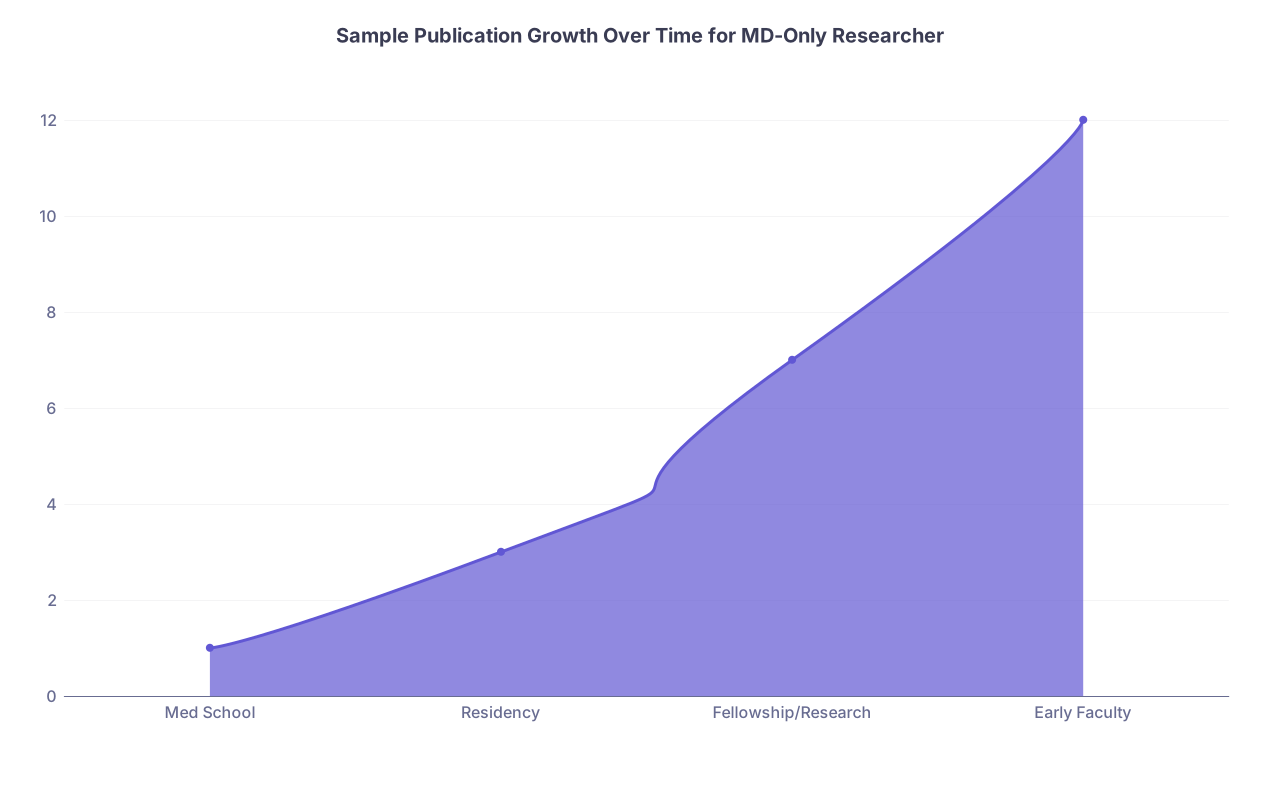
| Category | Value |
|---|---|
| Med School | 1 |
| Residency | 3 |
| Fellowship/Research | 7 |
| Early Faculty | 12 |
How to actually do this:
Early phase: plug into ongoing projects
- Join existing datasets and trials where you can own a secondary analysis.
- Take on tasks no one else wants (data cleaning, chart abstraction) in exchange for lead authorship.
- Avoid being “helpful” as 8th author repeatedly. That is not building your brand.
You should aim for:
- 1–2 meaningful first-author projects during late medical school / residency.
- Mix of original research, not just case reports and opinion pieces.
Research fellowship / protected years: production mode
During a 2-year research block, the bar goes up:
- 2–4 first-author original research papers.
- 2–4 co-author papers through collaborative work.
- One major project that could underpin a future K award or equivalent.
Every project should move you toward a coherent narrative:
“I study X problem in Y population using Z methods.”
Not “I put my name on whatever fell off the table in the department.”
Step 7: Acquire Methods Skills That Make People Take You Seriously
This is where PhDs often out-muscle MDs. They are not necessarily smarter. They just spent years on methods.
You are going to compress that.
Minimum methods toolkit for a credible MD researcher
You should be able to:
- Design a cohort study, case-control study, RCT, and pre-post study.
- Understand confounding, selection bias, measurement bias.
- Specify a primary outcome and defend it.
- Collaborate intelligently with a statistician:
- Regression models (linear, logistic, Cox).
- Sample size and power basics.
- Multiple testing, missing data, sensitivity analyses.
How to get there:
- Take structured coursework: Biostats I/II, Epidemiology I/II, Clinical Trials, or equivalent.
- Use software yourself:
- R, Stata, or SAS for outcomes work.
- REDCap for data capture.
- Sit down with your statistician and ask:
- “Walk me through how you choose this model.”
- “What assumptions are we making?”
- “What would make this analysis invalid?”
If you want to weight more toward data science / ML:
- Learn basic R or Python at a functional level, not hobby-level.
- Complete a serious project using EHR or registry data with actual coding, not just supervising others.
You do not have to become the statistician. But you cannot be the helpless clinician either. The days when that flew are over.
Step 8: Engineer Protected Time (or You Will Lose)
If your job is 1.0 FTE of service with research “on the side,” you are not in a research career. You are in a clinical career with a hobby.
You need:
- As a trainee:
- Dedicated 6–24 month blocks where your primary job is research.
- As junior faculty:
- 50–80% protected time if you are aiming for investigator-level research.
- 20–40% protected time if you want a hybrid but still serious research presence.
Typical models:
- 70/30 research/clinic: Standard for K award–funded junior faculty.
- 50/50 split: Works for clinical investigators, especially trials-heavy specialties.
- Industry: Often 80–100% research, nearly no clinic.
Negotiation strategy:
- Show up with a plan, not just a request:
- Specific aims.
- Potential mentors.
- Draft or concept for a K award, foundation grant, or industry partnership.
- Ask for:
- An explicit percent effort (e.g., 0.6 FTE research).
- Defined deliverables (papers, grants submitted).
- Access to resources (stat support, data warehouse, coordinator time).
If your program or department will not give any meaningful protected time for research despite a clear plan and mentors, you have your answer: you will need to change institutions or pivot to industry.
Do not waste five years hoping the culture will change.
Step 9: Use Non-PhD Credentials Strategically (Not as Degree Collecting)
MDs often panic and start collecting random letters after their name. That is not a strategy.
When is another degree useful?
- MPH / MS in Clinical Research / MS in Biostats:
- Highly valuable if:
- You plan a career in outcomes, clinical trials, population health, or policy.
- It comes with true mentored research time and projects.
- Highly valuable if:
- MBA:
- Can help for industry leadership or administrative roles.
- Less directly helpful for scientific credibility; do not use it as a substitute for research training.
- EdD or Education MS:
- Useful for a pure medical education research track.
- But not required if you have strong methods mentors and projects.
Your decision rule:
“Will this program directly improve my ability to design studies, analyze data, get grants, and publish in my target field within 2–3 years?”
If the answer is “maybe, kind of, indirectly,” skip it.
Step 10: Navigate Specific Career Targets Without a PhD
Let us get concrete and tactical.
A. Academic physician-scientist (clinical / translational)
Path:
- Medical school: join a lab or clinical research group, get at least 1 first-author paper.
- Residency: pick a program with:
- Strong research infrastructure.
- T32 or research tracks.
- Leaders who actually publish.
- Fellowship or dedicated research years:
- 2–3 years with 70–90% research.
- Earn MS/MPH if possible.
- Produce ~5+ meaningful papers.
- Submit a K08/K23 or similar.
Levers that matter more than a PhD:
- Your K award score.
- Your mentor’s reputation.
- Your first-author clinical or translational publications in good journals.
B. Clinical trials / industry-sponsored research lead
Path:
- During residency/fellowship, get onto active trials:
- Sub-investigator roles.
- Learn the protocol, monitoring processes, IRB, and contracts.
- Take a formal clinical trials design course if available.
- Lead at least one investigator-initiated trial or substantial sub-study.
- Build relationships with industry medical science liaisons and clinical operations teams.
When you apply for jobs:
- Academic: “Director of Clinical Trials Unit”, “Clinical Investigator”, “Associate Professor with major trial portfolio.”
- Industry: “Medical Director, Clinical Development”, “Translational Medicine Lead.”
No one will seriously care that you do not have a PhD if your CV screams “I run good trials, enroll patients, and hit endpoints.”
C. Outcomes / health services research
Path:
- Invest in strong quantitative training:
- MS in Clinical Research / Epidemiology / Biostats / Health Data Science.
- Join a health services research center or VA HSR&D program.
- Focus on:
- Large datasets (EHR, claims, registries).
- Methodologic depth (propensity scores, IV methods, competing risks, etc.).
- Work closely with biostatisticians and data scientists.
You are competing more directly with PhDs here, but your clinical insights and question selection are real advantages if your methods are respectable.
Step 11: If You Are Mid- or Late-Career
Pivoting at PGY-1 is one thing. Pivoting at age 40 as a busy attending is different, but not impossible.
Realistically, you have three main plays:
Internal pivot with serious retooling
- Negotiate 1–2 days per week of protected time.
- Enroll in part-time MS/MPH.
- Join existing research projects where you bring unique clinical access or niche expertise.
- Aim at pragmatic trials, implementation science, or quality/outcomes work that builds on your clinical base.
Jump to a research-friendly institution
- Some hospitals will never value research from non-PhDs.
- Academic or integrated systems with large data warehouses and research centers are better fits.
- You bring: mature clinical skills + focused interest in a specific question area.
Move to industry
- If your primary interest is trials, drug development, or devices, this can be a cleaner pivot.
- Your MD and clinical experience are highly valued; PhD is not required.
- Use your network: investigators, MSLs, and KOL meetings are your foot in the door.
Whichever path, you still need:
- At least a few serious publications.
- Solid understanding of research language and processes.
- Evidence you can commit to long-term projects, not just dabble.
Step 12: Put It All Together – A Concrete 3–7 Year Plan
Here is what an MD-only, research-heavy pivot can look like if you are in early residency now:
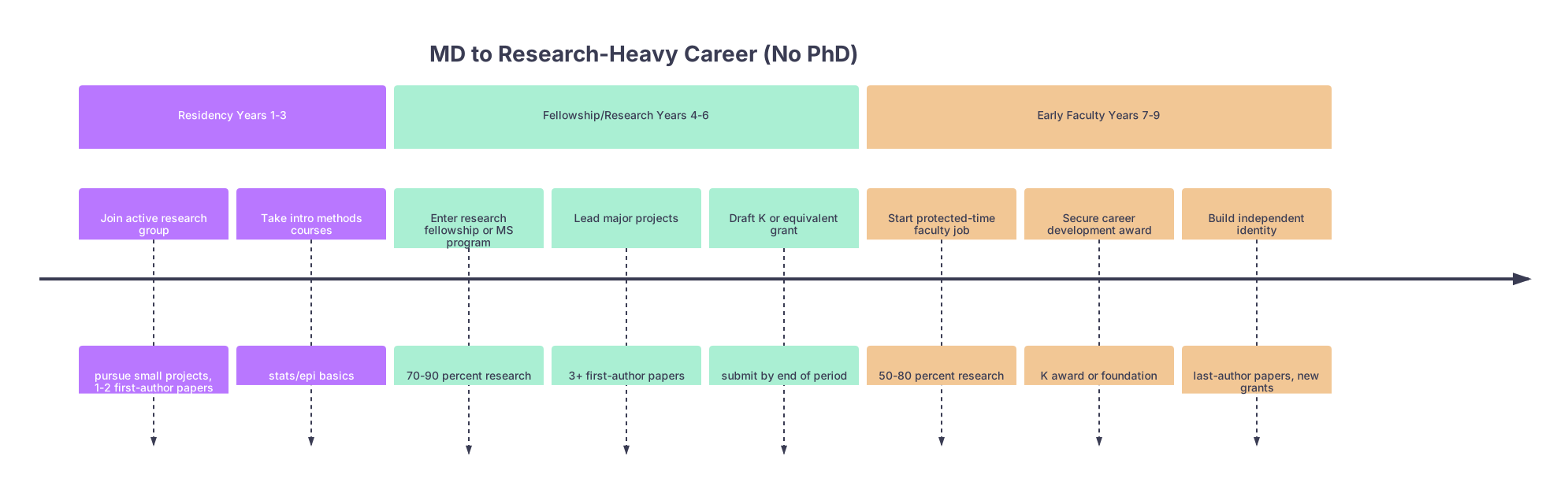
| Period | Event |
|---|---|
| Residency Years 1-3 - Join active research group | pursue small projects, 1-2 first-author papers |
| Residency Years 1-3 - Take intro methods courses | stats/epi basics |
| Fellowship/Research Years 4-6 - Enter research fellowship or MS program | 70-90 percent research |
| Fellowship/Research Years 4-6 - Lead major projects | 3+ first-author papers |
| Fellowship/Research Years 4-6 - Draft K or equivalent grant | submit by end of period |
| Early Faculty Years 7-9 - Start protected-time faculty job | 50-80 percent research |
| Early Faculty Years 7-9 - Secure career development award | K award or foundation |
| Early Faculty Years 7-9 - Build independent identity | last-author papers, new grants |
Even if your current position is different, the structure is the same:
- Get into a research ecosystem.
- Acquire methods and mentors.
- Create a stream of publications aligned to a clear niche.
- Lock down protected time with funding.
- Leverage that into a formal research-heavy role.
A Quick Reality Check
Let me be blunt about the downside so you are not surprised:
- This path is hard. You will work as much as any PhD student or postdoc did. Just compressed.
- You cannot keep full clinical volume and magically “add research” on top long term. Something has to give.
- You will hit resistance from people who fetishize degrees. That is their problem, not yours. You answer with data, grants, and papers.
- You must treat this as a career change, not a hobby. That means saying “no” to extra clinical shifts, low-yield committees, and random projects that dilute your focus.
But if you commit to a lane, choose your mentors carefully, and engineer protected time, an MD-only, research-heavy career is absolutely viable. And in many cases, it is faster and more flexible than bolting on a PhD in the middle of your life.
Key Takeaways
- You do not need a PhD; you need the outputs of a PhD: methods, mentorship, publications, and funding.
- The pivot works when you pick a clear lane, secure structured research training (fellowship or MS/MPH), and protect your time.
- Commit to a coherent research identity, not scattered “experience,” and build a track record that forces committees and employers to take you seriously as a researcher—degree or not.