Love Research but Want Patients? How to Structure an MD-Centered Path
You are a second‑year med student. It is 10:30 p.m. You just finished reading a clinical trial in JAMA and caught yourself thinking, “I want to run something like this.” But earlier today, you were in clinic with a preceptor, and the hour you spent explaining a new diagnosis to a scared patient felt like the most meaningful part of your week.
You like data. You like people. And you are staring at the classic fork in the road:
- “Do I need a PhD if I really care about research?”
- “If I do a PhD, am I giving up ever being a ‘real’ doctor?”
- “Is there a way to be research‑heavy and still see patients without disappearing into a 7‑year MD‑PhD black hole?”
Let me be blunt: if what you want is patient‑centered work with serious research involvement, you are not choosing between “MD vs PhD.” You are choosing how to architect an MD‑centered path that bakes research into your training and job.
That is fixable. With structure. With a plan. And with some hard choices made early instead of in PGY‑3 when you are already drowning.
Here is how to do it.
Step 1: Decide What “Research” Actually Means for You
“Love research” is too vague. You need to define what kind of research life you want, because the structure of your path depends on this.
A. Choose Your Research Identity (Be Honest)
Ask yourself which of these sounds closest to your ideal:
Clinician who contributes to research
- You see a lot of patients.
- You help enroll them in trials, maybe do some chart review projects, QI projects.
- You publish a few papers, maybe as middle author, sometimes first author.
- Research is 10–20% of your time.
Clinician–investigator (true hybrid)
- You see patients and run your own studies.
- You design trials or observational studies, lead a research group, apply for grants.
- You want 30–60% of your time protected for research.
- You want a consistent publication pipeline and maybe NIH funding.
Scientist who still sees some patients
- You care more about the science than the clinic.
- You are fine seeing patients 0–20% of the time, mostly to stay grounded.
- You want to live in the lab / data world.
- You might actually want an MD‑PhD or PhD‑heavy path.
If you are reading this and thinking, “I want #2,” then good. You are the person this article is for. A clinician–investigator with an MD‑centered career.
Now we structure for that.
Step 2: Understand the Real MD vs PhD Trade‑offs (Without the Romance)
Strip out the mythology. Here is what I tell students who say “I love research, should I do a PhD?”
| Path | Primary Identity | Typical Patient Time | Typical Research Time |
|---|---|---|---|
| MD | Clinician / Clin-Investigator | 50–90% | 10–50% |
| PhD | Scientist | 0–5% | 80–100% |
| MD-PhD | Physician-Scientist | 20–60% | 40–80% |
PhD alone (if you want patients, this is usually wrong)
Pros:
- Deep methodological training.
- You can be the expert in your niche.
- Whole career can be research.
Cons (specific to you):
- You will not be the primary clinician. At best, you might do allied clinical roles, but not physician‑level patient care.
- If patient care is “non‑negotiable,” a standalone PhD does not fix your problem.
MD‑PhD (tempting, but read this twice)
MD‑PhD is powerful. For people whose primary identity is scientist, and who also want to practice some medicine, it is fantastic.
For someone who:
- Wants to be in lab‑based, mechanistic, or translational research,
- Wants to spend at least half of their life doing research,
MD‑PhD is great.
But if:
- You care more about clinical research, outcomes research, QI, implementation science, population health, or health services.
- You genuinely want regular, heavy, patient contact.
- You do not feel an intense pull toward bench science.
Then you probably do not need an MD‑PhD. A PhD buys you depth and signaling, but it costs you 3–4+ extra years, delays your attending salary, and can lock you into a “you must get grants to justify your existence” treadmill.
MD with Structured Research Training (the path you are probably looking for)
For a patient‑centered research life, the pure MD with smart add‑ons is usually optimal:
- MD + targeted master’s (epidemiology, biostats, clinical investigation, public health, health policy).
- MD + research fellowships or T32 research years.
- MD + protected research time in your first faculty job.
That is where we are heading.
Step 3: Choose Specialties and Environments That Actually Support Clinician–Investigators
You can love research all you want; if you pick the wrong specialty + practice setting, you will never see daylight for your projects.
A. Favor Research-Friendly Specialties
This is not exhaustive, but these specialties commonly support research‑heavy careers:
- Internal Medicine (especially subspecialties: oncology, cardiology, pulm/crit, ID, nephrology, rheumatology, GI).
- Neurology.
- Pediatrics subspecialties.
- Psychiatry (especially academic).
- Emergency Medicine (in big academic centers).
- Radiation Oncology.
- Anesthesiology / Critical Care in academic settings.
More difficult (not impossible, but require more intentional planning):
- Community‑heavy FM without academic affiliation.
- Small‑market general surgery without research infrastructure.
- High‑RVU private practice anything.
B. Choose Academic or Academic‑Hybrid Settings
If you want research, and you choose a pure private practice group that lives on RVUs, you will be fighting the tide forever.
Your best bet:
- University hospitals.
- Large academic medical centers (AMC).
- VA systems with academic ties.
- Large integrated systems with strong research institutes (Kaiser, some large regional systems).
Step 4: Structure Your MD Path – Preclinical Through Residency
Here is where we get tactical. You want an MD‑centered path with patients and real research involvement. You need to build a timeline.
Med School Years 1–2: Build Skills and Relationships (Not Just Lines on a CV)
Goal: Become someone faculty actually want on a project.
Pick a lane early (topic + method)
- Topic: e.g., cardio‑oncology, stroke outcomes, diabetes care disparities.
- Method: clinical trials, retrospective database work, QI, qualitative work, etc.
You do not have to marry it forever, but depth beats “10 random poster projects.”
Find 1–2 serious mentors, not 7 casual ones
- Look for faculty with:
- Active grants (R01, K awards, foundation funding).
- Recent first/last‑author publications.
- Known as “good with students” (ask older students).
- Approach with: “I am interested in [X], willing to work hard, and want to learn how to be useful on a research team. Do you have a 10–15 minute project I can start on?”
- Look for faculty with:
Get method training early
If your school offers:- Summer stats/epidemiology courses.
- Short courses in R / Stata / SAS / Python.
- A clinical research certificate.
Do them. Being the student who can actually run basic stats or manage a REDCap project makes you 10x more valuable.
Use your first summer intelligently
Do a true 8–10 week research block with one team. Aim for:- A realistic first‑author abstract or small manuscript.
- Solid data‑wrangling and IRB exposure. Stop chasing “10 projects.” You want depth + tangible output.
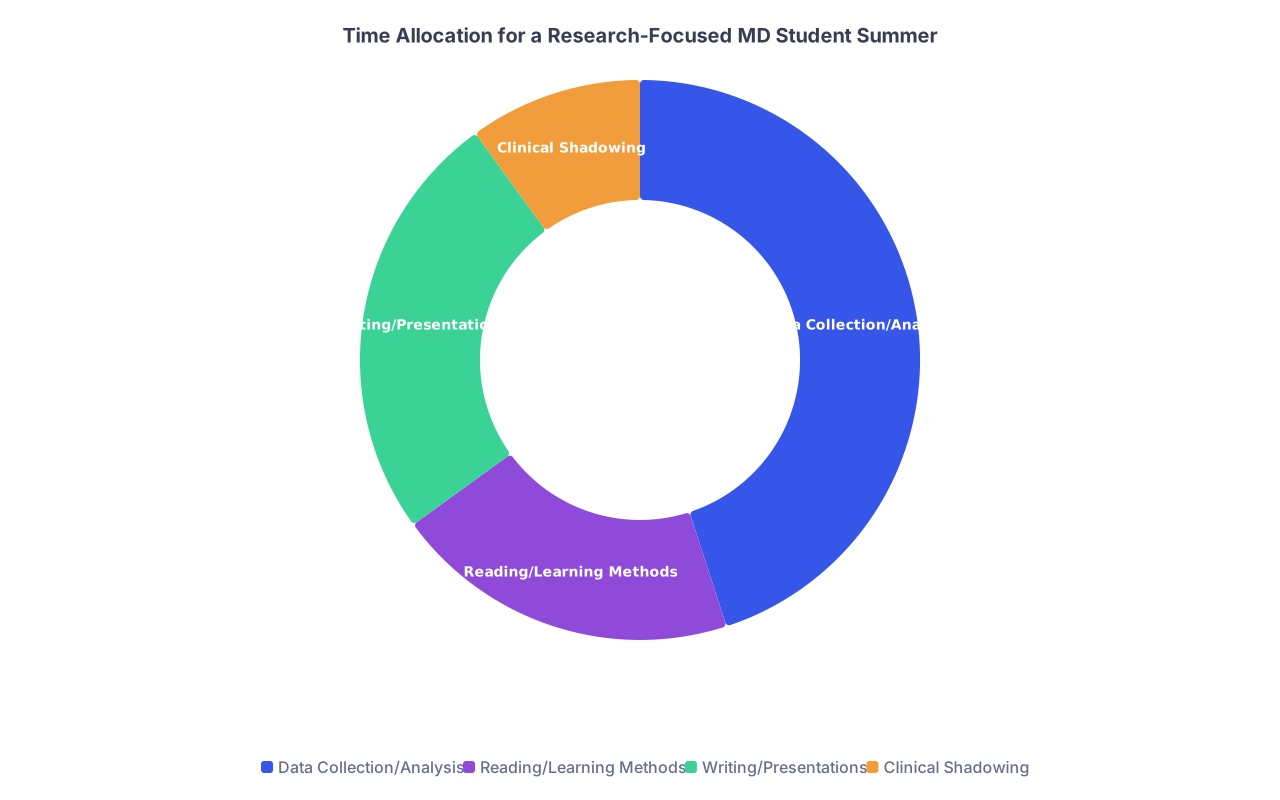
| Category | Value |
|---|---|
| Data Collection/Analysis | 45 |
| Reading/Learning Methods | 20 |
| Writing/Presentations | 25 |
| Clinical Shadowing | 10 |
Med School Years 3–4: Align Clerkships and Applications With Research
Goal: Do not let clinical years erase your research momentum.
During core clerkships
- Accept that your time is limited.
- Keep one small, low‑maintenance project alive:
- Data cleaning.
- Literature review.
- Helping write a methods or results section.
Schedule a dedicated research elective
- 2–4 weeks in MS3 or early MS4.
- Use it to:
- Finish manuscripts.
- Start a more ambitious project that can run into residency.
- Present at a conference if possible (make sure your PI knows that is a goal).
When applying to residency
You want programs that:- Have research tracks (physician‑scientist tracks, PSTP, R38/T32).
- Offer dedicated research time (3–6+ months).
- Have visible faculty in your area of interest.
Red flag: Programs that brag about “research” but all the “projects” are case reports and QI with no infrastructure or mentorship.
Step 5: Use Residency to Hard‑Wire a Research‑Heavy Clinical Career
This is the critical phase. If you get this wrong, you will struggle to ever carve out serious research time later.
A. Target Programs with Real Research Infrastructure
Look for:
- T32 or R38 grants supporting resident research.
- A formal Research Track / PSTP:
- Examples: internal medicine PSTPs at big academic centers (UCSF, Washington University, Hopkins, etc.).
- A proven record of:
- Residents publishing first‑author papers.
- Alumni going on to K‑awards, research fellowships.
| Feature | Strong Program | Weak Program |
|---|---|---|
| Formal research track | Yes, named and structured | No, just vague promises |
| Protected research months | ≥3 months, scheduled | “We will figure it out” |
| Statistics support | In-house biostats core | None, DIY only |
| Track record | K-award alumni | Mostly private practice |
B. Use Research Time Like It Is Your Job (Because It Is)
Common mistake: treating research elective time like vacation with “some research.”
Better approach:
- Block off: This is not the time to moonlight or pick up extra shifts.
- Set explicit goals for each block:
- Month 1: IRB submission and data abstraction infrastructure.
- Month 2: Data collection and preliminary analysis.
- Month 3: Manuscript draft and submission.
C. Decide If You Need Extra Formal Training (MS, MPH, MSCE, etc.)
If you want to run serious clinical or population research, you will likely benefit from a methods‑heavy degree:
- Options:
- MS in Clinical Investigation / Translational Research.
- MS or MPH in Epidemiology or Biostatistics.
- Health Services Research / Implementation Science master’s.
When to do it:
- Integrated into fellowship (many subspecialty fellowships bake this in).
- During a research fellowship after residency.
- Occasionally during residency if your program is very flexible (less common).
This is often far more efficient than a full PhD if your main goal is to be a clinician–investigator, not a pure academic methodologist.
Step 6: Fellowship and Early Faculty – Lock in the Clinician–Investigator Identity
Here is where you formalize what you have been aiming at.
A. Choose Fellowships That Support Research as a Real Career, Not a Hobby
If you do a fellowship (e.g., cards, heme/onc, pulm/crit, GI, ID, neuro subspecialties), your checklist:
Does the fellowship offer:
- ≥12 months of protected research time over 2–3 years?
- Tuition coverage for a master’s in research methods?
- Access to strong mentors in your niche?
What do alumni do?
- If many go into academic jobs with K‑awards and protected time, this is a good sign.
- If 90% go to private practice, understand that you might have to fight for an academic slot.
B. Build a Coherent Research Narrative
By the end of fellowship, you want:
- A clear theme: for example, “I study disparities in heart failure care,” or “I focus on implementation of sepsis protocols in community EDs.”
- A small portfolio of first‑author work and consistent co‑authorships.
- Evidence that you can:
- Conceptualize a question.
- Design an analysis.
- Execute and publish.
That is what gets you hired as a clinician–investigator, not “I like research and have some posters.”
Step 7: The Attending Job – Protecting Research While Seeing Real Patients
This is where patient‑centered research lives or dies. Most people lose the research side here because they negotiate poorly or take the wrong job.
A. Your First Job: What to Demand (and What to Avoid)
If you want a true MD‑centered, research‑active life, your first attending contract must include:
Protected research time defined in writing
- Not “informal understanding.”
- In the offer letter or contract:
- Example: “0.6 FTE clinical, 0.4 FTE funded research.”
Startup support
- Access to:
- Biostatistics.
- Research coordinator time.
- Data warehouse / IRB support. You cannot do everything yourself and see patients 3–4 days a week.
- Access to:
Reasonable clinical load
- Avoid jobs that:
- Quote you extremely high RVU targets.
- Hand‑wave research support with “you can always do that on your own time.”
- Avoid jobs that:
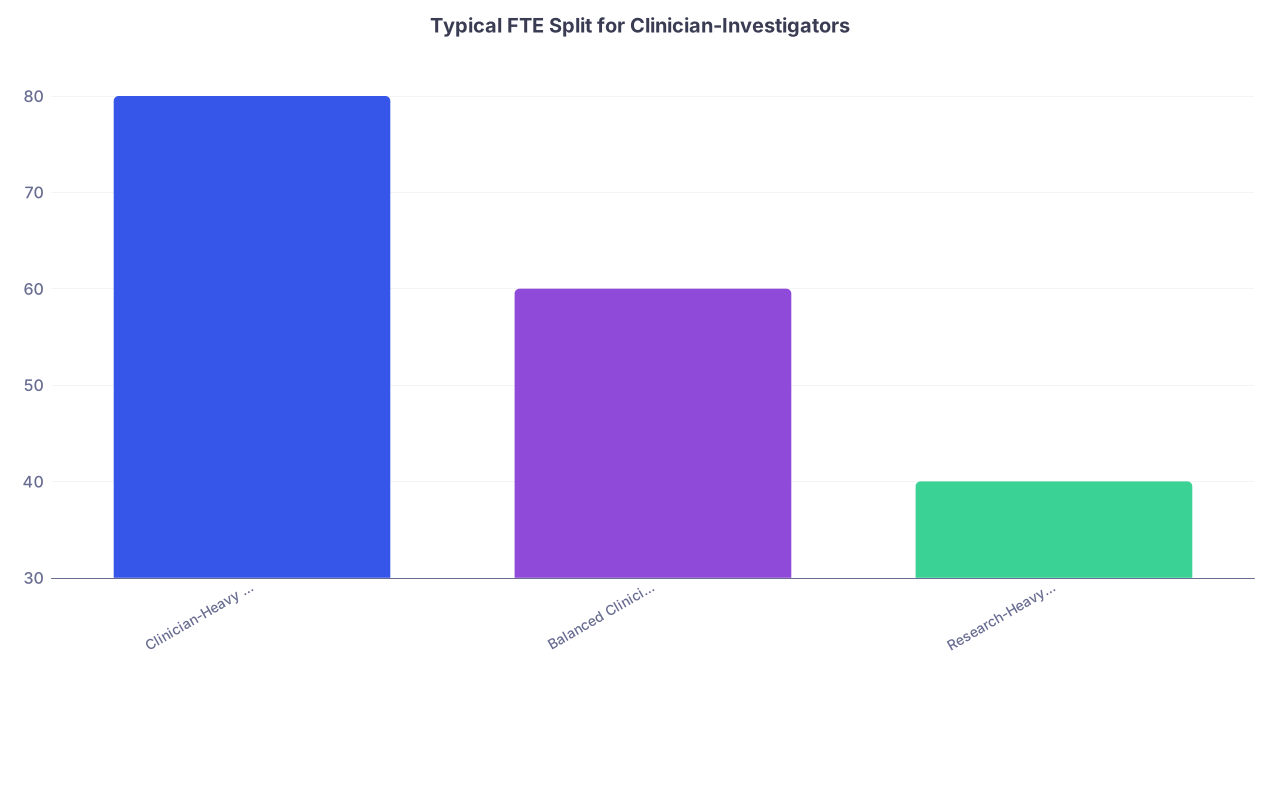
| Category | Value |
|---|---|
| Clinician-Heavy Academic | 80 |
| Balanced Clinician-Investigator | 60 |
| Research-Heavy MD | 40 |
(Values represent percent clinical time; remaining is research/admin/teaching.)
B. Pick the Right Kind of Clinical Work
When you want both patients and research, the nature of your clinical work matters.
Better:
- Outpatient clinics with predictable schedules linked to your research area (e.g., HF clinic if you study HF).
- Inpatient blocks that come in bursts, paired with protected research weeks.
- Specialty clinics where data collection can be standardized (stroke clinic, cancer survivorship, transplant).
Harder:
- Full‑time hospitalist with constant admissions and discharges.
- Pure procedural roles with relentless schedules and little downtime.
- Locums‑style work with no continuity or institutional attachment.
Step 8: Common Pitfalls and How to Avoid Them
Let me be direct about the patterns I have seen:
Pitfall 1: Collecting Random Projects Without a Spine
Symptom:
- Posters in unrelated areas: one in orthopedics, another in dermatology, then a QI project in ICU flow, etc.
Fix:
- From early in med school, commit to a rough thematic spine. It can evolve, but your CV should make sense as a story.
Pitfall 2: Choosing the “Wrong” Environment Then Blaming Medicine
Symptom:
- You say you love research.
- Then you accept a high‑RVU private practice job in a small community hospital “for the money and location.”
- Two years later, you say, “There is no way to do research and see patients.”
Fix:
- Accept that you cannot have everything at once.
You want:- Serious patients.
- Serious research.
You need: - A serious academic or hybrid institution.
Pitfall 3: Over‑romanticizing the PhD
Symptom:
- Assuming a PhD automatically makes you a better clinician–investigator or guarantees grants.
Reality:
- PhD is fantastic for method depth and academic strength.
- It is overkill for many clinician–investigators and can consume years you do not need to lose.
Fix:
- If you want to:
- Run large clinical trials.
- Do epidemiology, outcomes, implementation.
Often: - MD + targeted master’s + good mentorship > MD‑PhD for your goals.
Step 9: Concrete Example Paths (Without Fairy Dust)
Example 1: Internal Medicine – Cardiology Clinician–Investigator
- Med school:
- Summer research in HF outcomes.
- Several retrospective projects with biostats support.
- Residency:
- Research track IM residency at big AMC with 6 months protected time.
- 2–3 first‑author papers, co‑authorships in HF registry work.
- Fellowship:
- Academic cardiology fellowship with integrated MS in Clinical Epidemiology.
- Focus on disparities in HF readmissions.
- First job:
- Academic cardiology position:
- 0.6 FTE clinical (HF clinic + inpatient consults).
- 0.4 FTE research with access to data warehouse, coordinator.
- Academic cardiology position:
Result: Sees patients weekly. Runs HF outcomes studies. Publishes regularly. MD‑centered, real research.
Example 2: Neurology – Stroke Outcomes Researcher
- Med school:
- Stroke neurology lab doing chart reviews and prospective registry work.
- Residency:
- Neurology residency at a stroke center with established outcomes researchers.
- Fellowship:
- Vascular neurology fellowship with 50% research time.
- MPH in epidemiology paid by institution.
- First job:
- Split between stroke clinic, inpatient call blocks, and research on thrombolysis outcomes.
Still no PhD. Still a robust research life with real patient contact.
Step 10: A Simple Decision Flow
You want both research and patients. Here is the stripped‑down decision process you should run:

| Step | Description |
|---|---|
| Step 1 | Love research and patients |
| Step 2 | Consider MD-PhD or PhD-heavy track |
| Step 3 | Academic specialty + research track + methods degree |
| Step 4 | Academic job with 20-30 percent protected time |
| Step 5 | Target residencies and fellowships with T32 or PSTP |
| Step 6 | Negotiate first job with written protected time |
| Step 7 | Want lab-heavy or basic science? |
| Step 8 | Want research as main identity or strong side? |
Key Takeaways
- You do not need a PhD to have a serious research career if you design an MD‑centered path with the right specialty, training environments, and protected time.
- The crucial levers are: picking a research‑friendly specialty, committing early to a coherent research theme, securing structured methods training (often via a master’s), and choosing academic environments that back up their “we support research” talk with grants, time, and infrastructure.
- Your first attending job will make or break your hybrid identity—get protected research time in writing, in a setting that values clinician–investigators, or you will quietly become full‑time clinical no matter how much you “love research.”