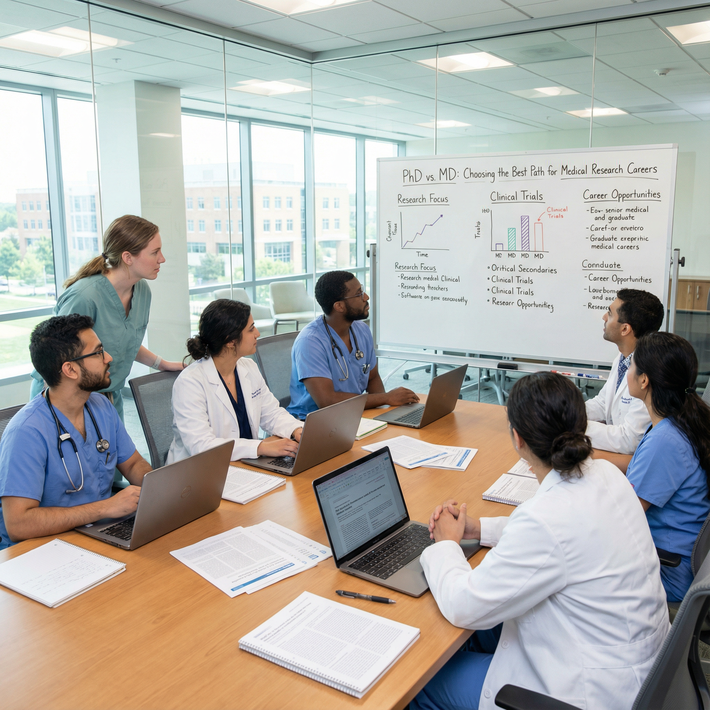
The MD world does not care how elegant your Western blots are. It cares whether you can keep a patient alive at 3 a.m.
If you have a PhD in basic science and you want a clinically focused MD role, you are not just switching jobs. You are changing tribes. Different language. Different currency. Different status markers. The good news: it is absolutely doable. The bad news: you cannot half-commit and “see how it goes.”
Here is the playbook to make the jump without wasting five years wandering in no man’s land.
Step 1: Get Ruthlessly Clear On Your End State
Before you start rearranging your life, you need to know exactly what you are aiming at. “More clinical” is not a goal. It is a mood.
You need a concrete target:
- Do you want to be a full-time clinician (80–100% patient care)?
- A clinician–educator (lots of teaching, moderate clinical)?
- A physician–scientist (real protected research time)?
- A clinical translational researcher with some clinic?
These are four different lives.
| Role Type | Clinic % | Research % | Teaching % |
|---|---|---|---|
| Pure Clinician | 80–100 | 0–10 | 0–10 |
| Clinician–Educator | 50–70 | 0–20 | 20–40 |
| Physician–Scientist | 20–50 | 40–80 | 0–20 |
| Translational Clinician | 40–60 | 20–40 | 10–20 |
Most basic science PhDs who move into MD roles end up in one of three buckets:
- Academic physician–scientist (IM, heme/onc, neuro, cards, etc.)
- Clinician–educator at an academic center, with your scientific background as “bonus content”
- Clinical trialist / translationalist, bridging lab and bedside
Pick your bucket now. It drives everything:
- Which specialties make sense
- How much research you realistically keep
- Which training paths are worth it vs suicidal
If you cannot answer this in one sentence (“I want to be an academic hematologist doing 50% clinic and 50% translational leukemia research”), pause here and fix that first.
Step 2: Decide: MD, MD/PhD, or Alternative Path?
You already have a PhD. That complicates things.
You now have three main routes:
- Standard MD (or DO) program
- MD-only with advanced standing / shortened training at a few places
- Non-MD clinical-adjacent roles (if what you want is “clinical impact,” not necessarily an MD)
Let’s be blunt.
Option A: Traditional MD or DO Program
For most basic science PhDs, this is the real path if you want a clinically focused role seeing patients.
Pros:
- Widest range of specialties afterward
- Clear, standardized path
- Your PhD is a real asset for academic programs
Cons:
- 4 years + 3–7 years of residency
- Financial hit and delayed attending income
- You go back to being a student, hard on the ego
Who this is good for:
- You are willing to commit to 7–10 more years of training
- You want independent patient care and board certification
- You want to be taken seriously in clinical spaces, not just as “the lab person in meetings”
Option B: MD/PhD as a Second Doctorate
Short answer: usually a bad idea for you.
Most MD/PhD programs are not set up for people who already have a PhD. They are set up to train people who have not done in-depth research yet. You are overqualified for the PhD segment and underleveraging your existing degree.
I have seen exactly two cases where this made sense:
- The prior PhD was in a totally unrelated field (e.g., philosophy), and they now wanted hardcore bench-to-bedside work.
- There was a unique institutional pathway with significant time credit granted.
In 99% of scenarios, if an MD/PhD office is telling you to “just apply like everyone else,” walk away. They will waste your time.
Option C: Clinical-Adjacent Without an MD
If what you really want is to be closer to patients and clinics, pause and ask: do you actually need an MD?
Examples where you do not:
- Clinical trials operations / PI on industry trials (at some institutions, PhDs can be site PIs)
- Medical science liaison (MSL) roles
- Translational core director in a cancer center
- Clinical informatics / data science roles
- Regulatory science (FDA, EMA, etc.)
These can give you patient impact, interaction with clinicians, and higher salaries, without med school.
But. If you want to:
- Write “MD” after your name
- Independently manage inpatients
- Bill for procedures
- Be the final decision-maker at the bedside
You need the MD.
Step 3: Do a Clinical Reality Check (Before You Apply)
Most basic scientists wildly underestimate how different clinical work feels.
You know the theory of sepsis. You have probably imaged neutrophils under a microscope. That does not prepare you for triaging four crashing patients and a family asking if dad is going to die tonight.
You must test whether you actually like clinical work, not the idea of it.
Concrete Actions (Next 3–6 Months)
Shadow Intensively, Not Just a Day
- Aim for:
- 3–5 full days with internal medicine or family med
- 1–2 days in an ICU or ED
- 1–2 days in a clinic aligned with your research (oncology, neurology, etc.)
- Watch for:
- Do you enjoy rapid, incomplete decisions?
- Does every patient feel like an N=1 experiment, or a burden?
- Aim for:
Volunteer or Work in a Clinical Environment
- Hospital volunteering, scribing, or clinical research coordinator work
- You want exposure to:
- Uncertainty
- Emotion
- Time pressure
- If you hate being on the wards by week 3, better to find out now.
Talk to Physician–Scientists in Your Field Ask them:
- If you had my background, would you still go to med school?
- What fraction of your work is actually intellectually satisfying vs administrative?
- What surprised you most about clinical life?
You should come out of this phase with either:
- “This is absolutely what I want,” or
- “I like being adjacent to this, but I do not want to live it.”
If you are lukewarm, do not proceed. Clinical training is too brutal to pursue on a maybe.
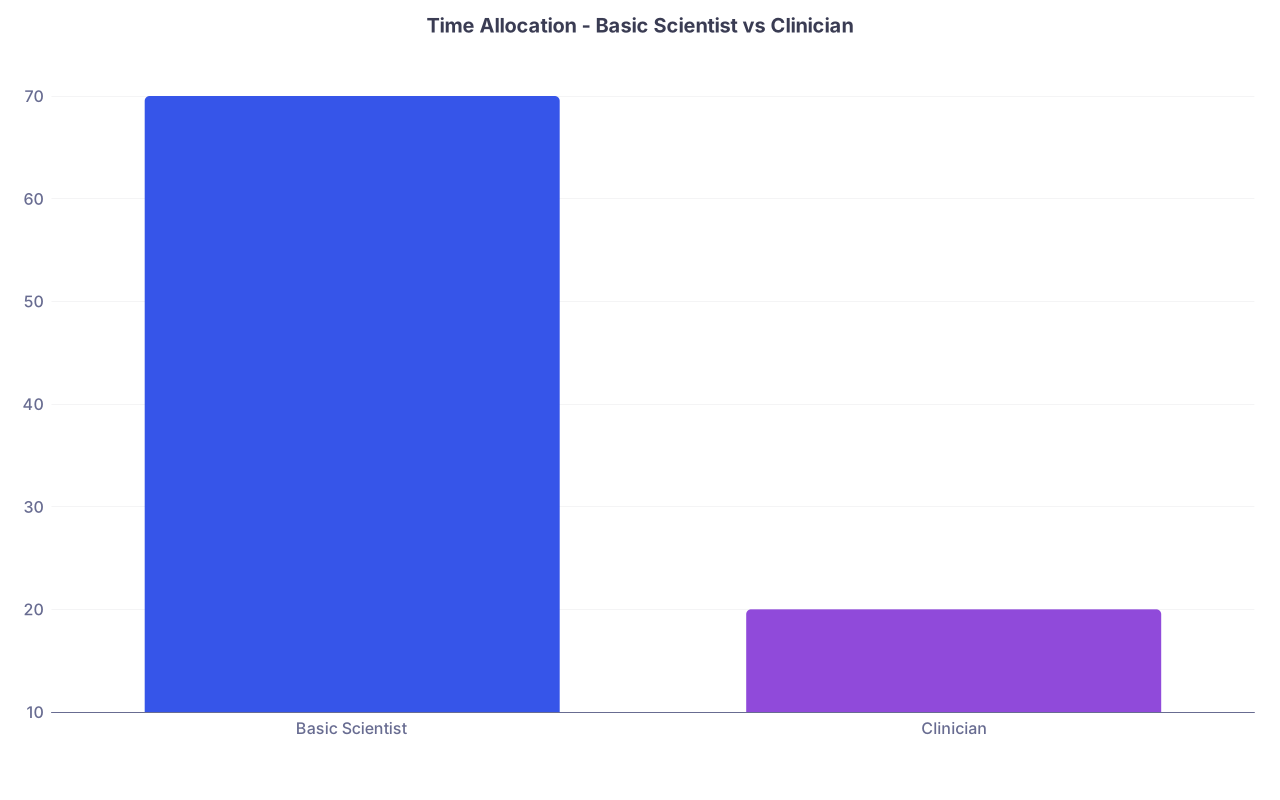
| Category | Value |
|---|---|
| Basic Scientist | 70 |
| Clinician | 20 |
(Interpretation: typical % of time in deep-focus work; clinical life has far less.)
Step 4: Build a Strategy for Medical School Admission as a PhD
Admissions committees do not fully know what to do with you. You are unusual. That can be a massive advantage or a weird red flag.
Your job is to look like:
- A safe bet academically (no concern you will fail boards)
- A mature candidate who understands what clinical work is
- Someone who will strengthen their match list and research profile
Academic Boxes You Must Check
Even with a PhD:
Prerequisites
- Make sure you have:
- 1 year each of gen chem, orgo, bio, physics (with labs)
- Some require biochem, stats, english
- If you did these 10+ years ago, consider a refresher or post-bacc class.
- Make sure you have:
-
- Yes, you probably still need it.
- Competitive as a PhD:
- 512+ is decent
- 515+ gets attention
- 518+ changes the conversation
- Your PhD does not compensate for a weak MCAT.
GPA
- Undergrad GPA still matters.
- A mediocre GPA can be partly rescued by:
- Strong PhD performance
- Recent A’s in post-bacc hard science courses
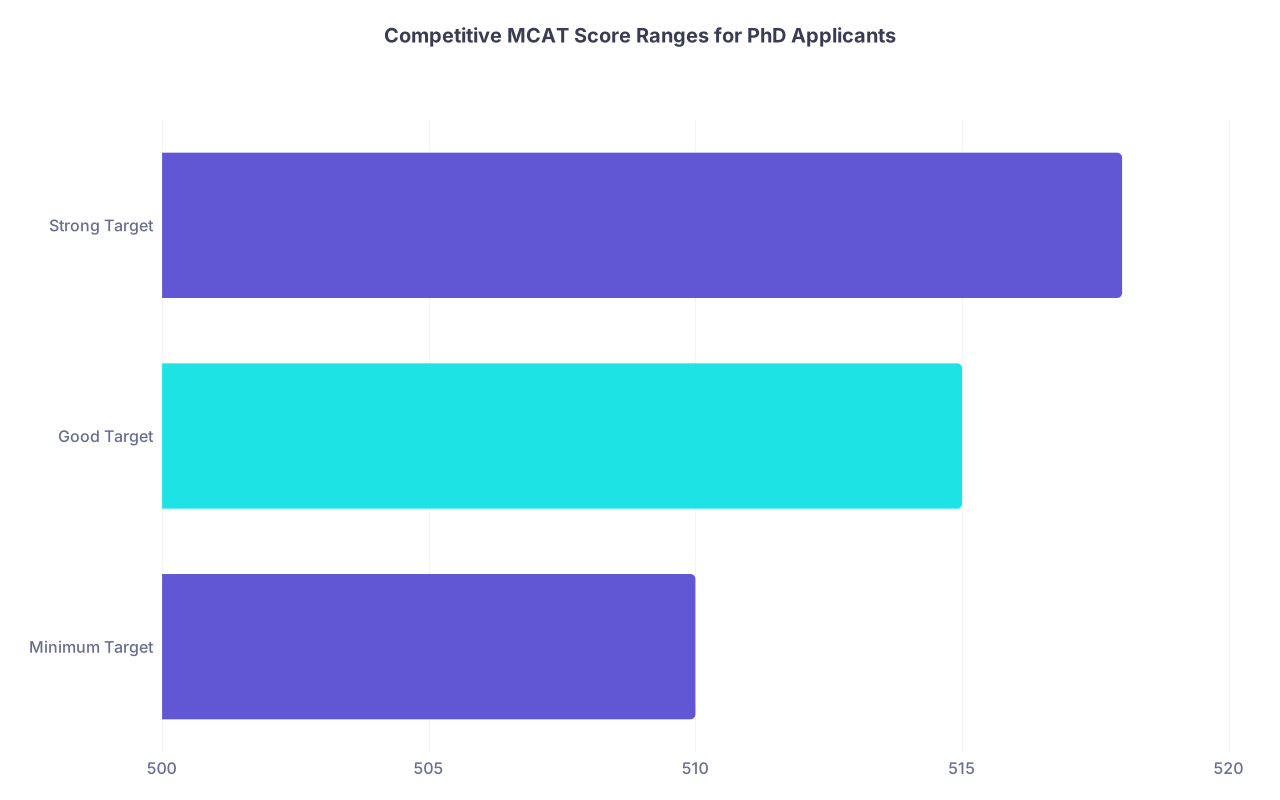
| Category | Value |
|---|---|
| Minimum Target | 510 |
| Good Target | 515 |
| Strong Target | 518 |
Experience Boxes You Must Check
Non-negotiables:
- Clinical exposure: 50–150+ hours of meaningful, in-person patient contact (not Zoom, not pure data work)
- Service / volunteering: Shows you can work with vulnerable populations
- Shadowing: Especially in fields you might pursue
Your PhD research does not count as clinical exposure. Even if it was “translational.”
Positioning Your PhD Correctly
This is where most scientists screw it up.
Common mistake: essay that sounds like “I discovered X pathway in Y disease, and now I want to bring my discoveries to the bedside.”
That reads as:
- You think MD is a tool for more science.
- You have not actually demonstrated commitment to patient care.
Better framing:
- “In my PhD I learned how biological mechanisms fail in disease X.
- In the clinic, I saw patients whose lives hinged on decisions about X.
- The gap between mechanism and bedside decisions is where I want to live.
- I am willing to do the full clinical training to earn that role.”
Hammer three points repeatedly:
- You respect clinical training as its own rigorous discipline.
- You understand you will not be primarily a bench scientist anymore.
- You have concrete examples of patient-centered motivation.
Step 5: Plan Your Specialty Strategy Early
You do not need to pick your exact specialty before med school, but you must know the cluster that fits you and your background.
PhDs in basic science are overrepresented in:
- Internal Medicine → Heme/Onc, Rheum, ID, Endo, Cards
- Neurology
- Psychiatry (for neuroscience PhDs)
- Radiation Oncology
- Pathology
- Medical Genetics
- Anesthesiology / Critical Care (for physiology types)
Underrepresented and more challenging to justify for a deeply research-focused PhD:
- Dermatology (though possible with immunology/oncology angle)
- Plastics, Ortho, ENT, Ophtho (surgical, often very competitive)
- EM (less research-heavy culture, though that is changing)
Translate your PhD domain into plausible specialties:
- Immunology / molecular biology → Rheum, Heme/Onc, ID, Allergy/Immunology, Transplant
- Neuroscience → Neurology, Psychiatry, Neurosurgery (very long, brutal, but possible)
- Cancer biology → Heme/Onc, Rad Onc, Surgical Onc (via Gen Surg)
- Physiology / biophysics → Anesthesia, Cards, Pulm/Crit, Nephrology
Competitive Specialty Reality Check
If you want something specialized and research-heavy (heme/onc, cards, GI, etc.), you must:
- Match at a solid IM or relevant residency first
- Use your PhD to get on research projects early
- Be realistic about time: you might be PGY-7 or PGY-8 before you see “normal life” again
Step 6: Mental and Financial Planning for the Long Haul
You are not 22. You probably have:
- A partner
- Maybe kids
- A mortgage
- A certain standard of living
You must treat this like a multi-year project plan, not “going back to school for fun.”
Time Reality
Let’s say you are 30–35 with a PhD and a couple of postdocs.
Typical timeline:
- 1–2 years: MCAT + prereqs + application cycle (depending on how efficient you are)
- 4 years: Medical school
- 3–7 years: Residency (plus fellowship if subspecialty)
You could easily be early-to-mid 40s before you are a fully independent attending in some subspecialties.
You need to be okay with:
- Being supervised by people younger than you
- Relocating more than once
- Deferring peak earnings and stability
Financial Reality
Run the numbers. Not vibes. Numbers.
Costs:
- Tuition and fees (unless you get a scholarship or MSTP-like arrangement, which is rarer for second PhDs)
- Lost income (opportunity cost of leaving your current job)
- Moving, childcare, etc.
Benefits:
- Long-term physician salary (substantial, especially in some fields)
- Job security
- Autonomy and career satisfaction
If you are already well-compensated in industry (e.g., senior scientist at a biotech earning $180–250k), the financial gap can be ugly in the short-to-medium term. You must really want the MD life.

| Step | Description |
|---|---|
| Step 1 | PhD in Basic Science |
| Step 2 | Clinical Reality Check |
| Step 3 | Stay Clinical Adjacent |
| Step 4 | Med School Prep |
| Step 5 | MCAT and Prereqs |
| Step 6 | Apply MD or DO |
| Step 7 | Matriculate |
| Step 8 | Clinical Exposure and Specialty Exploration |
| Step 9 | Residency and Fellowship |
| Step 10 | Clinically Focused MD Role |
Step 7: How To Survive Medical School As a Former PhD
If you do this right, you will be an asset and a leader. If you do it wrong, you will be the weird older student everyone avoids.
Use Your Strengths
You are already good at:
- Handling large volumes of complex information
- Delayed gratification
- Working insane hours to hit deadlines
- Critical reading of the literature
Leverage that:
- Crush the preclinical years using the same discipline you used to write your thesis.
- Get involved in meaningful clinical or translational projects early (not 15 small poster abstracts).
Avoid the PhD Traps
These common errors sink a lot of PhD students in med school:
Overvaluing knowledge, undervaluing workflow
- Medicine is not a trivia contest. It is about managing incomplete data efficiently.
- Focus on pattern recognition and clinical reasoning, not obscure mechanistic detail.
Arguing with attendings like they are your thesis committee
- Do not. Just do not.
- You are now low in the hierarchy. You can ask probing questions. You cannot cross-examine.
Clinging to research identity too tightly
- First job: become a competent, safe clinician.
- Research is a secondary identity during med school and early residency. You can ramp it later.
Trying to do a second PhD project during med school
- You already have one. You need:
- Strategic, short-cycle clinical or translational projects
- Work that builds your clinical brand, not ten more bench papers unrelated to your future specialty
- You already have one. You need:
Step 8: Converting Your PhD Into Real Clinical Advantage
The end game is not “having two doctorates.” It is having an unfair advantage in certain clinical niches.
Your PhD is leverage in:
- Choosing research-friendly residency programs
- Aim for programs with NIH T32 grants, strong physician–scientist tracks, and departmental research infrastructure.
- Negotiating protected time
- Once you have demonstrated clinical competence, your research background gives you more leverage to argue for 20–50% protected time.
- Owning a disease niche
- Example: You did a PhD on CAR-T cell biology.
- Target: heme/onc with focus on cellular therapy.
- You aim to be “the CAR-T complications person” at your center.
- Example: You did a PhD on CAR-T cell biology.
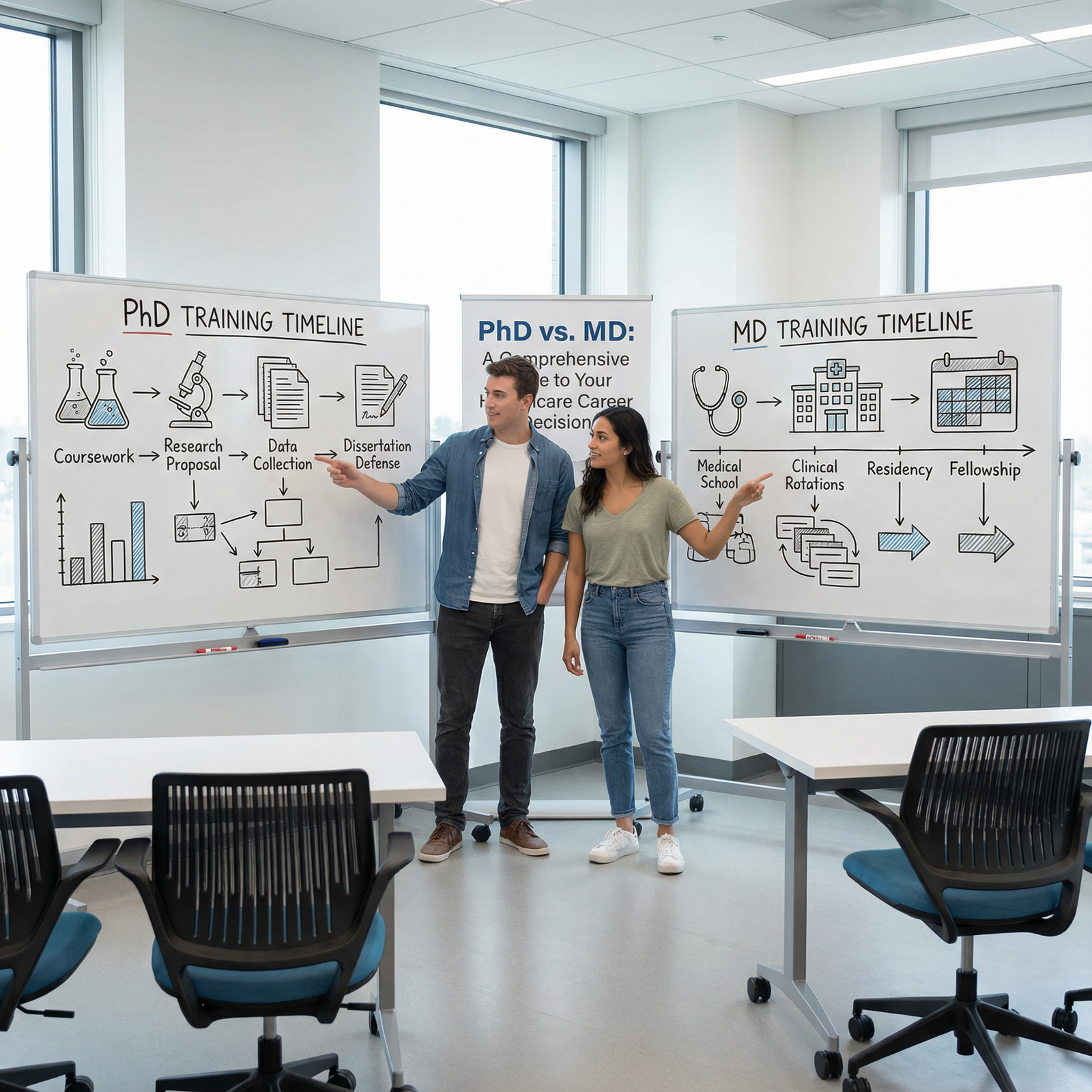
What This Looks Like In Real Life
Classic patterns I have seen work:
- Immunology PhD → Rheumatologist running translational lupus lab
- Neuroscience PhD → Movement disorders neurologist with deep clinical trials involvement
- Cancer biology PhD → Leukemia attending leading early-phase trials program
- Bioinformatics PhD → Clinical informatics physician shaping EHR and decision-support tools
The theme: you own both the mechanistic and bedside sides of a narrow area. You are not a generalist scientist anymore. You are deep in one clinically relevant slice.
Step 9: MD vs PhD Identity: Decide What You Are Now
The hardest part for many people is not the studying or the shift in work. It is the identity hit.
You went from:
- Being “Dr. X” running your own experiments
- Having deep domain authority
To:
- Being an MS1, then an intern, asking where the bathroom is
- Being told what to do by someone who has never opened a Cell paper
You need to make a choice.
Are you:
- A scientist who picked up an MD for access?
- Or a physician who brought a scientific toolkit with them?
The second identity works better in clinical systems. It is more sustainable. It wins you allies. It is also usually more honest if you commit fully.
Your day-to-day as a clinically focused MD will be:
- Notes
- Orders
- Calls
- Discussions with patients and families
- Dealing with unclear diagnoses and imperfect therapies
Your PhD shows up not as you lecturing people on pathways, but in how you think:
- Systematically
- Skeptically
- With comfort in uncertainty
Lean into that. Quietly.

Step 10: When You Should Not Do This
Someone needs to say this: there are cases where going for an MD after a basic science PhD is a bad move.
Do not do this if:
- You mostly want prestige or parental approval.
- You hate chaotic environments and rapid decision-making.
- You are already deeply burned out from your PhD and postdoc.
- You have zero tolerance for hierarchy and taking orders.
- You are financially unable to absorb 7–10 years of reduced income without serious damage.
Also, be realistic about physical and emotional stamina. Night shifts in your late 30s or 40s with small kids at home are not a theoretical hardship. They break people.
If, reading this, you feel more dread than excitement, strongly consider high-impact, clinical-adjacent roles instead:
- Clinical development roles in pharma/biotech
- MSL in your disease area
- Hospital-based translational science cores
- Health policy / regulatory positions (FDA, NIH)
You can change patient outcomes in big ways there. No stethoscope required.

The Short Version
If you want to turn a PhD in basic science into a clinically focused MD role, here is what actually works:
Clarify your end state and commit. Decide whether you truly want independent clinical responsibility, not just clinical adjacency. Your entire plan depends on that answer.
Treat the transition like a serious, multi-year project. Build real clinical exposure, hit MCAT and prereq targets, and position your PhD as a patient-centered asset, not an excuse to skip the hard clinical work.
Accept that your primary identity will shift. You are signing up to become a clinician first and a scientist second, even if you remain research active. If that trade-off excites you more than it scares you, then you are likely the right kind of person to make this leap.