
What MD Admissions Committees Really Think of PhD Applicants
It’s late January. You’re in your tiny apartment, staring at AMCAS, and you’ve got something most applicants don’t: a PhD or a nearly finished one. Your friends with traditional premed paths think you’re golden. “Schools love PhDs,” they say. “Automatic acceptance.”
Let me tell you what actually happens when your file hits an MD admissions room.
Someone flips to your CV and says: “Okay, heavy research, real PhD. Are we getting a scientist who can function clinically, or a career academic who’s bored with the lab this week?”
That’s the tension. You’re not seen as “stronger premed.” You’re seen as a different species of applicant. And committees argue about you more than you think.
I’ve been in those rooms. I’ve heard the exact lines. So let’s walk through what MD admissions committees really think when they see “PhD” on an application.
The First Reaction: “Interesting… but is this person actually going to practice?”
This is the initial gut check when someone sees your degree.
The PhD on your file does three things instantly:
- Raises your floor
- Raises the expectations
- Raises suspicions
Nobody on a serious committee believes “PhD = automatic admit.” They do believe “PhD = worth a closer look,” if you clear some basic hurdles.
Here’s the quiet calculus:
If your stats are strong (e.g., MCAT 515+ and GPA ≥3.6), your PhD becomes a multiplier. People around the table lean in and say, “This person could be a future academic physician, maybe faculty material. Worth bringing in.”
If your stats are borderline (e.g., MCAT 508–513, science GPA 3.3–3.5), the PhD buys you more discussion time than a typical applicant. But it doesn’t erase the concern. Someone will say, “I love the research… but do we think this person can get through our pre-clinical curriculum without struggling?”
If your stats are weak (MCAT under ~505 or science GPA under ~3.2 for most MD schools), the PhD doesn’t save you. People will say it out loud: “We’re not running a PhD rehabilitation program. They still have to pass Step exams.”
This is what nobody tells you: committees don’t start with “you’re brilliant because PhD.” They start with, “Can this person pass our curriculum and boards?” Only then does the PhD become a plus.
And there’s a second concern that comes up almost every time.
The Big Fear: “Are we just a backup plan because the PI track didn’t pan out?”
There’s a line I’ve heard more than once in committee:
“Is this a medic for hire, or someone who woke up at 32 and realized grants are brutal?”
Brutal, yes. But that’s not why they’re asking.
They’ve seen certain patterns:
- PhD in a basic science field
- Multiple post-docs or one long miserable one
- Age mid-30s to early-40s
- Language in the personal statement that screams burnout: “After years of frustration in the lab… I realized I needed something more fulfilling.”
That “something more fulfilling” sentence? Raises red flags.
Here’s what attendings and deans are actually worried about:
- Will you change your mind again midway through M3 and decide clinical work is also “not fulfilling”?
- Are you looking for job security and prestige, not a genuine medical calling?
- Are you going to refuse to touch patients and only care about getting back to the bench?
They’ve seen MD students with PhDs before. Some are fantastic. Others are disasters—visibly resentful on wards, uninterested in bedside care, constantly complaining about “low-level clinical stuff.”
So when they read your file, they’re trying to figure out which category you’re in.
Where this hits you hardest is in your:
- Personal statement
- Secondaries (“Why medicine?” and “Why now?”)
- Interview answers about your transition from PhD to MD
If your story sounds like you’re fleeing something instead of moving toward something, they notice. And they do not like it.
How Committees Actually Pick Apart Your Application
Let me break down what each part of your file really signals once they know you have a PhD.
1. MCAT and GPA: “Can you do the medicine part, or are you just smart in one niche?”
This is the first brutal truth: a PhD does not excuse mediocre MCAT performance.
In closed-door conversations, I’ve heard:
- “They did a PhD in molecular biology but got a 503? That’s concerning.”
- “If they struggled that much with MCAT CARS, I worry about clinical reasoning and Step 2.”
The unspoken comparison is MD/PhD standards. Committees subconsciously hold you closer to that bar, even if you’re not applying MSTP.
Rough internal thresholds at many mid–upper tier MD programs (not a rule, but a vibe):
| Metric | Seen As Weak | Borderline | Solid / Competitive |
|---|---|---|---|
| MCAT Total | <505 | 505–512 | 513+ |
| Science GPA | <3.3 | 3.3–3.5 | 3.6+ |
| Non-science GPA | <3.2 | 3.2–3.5 | 3.6+ |
Are there exceptions? Of course. But if you’re well below those, people immediately start justifying against you in the room.
They ask: “If this person is so brilliant, why is the MCAT mediocre?”
Sometimes there are good answers: very old prereqs, life chaos, test anxiety, different country, etc. You need to give them that context in your secondaries or interview.
But you don’t get a free pass because “I did a PhD” or “I hate standardized tests.” They’ve heard that too many times.
2. Research: “Is this real, or is this fluff?”
Here’s where you truly separate yourself—or sink.
Committees know the difference between “undergrad poster” and “decade-long, first-author in a serious journal” work. They will look:
- Not just at number of publications, but where and in what role
- For senior author letters that actually know you deeply
- For consistency over time: Did you stick with a line of inquiry, or hop around randomly?
I’ve heard a chair say:
“If we’re taking on a 35-year-old PhD, I want someone who can tangibly raise the research profile of this place, not just a technician with a long CV.”
That’s the hidden expectation. They’re not just admitting a student. They’re thinking like an institution: “Could this person become faculty here? Bring in grants? Mentor others? Boost our NIH ranking?”
So if your PhD was unfocused, or in a very narrow area with little clinical relevance, you need to explicitly connect the dots. Do not let them guess.
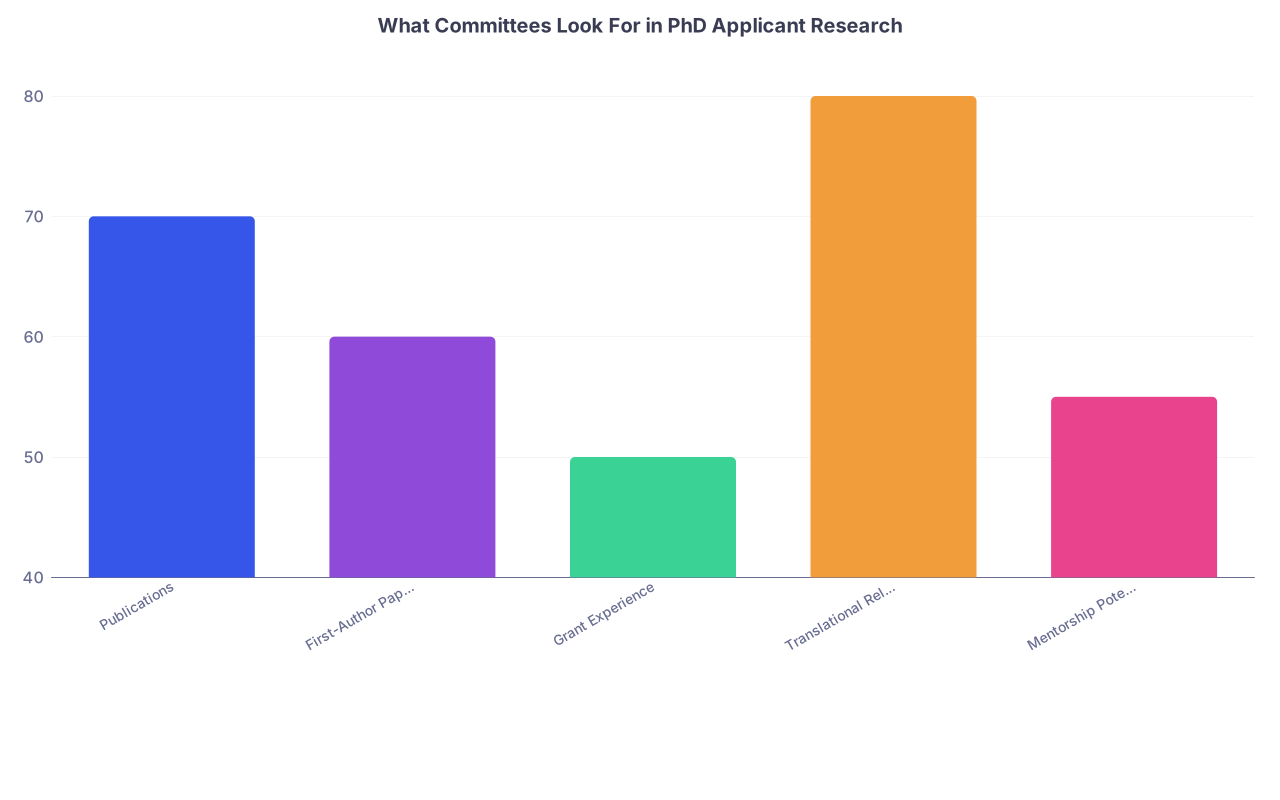
| Category | Value |
|---|---|
| Publications | 70 |
| First-Author Papers | 60 |
| Grant Experience | 50 |
| Translational Relevance | 80 |
| Mentorship Potential | 55 |
3. Clinical Exposure: “Do they actually like patients, or just the idea of patients?”
This is where many PhD applicants quietly die.
You submit 10–12 years of formal education and training, 4–10 publications, complicated methodology… and then 32 clinical shadowing hours, 15 hours of basic volunteering, and some line like, “These experiences confirmed my desire to pursue medicine.”
On the inside, people are thinking:
- “You spent a decade doing 60-hour weeks in the lab and squeezed in 3 weekends of shadowing and now you’re sure?”
- “This is not convincing. At all.”
They expect your clinical story to be just as detailed and mature as your research story. Not equal in hours, but equal in depth of reflection.
Bad pattern they’ve seen before: PhD student hates the politics of academia, does a minimal amount of shadowing to “check the box,” applies to MD, gets in, and then is miserable on the wards because medicine is not at all what they pictured.
Admissions committees are trying not to repeat that mistake.
You need to show:
- Sustained exposure to clinical environments
- Clear articulation of what you liked and what you didn’t
- Specific, patient-centered moments that changed your thinking
If everything in your app screams “I am my research” and you tack on two shallow lines about patient care, it undercuts your entire argument for an MD.
MD vs MD/PhD vs “PhD then MD”: How You’re Categorized
Here’s another behind-the-scenes truth: committees mentally cluster you into one of three buckets:
- Traditional MD applicant with extra research
- Future physician-scientist who should have gone MD/PhD
- PhD escapee looking for stability and a decent salary
You want to be seen as #1 or a very clear, late-blooming version of #2. You really don’t want #3.
Programs react differently depending on their culture.
At a heavy research institution (think WashU, Penn, UCSF, Hopkins), the discussion sounds like:
“Could this person be on our faculty someday? Would they drive projects, mentor residents, collaborate with basic scientists?”
At a more community-focused or primary care–oriented school, I’ve literally heard:
“I don’t want to admit someone who’s going to spend 80% of their time in the lab and treat clinic as a necessary evil.”
That’s why some PhD applicants are surprised to get more traction at research-heavy schools than at mid-tier “service” schools. At the latter, your PhD might actually hurt you if they think you’re uninterested in bread-and-butter clinical work.
So if you’re applying broadly, you need to subtly tune your story:
- At research-heavy MD programs: Highlight how your research intersects with clinical questions, how you’ll seek out physician-scientist mentors, how you’ve enjoyed teaching and leading projects.
- At service-oriented programs: Emphasize your commitment to actual patient care, your comfort around diverse populations, and give concrete evidence that you can connect with humans beyond the lab.

| Step | Description |
|---|---|
| Step 1 | PhD Applicant |
| Step 2 | Reject or Hold |
| Step 3 | Deep Skepticism |
| Step 4 | Backup Plan Vibe |
| Step 5 | Future Asset to Program |
| Step 6 | Stats Solid? |
| Step 7 | Meaningful Clinical Exposure? |
| Step 8 | Motivation Genuine? |
What They Love About PhD Applicants (When It Works)
Let’s flip to the positives, because there are many.
When a PhD applicant is good, they’re very good. I’ve seen committees basically sell the candidate to each other:
- “They know how to grind; grad school is brutal.”
- “They can handle failure and delayed gratification—good for research and for medicine.”
- “They’ve already mentored undergrads; they’ll be great in peer teaching roles.”
- “This person will raise our Step 1/2 pass odds if they can apply that same discipline.”
Three traits that earn real respect:
Resilience with evidence
Not “I’m resilient,” but actual war stories: experiments failing for months, grants rejected, papers revised 4 times, and you stuck through it. That maps directly to clinical life—complicated cases, difficult patients, long calls.Intellectual humility
This is huge. PhDs who act like they’re smarter than everyone in the room sink themselves in interviews. The ones who can say “I learned how much I don’t know” and mean it do very well.Ability to communicate complexity
If you can take a dense project and explain it to a non-scientist interviewer clearly, you’ve just demonstrated the exact skill needed to explain heart failure to a patient with a 6th-grade reading level.
When those three show up and your motivation for medicine makes sense, the PhD becomes a major advantage.
The Traps That Sink PhD Applicants
Here’s the part you really need to hear. These are the patterns that quietly kill applications from otherwise brilliant people:
1. “I’m too advanced for basic clinical experiences.”
You’re not.
I’ve seen PhD applicants refuse to do standard premed things because they felt “past” it:
- “Shadowing is beneath me.”
- “I don’t need to volunteer in a hospital, I’ve been in healthcare adjacent research for years.”
- “I’m not wiping tables in a clinic, my time is more valuable than that.”
That attitude bleeds into essays and interviews. And when it does, the reaction is visceral. Interviewers wonder: if you already think routine tasks are beneath you, what are you going to be like as an M3 doing scut?
2. Coming in hot with “I want to change the healthcare system.”
Committees are allergic to grandiosity unsupported by clinical exposure.
If, after 10 total hours in a clinic, you’re talking about designing health policy, transforming systems, and “fixing” medicine, you sound naive and arrogant. Especially if your PhD is in a narrow molecular topic and you’ve never actually seen what Medicaid patients go through.
You can talk about long-term impact, sure. But ground it in what you’ve actually seen and done, not what you’ve imagined from NIH websites and TED talks.
3. Being vague about why medicine, specifically
Let me be blunt: you must answer, clearly and repeatedly, the question:
Why do you need an MD for the life you say you want, as opposed to staying a PhD, doing an MD/PhD, or taking some other route (MPH, PA, industry, etc.)?
If your answer boils down to:
- More job security
- Better pay
- Frustration with grant cycles
…you might feel that deeply, but if you say it or even hint at it, you’re done. That’s the ugly truth.
You need a story where clinical work is not just tolerable, but integral to who you are and what you want to build.
How to Present Yourself So Committees Take You Seriously
Here’s what actually works when I’ve seen PhD applicants succeed and get love from multiple MD programs.
1. Thread a coherent narrative from undergrad → PhD → now
If your timeline looks chaotic on paper, you have to make it coherent.
Tie it together like this:
- What you were curious about as an undergrad
- What your PhD let you explore deeply
- What you hit the limits of in the lab (not just frustration—true limits of impact)
- The specific patient or clinical exposure moments that reframed your path
- Why, now, at this age, you’re willing to start over at the bottom of a very long ladder
Do not pretend you always wanted to be a doctor if you obviously didn’t. Committees respect honest evolution. They do not respect revisionist history.
2. Overcompensate on clinical maturity
You do not need 2,000 clinical hours. But you do need:
- Enough exposure that no one can say, “They have no idea what clinical life is actually like.”
- Stories that show you’ve seen unglamorous medicine: chronic disease, noncompliant patients, death, boredom, insurance headaches.
- A clear sense that you’re not romanticizing medicine as instant “impact” compared to research.
If you’re still in your PhD, start now. Hospital volunteering, hospice, free clinics, longitudinal shadowing with one or two physicians who can later write detailed letters. Not just a random shadow once a month.
3. Use letters strategically
Your letters are more important than you think.
Ideal mix for a PhD applicant:
- One or two strong letters from your PI or co-mentor who can comment on work ethic, independence, and character.
- At least one letter from a clinician who’s seen you in a patient care environment and can say, “They interact well with patients, they’re humble, they listen, they show up.”
- Optionally, someone who has seen you teach or mentor.
Purely academic letters without any clinical voice leave a gap that committees have to fill with their imagination. That’s dangerous.

Do MD Admissions Value PhDs Less Now That Step 1 Is Pass/Fail?
You’re probably wondering about this, so let’s address it.
Since Step 1 went pass/fail, a lot of programs have:
- Increased emphasis on research and Step 2
- Paid more attention to applicants with real scholarly output
- Leaned more on subjective markers: letters, narrative, and perceived “upside”
Your PhD slots nicely into that world—if paired with solid clinical potential.
I’ve heard more than one program director say something like:
“I would rather have a slightly older student with a PhD and a proven record of grinding through hard things, than a 22-year-old with perfect stats and no life experience.”
But that’s conditional. It assumes you’ve proven you want to doctor, not just study disease.
The Step 1 change did not suddenly make them desperate for every PhD with a pulse. It just turned research from “nice bonus” into a more central part of certain schools’ identity, especially those aiming for high academic prestige.
Final Thought: How You Handle the Transition Is What They Remember
Years from now, you will not be thinking about what the committee whispered when they saw your CV. You’ll be on wards at 2 a.m., trying to figure out why a patient is hypotensive, while your research brain wants to analyze, design, and optimize.
The people in those rooms are not just asking, “Is this person smart?” They’re asking:
- “Will this person show up for the hard, unglamorous stuff?”
- “Will they treat patients as real humans, not research subjects or ‘cases’?”
- “Will they still want this when the intellectual dopamine wears off and all that’s left is the grind?”
If you can show them—through your story, your experiences, and how you talk about both your PhD and medicine—that the answer is yes, your degree stops being a question mark and becomes a major asset.
You’re not just the “PhD applicant.” You’re someone who has already fought hard battles, learned from them, and is voluntarily starting back at the bottom because you know exactly why you’re doing it.
That, more than any publication count, is what gets remembered in those rooms.