
The biggest mistake PhDs make when entering the MD clinical world is thinking it’s just a new workplace. It’s not. It’s a different species of ecosystem with its own unspoken rules, power structures, and currencies—and your old instincts will misfire if you do not recalibrate fast.
I’ve watched brilliant postdocs walk into clerkships and residency thinking their intelligence would carry them. It doesn’t. Not here. In the lab, your value is ideas and data. On the wards, your value is speed, reliability, and not making the attending’s day harder. Those are not written in any handbook. But they run everything.
Let me walk you through how this really works—what people actually say in resident rooms and faculty meetings when you’re not there—and how to convert your PhD capital into MD credibility without burning yourself out or getting quietly sidelined.
1. The Hidden Culture Shift: From “Why” to “What Now”
In the lab, asking “why” is noble. It’s the whole job. In the hospital, “why” has a half-life. There’s a clock running on every decision.
A PhD brain is trained to expand problems:
- Define the question more precisely
- Identify confounders
- Consider alternative models
Clinicians are trained to compress problems:
- What’s the problem?
- What will kill this patient first?
- What can I do about it in the next 5–30 minutes?
I’ve sat in ICU rounds where a former PhD intern launches into a beautiful explanation of cytokine networks in sepsis. Halfway through, the attending cuts in: “Fine. What’s your plan?” That’s the real test. They’re not impressed by what you know; they care what you do.
You have to retrain your instinct. First answer:
- “What is happening?”
- “What do we do now?”
- “What could go wrong next?”
Then, if there’s time, bring in your conceptual depth. If you reverse that order, people experience you as unfocused and “not clinically minded,” even if your understanding is twice as deep as everyone else’s.
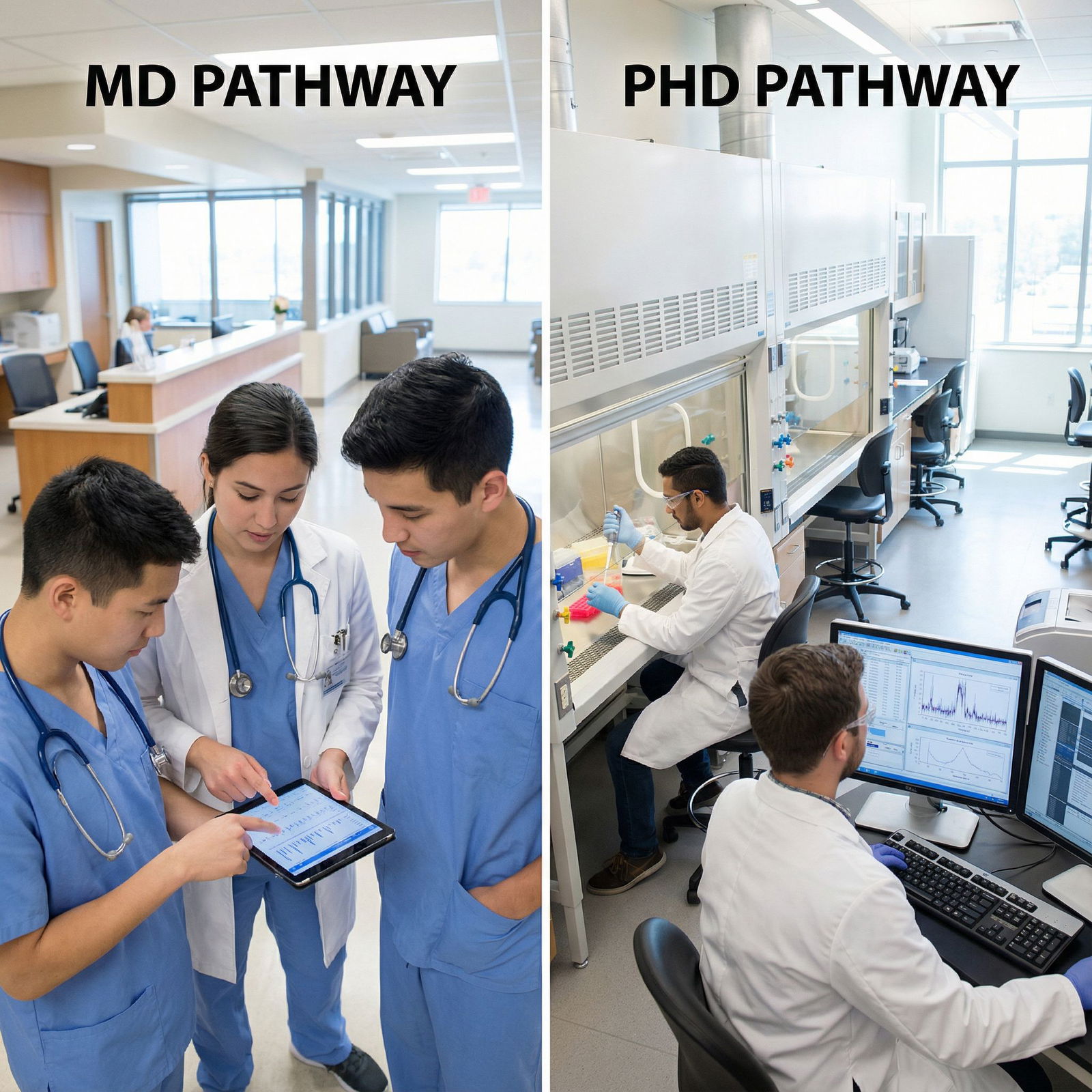
Here’s the mental translation you need to run constantly:
- Lab reflex: “What’s the mechanism?”
- Clinical reflex: “What decision does this change right now?”
If the answer is “none,” keep the mechanism in your back pocket unless someone explicitly asks.
2. Your PhD Reputation: Secretly Loved, Openly Suspected
Program directors and attendings say the same line in meetings about MD/PhDs and PhD transitions: “Brilliant… but will they be fast enough clinically?”
I’ve heard variations of:
- “They’re great when you sit down and talk through cases. But they’re always behind on notes.”
- “Super thoughtful. Just… a little slow.”
- “They want to read a paper about everything instead of just treating the thing.”
They’re not questioning your intelligence. They’re questioning your translation speed. In the lab you had hours, days, weeks to think. On the wards, you have a 15–20 patient list, pages going off, families asking questions, and the attending trying to leave by 5.
So the unspoken expectation is this: if you have “PhD” anywhere in your trajectory, you need to be at least average speed clinically, or your identity becomes “slow but smart,” and that label is nearly impossible to shake in that program.
You counter this in three ways:
- Over-prepare early. Pre-round notes, templates, checklists. Do the cognitively heavy pattern-building outside of real time so you’re faster in real time.
- Make your thinking visible but concise. “This is pneumonia; plan is A/B/C. I also briefly checked [x] because of [y], but it’s not driving management.” That signals depth and prioritization.
- Never let your curiosity delay care. Do the clinically obvious thing first. Read later.
If attendings see that you can think at PhD depth but operate at MD speed, you jump categories from “risk” to “asset.” And then your PhD background actually starts to help you.
3. The New Currency: From First Author to First to Help
In research, your value is tied to outputs: papers, grants, methods, ideas. Everything’s long-term.
In clinical training, your value is almost entirely short-term and hyper-local:
- Did you answer the page?
- Did you update the family?
- Did you help the intern when they were drowning?
- Did your sign-out match reality or create a mess?
Residents talk. Constantly. About you. Not your thesis, not your h-index, not your impact factor. They talk about:
- Whether you picked up tasks without being asked
- Whether your sign-outs were safe
- Whether you disappeared when things got busy
I’ve heard: “Yeah, they did a PhD at [big-name lab], but on nights I can’t find them when things blow up.” That kills you faster than a low Step score.
You’re thinking about your “body of work.” They’re thinking about whether you were there at 3 a.m. when their GI bleeder tanked.
Here’s the harsh translation:
Your new impact factor is how much easier you make everyone else’s shift.
| Setting | What Actually Gets You Valued |
|---|---|
| PhD Lab | First/last authorship, grants, methods |
| Wards | Reliability, speed, safe sign-outs |
| PhD Lab | Depth of theory, complex models |
| Wards | Clear plans, anticipatory thinking |
| PhD Lab | Novel questions |
| Wards | Not missing obvious badness |
Once you internalize this shift, your behavior changes:
- You volunteer for the annoying but essential tasks.
- You prioritize answering pages over polishing the perfect note.
- You protect your team from dropped balls more than you protect your own “interesting” work.
That’s how you build political capital. Then, when you do ask for something—protected research time, a particular elective, time to work on a manuscript—people are inclined to say yes because you’ve proven you’re a net positive in the trenches.
4. Hierarchy: Lab “Collaboration” vs Clinical Chain of Command
The lab can be flat. You call your PI by their first name. You argue with them in lab meeting. You send them a 2 a.m. Slack about some figure.
Clinical medicine is a soft military structure. A lot of PhDs underestimate how real that is.
I’ve watched MD/PhDs get quietly flagged as “difficult” because they carried their lab communication style straight into the hospital:
- Arguing with attendings on rounds like a journal club
- Publicly correcting seniors without reading the room
- Emailing division chiefs directly about relatively small issues
Behind closed doors, attendings will say: “They’re smart but do not get hierarchy.” That is not a compliment. It means: “I don’t trust them in a crisis when we need clear command.”
The unwritten rules:
- You can question. You just pick your timing and your tone.
- You don’t blindside seniors in front of patients or nurses unless safety is at risk.
- If you’re going to push back, frame it as curiosity or concern, not a challenge.
You already know how to do this—it’s the difference between tearing apart a paper in a journal club vs asking a national speaker a “question” that’s really a critique. On the wards, you live in that second mode most of the time.

| Step | Description |
|---|---|
| Step 1 | Notice issue |
| Step 2 | Speak up immediately to anyone nearby |
| Step 3 | Clarify with senior resident |
| Step 4 | Call attending or rapid response |
| Step 5 | Discuss with attending privately |
| Step 6 | Document and follow plan |
| Step 7 | Is patient unsafe now |
If safety is at stake, blow up the hierarchy. People will back you. If it’s not, work through the hierarchy and you’ll avoid getting tagged as “disruptive.”
5. How to Use Your PhD Without Becoming “That Person”
There’s a right and wrong way to bring your science into the hospital. Done right, you become the go-to for tough topics. Done wrong, everyone rolls their eyes when you start talking.
Wrong:
- Turning every patient into a literature review
- Interrupting rounds with long mechanistic explanations
- Fact-checking attendings in real time over minutiae
Right:
- Being the person who can, on request, explain a confusing test or therapy in 30–60 seconds flat
- Sending a concise, relevant paper after rounds when someone expresses interest
- Volunteering to give a 15-minute chalk talk on an area that keeps coming up (CAR-T, CRRT, epigenetics, whatever your wheelhouse is)
The key is consent and timing. If your team is 20 minutes behind and the attending is rushing to the OR, that’s not the moment to explain CRISPR off-target effects.
Where your PhD absolutely shines:
- Interpreting odd diagnostics (NGS, exome, quirky biomarker panels)
- Thinking through weird drug mechanisms and side effects
- Designing QI projects that aren’t just “audit and maybe we improved something”
- Mentoring med students on scholarly work with actual methodological rigor
When you pick your spots, your reputation becomes: “They really know their stuff and they don’t slow us down.” That’s the sweet spot.
6. Time, Boundaries, and Burnout: You’re Built for Marathon, They’re Running Sprints
Here’s a brutal truth: the resilience that got you through a PhD can hurt you in residency.
PhD culture normalized:
- Long, unstructured hours
- Blurry lines between work and life
- Grinding through weekends because the cells are ready or the deadline is soon
Residency adds:
- Fixed, punishing schedules
- High acuity emotional load
- Constant evaluation and comparison
So what happens to ex-PhD folks? They default to their old pattern: stay late, perfect everything, say yes to extra projects, read five papers for every interesting patient.
And then, about 6–12 months in, they crack. Quietly. Cynicism, exhaustion, that “I used to love this” feeling.
You need to be more ruthless with yourself than you ever were in the lab. Your new rule set:
- Clinical safety and reliability first
- Good enough documentations, not perfect treatises
- Protect sleep like you used to protect your samples
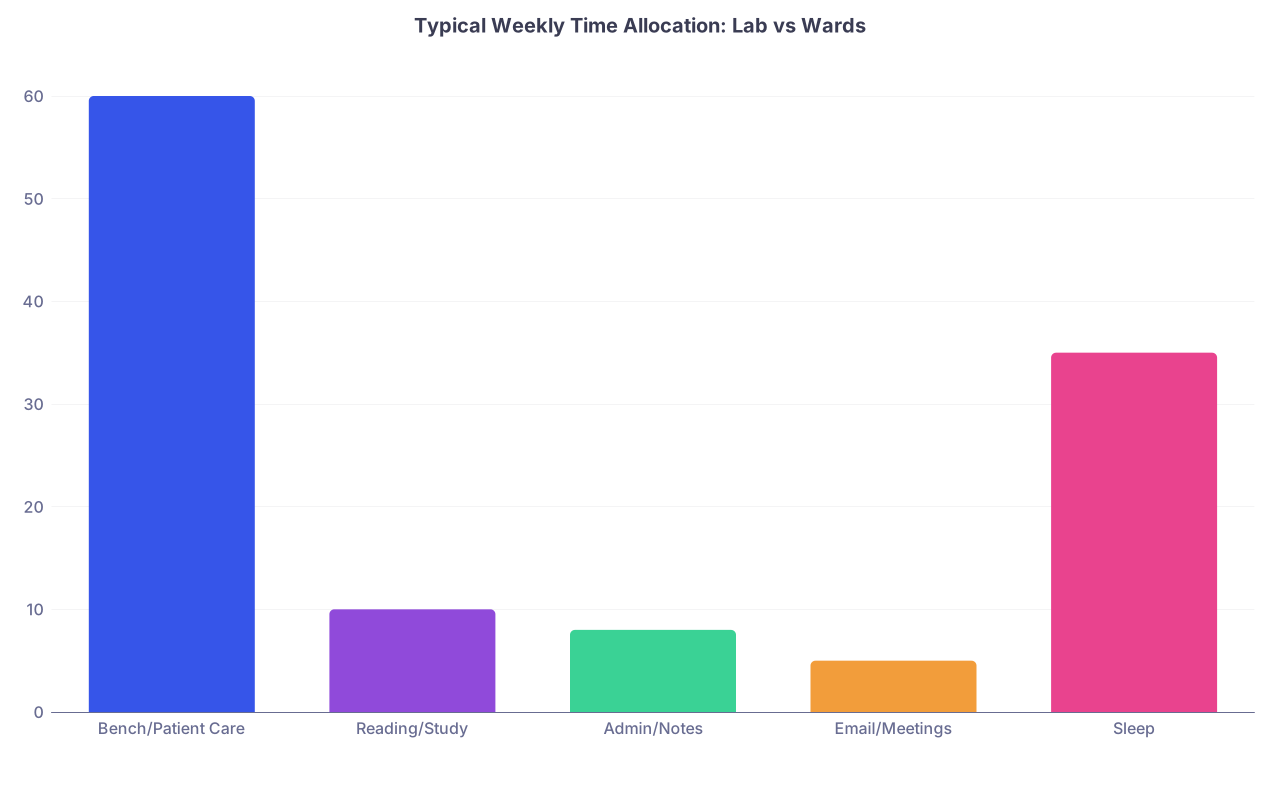
| Category | Value |
|---|---|
| Bench/Patient Care | 60 |
| Reading/Study | 10 |
| Admin/Notes | 8 |
| Email/Meetings | 5 |
| Sleep | 35 |
In the lab, you could binge-work and then coast. In the hospital, your baseline load is already near your limit. If you add PhD-level “extras” on top without cutting somewhere else, you burn out.
You’re not weak for choosing to not chase every interesting side project in PGY1. You’re playing the long game.
7. Politics and Power: Who Actually Matters Now
Another rude awakening. The people who controlled your destiny in the lab—PIs, grant reviewers, journal editors—are not the same people who control your trajectory now.
In medical training, your fate is mostly in the hands of:
- Program directors
- Chief residents
- A handful of influential attendings on key services
- Sometimes, the senior residents who shape your informal evals
Publication record helps if you want fellowships or academic tracks. But for your day-to-day survival and opportunity, the unwritten ledger is composed of:
- “Are they safe?”
- “Are they teachable?”
- “Would I want to be on call with them again?”
I’ve watched programs pass over objectively more accomplished PhDs for fellowship letters because the quiet, clinically solid resident was “someone I trust in the unit at 2 a.m.” That’s not a meritocracy based on your PubMed search. It’s a trust economy.
You want both. Clinical trust now, academic reputation later. Sequence matters.
8. Tactical Moves: Concrete Behaviors That Change Your Trajectory
Let’s be very practical. Here are specific behaviors that I’ve seen turn PhD-to-MD transitions from rocky to outstanding.
First three months on wards:
- Speak 20% less, think 20% more. Listen to how seniors present and frame plans. Pattern-match.
- After rounds, pick one patient or condition per day to read about in depth. Not ten. One.
- Ask for feedback early: “I know I come from a research background. I want to be sure I’m meeting expectations clinically. Anything I should tighten up this week?”
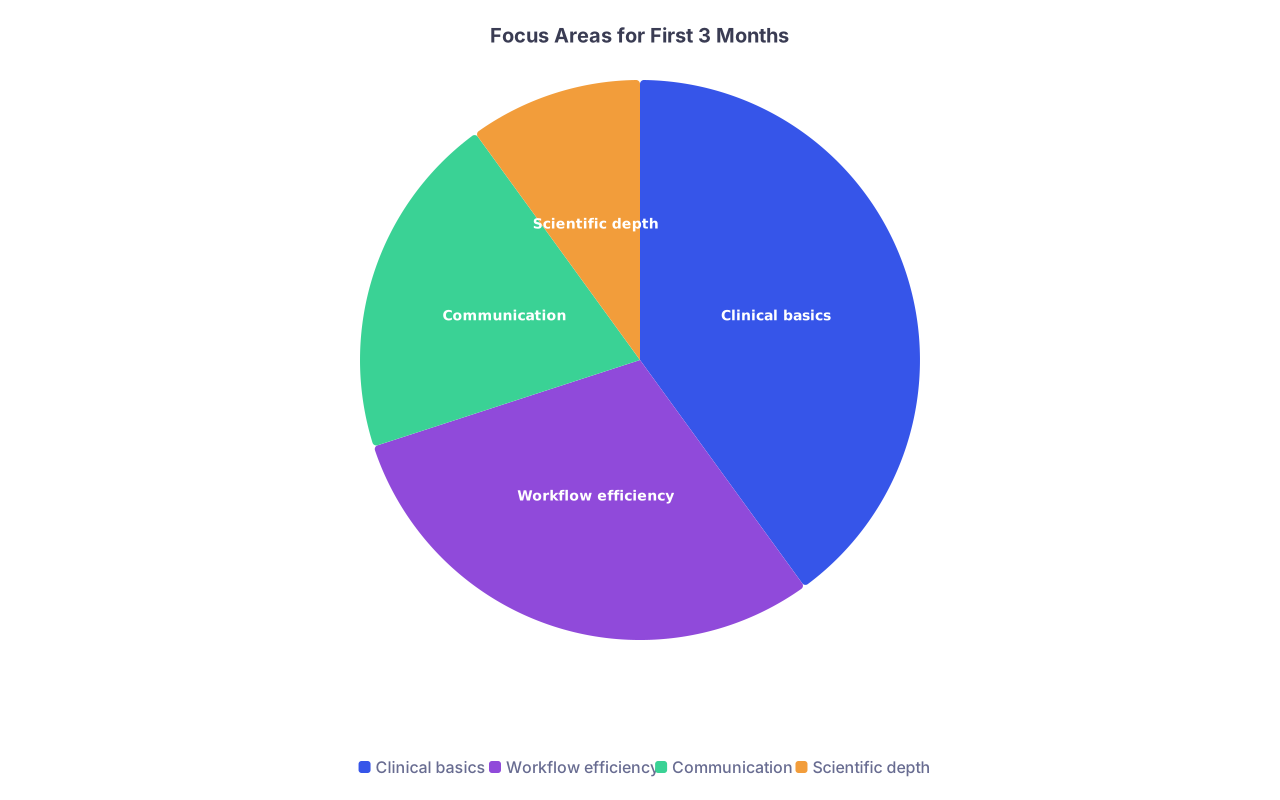
| Category | Value |
|---|---|
| Clinical basics | 40 |
| Workflow efficiency | 30 |
| Communication | 20 |
| Scientific depth | 10 |
On any given rotation:
- Find the “informal chief” resident. The one people defer to. Ask how they like things done. You don’t need to agree; you need to understand.
- Keep a running list: “Things I do slower than others.” Target one per week. Pre-charting, writing notes, calling consults, whatever. You will accelerate.
- Notice when you’re about to start a long explanation. Ask yourself: “Does this change the plan right now or can it wait?”
Leveraging your PhD without alienating people:
- Offer to give a concise teaching session on something obscure-but-relevant. Let the chief or attending invite it.
- If your program does journal clubs, volunteer early. Use that to showcase your ability to dissect methods and stats in a way that helps others, not just to flex.
- Be the person who can find the right paper fast and summarize in three sentences on rounds when asked.
Building bridges back to the research world:
- Protect at least one half-day per month (when possible) to stay plugged into your old lab or scientific community—Zoom into lab meetings, review a manuscript, whatever. But don’t sacrifice sleep or clinical basics for this in intern year.
- Identify one faculty member early who actually lives in the clinician-scientist space. Buy them coffee. Ask them what they screwed up in their transition. You’ll get better advice than any brochure.

9. Identity: Letting Go Without Losing Yourself
This part no one talks about at noon conference. There’s a real grief in going from being the expert—“the mass spec person,” “the mouse genetics guru”—to being the most ignorant person in the room on rounds.
You will feel stupid. Daily. That’s not impostor syndrome. That’s reality. You are a novice in this new domain.
The trap is trying to protect your ego by constantly reminding everyone (and yourself) of what you used to be good at. That just makes the contrast sharper.
Better move: privately accept that you’re starting over in this domain, while knowing that your real asset is not your thesis but the way your brain was trained to attack complex problems. That meta-skill does transfer:
- Recognizing patterns in messy data
- Being comfortable with uncertainty and iteration
- Not panicking when experiments (or plans) fail
Use that to tolerate feeling lost longer than your peers without falling apart. That’s where your PhD training actually gives you a psychological edge.
Years from now, when you’re back in a lab-meets-clinic role, this period will make sense. Right now, it just feels like a demotion. That’s normal.
FAQ (Exactly 4 Questions)
1. Should I hide or downplay my PhD during clinical rotations to avoid bias?
No, don’t hide it. Just don’t lead with it every time you open your mouth. Let people discover its value in concrete ways: your ability to explain complex concepts concisely, your fluency with data, your comfort with uncertainty. If someone clearly has a chip on their shoulder about “basic scientists,” arguing will not fix it. Being clinically solid will.
2. How much time should I realistically spend on research during intern year or early clerkships?
Less than you think. For most people, that means small, low-maintenance projects: a case report, a chart review, helping clean up a dataset. Your primary job is becoming safe and efficient clinically. If you try to maintain pre-residency levels of research productivity in PGY1, you will usually drain yourself and your clinical performance will suffer—and that is what program leadership actually notices.
3. What’s the fastest way to stop sounding “too PhD” in presentations?
Change your structure. Start with: “Summary, Assessment, Plan.” Only then, if asked, add: “Mechanistically, one thing that might be relevant is…” Practice giving a 30–60 second version of your thinking. If you can’t compress it, you don’t understand it well enough for the clinical setting, no matter how many papers you’ve read.
4. How do I handle attendings who get basic science obviously wrong?
You pick your battles. If the error is going to change patient care or mislead the team in a meaningful way, you correct—but with humility and timing: “I may be off here, but I thought the data suggested X, which might affect how we think about Y.” If it’s a small conceptual slip that doesn’t change management, let it go in the moment. You’re not there to win a seminar; you’re there to take care of patients and build trust.
Years from now, you won’t remember every awkward moment when your PhD instincts crashed into the clinical culture. You’ll remember the moment it stopped feeling like two separate worlds and started feeling like one integrated identity—someone who can stand in a room with a sick patient and bring both rigorous science and decisive care to the table. That’s the real transition. And it’s worth the discomfort.