
You’re in your second year (or maybe late M1). You like science more than most of your classmates, you actually read the methods section of papers, and a part of you wonders if you’re “supposed” to do an MD–PhD instead of “just” an MD. But you’ve also heard horror stories: 8–10 year programs, lost income, people regretting it. Now you’re asking the right question:
Should you commit to a full MD–PhD, or do an MD with a dedicated research year (or two) instead?
Here’s the answer you’re looking for.
Big Picture: Who Actually Needs an MD–PhD?
Let me be blunt: most people who think about MD–PhD do not need an MD–PhD.
You should strongly lean toward MD–PhD only if all three of these are true:
- You want to spend the majority of your career doing independent research (running a lab, writing grants, designing studies).
- You want your primary academic identity to be “physician–scientist,” not “clinician who does some research.”
- You’re okay with 7–9 years of training before residency and a slower financial start, in exchange for that research career.
If any of these three make you hesitate, then “MD with heavy research” plus a research year (or more) is usually the better, more flexible move.
Let’s break this down by what actually matters.
Time: How Long Are You Willing to Stay in Training?
This is where most people underestimate the cost.
| Path | Approx. Years Before Attending Level |
|---|---|
| MD only (no research year) | 4 med + 3–7 residency = 7–11 |
| MD + 1 research year | 5 med + 3–7 residency = 8–12 |
| MD–PhD | 7–9 med/PhD + 3–7 residency = 10–16 |
Timeline reality:
- MD only: 4 years, then residency. Straight shot.
- MD + 1 research year: Usually 5 total years of med school (e.g., between M3 and M4).
- MD–PhD: 7–9 years before residency. Typical format is:
- M1–M2 (preclinical)
- 3–5 years PhD
- Back for M3–M4
If you start MD–PhD at 22 and finish in 8 years, you’re 30 before residency. Add 3–7 years of residency/fellowship and you might not be an attending until mid-30s or later.
Does that kill the MD–PhD option? No. But you need to walk into it with both eyes open. If you feel a visceral dread at adding 3–4 extra full-time grad school years to your life, don’t do MD–PhD. That dread doesn’t magically go away.
Money: MD–PhD Funding vs Lost Income
Here’s where people get confused. MD–PhD is cheap up front, but expensive in opportunity cost.
Most MD–PhD programs (especially MSTPs) offer:
- Full tuition coverage (for MD and PhD years)
- Stipend in the ballpark of ~$30–40k/year during the program
MD-only:
- You pay tuition (often with loans)
- No stipend, but you finish sooner and start earning an attending salary earlier
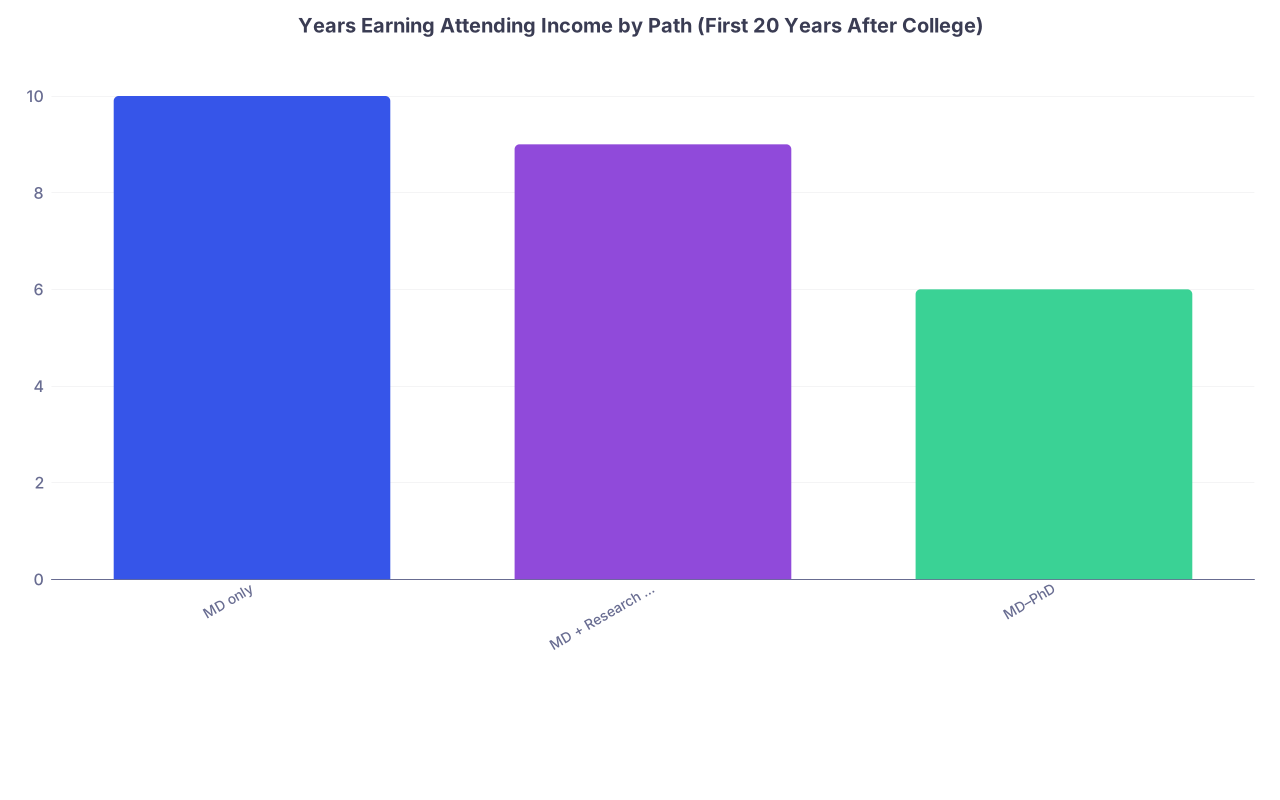
Let’s be concrete.
| Category | Value |
|---|---|
| MD only | 10 |
| MD + Research Year | 9 |
| MD–PhD | 6 |
(Exact numbers vary, but you get the point: MD–PhD delays the high-earning years.)
If your primary money question is: “Which path maximizes my lifetime earnings?” — pure MD usually wins, then MD + research time, with MD–PhD last.
If your main concern is: “I want to avoid debt and I’m okay with a delayed timeline if my career fits” — MD–PhD is very reasonable.
My rule of thumb: Don’t choose MD–PhD primarily for the free tuition. That’s a terrible trade if you don’t actually want a research-heavy career. You’ll pay for that decision with years you can’t get back.
Career Reality: What Jobs Do MD–PhDs vs Research-Heavy MDs Actually Do?
Strip away all the marketing. Here’s what people typically do:
Common MD–PhD career pattern
You see this at big academic centers like UCSF, Penn, WashU, Hopkins:
- 60–80% time on research (running a lab, writing grants, mentoring)
- 20–40% clinical (clinic, OR, inpatient)
- Maybe some teaching/admin mixed in
Titles often look like:
- Assistant/Associate Professor of Medicine (or Surgery, etc.)
- PI of an NIH-funded lab
- “Translational oncologist,” “neuroscientist,” “immunologist” with clinical role
An MD–PhD makes the most sense if your dream job is:
- “I want my own lab.”
- “I want to write R01 grants and lead multi-center studies.”
- “I want to be known for discoveries, not just for clinical excellence.”
Common MD + strong research track pattern
Plenty of MD-only folks at the same institutions:
- 10–40% time on research (often collaborative, not always as PI)
- 60–90% clinical
- Maybe medical education roles, QI projects, clinical trials
Titles often look like:
- Clinician–educator with research
- Clinical researcher
- Co-investigator on big projects
They may:
- Do a research year in med school
- Choose a research-heavy residency/fellowship (e.g., ABIM research pathway)
- Get a master’s degree (MS, MPH, MHS) instead of a PhD
- Build solid publication records without ever having done MD–PhD
If you want a career where:
- You’re mainly a clinician
- You still publish
- You work on trials and collaborative projects
…then MD alone with focused research time is more than enough.
Specialty Choice: Does MD–PhD Help or Hurt?
Here’s where it really matters. Different specialties value research differently.
| Specialty | Strong Research Value | MD–PhD Advantage |
|---|---|---|
| Physician–Scientist IM subspecialties (heme/onc, cards, ID) | Very high | Strong |
| Neurology, Psychiatry (academic) | High | Strong |
| Dermatology, Radiation Oncology | High | Moderate–Strong |
| Neurosurgery | High | Moderate |
| General Surgery subspecialties | Moderate–High | Some |
| EM, Family, Community IM (non-academic) | Low–Moderate | Minimal |
Reality:
- For classic physician–scientist paths (oncology, immunology, neuro, psych research):
MD–PhD genuinely helps and often predicts you’ll get protected research time later. - For very competitive but clinically driven fields (ortho, plastics, private derm):
Strong research helps for matching, but MD–PhD is not required and sometimes you’ll end up mostly clinical anyway. - For less research-heavy careers (community IM, EM, FM):
MD–PhD is usually overkill unless you’re dead set on being that rare academic researcher in the field.
If you’re not at least 70% sure you want a research-oriented specialty, MD–PhD is a risky bet.
Day-to-Day Training: What You’re Signing Up For
This part people underestimate badly.
MD–PhD path daily life
During PhD years:
- You’re a grad student, not a med student
- 40–60 hours/week in lab or at a computer
- Experiments fail, grants get rejected, your PI might be amazing or might be a nightmare
- Progress is slow; 4th Western blot of the week level of slow
Then you jump back into M3:
- You’ve forgotten a chunk of basic clinical stuff
- Your classmates are younger and socially ahead in the med school cohort
- You’re rusty at standardized tests, then Step 2/3 come knocking
You need to actually like the process of discovery. Not just the idea of “being a scientist.” The daily grind.
MD with research year daily life
During research year:
- Often 1–2 dedicated projects
- Mix of clinical research, chart review, maybe basic/translational if you’ve got the setup
- More structured mentoring in many cases
- Timeline is often 1 year, not “whenever the thesis is done”
You still go back a bit rusty, but you were out for 1 year, not 3–5. Much easier re-entry.
If the idea of debugging code or protocols for months sounds miserable, MD–PhD is going to be rough.
Competitiveness, Signaling, and Match Advantage
People like to over-romanticize this. Let’s be real.
MD–PhD as a signal
Programs see MD–PhD and think:
- “This person is serious about research.”
- “We can invest in them for long-term academic roles.”
You get:
- An easier time matching into research-heavy residencies
- Extra benefit at places that want NIH funding and physician–scientists
But.
If you do MD–PhD and then barely publish, don’t push for grants, and act like a mostly clinical doc — that signal gets neutralized pretty fast. The degree alone is not magic.
MD + research year as a signal
Programs see:
- “This person cares about research enough to dedicate a year.”
- Then they look at what you actually produced: publications, presentations, letters from researchers.
For matching into competitive fields (derm, ENT, ortho, rad onc), a well-done research year often gives you 80–90% of the match benefit of an MD–PhD with far less commitment.
Bottom line: For matching, actual output (papers, presentations, strong letters) matters more than whether you have “PhD” on your name tag.
Personality Fit: This Is the Most Under-Discussed Factor
Forget prestige. Ask yourself:
- Do you actually enjoy asking open-ended questions, designing experiments, and dealing with uncertainty for months or years?
- Can you tolerate failure and boredom? Because research has a lot of both.
- Do you like thinking deeply about one very narrow topic for a long time?
If yes, MD–PhD becomes much more attractive. Those are the people who thrive in it.
If you love:
- Fast feedback
- Patient interaction
- Clear, short feedback loops
…you’re probably wired more for clinical work, maybe with some research on the side.
When MD–PhD Is Clearly the Right Call
Do MD–PhD if most of these are true:
- You’ve already done substantial research (e.g., 1–3 years, not just a summer).
- You’ve liked the process, not just the end result line on your CV.
- You can point to specific questions you want to answer in science, not just “I like research.”
- You genuinely want a career where your main job is to produce new knowledge.
- You’re okay with being in training longer and starting your high-income years later.
For example:
- You spent 2 gap years doing bench research in cancer immunology.
- You have multiple posters/pubs and actually know the field.
- You light up talking about experimental design and mechanisms.
- The idea of landing an R01 grant excites you.
That’s an MD–PhD person.
When You Should Stick to MD + Research Time
Go MD (maybe with a research year) if:
- You like research, but only if it’s tethered to patient care or short-to-medium-term projects.
- You want the option to be academic but don’t feel married to running a lab.
- You’re not ready to commit to a 3–5 year PhD on top of med school.
- Your top priorities include:
- Getting to independent clinical practice sooner
- Flexibility in specialty choice
- Ability to pivot away from research if it’s not your thing
A very reasonable path for you might be:

| Step | Description |
|---|---|
| Step 1 | Start MD |
| Step 2 | Summer research |
| Step 3 | Elective research blocks M3/M4 |
| Step 4 | Dedicated research year or MPH/MS |
| Step 5 | Apply to residency |
| Step 6 | Choose research heavy residency or not |
| Step 7 | Still want more? |
That path creates a research-capable clinician without locking you into 8+ years before residency.
Quick Gut-Check Framework
If you’re still stuck, answer these honestly:
- If someone took away the “PhD” letters but let you do the same research career, would you still want to spend 3–5 extra years now?
- If you ended up in a mostly clinical job, would you feel like MD–PhD was a waste?
- Are you already certain you like doing research full-time, or are you just curious?
My general guidance:
- If you can’t answer a confident yes to “I want full-time research as a big part of my career,” do MD first.
- You can always add:
- A research year
- A funded research fellowship
- A master’s degree
- Even a PhD later (far less common but exists)
But you can’t easily undo a full MD–PhD once you’re in deep.
FAQs
1. Will MD–PhD make residency applications significantly easier?
For research-heavy specialties and programs, yes, it helps a lot. For competitive but mostly clinical specialties (ortho, plastics, anesth), what helps more is strong research output, not the letters “PhD.” A focused research year can do most of that work for you.
2. Can I become a physician–scientist with just an MD?
Yes. Plenty of leaders in clinical research and even some lab-based researchers are MD-only. They often stacked:
- Strong med school research
- Research-heavy residency/fellowship
- Mentored early-career awards (e.g., K awards) MD–PhD just makes that path smoother and more structured for basic/translational science.
3. Do MD–PhDs make less money than MDs?
Over a lifetime, usually yes, because they start earning attending salaries later and often choose academic jobs with lower clinical volume. But they also avoid med school tuition and get stipends. If pure income maxing is the goal, MD-only, clinically heavy career wins.
4. What if I’m interested in research but not sure of my exact field yet?
That’s normal. If your uncertainty is about which field, but not about whether you want research as a core part of your career, MD–PhD can still make sense. If you’re unsure whether you like research enough at all, start with MD and get more exposure first.
5. How can I decide before applications are due?
Do three things now:
- Talk to at least two MD–PhDs and two MD-only academic physicians about their actual week schedules.
- Honestly assess your past research experiences—did you enjoy the process or just the outcomes?
- If you’re still unsure, apply MD-only, go to a research-strong med school, and reevaluate during M1/M2. Many places let you apply internally to MD–PhD or add a research year later.
Key takeaways:
- MD–PhD is for people who want research as a main career pillar, not just a bonus.
- MD + targeted research (including a research year) is enough for most academic and competitive specialty goals.
- Don’t do MD–PhD for the “free tuition” or prestige alone. Do it only if you’re willing to trade years of time for a true physician–scientist career.