
The blunt truth: most clinicians do not need a PhD after residency—and for many, it’s a terrible use of 4–7 prime career years. But for a very specific slice of physicians, it can be absolutely worth it.
Let me walk you through which camp you’re in.
The Core Question: What Problem Are You Trying to Solve?
Before you get lost in titles, prestige, or “maybe I’ll like research,” you need to answer one question honestly:
What concrete career ceiling are you hitting that you believe only a PhD will fix?
If you cannot state this in one or two sentences, you’re not ready to pursue a PhD. Here are common bad and good reasons.
Bad reasons:
- “I like learning and school.”
- “I want to be more competitive in general.”
- “Everyone in my department has multiple degrees.”
- “I’m burned out; this seems like a nice break from clinical work.”
Good reasons:
- “I want to run an independent, grant-funded lab focused on X.”
- “I want to build a career as a clinical trials PI and lead multicenter studies.”
- “I want a tenure-track basic/translational science position at a research-intensive institution.”
- “My long-term plan is 70–90% research, and I want the training and credibility to match.”
If your goal is primarily clinical—being an excellent specialist, building a practice, making good money, maybe doing some teaching—a PhD after residency is almost never worth the cost.
What a PhD Actually Buys You (and What It Doesn’t)
Let’s be precise about what a PhD does and does not do for a clinician.

A PhD tends to give you:
- Deep training in a specific research methodology (e.g., molecular biology, biostatistics, health services research, AI/ML).
- Time and structure to produce first-author papers in a focused area.
- Credibility when applying for certain grants or tenure-track basic science roles.
- Access to mentors and collaborations that can shape a research-focused career.
It does not automatically give you:
- Guaranteed better pay (often the opposite in the short-to-medium term).
- A fast track to promotions in most clinical departments.
- Protection from burnout (academic pressures are real and nasty).
- Respect from clinicians who value RVUs and patient care volume above all.
A PhD is a tool, not a golden ticket. If you cannot name the type of research you want to be doing with some specificity, you’re signing up for 4–7 years of confusion.
Scenarios Where a PhD After Residency Is Worth It
Let’s talk about where this path genuinely makes sense. These are not theoretical; I’ve seen people do exactly these.
1. You Want to Be a True Physician-Scientist (Heavy Basic or Translational Research)
If your dream week looks like:
Two half-days of clinic, the rest in the lab, writing grants, supervising postdocs, giving talks on your niche area—then a PhD can be very rational.
You’re a good fit for:
- MD–PhD-like roles, but you got your MD only and now want to “backfill” the PhD.
- Departments that expect R01-level funding and significant bench or translational work.
- Institutions like major academic centers (e.g., UCSF, Hopkins, Penn) where research output is currency.
Key point: To compete for independent investigator roles in basic science departments, an MD alone often isn’t enough anymore. A PhD signals serious research training.
2. You Want to Be a Methods Expert (Biostats, Epidemiology, Outcomes, Data Science)
This is different from being a “content expert” in one disease area.
If your long-term role is:
- Designing and analyzing complex clinical trials or health services research.
- Leading an informatics / data science group in a major health system.
- Being the go-to for advanced methods, large database studies, or risk modeling.
Then a PhD in:
- Biostatistics
- Epidemiology
- Health services research
- Biomedical informatics / data science
can make sense and is actually used on a daily basis.
Here, you’ll often end up with:
- Joint appointments (e.g., Medicine + Biostats).
- Stable percent effort on grants (protected time paid by research dollars).
- A track that genuinely values those methods skills.
Scenarios Where a PhD After Residency Is Overkill (or a Distraction)
This is where most clinicians land.

You do not need a PhD if your realistic future is:
1. Mostly Clinical, Some Teaching, Occasional Research
If you see yourself:
- 80–90% clinical
- Doing QI projects, some retrospective chart reviews, maybe co-authoring clinical papers
- Teaching residents, maybe leading a small fellowship program
You do not need a PhD. Period.
What you need instead:
- Good mentors.
- Some workshops or a certificate in clinical research/QI.
- Enough protected time to actually finish projects.
2. You Want to Work in Community Practice or Private Practice
Almost zero community jobs require a PhD.
Most do not even particularly value it financially.
You might carry the prestige with patients and colleagues, but you will probably:
- Earn less overall due to lost attending years.
- Use the “PhD” part only on your email signature.
If your priority hierarchy is: income, flexibility, location → a PhD is misaligned with your real goals.
3. You’re Just Tired of Clinical Work and Looking for an Exit
A PhD is a terrible burnout cure.
You’ll trade:
- Long clinical days and emotional exhaustion
for - Long research days, pressure to publish, grant rejections, committee politics.
If you want out of full-time clinical care, there are faster and more targeted options:
- Industry roles (medical affairs, pharma, med tech).
- MPH or MS in clinical research.
- Hospital admin / MBA. All shorter, more directly applicable, and often better for career switching.
Time, Money, and Opportunity Cost: The Harsh Math
Let’s put some numbers and structure to this.
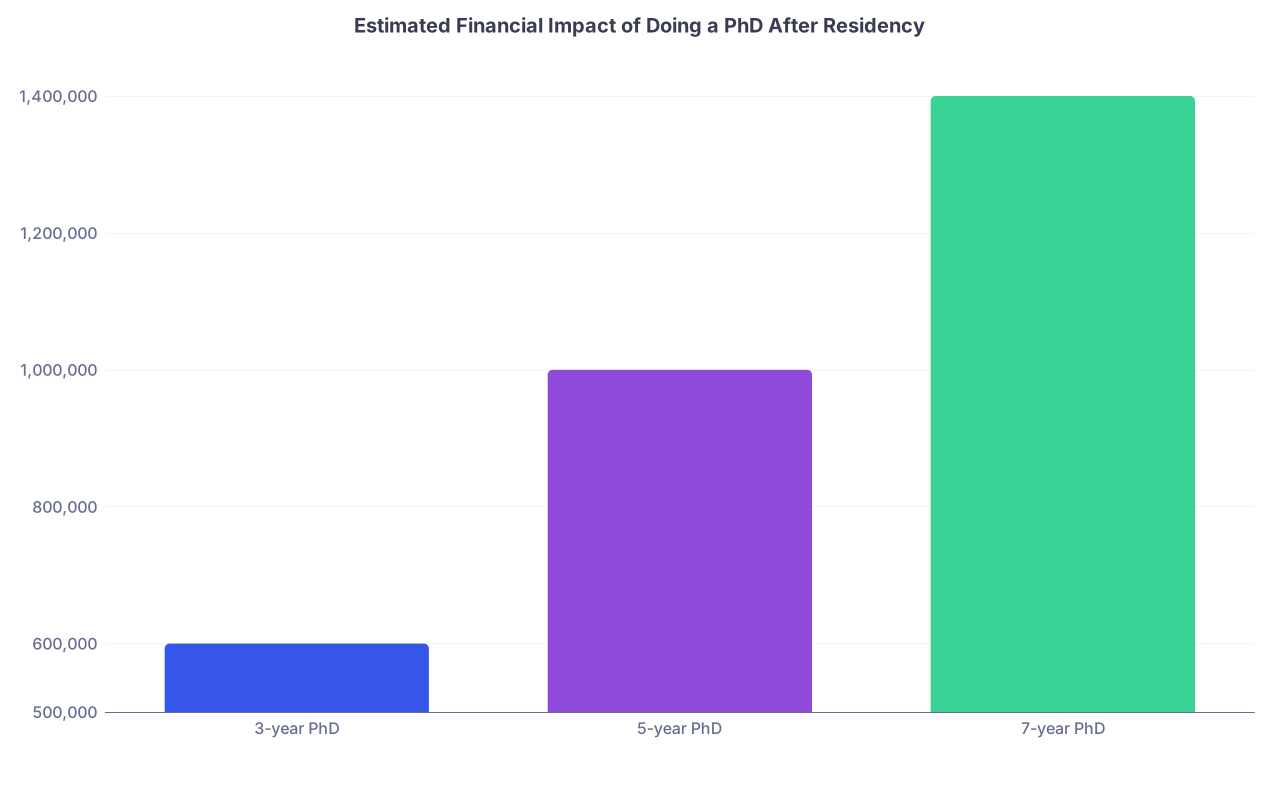
| Category | Value |
|---|---|
| 3-year PhD | 600000 |
| 5-year PhD | 1000000 |
| 7-year PhD | 1400000 |
Assumptions:
- You could be earning ~$250–350k/year as an attending (varies by specialty/region).
- PhD stipend/salary might be $50–80k/year if aligned with faculty appointment or $30–40k if you’re truly in a grad-student-style role.
Over 3–7 years, the lost attending income easily hits $600k–$1.4M+. That’s before compounding, retirement contributions, loan payments, etc.
Opportunity cost also includes:
- Delayed promotion to associate/full professor.
- Delayed family plans or geographic stability.
- Being “behind” your residency peers in earnings and seniority.
Is that automatically bad? No. If your long-term dream is research-heavy academia, you may gladly pay that price. But pretending it’s a neutral trade is self-deception.
Alternatives That Often Make More Sense Than a PhD
For many clinicians, the right answer is more training, but not necessarily a PhD.
| Path | Typical Length | Best For |
|---|---|---|
| MPH | 1–2 years | Public health, epi, policy |
| MS in Clinical Research | 1–2 years | Clinical trials, outcomes research |
| Certificate/Fellowship in Research | 6–24 months | Basic methods, starter projects |
| MBA | 1–2 years | Admin, industry, leadership |
These options often:
- Give you enough methods training for clinical and translational research.
- Take less time.
- Disrupt your earnings less.
- Keep you closer to clinical work if that matters to you.
If you just want to be able to:
- Design good prospective studies.
- Run a few clinical trials.
- Authorship on solid papers in your specialty.
Then an MPH or MS + a good mentor + protected time will usually get the job done.
How to Decide: A Simple Framework
Here’s the decision tree I walk people through.

| Step | Description |
|---|---|
| Step 1 | Clinician after residency |
| Step 2 | Do not do PhD |
| Step 3 | Consider MPH or MS |
| Step 4 | Advanced training without PhD |
| Step 5 | PhD may be worth it |
| Step 6 | Want research as main career? |
| Step 7 | Basic or heavy methods research? |
| Step 8 | Need independent lab or tenure track? |
Ask yourself:
- Do I want research to be my main job, or just a side activity?
- Do I see myself as a PI with my own program, or as a collaborator/contributor?
- Is the work I want to do mostly:
- Lab-based / highly mechanistic?
- Deep statistical/methodological innovation? If yes, PhD becomes more justifiable.
- Have I already done enough research to know I actually like the process:
- Writing grants.
- Dealing with IRB and regulatory nonsense.
- Revisions, rejections, slow timelines. If you’ve only done a summer project and enjoyed pipetting for 6 weeks, that’s not enough data.
If you answer “no” to most of these, your problem is usually better solved by incremental training and more structured research time, not a full PhD.
Practical Realities: Prestige, Politics, and Culture
You’ll also run into culture issues.
Some departments:
- Quietly (or loudly) favor MD–PhDs or MDs with PhDs for major research roles.
- Use the PhD as a screening heuristic, especially in basic science or health services departments.
Other departments:
- Couldn’t care less.
- Care about RVUs, patient satisfaction scores, and call coverage.
So you need to look at:
- The department(s) you’d realistically join.
- The division chiefs’ CVs. How many have PhDs?
- Promotion criteria at your target institutions.
If 80% of the people in roles you want have PhDs (or MD–PhDs), that’s your answer. If almost none of them do, that’s also your answer.
When in Doubt, Try a “Test Year” First
If you’re on the fence, I strongly recommend a lower-risk test.
Options:
- A 1-year or 2-year research fellowship after residency.
- An NIH T32 research track.
- Protected research time as junior faculty with a clear project and mentor.
Treat this as:
- A reality check on whether full-time research fits you.
- A chance to see what degree/skills gap you actually have.
- An opportunity to build preliminary data and publications that’ll help if you later apply for a PhD or other advanced degree.
Often, one of two things happens:
- You realize you’re satisfied with a master’s-level skill set and structured projects → no PhD needed.
- You fall in love with the work and identify a precise methodological area you want to master → then a PhD becomes a targeted move, not an escape.
Key Takeaways
- A PhD after residency is worth it only if you’re serious about a research-dominant career—basic, translational, or high-level methods—and you can clearly articulate the role it plays.
- For the vast majority of clinicians whose careers will be mostly clinical with some teaching or light research, the opportunity cost is too high; lean on shorter, focused degrees (MPH/MS) and good mentorship instead.
- Before committing, do a “test year” of structured research and study what people in your dream job actually have on their CV. Match your training to their reality, not to a vague idea of “more letters are better.”
FAQ (Exactly 5 Questions)
1. Does having a PhD after residency significantly increase physician salary?
Usually no. In many clinical departments, a PhD does not meaningfully increase base salary and can actually lower your lifetime earnings due to years of lost attending income. Where it can pay indirectly is in research-centric roles where grant funding and tenure can stabilize or enhance long-term compensation—but that’s a narrow slice.
2. Is it harder to get academic promotion without a PhD?
It depends on the track and institution. On pure clinical tracks, promotion is more about clinical excellence, teaching, and some scholarship. On research or tenure tracks, lacking a PhD can be a handicap, especially in basic science or methods-heavy fields, because committees use it as a signal of formal research training.
3. Can I get involved in serious research without a PhD?
Yes. Plenty of MDs without PhDs are PIs on clinical trials, lead observational studies, or run strong outcomes programs. They often have an MPH/MS, a research fellowship, or simply strong mentorship and protected time. The key is sustained output and clear expertise, not the degree itself.
4. How late is “too late” to start a PhD as a clinician?
I’ve seen people start in their late 30s or early 40s. It’s not impossible, but the opportunity cost goes up as you age, especially if you have family, mortgage, and established income. The older you are, the more critical it is that the PhD aligns tightly with a specific, high-impact career goal you can’t reach otherwise.
5. If I already know I want a research-heavy career, should I skip straight to a PhD after residency?
Sometimes, yes—but only if you’ve already done substantial research, know your area, have strong letters from research mentors, and are certain you enjoy the day-to-day of research work. If you’re not 100% sure, a research fellowship or master’s first is smarter. It reduces the risk of locking into a 4–7 year commitment you later regret.