The short answer: yes, you can absolutely lead a lab with an MD only—no PhD—but not the way most students imagine it.
If you’re picturing “finish MD, do residency, then casually start a lab at a big-name institution”… that’s fantasy. MD-only lab leadership is doable, but it’s front-loaded with training, funding hurdles, and strategic choices. The letters after your name matter less than the proof that you can produce grant‑funded science.
Let’s walk through what’s actually required and what paths are realistic.
MD vs PhD: Who’s Allowed to Run a Lab?
Let me cut through the mythology.
Hospitals, universities, and the NIH do not have a rule that says “only PhDs can be PIs” (principal investigators). Plenty of MD-only investigators run labs. The real rule is more brutal:
You can lead a lab if:
- An institution hires you into a research-track role, and
- A funding agency (NIH, foundation, etc.) trusts you with money.
Your degree is just a proxy. Committees care about:
- Publications (first/last author, impact, consistency)
- Grants (especially NIH K, R, and equivalent)
- Evidence you can lead a research program (mentoring, collaborations, methods)
So, yes, MD-only lab leadership is completely legit. But you have to reverse-engineer your way into it:
You don’t get a lab and then start doing research.
You do significant research first, then get trusted with a lab.
Typical Paths for an MD-Only to Run a Lab
There are three main MD-only routes that actually work. I’ve seen all of them.
1. The Classic Physician–Scientist Route (Academic)
This is the “MD behaving like a PhD” route. You:
- Get heavy research exposure in med school (or earlier)
- Choose a research-heavy residency (IM, Neuro, Peds, Psych, etc., at a strong academic center)
- Do a research fellowship or postdoc (often 2–4 years, sometimes via T32 or similar)
- Get mentored into a K award (K08, K23, etc.)
- Use the K as the launchpad to your first R01 and independent lab
Typical features:
- You’re in a major academic medical center
- Your job title is something like “Assistant Professor, Physician–Scientist Track”
- Your time is 60–80% protected for research if the department is serious about you
- You run a lab, mentor students/postdocs, and still see patients
2. The Clinician–Investigator in a Clinical/Translational Lab
You’re less “pipette all day,” more “data, trials, and human subjects.”
This looks like:
- Focus on clinical trials, outcomes research, health services research, informatics, or translational work
- You lead a clinical research unit or translational lab (biobanking, imaging, device trials, etc.)
- Your lab is people, protocols, and data, not just bench experiments
- You still can be PI on major NIH and foundation grants
These labs often sit in:
- Departments like Medicine, Surgery, Radiology, Pediatrics, Emergency Medicine
- Cancer centers, CTSI units, big institutional cores
3. Industry / Non-Academic Leadership
Less discussed but very real:
- Biotech, pharma, device companies hire MDs into clinical research leadership roles
- You may not have a “lab” with your name on the door, but you run research programs and teams
- Sometimes you oversee both clinical and preclinical work with PhD scientists reporting to you
This is still lab leadership in a practical sense—just not in the classic university PI model.
What You Actually Need: Concrete Requirements
Let’s get specific. Here’s what tends to separate MDs who successfully lead labs from those who don’t.
| Requirement Type | What You Actually Need |
|---|---|
| Research Training | 2–4+ years of serious research (often post-residency) |
| Publications | Multiple first-author, at least some high-quality |
| Mentorship | Strong mentor PI(s) with funding history |
| Protected Time | 50–80% research time in early faculty years |
| Funding | K award or equivalent, then R-level grant |
1. Research Training (Beyond “I Did a Summer Project”)
If your research CV is:
- One poster at a regional conference and
- A middle-author paper buried in PubMed
…you’re not close.
Realistic MD-only lab leaders usually have:
- Dedicated research years (MD research year, gap year, or 5th year)
- A research fellowship or formal postdoc (2–4 years)
- Consistent time at the bench or with data: 20–40 hrs/week for several years
Some do:
- Master’s degree (MS, MPH, MHS, MBI, etc.) during residency/fellowship
- T32 research fellowships
- Institutional research tracks with built-in protected time
The missing PhD is replaced by equivalent years of focused research experience.
2. Publications: Quality and Trajectory
You need a story that says: “This person is becoming an independent scientist.”
That usually looks like:
- Several first-author papers in your area
- Some senior/last-author or co-senior as you get leadership roles
- A coherent theme (e.g., inflammation in heart failure, AI in radiology, health equity in oncology)
Things that don’t impress grant reviewers:
- Publications scattered across random topics with zero theme
- One-off case reports and tiny retrospective studies
- Five co-author papers where you can’t clearly state your role
You want your CV to make someone say: “Ok, this person clearly owns this niche.”
3. Strong Mentorship and Environment
MD-only PIs almost always come out of:
- Well-known PI labs
- Departments that invest in physician–scientists, not just lip service
Red flags to avoid:
- “Sure, you can do research… on your own time after clinic.”
- “We don’t have many grants, but maybe you can get one.”
- “Protected time” that turns into “you’re on call half the time.”
Ask hard questions when choosing training programs:
- How many MDs here have K awards? R01s?
- Who’s an MD-only PI I can talk to about their path?
- How much true research time will I get as a fellow and junior faculty?
How Funding Works for MDs Without a PhD
This is the real gatekeeper.
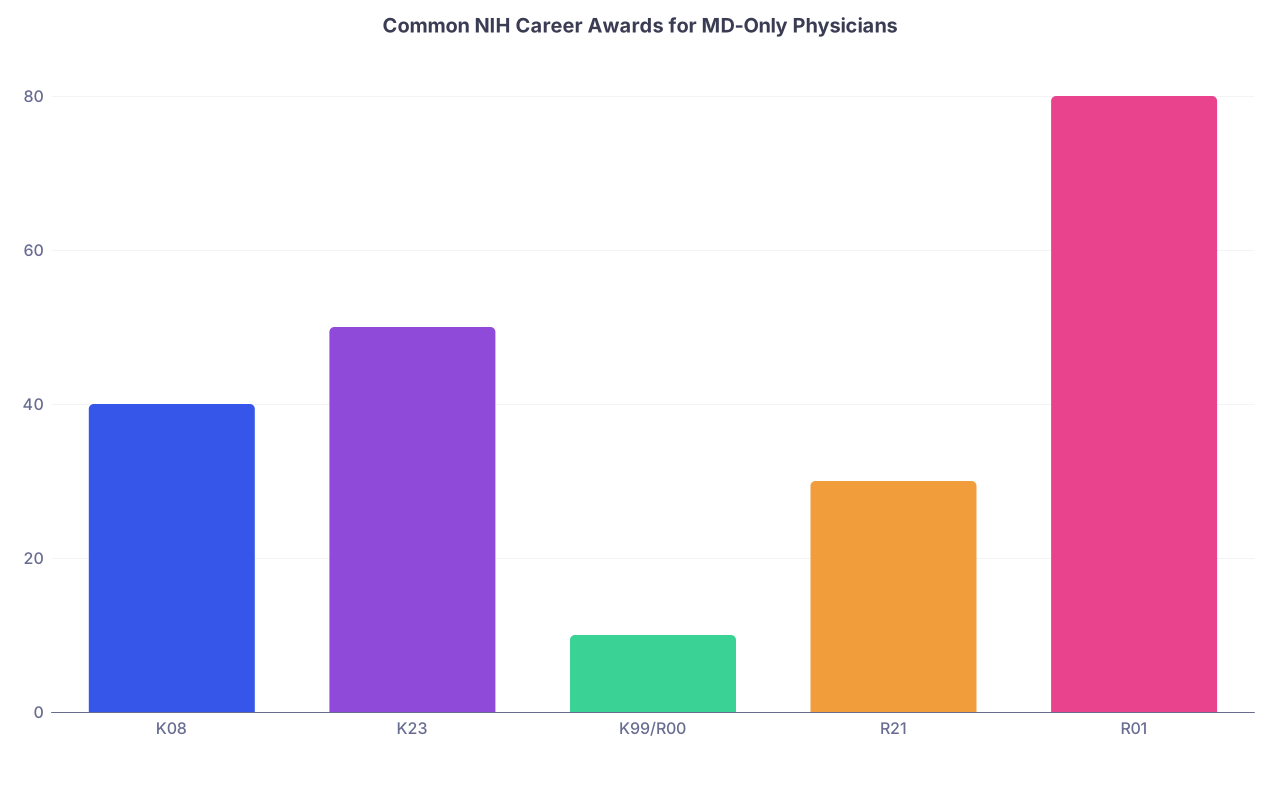
| Category | Value |
|---|---|
| K08 | 40 |
| K23 | 50 |
| K99/R00 | 10 |
| R21 | 30 |
| R01 | 80 |
You don’t get a fully built lab handed to you. You earn it with grants. Here’s the usual progression:
Early training awards
- Medical student research grants (HHMI, NIH summer programs, etc.)
- Resident/fellow small grants (society grants, institutional awards)
Career development award (K-type or equivalent)
- K08 – basic/translational for MDs
- K23 – patient-oriented/clinical research
- VA CDA, foundation career awards (AHA, ASCO, etc.)
These:
- Buy you protected time (often 75%+ research)
- Come with mentorship and structured career development
- Are the single biggest lever for MD-only lab leadership
- Independent funding (R-level or equivalent)
- R21 – exploratory/developmental
- R01 – the heavyweight
- Foundation/DoD/PCORI grants of similar scale
Once you hit this level:
- You’re taken seriously as an independent PI
- Your institution will give you more space, staff, and resources
- You can now recruit trainees and grow your lab
Can an MD-only get these? Yes. Will you get them without a serious research track record? No.
Clinical Load vs. Running a Lab: The Non-Negotiables
Here’s the brutal math.
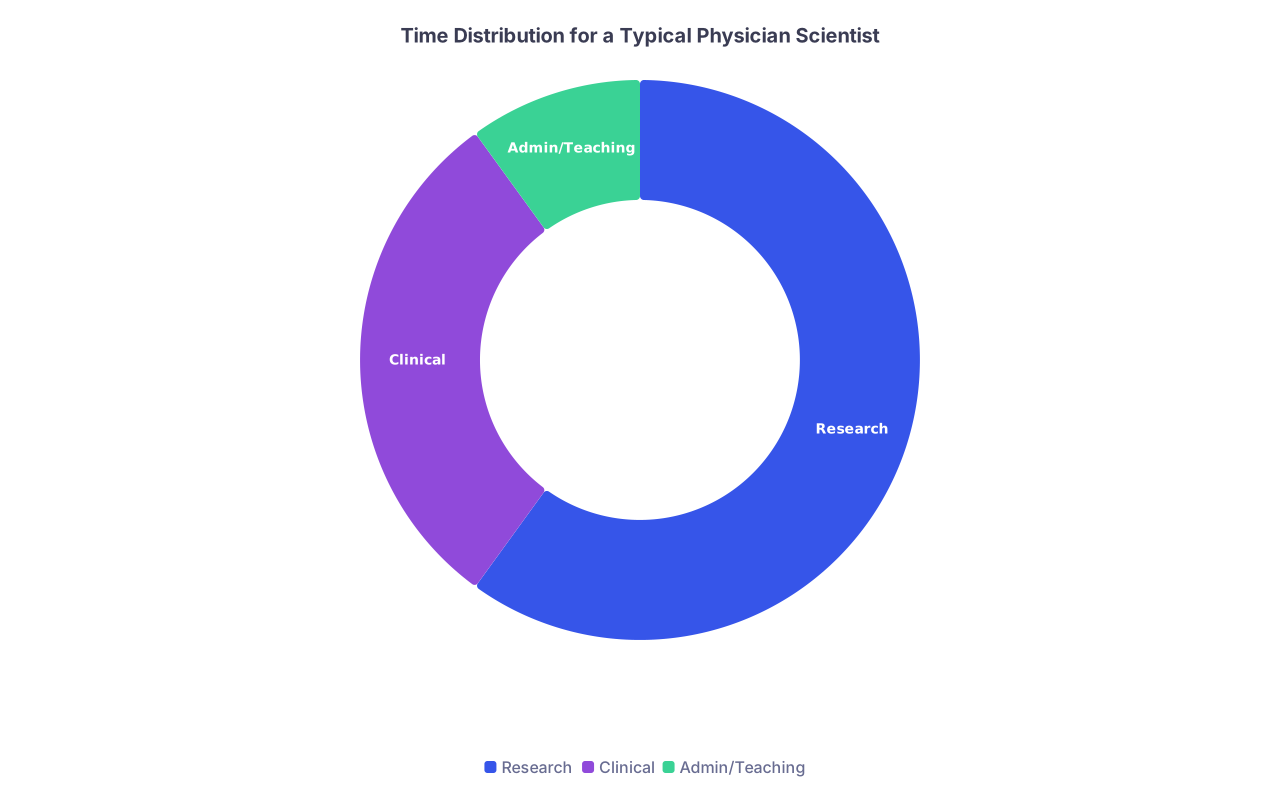
| Category | Value |
|---|---|
| Research | 60 |
| Clinical | 30 |
| Admin/Teaching | 10 |
If you’re:
- Full-time clinician
- In a private group or community hospital
- Doing “research on the side”
You will not run a serious lab. You might:
- Help with trials
- Do some QI projects
- Co-author a few papers
But a true PI lab requires:
- Regular, predictable time for research (multiple half-days or whole days weekly)
- Minimal call or call structured to protect your research blocks
- Departmental buy-in that your productivity will be judged on grants and papers, not just RVUs
Reasonable early-career setup for a serious MD-only PI:
- 60–80% research
- 20–40% clinical
- Protected from “clinical creep” (this is where a lot of careers die)
If a chair tells you: “You’ll start with 10% research and build from there” — that’s code for “You’ll be a full-time clinician with a hobby.”
Is Getting a PhD Later Necessary?
Short version: usually not. Sometimes helpful. Often a distraction.
Scenarios where adding a PhD might be reasonable:
- You know you want hardcore bench research and your foundational science skills are weak
- You’re in a structured program (e.g., 3–4 year PhD integrated into a residency/fellowship with guaranteed support)
- Your mentors strongly recommend it and have a track record of MD-only and MD/PhD success
Scenarios where it’s usually a bad idea:
- You’re already mid-residency or post-fellowship and thinking “maybe I should go back for a PhD”
- You want it mostly for the letters, not for the specific training
- You could get the same skills via a focused research fellowship + master’s + strong mentorship
Grant reviewers care about:
- What you’ve already done
- What you propose to do
- Whether your training plan fills real gaps
They don’t award extra points because you added “PhD” too.
Practical Decision Framework: Should You Aim to Lead a Lab as MD-Only?
Here’s a blunt self-check.

| Step | Description |
|---|---|
| Step 1 | MD or med student |
| Step 2 | Do clinical with small projects |
| Step 3 | Clinical career with occasional research |
| Step 4 | Change institutions or expectations |
| Step 5 | Aim for K award and PI track |
| Step 6 | Enjoy research enough to spend years on it |
| Step 7 | Willing to sacrifice income and time? |
| Step 8 | Have or can get strong mentors and research environment |
Ask yourself:
- Do you actually like the day-to-day of research? Not the idea, the reality: failed experiments, rejected papers, endless revisions.
- Are you willing to give up higher-earning clinical time early on?
- Do you have (or can you go to) an institution with a track record of growing MD-only PIs?
- Are you okay with uncertainty? Grants get rejected. Labs collapse. It’s not a stable, guaranteed path.
If yes to those, then yes — going for MD-only lab leadership is rational.
If no, you might be happier as:
- A clinically heavy doc who collaborates on research
- A trials-focused clinician
- A quality improvement or education leader
No shame in that. What’s dumb is pretending you’ll “probably have a lab someday” while doing nothing now that makes that future plausible.
FAQs
1. Can I be a PI on NIH grants with an MD only and no PhD?
Yes. NIH does not require a PhD to be a PI. You need:
- Appropriate training and experience
- A strong proposal
- Institutional support (title, space, resources) Many R01, K08, and K23 PIs are MD-only. The barrier is your research record, not your lack of a PhD.
2. Do I need an MD/PhD to run a basic science lab?
No, but it helps. MD-only physicians do run basic science labs, especially if they:
- Trained heavily in a strong basic science lab as students, residents, or fellows
- Did 2–4+ years of postdoc-style work
- Have strong PhD co-mentors and collaborators If you’re dead set on pure bench work and you’re early in training, MD/PhD is often the smoother route. But it’s not the only route.
3. What’s the minimum research I need in med school if I want to lead a lab someday?
Bare minimum if you’re serious:
- At least one substantial research project (not just chart review) with real responsibility
- Attempt to get a first-author paper or at least a strong abstract/poster
- Work with a mentor who can take you on for future projects during residency/fellowship If you already know you love research, consider a dedicated research year or structured research programs (HHMI, Sarnoff, NIH programs).
4. Which specialties are best for MD-only lab leaders?
Most common:
- Internal Medicine subspecialties (cards, heme/onc, pulm/crit, ID, endo, etc.)
- Neurology
- Pediatrics and Peds subspecialties
- Psychiatry Also possible but more challenging due to clinical demands:
- Surgery and surgical subspecialties
- Emergency Medicine
- OB/GYN Any field can produce MD-only PIs, but some make it a lot easier to get and keep protected time.
5. Can I realistically run a lab in private practice?
Almost never in the classic sense. You can:
- Participate in clinical trials
- Collaborate with academic centers
- Do outcomes/QI work within your system But a traditional, grant-funded lab with trainees, technicians, and a real research agenda usually requires:
- Academic appointment
- Institutional infrastructure
- Startup package and lab space
6. If I hate bench work but love data, can I still lead a lab?
Yes, absolutely. Many MD-only PIs:
- Run clinical research labs focused on cohorts, registries, EHR data
- Lead outcomes, health services, or health equity labs
- Direct AI / informatics / imaging analysis groups You still need training (biostats, methods, maybe an MPH/MHS), but you don’t need to love pipetting. You’re still a lab leader if you’re setting the questions, directing the team, and securing the funding.
Key takeaways:
- Yes, you can lead a lab with an MD only — if you build real research training, publications, and funding, not just an interest.
- The gatekeepers are protected time, strong mentors, and career development awards (K-type or similar), not the absence of a PhD.
- Decide early how serious you are, choose environments that actually support physician–scientists, and don’t lie to yourself about how much clinical time you can carry while trying to run a real lab.