
The popular narrative about MD vs PhD income is wrong: the key difference is not the peak salary, it is the time path of earnings, risk, and probability that you actually reach that peak.
If you care about long‑run money, you should be thinking in terms of 30‑year earnings trajectories, not “what does an attending make?” or “what’s a professor’s salary?”. Let me walk through this the way I would for someone building a financial model.
I will focus on the United States, use conservative mid‑range numbers (not the outlier neurosurgeon at a prestige hospital, not the underpaid adjunct), and assume you actually finish your training on time. The exact dollar values will vary by specialty and field, but the shape of the curves does not.
Baseline assumptions: age, training length, and start dates
First, you need a common timeline. I will assume:
- High school graduation: age 18
- Undergrad: 4 years (finish at 22)
- Analysis window: age 22–52 (30 years of “post‑college” life)
Then typical training paths:
MD (clinical, no PhD)
- 4 years med school: age 22–26
- 3–7 years residency; I will use 4 years as a representative mid‑length (e.g., internal medicine then fellowship) → age 26–30
- Start as attending: age 30
PhD (biomedical / life sciences)
- 5.5 years average PhD duration (biomed often 5–7; I will pick 5.5) → age 22–27.5
- 3 years of postdoc (very common; many people do 6+) → age 27.5–30.5
- First “real” job (assistant professor / industry scientist): age 30.5
MD–PhD (MSTP‑type physician‑scientist)
- 8 years combined (4 med + 4 PhD; many are 7–9, 8 is a solid middle) → age 22–30
- 4 years residency: age 30–34
- Start as attending / physician‑scientist: age 34
Already you see the first structural difference:
- MD has ~22 “career” years (30–52) as a high‑income attending
- PhD has ~21.5 “career” years (30.5–52) at mid to high income, usually lower peak than MD
- MD–PhD has only ~18 “career” years (34–52) at high income, but with potentially unique funding and leadership roles
Salary assumptions: what the data actually show
Numbers vary wildly by specialty and field. I am not going to play the game of “what if you pick ortho vs family medicine vs hedge fund quant.” I will pick realistic midpoints from sources like AAMC, Medscape, NIH, and industry salary surveys and stay in the middle of the distribution.
All numbers are in today’s dollars, ignoring inflation and investment returns for now. Think of this as a “real income” model.
MD (general internal medicine / mixed primary care‑type)
- Med school: $0 salary (you are paying tuition or on scholarship)
- Residency / fellowship: average PGY1–4: call it $65k per year (national average is low‑mid $60k, with modest raises)
- Attending base salary (general IM / outpatient / hospitalist mid‑market): $250k per year
- Real annual growth: 1% per year (small raises, promotions, slight productivity growth; conservative)
PhD (biomedical, mix of academic and industry probability)
Very dependent on whether you stay in academia or go to industry. The data show:
- Grad student stipend: often $30–38k, take $32k as a conservative national median for biomed
- Postdoc: $55–65k, use $60k
- Assistant professor (tenure‑track, R1): $90–110k, say $100k
- Senior academic (tenured professor): commonly $140–220k including supplements, I’ll target an average trajectory to $170k by year 20
- Industry PhD scientist: $110–140k early career, often rising into $160–220k for senior/principal.
To keep this general, I will assume a blended pathway:
- Starting “career” salary age 30.5: $110k
- Real growth 2% per year (faster relative growth than MD, but from a lower base)
- This yields salary around $173k by year 20 of career
This is quite generous for an academic‑only path and on the conservative side for an industry‑heavy path. Good enough for directional comparisons.
MD–PhD (physician‑scientist, academic heavy)
MD–PhD incomes bifurcate: some behave like pure clinicians and earn like MDs; others are 70% research and make less clinical income but potentially grant‑funded supplements. MSTP surveys show that a large fraction end up in academic medicine with mixed clinical pay and research support.
Let us model a typical academic physician‑scientist:
- Med school years are paid a PhD‑level stipend: $32k
- PhD years: also $32k
- Residency: same as MD, about $65k
- Attending / physician‑scientist starting salary (academic, 60–70% research): $220k
- Real growth: 1.5% per year (promotion to associate, then full professor with some increase in chairmanship/hard money supplements)
By year 18 of their attending career, this yields roughly $286k annual salary—slightly above the general MD path but below aggressive MD subspecialties that stay clinical.
30‑year cumulative earnings: the raw comparison
You care less about a snapshot and more about “over 30 years after college, how much pre‑tax cash actually flows to me?”
Let’s compute approximate cumulative earnings over the 30‑year window (age 22–52). These are back‑of‑the‑envelope but anchored in reality.
MD: 30‑year cumulative earnings
Years:
- Age 22–26 (med school): 4 years at $0 → $0
- Age 26–30 (residency): 4 years at $65k → $260k
- Age 30–52 (attending): 22 years starting at $250k with 1% real annual growth
Use the sum of a growing annuity. The factor for 1% real growth over 22 years is about 24.3% on top of a flat 22x. But I will approximate more simply.
Average real salary over that 22‑year attending span, with 1% growth, is roughly:
- Start: $250k
- End: $250k × (1.01^22) ≈ $250k × 1.244 ≈ $311k
- Average (linear approximation): (250 + 311) / 2 ≈ $281k
So 22 years × $281k ≈ $6.18M in today’s dollars.
Total MD 30‑year earnings:
- Training: $260k
- Attending: ~$6.18M
- Total ≈ $6.44M
PhD: 30‑year cumulative earnings
Years:
- Age 22–27.5 (PhD, 5.5 years): 5.5 × $32k ≈ $176k
- Age 27.5–30.5 (postdoc, 3 years): 3 × $60k = $180k
- Age 30.5–52 (career scientist): 21.5 years, starting at $110k, 2% growth
Again approximate:
- Start: $110k
- End after 21.5 years at 2% real: 110k × (1.02^21.5) ≈ 110k × 1.53 ≈ $168k
- Average: (110 + 168) / 2 ≈ $139k
21.5 years × $139k ≈ $2.99M
Total PhD 30‑year earnings:
- Grad + postdoc: $176k + $180k = $356k
- Career: ≈ $2.99M
- Total ≈ $3.35M
So, on these assumptions, the MD path produces roughly 1.9x the 30‑year earnings of the PhD path.
MD–PhD: 30‑year cumulative earnings
Years:
- Age 22–30 (8 years MD‑PhD): 8 × $32k = $256k
- Age 30–34 (residency): 4 × $65k = $260k
- Age 34–52 (attending physician‑scientist): 18 years, starting at $220k, 1.5% real growth
Attending phase:
- Start: $220k
- End: 220k × (1.015^18) ≈ 220k × 1.30 ≈ $286k
- Average ≈ (220 + 286) / 2 ≈ $253k
18 years × $253k ≈ $4.55M
Total MD–PhD 30‑year earnings:
- Training: 256k + 260k = $516k
- Attending: ≈ $4.55M
- Total ≈ $5.07M
Direct head‑to‑head 30‑year totals
| Path | Training Earnings | Career Earnings | Total 30-Year Earnings |
|---|---|---|---|
| MD | $260k | ~$6.18M | **~$6.44M** |
| PhD | $356k | ~$2.99M | **~$3.35M** |
| MD–PhD | $516k | ~$4.55M | **~$5.07M** |
So, in round numbers over a 30‑year horizon:
- MD: about $6.4M
- MD–PhD: about $5.1M
- PhD: about $3.4M
That is the unvarnished earnings hierarchy under mid‑range assumptions.
Now, let’s look at how the trajectories differ year by year.
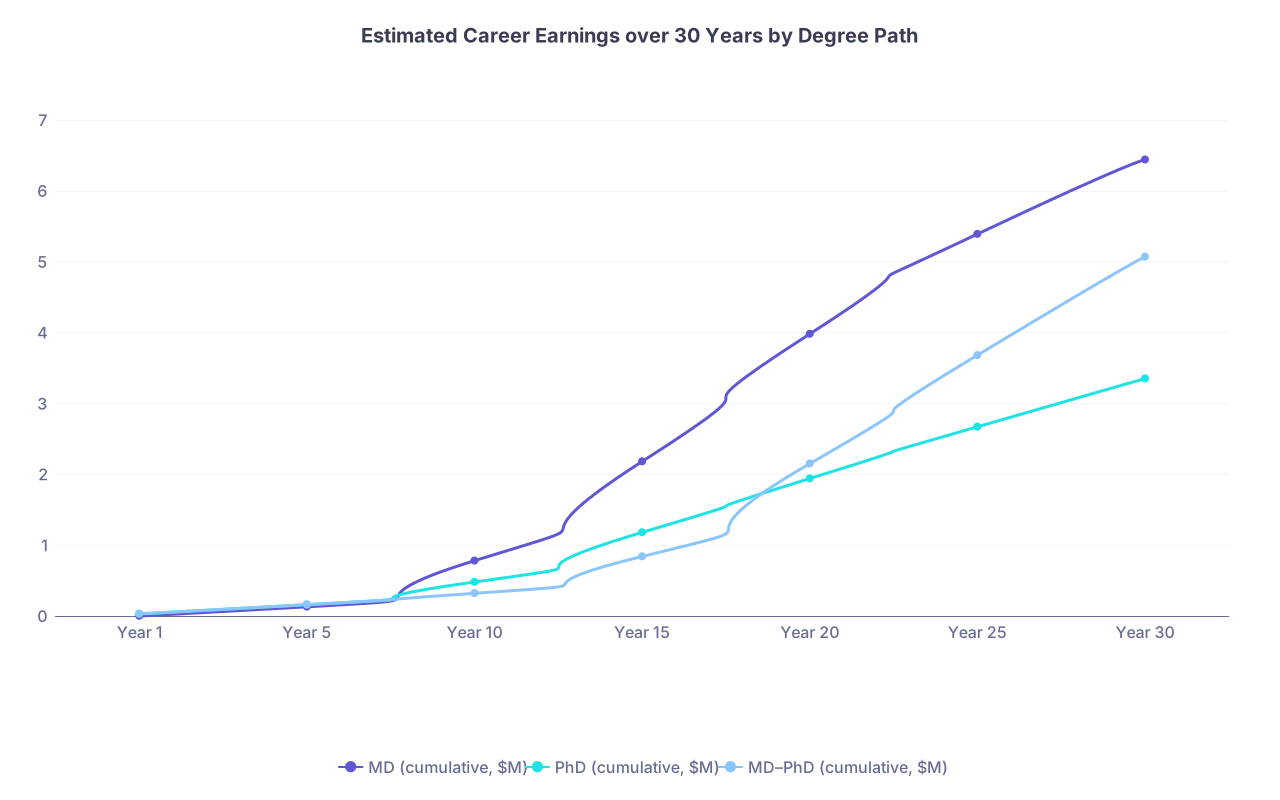
| Category | MD (cumulative, $M) | PhD (cumulative, $M) | MD–PhD (cumulative, $M) |
|---|---|---|---|
| Year 1 | 0 | 0.03 | 0.03 |
| Year 5 | 0.13 | 0.16 | 0.16 |
| Year 10 | 0.78 | 0.48 | 0.32 |
| Year 15 | 2.18 | 1.18 | 0.84 |
| Year 20 | 3.98 | 1.94 | 2.15 |
| Year 25 | 5.39 | 2.67 | 3.68 |
| Year 30 | 6.44 | 3.35 | 5.07 |
Opportunity cost: the MD–PhD penalty in pure dollars
The glaring fact: the MD–PhD starts high‑income work later than the MD. Four extra years in training at low pay is expensive relative to what an MD could be earning in those same years.
Let’s quantify the “lost” MD income during the MD–PhD extra years:
- MD becomes attending at 30
- MD–PhD becomes attending at 34
Using the MD model, approximate MD attending salary ages 30–34:
- Age 30: $250k
- Age 31: $253k
- Age 32: $256k
- Age 33: $259k
Total ≈ $1.02M in attending income for the MD during those four years.
MD–PhD instead earns:
- Ages 30–34 residency: 4 × $65k = $260k
So opportunity cost ≈ $760k in forgone MD attending income over those four years, in today’s dollars.
This is the real “price tag” of the MD–PhD in financial terms, net of the small stipend you actually receive. You pay that in time and delayed compounding.
Does the MD–PhD ever “catch up” to the MD purely on salary? Under the assumptions above, no. Even with slightly higher long‑term academic salaries, the MD’s 4‑year head start and longer high‑income runway keep it ahead in cumulative income.
To put it bluntly: If your primary objective is lifelong salary maximization, and you had the credentials to get into medical school, the MD almost always dominates the MD–PhD financially.
Variability by specialty and field
So far I have given you “central path” numbers. In real life, your specialty choice or PhD field can swing these curves by millions.
MD variability
Median generalist vs high‑pay specialty is not a minor difference:
- Family medicine / pediatrics: often $220–250k range
- Internal medicine subspecialties (cards, GI): $450–700k+
- Ortho, neurosurgery, interventional: $600k–1M+ at high end, especially with private practice and call pay
If you rerun the MD model with a $450k starting salary instead of $250k, the 22‑year attending earnings jump toward $11M+ in today’s dollars. That changes the MD vs PhD ratio from 1.9x to something more like 3x+. The MD–PhD is also affected if they pick a lucrative clinical subspecialty, but again they start later and tend to tilt more toward academic / hybrid roles, which tempers the upside.
PhD variability
On the PhD side, the tail outcomes are more extreme:
Academic bust scenario:
- 1–2 postdocs instead of 1 (so 6 years at $60k not 3).
- Adjunct or non‑tenure positions at $60–80k for years.
- You might not see a six‑figure salary until your early–mid 40s.
Industry / data / biotech upside:
- Start at $120–140k age 30–31 in big pharma or data science.
- Climb into $200–300k range by mid‑career if you move into leadership (director/VP).
The data show that staying purely in academia as a life sciences PhD is a financial bet with a poor expected value unless you hit the top ~10–15% of the distribution.
MD–PhD variability
The MD–PhD has multiple equilibrium points:
- Academic heavy (70–80% research): salary might be close to or slightly lower than a generalist MD in the same institution, but you have more grant dependence.
- Clinical heavy (50–80% clinical): you can earn near MD levels, especially if you take more call, more clinic sessions, or years in private practice. Many MD–PhDs effectively “behave like MDs” later in life, financially.
- Leadership route (division chief, chair, dean): now you can push into $400–700k territory in certain institutions. This is rare, but it exists.
You do not pick these outcomes cleanly at age 22. The probabilities evolve with your research productivity, grant success, and institutional politics.
Risk, probability, and “realistic” outcomes
You cannot just look at the line that says “senior professor makes X” or “cardiologist makes Y”. You have to ask: what is the probability that I land there?
Here is a simple way to frame it: expected value = sum(salary × probability of that outcome).
MD risk profile
MD income is high and relatively stable. Outside of personal disability or severe misconduct, the worst‑case is usually still a six‑figure job:
- Probability you finish med school and some residency: very high (>90% for a reasonably committed person)
- Probability you match into some specialty: high
- Probability of being unemployable at >$150k/year in the US after residency: very low
The MD path is a high‑floor / moderate‑ceiling income trajectory.
PhD risk profile
PhDs in biomedical research face:
- Probability that you get a stable, well‑paid tenure‑track role at an R1: low (single digits to low teens %)
- Probability you end up in a series of postdocs and soft‑money positions: high
- Industry remains a strong and somewhat safer pivot, but not guaranteed and often easier if you planned for it (skills, internships, networking)
The PhD path is a low‑floor / moderate‑ceiling path in academia, and medium‑floor / moderate‑ceiling in industry. Financially, it is much riskier.
MD–PhD risk profile
The MD–PhD is hedged:
- You keep the MD license and clinical skills. That is your income floor.
- You add research capacity, which can create upside in grants, leadership, and prestige but usually not in dramatically higher salary than purely clinical MD peers.
- The main predictable cost is delayed earnings and potentially slower climb on the pure clinical pay scale if you are devoting large chunks of your time to research.
So the data pattern is straightforward:
- In probabilistic terms, MD–PhD has a similar floor to MD, with slightly higher variance and slightly lower expected monetary value (because of the opportunity cost).
- PhD alone has both a lower floor and lower median earnings, with higher variance but only a moderate upside in the 90th+ percentile.
How student debt changes the calculus
Ignoring debt is dishonest. You are not just comparing gross salary; you are comparing disposable income after loan payments.
Basic reality:
- PhD in biomedical fields: often funded. Tuition is covered, you get a stipend. Debt stays at undergrad level, and sometimes not even that if you had scholarships.
- MD: median medical school debt for US grads hovers around $200–250k, sometimes more.
- MD–PhD: most MSTP / NIH‑funded programs cover full tuition and pay a stipend. Many MD–PhDs finish with near‑zero med school debt, again only undergrad loans.
So, you can refine the 30‑year numbers by subtracting cost of servicing debt.
A crude comparison:
- MD with $250k debt at 6% over 10 years: monthly ≈ $2,775, or about $33k/year. Over 10 years ≈ $330k in today’s dollars (ignoring tax benefits).
- MD–PhD with $0 additional med school debt: you avoid that $330k outflow.
So, in net terms:
- MD–PhD’s $1.4M lifetime earnings disadvantage vs MD (6.44M vs 5.07M) narrows by maybe $0.3M when you consider avoided med school debt. You are still behind by roughly $1.1M, but the penalty shrinks.
PhD may finish with minimal debt but the absolute income gap to MD is so large (≈$3.1M over 30 years in this model) that the advantage of lower debt does not close it materially.
Time, life, and burnout: the non‑trivial non‑financials
I am the “Data Analyst” here, but ignoring non‑financial constraints would be silly.
Key non‑numeric factors that do interact with the salary data:
Time to financial stability
- MD: stable medium‑high income by early 30s (if you do not pick neurosurgery etc.).
- PhD: stability may not appear until mid‑30s or later, especially in academia.
- MD–PhD: stability appears mid‑30s, but with the cushion of an MD license.
Burnout risk and schedule control
- High‑pay MD specialties often trade dollars for hours, nights, and stress.
- PhD academic roles can be intense but with more daytime work, less emergency call.
- MD–PhD academic roles can have better day‑to‑day variety but heavy grant pressure.
Geographic flexibility
- MDs have very high geographic mobility; every region needs clinicians.
- PhDs are more constrained by specific institutions and industries.
- MD–PhDs sit in the MD bucket for mobility if willing to go more clinical.
Those factors do not overturn the salary comparisons, but they change what “maximizing” means in practice. A $600k interventional cardiology job in a place you hate, with 1 in 3 call forever, is not actually superior for many humans to a $180k research role with reasonable hours and autonomy. Numbers matter, but they are not everything.
Pulling it together: who “should” pick what?
Let me strip away the fluff.
If your goal is maximizing 30‑year financial outcome and you can get into MD
- The data are blunt: MD alone dominates.
- MD–PhD is a financial downgrade unless you place huge personal value on research or expect to land in a high‑pay leadership niche.
- PhD alone is vastly inferior financially unless you hit a strong industry outcome.
If you are obsessed with research and willing to accept lower lifetime cash for it
- MD–PhD is often the best risk‑adjusted compromise.
- You get research training, some protected time, AND the MD backstop.
- You pay perhaps ~$1M (present‑value equivalent) in lost lifetime earnings vs MD, which is not trivial but is the cost of that dual identity.
If you are purely research‑driven and not interested in clinical work
- Then do not contort yourself into an MD just for money.
- Accept the lower earnings of the PhD path and optimize aggressively for industry‑relevant skills if you care about financial stability.
Last piece of data‑driven advice: the more you find yourself saying “I want the MD because I heard doctors make good money,” the more you should lean away from MD–PhD and PhD. That mindset will not carry you through an 8‑year dual‑degree experiment or a decade of soft‑money grants.
Core takeaways
- Over a 30‑year horizon, a typical MD earns about 2x a typical biomedical PhD and about 25–30% more than a typical MD–PhD in real, cumulative dollars.
- The MD–PhD is financially a discount version of the MD, bought with extra years of training, but it buys you research capability and academic leverage that pure MDs often do not have.
- The PhD path offers the lowest and riskiest financial trajectory of the three, unless you deliberately steer toward industry or data‑heavy roles, where it can become respectable but still usually trails the MD path by a wide margin.