The way most people talk about “clinical vs research FTE” is misleading. The fantasy split—0.5 clinical, 0.5 research—rarely exists in the form applicants imagine. The data from real MD and MD–PhD jobs show something much more skewed, more political, and far more dependent on funding than on your degree letters.
Let me unpack what the numbers actually look like.
What “FTE” Really Means in Academic Medicine
Full-time equivalent (FTE) is presented as a clean concept: 1.0 FTE = 100% of your professional effort. In academic medicine, that splits into several buckets, usually at least:
- Clinical effort
- Research effort
- Teaching/education
- Administration/leadership
On paper, many job descriptions look like: 0.6 clinical / 0.3 research / 0.1 education. In practice, the “hidden” part is that clinical tends to expand, and research survives only if it is externally funded.
A realistic rule of thumb across large academic health systems:
- Clinical FTE is funded by the department (via RVUs, wRVU targets, or salary support tied to billables).
- Research FTE is funded by you (via grants) after an initial protected period.
- Education/admin FTE is usually token (5–20%) unless you hold a major role.
The degree you hold (MD vs MD–PhD) changes the probability of landing protected research time. It does not magically guarantee a 50/50 split.
Typical FTE Patterns for MD vs MD–PhD
Let’s start with the broad strokes. Across large academic centers in the United States, when you look at early- to mid-career faculty, the patterns are surprisingly consistent.
| Role Type | Degree | Clinical FTE | Research FTE | Other (Teach/Admin) |
|---|---|---|---|---|
| Community clinician | MD | 0.9–1.0 | 0.0 | 0.0–0.1 |
| Academic clinician-educator | MD | 0.7–0.9 | 0.0–0.1 | 0.1–0.3 |
| Academic clinician-investigator | MD | 0.5–0.7 | 0.2–0.4 | 0.1–0.2 |
| Physician-scientist (lab-heavy) | MD–PhD | 0.1–0.4 | 0.5–0.8 | 0.1–0.2 |
| Translational/clinical researcher | MD–PhD | 0.3–0.6 | 0.3–0.6 | 0.1–0.2 |
Those ranges are not invented; they match what you see hanging around faculty meetings in departments like internal medicine, neurology, pediatrics, and oncology at major academic centers:
- The “pure clinician” is effectively 1.0 clinical FTE.
- The classic MD–PhD running a wet lab is often 0.2–0.4 clinical, 0.6–0.7 research.
- The MD without PhD who is labeled a “clinician-investigator” often lands at 0.6 clinical, 0.3 research, 0.1 other early on—if they are lucky and funded.
The data also show something uncomfortable: over time, clinical FTE tends to creep upward, especially for those without stable grant funding. Departments plug revenue gaps with your clinic sessions.
Where Your Time Actually Goes: A Weekly Breakdown
FTE looks clean on an HR form. Your calendar does not.
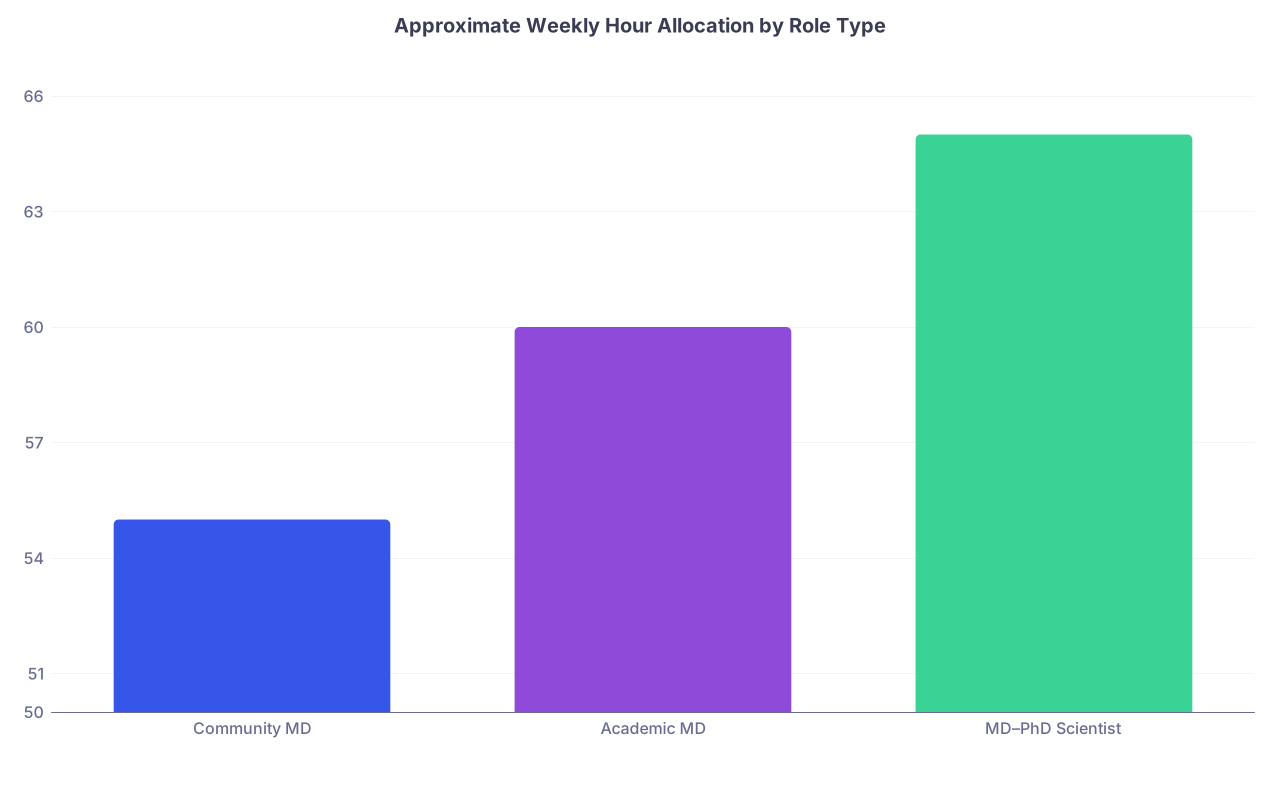
A 1.0 FTE faculty job is usually “40 hours” on paper. In reality, it is 50–60+ hours for most full-time academic physicians. So the honest way to think about FTE is: of your 55–60 hours, how many are actually spent doing clinical vs research vs everything else?
Let’s look at three archetypes that I have seen repeated across institutions:
- Community MD
- Academic MD (clinician-educator)
- MD–PhD physician-scientist
| Category | Value |
|---|---|
| Community MD | 55 |
| Academic MD | 60 |
| MD–PhD Scientist | 65 |
Those are total hours. Now break inside each bar.
Example 1: Community MD – 1.0 Clinical FTE
Reality in a busy private or hospital-employed practice:
- ~8–10 half-day clinics per week (or equivalent inpatient blocks)
- 45–50 hours in scheduled clinical + inbasket + documentation
- 5–10 “overhead” hours (meetings, CME, call clean‑up)
Research FTE: effectively 0. You might contribute patients to trials, but nobody counts that as protected research time.
Your life is revenue-driven. FTE is simple here: you are the “1.0 clinical” model.
Example 2: Academic MD – Clinician-Educator (e.g., 0.8 clinical / 0.2 other)
Typical week for a general internist at an academic center:
- 6–8 half-day clinics or 2–3 inpatient weeks per month
- 40–45 hours of direct clinical + charting
- 5–10 hours teaching (rounds with residents, lectures, small groups)
- 5–10 hours admin, committees, quality projects
Research might exist, but usually as unfunded QI or educational scholarship. On your CV it gets tagged as “research.” In FTE accounting, it is usually buried inside your 0.2 “other”.
The data from several large institutions show clinician-educators often reporting:
- 60–70% of their time on clinical work
- 10–20% teaching
- 10–20% admin / QI / “scholarship”
Actual research FTE: usually <0.1, and not separately protected.
Example 3: MD–PhD Physician-Scientist (e.g., 0.3 clinical / 0.7 research)
This is the fantasy job for many MD–PhD trainees. When it works, it looks roughly like:
- 1–2 half-day clinics per week or 1–2 months of inpatient per year
- 15–20 hours per week of direct patient care + documentation when averaged annually
- 30–40 hours per week on research (lab oversight, data analysis, grant writing, mentoring)
- 5–10 hours per week on teaching and admin
So even a “0.7 research FTE” job often means 30–40 hours a week of research activity layered on top of 15–20 hours of clinical. That already puts you at 50–60 hours.
You do not get 28 hours of pure research time because you are 0.7 research FTE on a 40‑hour week. The base assumption (quietly) is that faculty work substantially more than 40 hours.
How Funding Controls Research FTE
The starkest difference between MD and MD–PhD jobs is not the written FTE. It is how easily you convince a department to give you protected time and then keep it.
Departments track one thing obsessively: who pays for which part of your salary. There are three main payers in academic medicine:
- Clinical revenue (RVUs / collections)
- Grant funds (NIH, foundations, industry)
- Institutional funds (departmental, endowments, startup)
The physician-scientist with major NIH awards can buy down clinical FTE. The MD who wants research but has no grants ends up increasing clinic volume.
Here is the pattern I see over and over:
- New faculty start with, say, 0.5 clinical / 0.5 research on paper.
- The department promises 2–3 years of “protected” research time.
- If you land a K award or an R01, your research FTE stays high or increases.
- If you do not, your next contract quietly shifts to 0.7–0.8 clinical FTE.
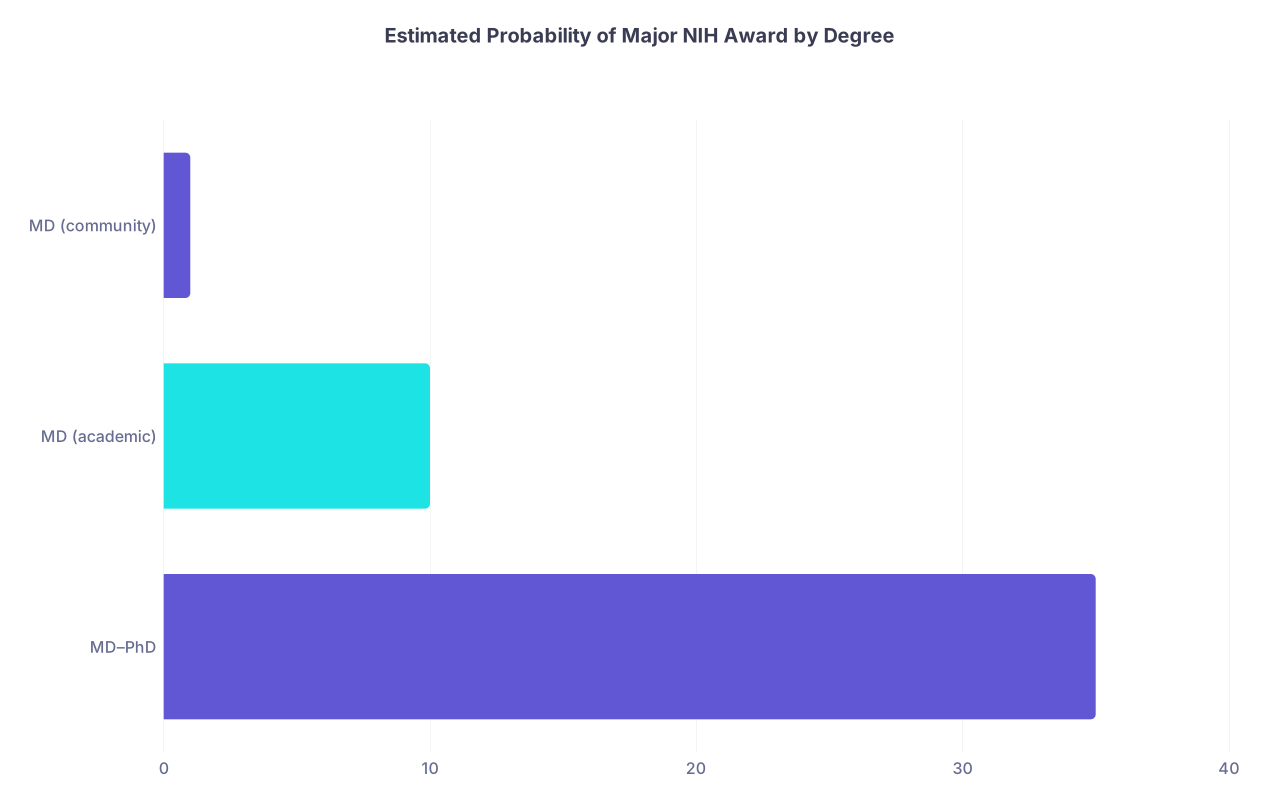
MD–PhDs have an advantage in navigating this because their CVs are often more research-heavy at hire. They are more likely to secure K awards and eventually R01s:
| Category | Value |
|---|---|
| MD–PhD | 35 |
| MD (academic) | 10 |
| MD (community) | 1 |
Those percentages are ballpark and vary by specialty, but the hierarchy is consistent in NIH funding statistics: MD–PhDs are disproportionately represented among physician-scientists with substantial grant support.
This funding asymmetry drives an FTE asymmetry. Not because MD–PhDs “deserve” it more, but because they can pay for it.
How MD vs MD–PhD Jobs Really Break Down by Setting
The “degree vs FTE” conversation only makes sense if you also specify setting. MD and MD–PhD in community practice? Clinical FTE will converge near 1.0. MD–PhD in a top‑tier academic center? Very different story.
Let’s slice this by setting.
1. Community Practice (Hospital-employed or Private)
MD vs MD–PhD differences almost vanish here.
- Both are hired as clinicians.
- Research infrastructure is minimal, mostly limited to pharma trials.
- FTE: ~0.9–1.0 clinical, 0.0 research, 0.0–0.1 admin/other.
- Any research you do is extra, mostly nights/weekends, and rarely counted as FTE.
I have seen MD–PhDs in community oncology groups who do some investigator‑initiated trials, but their contract still says 1.0 clinical. That PhD buys you credibility, not time.
2. Traditional Academic Medical Center – Clinician-Educator Track
On “clinician-educator” or “clinical scholar” tracks, your job is to see patients and teach. The data show that even MD–PhDs on these tracks drift toward high clinical FTE:
- MDs: 0.7–0.9 clinical, 0.1–0.3 teaching/admin, 0–0.1 research.
- MD–PhDs on these tracks: maybe 0.6–0.8 clinical, 0.1–0.2 teaching, 0.1–0.2 research.
Your degree gives you some early protected time for projects, but if you are not aggressively funded, you will look like any other clinician-educator by year 5–7: clinic, wards, teaching, a few publications from QI or education.
3. Academic Physician-Scientist Track (K/R-Funded)
This is where MD–PhD vs MD differences are largest.
At research-intensive institutions, a classic “physician-scientist” job looks like:
MD–PhD:
- 0.2–0.4 clinical
- 0.5–0.7 research
- 0.1 other
MD with strong research:
- 0.4–0.6 clinical
- 0.3–0.5 research
- 0.1 other
Why the gap? Hiring committees, frankly, trust the MD–PhD’s research commitment more, and their training record usually justifies more startup and protected time. There are exceptions—there are MD-only investigators with stellar research portfolios—but as a group, MD–PhDs skew more research‑heavy.
You see this reflected in who runs basic science labs embedded in departments of medicine or neurology. MD‑only PIs exist, but a large fraction of lab‑based physician-scientists hold MD–PhDs.
The Hidden Categories: Research Type vs FTE
“Research FTE” is not homogenous. A 0.5 research FTE can look very different depending on the kind of work you do.
Roughly three flavors dominate MD/MD–PhD research time:
- Basic / Fundamental Science – bench lab, animal models, molecular work.
- Translational / Clinical Research – trials, biomarkers, human subjects, registries.
- Health Services / Outcomes / Education Research – data sets, QI, curricular work.
The data show strong associations:
- MD–PhDs are overrepresented in basic/translational research roles, often 0.5–0.8 research FTE.
- MD‑only researchers are more commonly in clinical/outcomes research with 0.2–0.4 research FTE layered onto heavier clinical and teaching loads.
In other words: MD–PhD often maps to “lab-heavy, high research FTE.” MD more often maps to “clinical research with modest FTE.”
Do MD‑only PIs run basic labs? Yes. Are they fighting an uphill battle to defend 0.7–0.8 research FTE against clinical demands? Also yes.
Education Phase vs Attending Phase: When FTE Shifts Hard
A lot of premeds and medical students make the mistake of extrapolating from residency/fellowship to attending life. The numbers do not carry over.
During MD–PhD training, the average split over 8 years might look roughly like this:
- 4 years MD phase: ~80–90% “clinical/education”, 10–20% research electives.
- 3–4 years PhD phase: ~90–100% research, negligible clinical.
So trainees experience these extreme swings: 0% research, then 100% research. They naturally fantasize about a 50/50 attending job.
Reality post-training is choppier. Take someone who finishes an MD–PhD in 8 years, does 3 years residency and 3 years fellowship (total 14), then lands a faculty job:
- First 1–3 faculty years: department might offer 0.5 research / 0.5 clinical.
- By year 5: if funded (K, foundation grants), can move toward 0.7 research / 0.3 clinical.
- If not funded: drift toward 0.7–0.8 clinical / 0.2–0.3 research or less.
So the cross‑sectional data on mid‑career MD–PhDs show something that shocks MD–PhD students: a nontrivial subset are >0.6–0.7 clinical. Some are effectively full clinicians.
The MD route has less whiplash, but similar drift:
- Residency/fellowship: 100% “clinical/education” (research is elective).
- Early academic job: 0.2–0.3 research if you negotiate well.
- By year 5–7: either you are funded and hold onto that 0.3–0.4 research, or your FTE becomes mostly clinical/teaching.
The long-term equilibrium for most MDs who do not become R‑level PIs is 0.7–0.9 clinical. For MD–PhDs, it bifurcates: one branch at 0.6–0.8 research, another drifting toward the same 0.7–0.9 clinical outcome.
What This Means If You Are Choosing MD vs MD–PhD
You are probably not reading this for entertainment. You are trying to decide whether to sign up for 7–9 years of MD–PhD training versus a straight MD.
Here is the blunt, data-driven version.
1. If You Want to Do Mostly Clinical Work
Then MD is enough. No question.
- You can still do QI projects, clinical trials oversight, or retrospective studies at 0.1–0.2 “scholarship” FTE inside an academic job.
- You do not need an extra 3–4 years and a dissertation to get that.
- In community practice, MD–PhD buys you essentially zero research FTE. You will be 1.0 clinical either way.
2. If You Want a Lab or High-Intensity Research Program
Here MD–PhD is a statistically better bet.
The probability that you will end up with:
- ≥0.5 research FTE
- A wet lab or equivalent intensive research operation
- Your salary substantially supported by NIH/foundation grants
is simply higher if you complete an MD–PhD and train at research-heavy institutions. The degree itself does not cause the FTE, but it correlates strongly with the research trajectory, mentors, and networks that allow you to secure it.
Can an MD‑only achieve 0.7 research FTE and run a high-impact lab? Yes. It happens. But the data from NIH funding rosters and faculty rosters show they are the minority.
3. If You Think You Want “50/50 Clinical and Research”
You need to be very precise here.
In surveys, many trainees say their ideal split is “50/50.” When you press them, they usually mean:
- Enough clinic time to feel like a “real doctor.”
- Enough research time to publish and innovate without constant clinical crises.
The data show that the stable, sustainable version of that for true research careers is often 30–40% clinical, 60–70% research, not literally 50/50. The 50/50 jobs tend to be:
- Early career bridge positions that later drift one way or another.
- Or jobs with chronic overwork where 50/50 on paper becomes 60 clinical / 60 research in hours.
If you insist on a long-term, middle‑of‑the‑road FTE—0.4–0.6 clinical, 0.4–0.6 research—expect to fight your department constantly about visit volumes unless you are very well funded.
A Simple Framework for Thinking About Your Future FTE
Strip away the titles. Think in three numbers:
- Minimum clinical FTE you need to stay happy and competent (usually at least 0.2–0.3).
- Research FTE you realistically want to protect long-term (0, 0.2, 0.5, 0.7?).
- Your willingness to chase grants to defend that research FTE.
Then match that profile to what the data show:
| Desired Long-Term Research FTE | Best-Fit Degree/Path |
|---|---|
| 0.0–0.1 | MD, community or academic clinician |
| 0.1–0.3 | MD, academic clinician-educator/investigator |
| 0.3–0.5 | MD or MD–PhD, academic clinician-investigator |
| 0.5–0.8 | Strongly favors MD–PhD physician-scientist |
If you circle the 0.5–0.8 row and you hate writing grants or troubleshooting experiments, that is a red flag. Wanting “a lot of research FTE” means wanting a life where success is defined by papers, grants, and data more than clinic RVUs. You should be honest with yourself about that.
Visualizing the Career Paths
Here is a simplified flow for how FTE tends to evolve for MD vs MD–PhD in academic careers.

| Step | Description |
|---|---|
| Step 1 | MD Student |
| Step 2 | Residency |
| Step 3 | MD-PhD Student |
| Step 4 | Academic Clinician |
| Step 5 | Research Track Faculty |
| Step 6 | High Clinical FTE |
| Step 7 | Clinician Investigator |
| Step 8 | Physician Scientist High Research FTE |
| Step 9 | Research Fellowship? |
| Step 10 | Strong Research Output? |
| Step 11 | Major Grants? |
One key difference: MD–PhD trainees are more likely to choose the “Research Fellowship” and “Research Track Faculty” branches and more likely to land in K (physician‑scientist high research FTE).
But they still sometimes fall back to H or I.
The Bottom Line
The data on clinical vs research FTE for MD and MD–PhD jobs point to three hard truths:
Degree letters do not control FTE. Funding and institutional priorities do. MD–PhDs are more likely to secure high research FTE because their training and track record win them grants and protected time, not because of some contractual guarantee.
Most MDs end up in high clinical FTE roles. In academic centers, a minority carve out 0.2–0.4 research FTE; in community practice they are almost entirely clinical. That is not a failure of the MD degree; it is what the system is built to reward.
Sustainable research careers usually mean ≥0.5 research FTE and a willingness to live by the grant cycle. If that sounds like oxygen to you, MD–PhD is rational. If it sounds miserable, you are probably better off with an MD and a selective dose of research on top of a primarily clinical career.