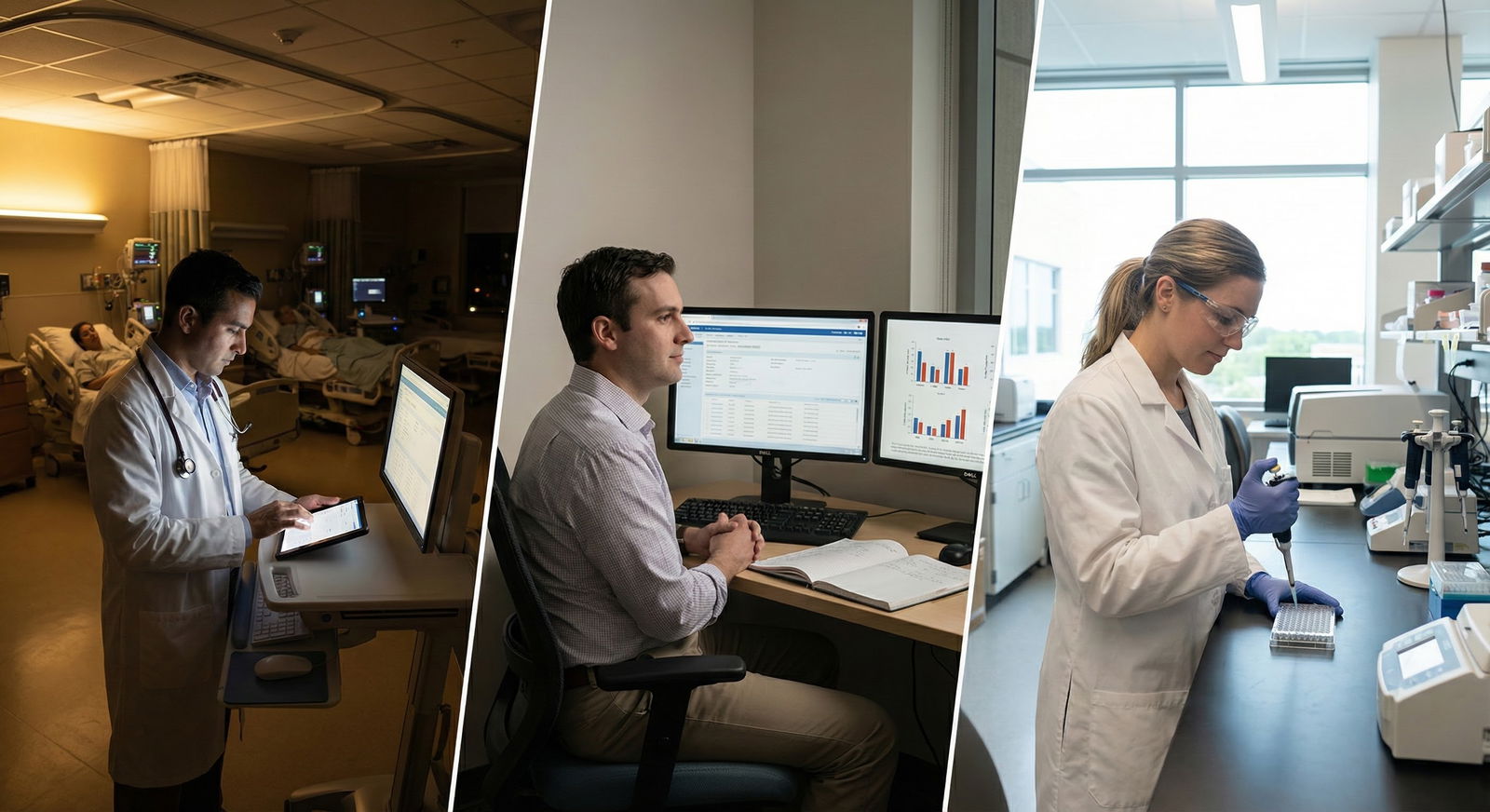
The mythology about work hours is wrong: MDs are not always drowning, PhDs are not always cushy, and MD–PhDs are not “half and half.” The data show three very different work‑hour profiles with distinct peaks, volatility, and long‑term trajectories.
If you are choosing between MD, PhD, or MD–PhD, you are effectively choosing a lifetime time‑budget. Let’s treat it that way.
The Big Picture: Lifetime Hour Profiles
Strip away the anecdotes and you see a fairly consistent pattern across large datasets (AAMC, NRMP, Medscape, NIH, Nature surveys) and what I have seen across academic medical centers:
- MD clinicians: Very high hours during training, then a tapered but still heavy and volatile schedule with nights/weekends and call.
- PhD scientists: Long, often undercounted hours in early career, but more daytime‑concentrated and with fewer true emergencies.
- MD–PhDs: Peak hours rival surgical residents at certain points, then settle into a high but more diversified load split between clinic, research, admin, and teaching.
To make this less abstract, here is a rough comparison at a mature career stage (not residency or postdoc, but when you are in a stable attending/PI role).
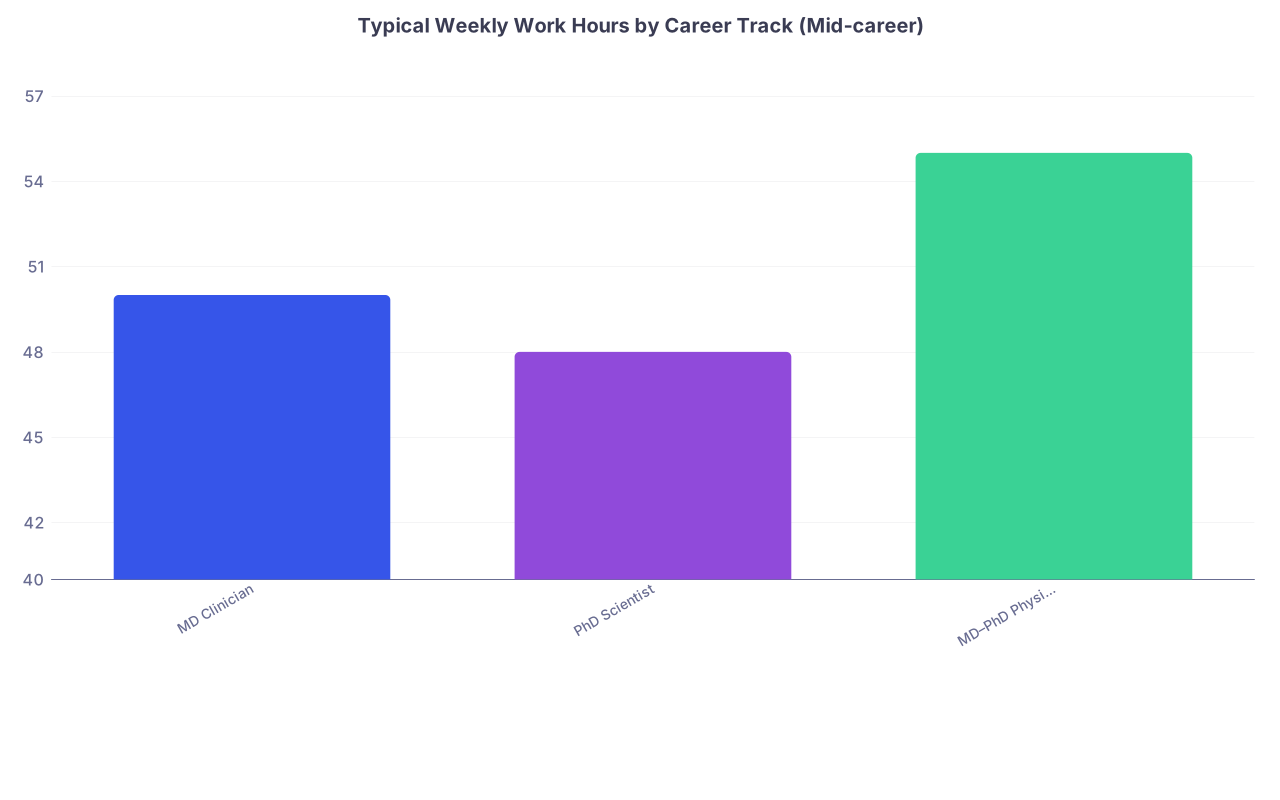
| Category | Value |
|---|---|
| MD Clinician | 50 |
| PhD Scientist | 48 |
| MD–PhD Physician-Scientist | 55 |
You should not obsess over the exact numbers—different specialties and institutions vary—but the shape is consistent: MD–PhPs usually run the highest sustained weekly load; pure MD and pure PhD cluster just under that.
Now let’s dissect the profiles across phases of training and career.
Phase 1: Training – Medical School, Graduate School, MD–PhD Integration
MD Path: Medical School
Medical school hours are front‑loaded and exam‑driven. They are also underreported because “studying at home” does not show up in any HR system.
Typical 1st–2nd year MD student at a U.S. allopathic school:
- Scheduled class/lab: 25–30 hrs/week (many schools moving to more asynchronous content, but students still treat it as time).
- Independent study: 20–30 hrs/week (closer to 40 during Step 1 prep peak).
- Clinical shadowing / optional activities: 2–5 hrs/week.
Realistic total: 45–60 hrs/week most weeks; 70+ during exam or dedicated Step 1 period.
Clinical years (MS3–MS4) shift from study‑heavy to service‑heavy:
- Core clerkship rotations: 60–80 hrs/week on surgery/IM; 50–60 on outpatient‑heavy blocks.
- Shelf exam study layered on top: 5–10 hrs/week.
So the med student work‑hour profile is spiky: moderate but sustained in pre‑clinicals, then 12–18 months of near‑resident hours in clinicals.
PhD Path: Graduate School
PhD programs rarely track hours formally, but every serious survey converges on the same picture: long, elastic workweeks that hinge on project and advisor.
Common pattern for biomedical science PhD students:
- Early coursework year: 40–55 hrs/week (classes, rotating labs, reading).
- Full‑time research years: 50–65 hrs/week typical; 70+ near submission deadlines, experiments, or qualifying exams.
The key difference from MD students:
- Fewer enforced nights and weekends. Many PhD students still come in Saturdays (cell culture, animal work, sequencing runs), but those hours are often self‑scheduled.
- Less “hard stop” deadlines except for conferences, grant submissions, qualifying exams, and thesis defense.
In practice, I have seen plenty of serious PhD students in the lab 9–7 Monday–Friday and 4–6 hours one weekend day: that is ~55–60 hours, but the shape is more flexible and discretionary than an M3 internal medicine rotation.
MD–PhD Path: Combined Training
For MD–PhDs, you stack these phases, not average them. The combined track keeps you in training longer (7–9 years for MD–PhD vs 4 years MD or 5–6 years PhD), and the work‑hour pattern whiplashes:
- MD pre‑clinical phase: 45–60 hrs/week, same as MD peers (with extra research or program duties in many MSTPs).
- PhD phase: 50–65 hrs/week, but with a layer of “maintain clinical identity” requirements (clinic, seminars, Step exam timing).
- MD clinical phase return: 60–80 hrs/week, often after several years “out of the wards.”
The result is a prolonged high‑intensity stretch before you even start residency. An MD–PhD finishing at 30 has often logged more total training hours than a same‑age MD and PhD combined, because there is less downtime between phases and more dual commitments.
Phase 2: Residency vs Postdoc – The True Peak
This is where the differences become brutally clear. Residency is the most strictly regulated and best‑measured part of U.S. physician training. Postdocs are loosely monitored and heavily culture‑driven.
MD Clinicians: Residency and Fellowship
ACGME standards cap resident duty hours:
- Max 80 hours/week averaged over 4 weeks.
- One day free of clinical duties in 7, averaged over 4 weeks.
- 24‑hour continuous duty cap, with up to 4 hours extra for transition/education.
Those are caps, not averages. Real data from multiple residency programs show typical ranges:
- Many medicine, surgery, OB/GYN, and EM residents: 60–75 hours/week most months.
- Outpatient‑heavy specialties (neurology, psychiatry, derm) somewhat lower: 55–65 hours/week.
The profile also includes:
- Nights, 24‑hour calls, flip‑flopping circadian cycles.
- Non‑negotiable presence: when you are on, you are there. You do not “shift your hours” to Sunday afternoon.
Subspecialty fellowship often resembles a slightly toned‑down version of residency:
- Many fellowships: 55–70 hours/week depending on call burden and procedural load.
The physician training work pattern is fully immersive and often physically punishing. The 80‑hour limit is not a theoretical worst case; it is routinely approached in some surgical and ICU months.
PhD Scientists: Postdoctoral Years
Compare that to a typical life sciences postdoc in academia:
- Lab presence: 45–55 hours/week baseline (9–6 most weekdays, plus 1 short weekend day).
- Peaks: 60–70 hours/week around paper submission, grant deadlines, big experiments.
- Nights: often limited to specific experimental needs; not predictable shifts or in‑house call.
The psychological component is different. Postdocs are under immense pressure (publications, funding, job prospects), but they usually:
- Sleep in their own bed every night.
- Rarely work 28‑hour continuous stretches.
- Have somewhat real weekends outside of crunch periods.
The hours can still be brutal, especially under high‑expectation PIs. But the absence of structured call and night float makes the hour profile less physiologically taxing than residency.
MD–PhDs: Residency/Research Hybrids
MD–PhDs in residency usually do the same residency as MD colleagues. The work‑hour rules do not change because you have a PhD. Where it diverges is:
- Research time: Many physician‑scientist tracks build in 1–2 protected research years or 20–50 percent research time during upper years.
- “Protected” is often aspirational during clinical crunch times. I have seen MD–PhDs on paper at 50 percent research who are effectively doing 100 percent residency plus research on evenings/weekends.
Real‑world consequence: MD–PhDs often experience the highest peak hours of anyone in the system.
When a PGY‑4 in physician‑scientist track says: “I do 60 hours clinical and 20 in the lab,” they are not exaggerating. That 80 hours is above a typical postdoc and right at the ACGME cap, but with less flexibility.
Phase 3: Early Career – Attending vs Assistant Professor
After training, hours come down, but not as much as people imagine. And the profiles now diverge by role: pure clinician, pure scientist, or hybrid.
MD Clinicians: Clinical Attending
The data from Medscape, specialty societies, and multiple workforce surveys converge around this: most full‑time physicians work in the 45–60 hour range weekly.
| Specialty | Average Weekly Hours |
|---|---|
| Family Medicine | 50–55 |
| Internal Medicine | 55–60 |
| General Surgery | 60–65 |
| Emergency Medicine | 40–45 (but shifts) |
| Dermatology | 40–45 |
Some nuance:
- Shift‑based fields (EM, hospitalist, anesthesiology): Hours are clearer (12 shifts × 10 hours ~ 120 hours every 2 weeks; 60/week). Off is truly off.
- Office‑based fields: “Clinic” hours hide charting, results calls, and inbox messages. Official 40‑hour week is often 50+ in reality.
- Surgical fields: OR days can run 10–14 hours, with overnight call on top, especially in academic centers.
Key structural traits:
- Nights/weekends remain common in hospital‑based specialties.
- Emergencies override your schedule.
- Little separation between “work” and “non‑work” psychologically, especially in primary care or inpatient roles.
The average may look similar to other professions, but the distribution is skewed: more extreme spikes, more circadian disruption, more “zero‑control” hours.
PhD Scientists: Assistant Professor / PI
Early‑career PIs, especially in biomedical research, work a lot. Surveys of faculty show consistent numbers:
- 50–60 hours/week as a realistic baseline.
- 60–70 hours/week around grant deadlines (R01, K awards) and paper submissions.
However, the time composition is very different from clinicians:
- Grant writing and revisions: 10–20 hours/week in high‑stakes periods.
- Paper writing/review: 5–10 hours/week.
- Lab meetings, mentoring: 5–10 hours/week.
- Actual bench work (if early career and hands‑on): 10–20 hours/week.
- Teaching/admin: variable by institution (0–15 hours/week).
Most of this is daytime and can be flexed. Yes, plenty of PIs answer emails at night, but the intensity and immediacy of a code blue is not part of the job.
The hour profile is high but smoother. Fewer 3 AM emergencies. More “cycle around deadlines” than “cycle around pathology.”
MD–PhD Physician‑Scientists: Dual Role Attending
Now combine the clinical load of an attending with the research load of a PI. That is the MD–PhD early‑career picture.
Typical academic physician‑scientist appointment:
- 60–80 percent research, 20–40 percent clinical on paper.
- “20–40 percent clinical” usually concretizes as 1–2 full clinic days or 1–2 weeks of inpatient service per month, plus call.
In raw hours this often looks like:
- Clinical: 16–24 hours/week averaged over the year (but very spiky—zero when off service; 60+ when on service weeks).
- Research/admin/teaching: 30–40 hours/week.
Aggregate: 50–65 hours/week for many, especially in the first 5–10 years while building a lab and CV.
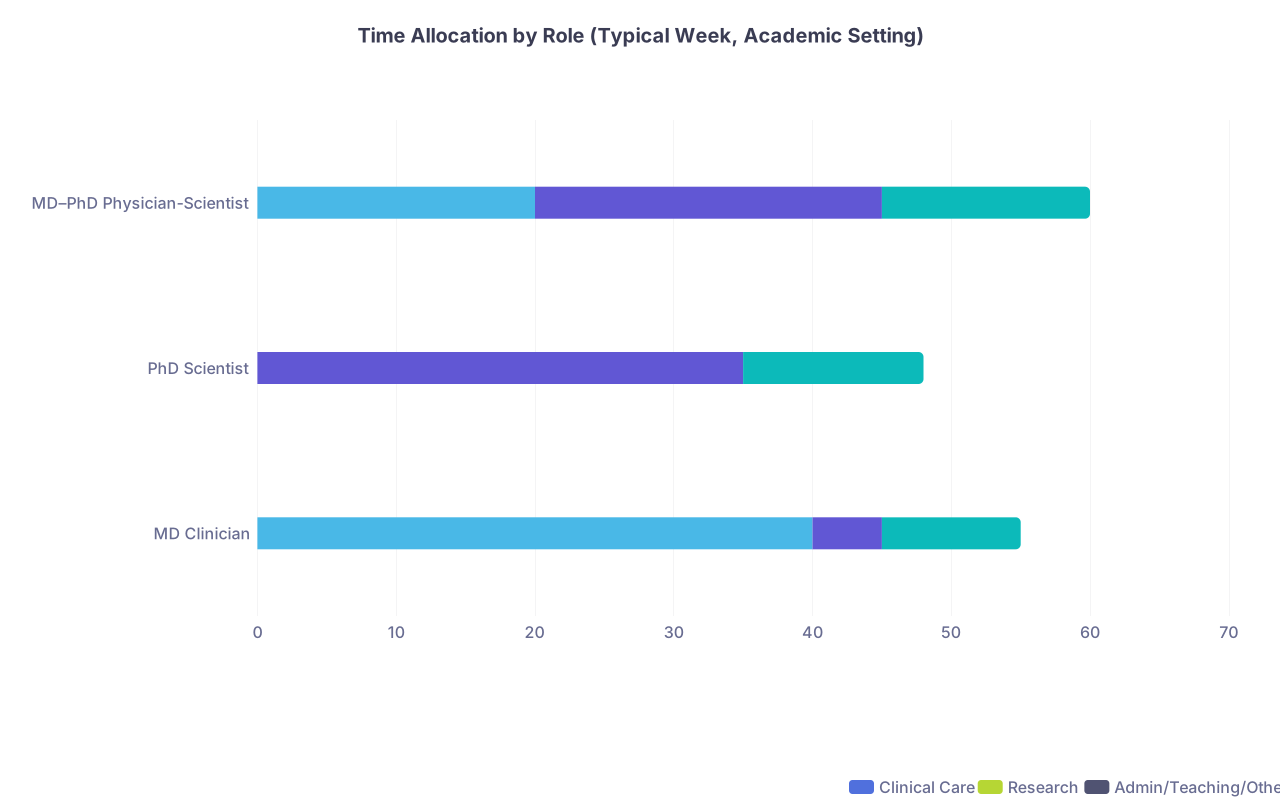
| Category | Clinical Care | Research | Admin/Teaching/Other |
|---|---|---|---|
| MD Clinician | 40 | 5 | 10 |
| PhD Scientist | 0 | 35 | 13 |
| MD–PhD Physician-Scientist | 20 | 25 | 15 |
The punchline: MD–PhDs routinely work physician‑level clinic/service hours plus scientist‑level research/admin hours. They are not “half a doctor and half a scientist.” They are often “75 percent of each.”
Circadian Load, Autonomy, and Volatility
Raw weekly hours miss two critical dimensions that matter for your life: when you work and how much control you have over it.
Circadian Stress
- MD clinicians: High circadian load. Rotating nights, 24‑hour calls, step‑downs from residency may continue into attending life depending on specialty.
- PhD scientists: Mostly daytime oriented. Some late nights for experiments but rarely systematic night work.
- MD–PhDs: Clinical portion exposes them to the same circadian issues as MD peers; research portion is usually daytime. So they get the worst of both realms: disrupted circadian rhythm during clinical weeks, then needing to perform high‑cognitive research work immediately after.
Autonomy Over Schedule
Let me be blunt: if you want maximum autonomy over your calendar, pure clinical medicine is the worst choice of the three—especially in training.
Rough hierarchy of control:
- High control: Senior PIs (PhD) who set their lab’s culture and teaching load.
- Medium control: Mid‑career MD clinicians in outpatient‑heavy fields or locum/shift‑based roles; they can sometimes choose FTE and shift mix.
- Low control: Residents, fellows, early‑career MD–PhDs trying to keep both their division chief and department chair happy.
PhD trajectories also have periods of low control (grad school, postdoc under a domineering PI), but the knob you turn to change things (switch labs, switch institutions) is often more feasible than switching medical specialties after residency.
Long‑Term Trends: Hours Over the Career Arc
Think about the full arc: age 22–65. The best way to visualize the difference is a qualitative “area under the curve” for intense hours.
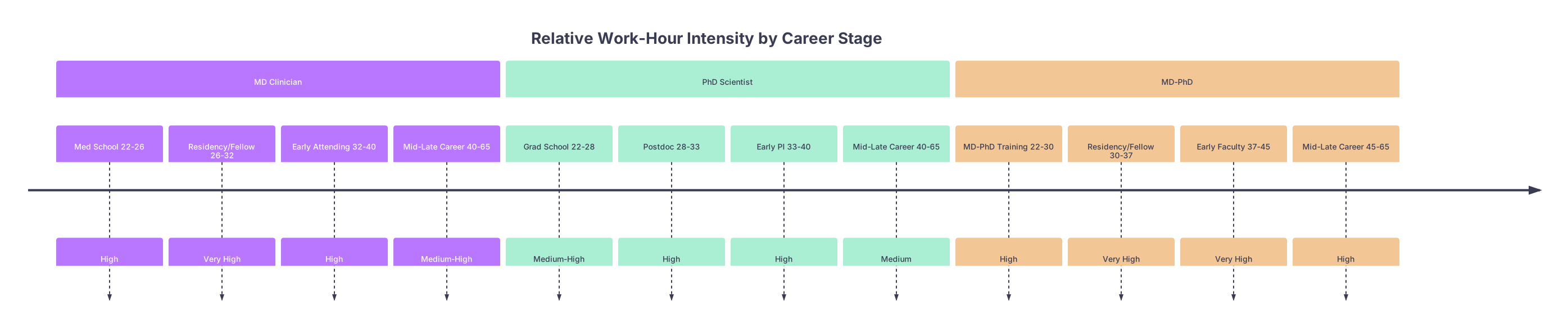
| Period | Event |
|---|---|
| MD Clinician - Med School 22-26 | High |
| MD Clinician - Residency/Fellow 26-32 | Very High |
| MD Clinician - Early Attending 32-40 | High |
| MD Clinician - Mid-Late Career 40-65 | Medium-High |
| PhD Scientist - Grad School 22-28 | Medium-High |
| PhD Scientist - Postdoc 28-33 | High |
| PhD Scientist - Early PI 33-40 | High |
| PhD Scientist - Mid-Late Career 40-65 | Medium |
| MD-PhD - MD-PhD Training 22-30 | High |
| MD-PhD - Residency/Fellow 30-37 | Very High |
| MD-PhD - Early Faculty 37-45 | Very High |
| MD-PhD - Mid-Late Career 45-65 | High |
Qualitative summary:
- MD clinicians: Brutal peak 26–32, then plateau at “busy but manageable,” with possible reduction in call and clinical volume in late career.
- PhD scientists: More evenly high from late 20s into 40s, then can taper teaching/admin or lab size depending on funding and institutional norms.
- MD–PhDs: Very high from late 20s into at least mid‑40s. Many only meaningfully reduce their hours after they are firmly established with sustained funding and promotions.
An MD–PhD physician‑scientist who is 45 with two R01s and leadership roles may finally have enough leverage to offload some clinical or administrative burden. But the run‑up to that point is long and intense.
Special Cases and Outliers
There are exceptions that matter.
Lower‑Hour MD Profiles
These typically involve:
- Dermatology, pathology, some radiology, certain outpatient psychiatry settings.
- Employed positions with strictly enforced clinic hours and minimal call.
- Part‑time or 0.6–0.8 FTE roles, often later in career or in non‑academic settings.
Even then, total hours often drift up with inbox management, patient messages, and “just one more chart.”
Lower‑Hour PhD Profiles
These are more common outside research‑intensive R1 universities:
- Primarily teaching colleges (4‑year liberal arts institutions) where research expectations are lower.
- Industry roles where workload peaks but 40–50 hours/week is the cultural norm.
- Data science/biotech positions with true 9–5-ish structure plus occasional product pushes.
If you measure effective stressful hours, some of these roles compare favorably with almost any clinical job.
High‑Hour PhD Outliers
There are also PIs who work like surgical attendings:
- Constant grant churn in underfunded areas.
- Large lab management plus heavy teaching plus departmental roles.
- External duties (study sections, editorial boards, conferences) stacked on top.
The difference is still structural: they usually choose when they work those hours. They are not being paged at 2 AM to fix a hemorrhage.
Decision Framing: What The Data Actually Suggest
Stop asking “Who works harder, MDs or PhDs?” That is the wrong question. The better questions:
- How much circadian disruption am I willing to tolerate?
- How much control do I want over when I work?
- How long am I willing to sustain >55–60 hours/week as a baseline?
- Do I actually want to stack two demanding careers (MD–PhD), or am I romanticizing the label?
If you want a clear, data‑aligned framing:
- MD only: Expect intense, low‑control hours through your early 30s and 45–60 hours/week (sometimes with nights/weekends) for most of your career. Maximum direct patient contact, minimum schedule autonomy in training.
- PhD only: Expect 50–60 hours/week from mid‑20s onward with more flexible timing and fewer nights/weekends, but with chronic pressure to secure funding and publish.
- MD–PhD: Expect the most sustained high load, especially from age ~28–45, with resident‑level or higher total hours and split priorities between clinic and research. The reward is a hybrid identity; the cost is time and volatility.
One visual to close the loop on correlation between workload and “mixed” roles:
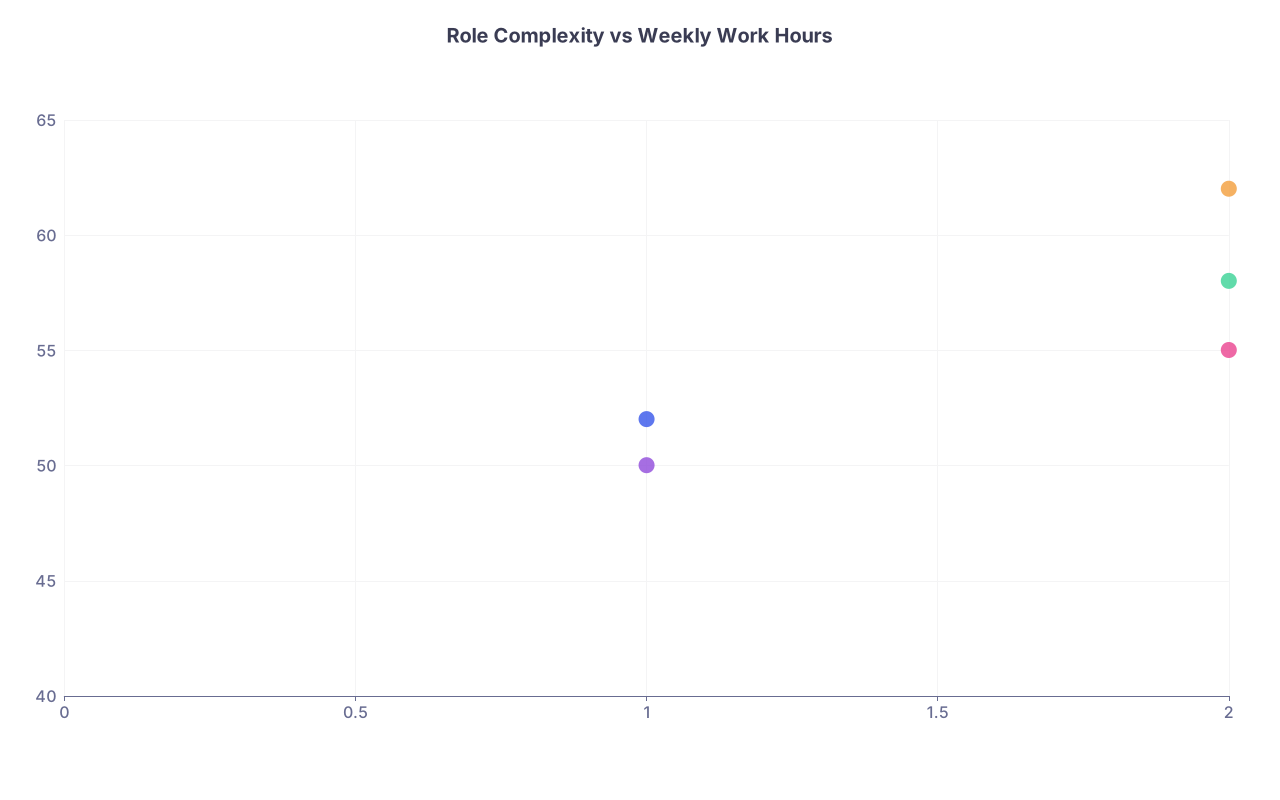
| Category | Value |
|---|---|
| MD Clinician | 1,52 |
| PhD Scientist | 1,50 |
| MD–PhD A | 2,58 |
| MD–PhD B | 2,62 |
| Clinician-Scientist MD | 2,55 |
Here, “role complexity” is a crude axis: 1 = single primary role, 2 = dual role. The data pattern is simple: the more identities you try to fully inhabit, the more hours you will work.
Key Takeaways
- MD, PhD, and MD–PhD paths differ less in raw weekly hours than in when and how those hours occur. MDs carry the heaviest circadian and emergency burden; PhDs have more flexible but still long workweeks; MD–PhDs stack both.
- Across the career, MD–PhDs usually sustain the highest cumulative load, with physician‑level clinical work plus scientist‑level research expectations, especially from late 20s through mid‑40s.
- If you are choosing a path, optimize not for prestige but for the time‑profile you can realistically tolerate: your sleep, your autonomy, and your willingness to live at 55–65 hours/week for decades.