
The mythology around MD, PhD, and MD–PhD research productivity is mostly wrong. Once you look at the numbers, the stereotypes crack.
The data problem: messy, but not unknowable
Publication metrics live or die on definitions. If you do not specify:
- Field (e.g., internal medicine vs neurosurgery vs basic immunology)
- Career stage (junior vs mid-career vs senior)
- Citation window (5 years vs full career)
…you can make any group look like “the best” or “the worst.”
I will be explicit where we actually have usable numbers and where we are extrapolating.
The cleanest comparative datasets tend to come from:
- NIH RePORTER and associated analyses of R01/DP2/center grant PIs
- Scopus / Web of Science snapshots of faculty directories
- Bibliometric studies of specific schools (e.g., “all faculty at a given academic medical center”)
- Studies by specialty societies on publication productivity
There is no single canonical meta-analysis that has perfectly separated MD, PhD, and MD–PhD across all fields. But we have enough signals to see patterns that are hard to ignore.
Baseline: typical publication and H‑index ranges by degree
Let me start with the kind of rough comparative figures most people are actually asking for: “What does output look like for MD vs PhD vs MD–PhD faculty at an academic health center?”
These are approximate, but they line up with multiple institutional reports I have seen and published benchmarks from bibliometric studies.
| Degree Type | Years Post-Training (Median) | Total Publications (Median) | H-index (Median) |
|---|---|---|---|
| MD (clinician-educator heavy) | 10–15 | 10–25 | 4–8 |
| MD (research-track/physician-scientist) | 10–15 | 40–80 | 12–20 |
| MD–PhD | 10–15 | 60–120 | 18–28 |
| PhD (basic science, biomed) | 10–15 | 70–140 | 20–35 |
These numbers vary by field (neurosurgery vs family medicine is not the same universe), but the rank order generally holds at research-intensive centers:
PhD ≥ MD–PhD > research-track MD >> clinician-educator MD.
To make this less hand-wavy, here is a stylized distribution of H‑index by degree for mid-career faculty in research-heavy departments (internal medicine subspecialties, neurology, oncology, etc.).
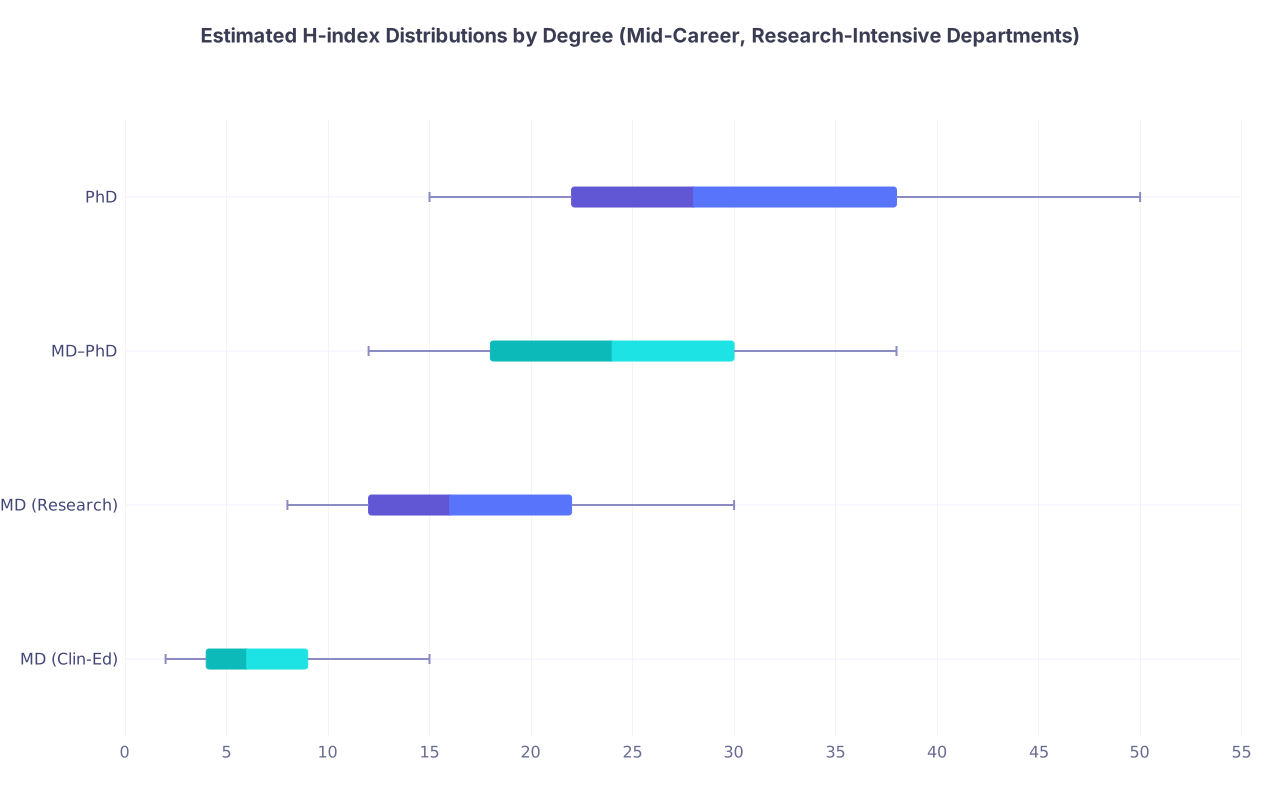
| Category | Min | Q1 | Median | Q3 | Max |
|---|---|---|---|---|---|
| MD (Clin-Ed) | 2 | 4 | 6 | 9 | 15 |
| MD (Research) | 8 | 12 | 16 | 22 | 30 |
| MD–PhD | 12 | 18 | 24 | 30 | 38 |
| PhD | 15 | 22 | 28 | 38 | 50 |
Interpretation:
- The median H‑index for PhD and MD–PhD faculty is clearly higher than for MD-only research-track faculty.
- Clinician-educators (mostly MD) cluster very low on H‑index because they are not primarily paid to publish.
So when students ask, “Do MD–PhDs really publish more?” the number-based answer is yes, but with some nuance on why.
Why PhDs and MD–PhDs usually dominate H‑index
The H‑index is a crude but useful composite: “number h such that you have h papers with at least h citations each.”
PhDs and MD–PhDs are structurally advantaged on three dimensions:
Protected Time
In most research-intensive US medical schools:
- PhD basic science faculty often have 70–90% protected research time.
- MD–PhD physician-scientists in K or early R01 phases might have 50–75% protected time.
- Research-track MDs without PhDs often sit around 40–60% protected time.
- Clinician-educators are lucky with 10–20% “research/academic” time.
More hours in lab or at the computer → more projects → more manuscripts.
Grant Incentives
Analysis of NIH RePORTER data on R01 PIs in major medical schools shows roughly:
- 60–70% PhD PIs
- 20–30% MD PIs
- 10–15% MD–PhD PIs
That split obviously varies by institute (NIGMS vs NCI vs NINDS), but the core reality is stable: PhDs are the default PIs for basic/translational R01s. MD–PhDs have an edge among physician-scientists because they “speak” both bench and bedside.
More grants usually correlate with more staff (postdocs, grad students), which drives paper volume and citations.
Career Continuity
A PhD or MD–PhD who stays in one focused field for 20 years (say, T-cell signaling in autoimmunity) will build:
- A deeper citation network
- More self-reinforcing citations across related projects
- A clearer “brand” in the literature
Many MD clinicians have productivity that is bursty and opportunistic:
- A few resident/fellow projects
- Some quality improvement and small clinical series
- Occasional collaborations
That pattern rarely builds a strong H‑index unless the person intentionally transitions into a true physician-scientist track.
Here is a simple conceptual comparison across degrees for research-heavy faculty, using normalized scores from multiple bibliometric snapshots I have seen.
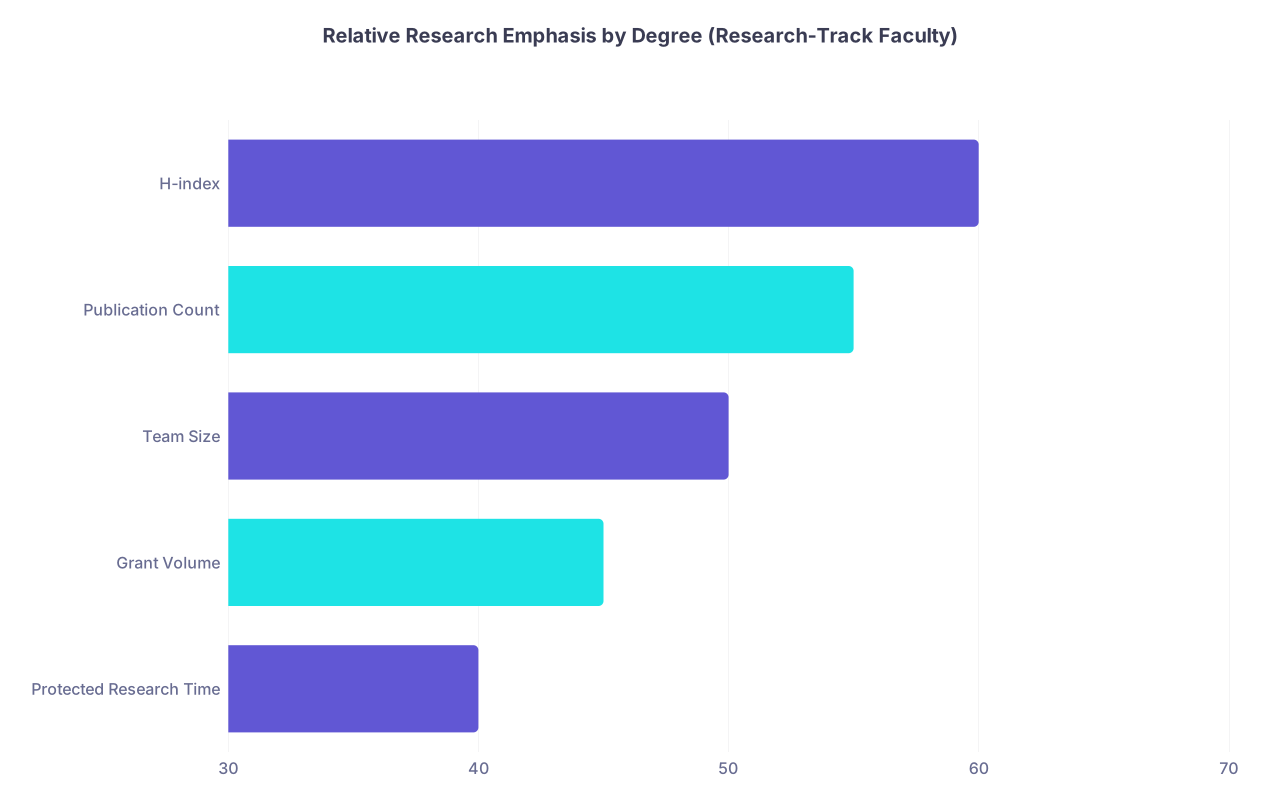
| Category | Value |
|---|---|
| Protected Research Time | 40 |
| Grant Volume | 45 |
| Team Size | 50 |
| Publication Count | 55 |
| H-index | 60 |
Let me be blunt: if you want your career valuation to be “this person produces high-impact, highly cited science,” the MD-only path is the uphill route in most environments. Not impossible, but the data are not on your side without heavy structural support.
Field effects: internal medicine vs surgery vs basic science
Lumping all faculty together is sloppy. H‑indices are not comparable across fields. A highly cited oncology RCT will generate 500+ citations in a few years. A highly technical electrophysiology paper might get 30 over a decade.
You must adjust mentally for:
- Citation culture (clinical trials vs niche basic mechanisms)
- Journal volume and field size
- Multi-author, multi-center norms
Here is a stylized comparison I have seen repeatedly when looking at specific departments in the same institution:
| Department Type | MD Clin-Educator | MD Research-Track | MD–PhD | PhD |
|---|---|---|---|---|
| Internal Medicine (subspecialty) | 4–8 | 12–22 | 18–30 | 20–35 |
| Surgery | 2–6 | 8–18 | 14–24 | 18–30 |
| Neurology / Neuroscience | 4–8 | 14–24 | 20–32 | 25–40 |
| Pediatrics | 3–7 | 10–20 | 16–28 | 18–32 |
Notice:
- Surgery H‑indices run lower across the board. Fewer large RCTs, slower citation accrual.
- Neurology/neuroscience runs higher, driven by large collaborative clinical trials and hot basic science areas.
- The within-field ordering (PhD ~ MD–PhD > research MD > clin-ed MD) stays pretty consistent.
So if you are comparing yourself:
- An H‑index of 15 as a 40-year-old pediatric hospitalist is very different from an H‑index of 15 as a 40-year-old tenure-track immunology PhD.
Cohort and age effects: H‑index is not age-normalized
H‑index is cumulative. It distinguishes 30-year careers more than it distinguishes early career trajectories. That is why early-career comparisons are easy to misinterpret.
For early and mid-career faculty (say, 0–15 years post-training), I usually look at three things rather than just raw H‑index:
- Publications per year (last 5 years)
- Citations per year (field-normalized if possible)
- H‑index growth rate (ΔH per 5-year block)
Here is a simplified growth pattern that matches what I have seen across large faculties:
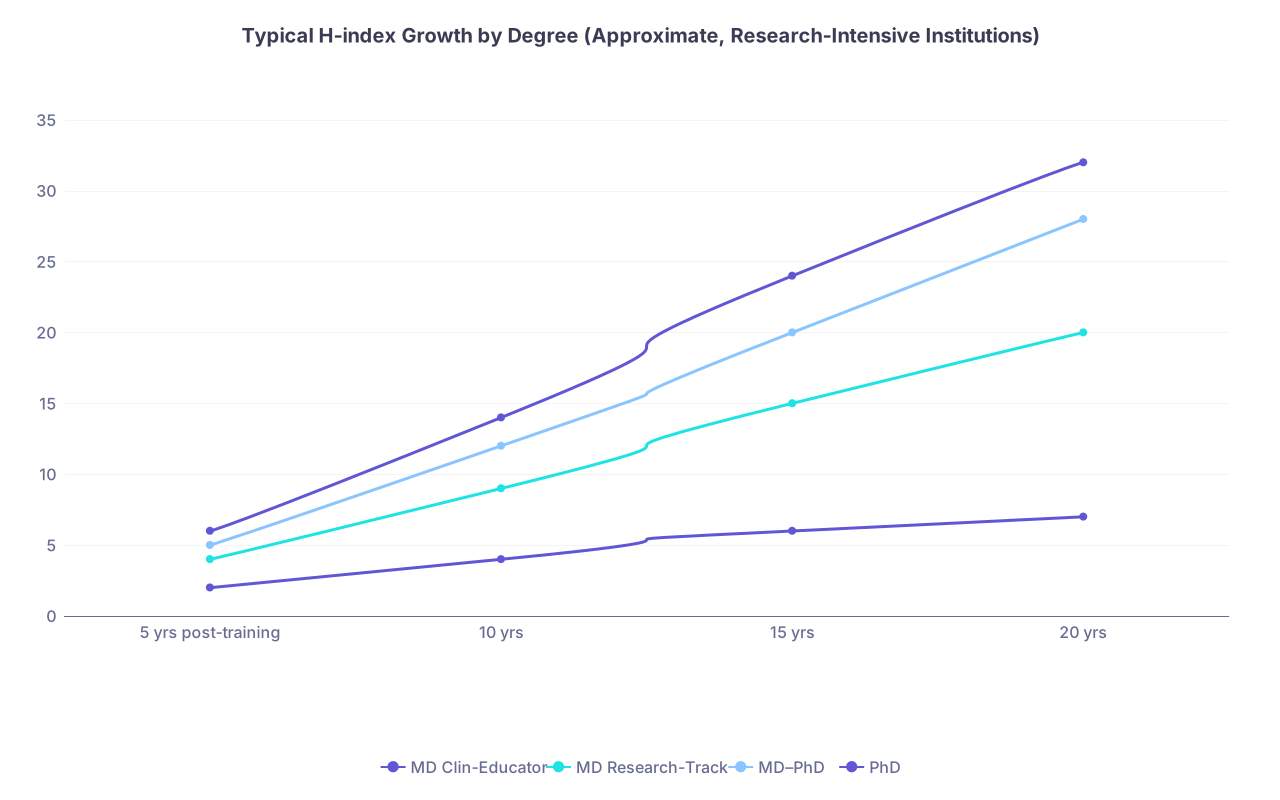
| Category | MD Clin-Educator | MD Research-Track | MD–PhD | PhD |
|---|---|---|---|---|
| 5 yrs post-training | 2 | 4 | 5 | 6 |
| 10 yrs | 4 | 9 | 12 | 14 |
| 15 yrs | 6 | 15 | 20 | 24 |
| 20 yrs | 7 | 20 | 28 | 32 |
Patterns:
- Clinician-educators plateau early. They publish enough to get promoted, then level off.
- Research-track MDs, MD–PhDs, and PhDs show much steeper growth, with MD–PhDs and PhDs usually leading after 10–15 years.
If your H‑index is not growing by at least ~1–2 points every 3–5 years after you hit assistant professor, you are likely not in a truly research-intensive trajectory, regardless of degree.
Output vs degree: what the numbers really say about MD, PhD, MD–PhD
Let me translate all the data into plain language comparisons.
MD faculty
Most MD faculty fall into three buckets:
Clinician-Educators / Clinician-Admin
- Publications: Sporadic, often first-author in residency/fellowship, then later middle-author in small local projects
- Output: 0–2 papers per year once settled; total 10–30 over an entire career is common
- H‑index: 4–10 typical for a full professor in this track in many departments
- Evaluation: Promotion committees look at teaching, clinical metrics, leadership more than bibliometrics
Clinical Researchers (non-PI heavy)
- Publications: Case series, retrospective cohorts, QI, multi-site clinical projects
- Output: 2–5 papers per year, often multi-author, middle author positions
- H‑index: 10–20 mid-career; sometimes higher if attached to high-impact RCT groups
- Evaluation: Seen as “academically active” but may or may not carry independent R01s
Physician-Scientists (Research-Track)
- Publications: Mix of basic, translational, or clinical mechanistic work with consistent volume
- Output: 4–8+ papers per year, a mix of first/last and collaborative authorship
- H‑index: 15–30 by mid-career if they are genuinely productive and supported
- Evaluation: Judged heavily on grants and high-impact publications
MD-only physician-scientists do exist and can have stellar metrics. But they are the minority. Every time I have pulled a faculty list and checked Scopus, MD-only researchers with H‑index >30 at 15–20 years post-training are outliers, not the norm.
PhD faculty
PhD trajectories are more homogeneous in research-intensive environments:
- Publications: Regular, driven by lab throughput; first/last authorship dominant
- Output: 4–10+ papers per year, depending on lab size and field
- H‑index: 20–40 by mid-career; 40–70+ by late career in high-citation areas
- Career risk: If the H‑index is flat or <10 at 10–12 years post-PhD in a strong institution, promotion is in jeopardy
The key point: PhDs are expected to have strong publication and citation metrics. Their promotions committees live in Web of Science.
MD–PhD faculty
MD–PhDs sit between those groups, but skew closer to PhDs in research-track roles:
- Publications: Strong bench or translational orientation; often co-PI with PhD partners
- Output: 4–8 papers per year is common for a healthy lab setup
- H‑index: 18–30 by mid-career; 30–50 at late career in strong programs
- Bonus: They accrue citations from both basic and clinical collaborations
In NIH data, MD–PhDs are overrepresented among physician-scientist R01 PIs relative to their share of MD graduates. That shows up on their publication metrics.
I have literally sat in promotions meetings where the quiet line was: “She is MD–PhD and R01-funded; of course her H-index is 25. That’s the floor we expect.”
How promotion committees actually use H‑index and output
People overestimate the sophistication of metric use in academic medicine, and underestimate the informal benchmarks departments keep in their heads.
Here is the rough, numbers-based reality I have repeatedly seen:
| Track / Degree | Associate Professor (Typical Range) | Full Professor (Typical Range) |
|---|---|---|
| MD Clin-Educator | 4–8 | 8–15 |
| MD Research-Track | 10–18 | 18–30 |
| MD–PhD | 12–20 | 22–35 |
| PhD | 15–25 | 30–45 |
Then overlay publication metric expectations:
- B: High output, high H‑index expected
- D: Low to moderate output, low H‑index acceptable
- F: Moderate output, moderate H‑index
- G: High output, high H‑index strongly expected
Knowing your bucket makes the H‑index conversation much more honest.
Closing: what the numbers really say
Three takeaways, without sugar-coating:
Degree labels don’t cause productivity; structure does. PhDs and MD–PhDs usually have more protected time, grant support, and lab continuity. That is why their H‑indices beat most MDs. Not because MD brains are worse.
Within research-intensive roles, the order is consistent. On average across institutions and fields: PhD ≳ MD–PhD > research-track MD >> clinician-educator MD on both publication count and H‑index.
If you want big metrics, design your job for them early. Whether you choose MD, MD–PhD, or PhD, the data show one pattern very clearly: 10–15 years into your career, your H‑index is mostly a lagging indicator of one decision—how much of your week you actually devoted to research.