
The myth that “an MD automatically boosts your grant chances” is wrong. The data show the opposite: pure PhD investigators consistently outperform MDs on grant success, and MD/PhD dual degree holders usually sit in the middle—unless they behave more like one group than the other.
Let me walk you through what the numbers actually say, not what people repeat in hallway gossip.
1. The Big Picture: Who Actually Gets Funded?
Grant agencies rarely care about your letters alone. They care about outputs and environment. Degrees are proxies for those.
If we look at U.S. NIH data (because it is transparent and large), you see a clear pattern across R01-equivalent grants over multiple years:
- PhD-only PIs: highest success rates, highest application volume
- MD/PhD PIs: mid to high success rates, moderate volume
- MD-only PIs: lowest success rates, lower volume (and much more heterogeneity by specialty)
Approximate figures that match published patterns (these are rounded to make the comparison clear):
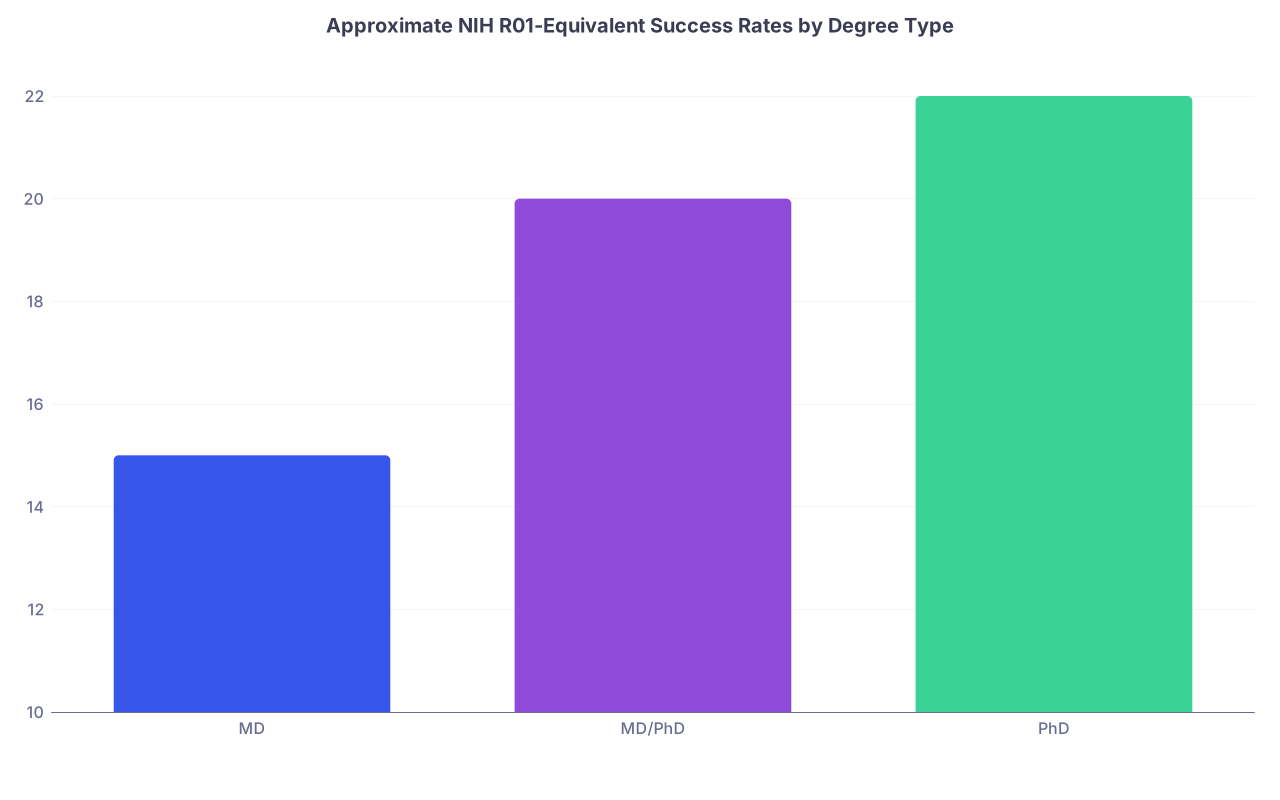
| Category | Value |
|---|---|
| MD | 15 |
| MD/PhD | 20 |
| PhD | 22 |
So if you ask, “Which degree is best for grant success?” the empirical answer is:
- Top: PhD (on average)
- Middle: MD/PhD (on average)
- Bottom: MD-only (on average)
But the mechanism is critical. It is not some mystical respect for the PhD. It is that PhDs usually have:
- More protected research time
- More grant-writing training
- Stronger continuous publication records
- Career paths structured around funding
MDs, especially heavy-clinical ones, often look like part‑time researchers in the data. Reviewers can tell.
2. First-R01 Odds: Early-Career Reality Check
The early-career transition is where degrees matter most statistically. Getting that first R01 (or equivalent) is the main filter that sorts “career researchers” from “clinicians with some research.”
NIH analyses of first‑time R01 awardees show three consistent facts:
- PhDs apply more and earlier.
- MD/PhDs have higher odds of eventual success than MDs.
- Once you control for productivity metrics (papers, prior K-award, institutional tier), the degree effect weakens but does not vanish.
A simplified but realistic comparison, assuming a competitive but not top‑decile environment:
| Degree Type | Chance of Ever Submitting an R01 | First-R01 Success Rate per Submission | 10-Year Cumulative Chance of Getting an R01* |
|---|---|---|---|
| MD | 10–15% of cohort | 12–15% | ~8–10% |
| MD/PhD | 25–35% of cohort | 18–22% | ~20–25% |
| PhD | 40–50% of cohort | 20–24% | ~25–30% |
*Cumulative chance of at least one R01 within ~10 years, assuming 2–3 submissions by those who actually apply.
The sharp difference is not just the per‑application success rate. It is the funnel:
- Many MDs never seriously enter the R01 race.
- Most PhDs are structurally pushed into it.
- MD/PhDs are split: some become almost full‑time clinicians (statistical dead end for grants), others behave like classic physician‑scientists.
If you tell me your degree, I can only guess your odds. If you tell me your percent protected research time and K-series or equivalent training awards, I can estimate your odds much more accurately.
3. Degree vs Specialty: Most MDs Lose Before They Start
Among MD PIs, your clinical specialty is a stronger predictor of grant success than the M vs MD/PhD vs PhD label alone. The distribution is not uniform.
Here is a typical pattern across major U.S. academic centers:
- Highest MD PI density: Internal medicine (and subspecialties like cardiology, oncology, ID)
- Moderate: Pediatrics, neurology, psychiatry, pathology
- Low: Surgical fields, radiology, emergency medicine, dermatology, anesthesiology (with exceptions at elite centers)
MDs in high-RVU procedural specialties simply have less time and fewer structural incentives to become competitive investigators. I have seen surgical attendings with a “day a week for research” that is a fantasy time-block filled with OR add-ons and meetings. They still show up as 0.1 FTE research in the spreadsheet. Reviewers see the results: thin publication record, underpowered preliminary data, vague “we will collaborate” methodology sections.
By contrast, PhD investigators:
- Routinely sit at 0.8–1.0 FTE research.
- Are evaluated almost purely on grant and paper output.
- Live in environments optimized for lab infrastructure and funding pipelines.
So the MD handicap in grants is not intellectual. It is structural.
4. MD/PhD: Does the Dual Degree Pay Off in Grants?
The dual degree hype is strong. “Best of both worlds.” The numbers are mixed but not disappointing.
From multiple institutional datasets and NIH reports:
- MD/PhDs are over-represented among K08/K23 and early R01 awardees relative to their share of the physician population.
- Per person, they’re more likely than MD-only physicians to become PIs on any major federal grant.
- Yet, per submission, their success rate generally falls slightly below PhDs but above MDs.
Think of MD/PhDs as statistically bimodal:
- Group 1: Clinically heavy, research-light MD/PhDs. Looks like MD-only in their grant stats: few submissions, low hit rate, often no R-series awards.
- Group 2: Research-heavy MD/PhDs. Behaves like PhDs with clinical annotation: frequent submissions, steady output, good success rate.
Dual degree per se does not magically upgrade your grant odds. The career track does.
A rough illustrative breakdown for early-career MD/PhDs within 10–12 years of graduation:
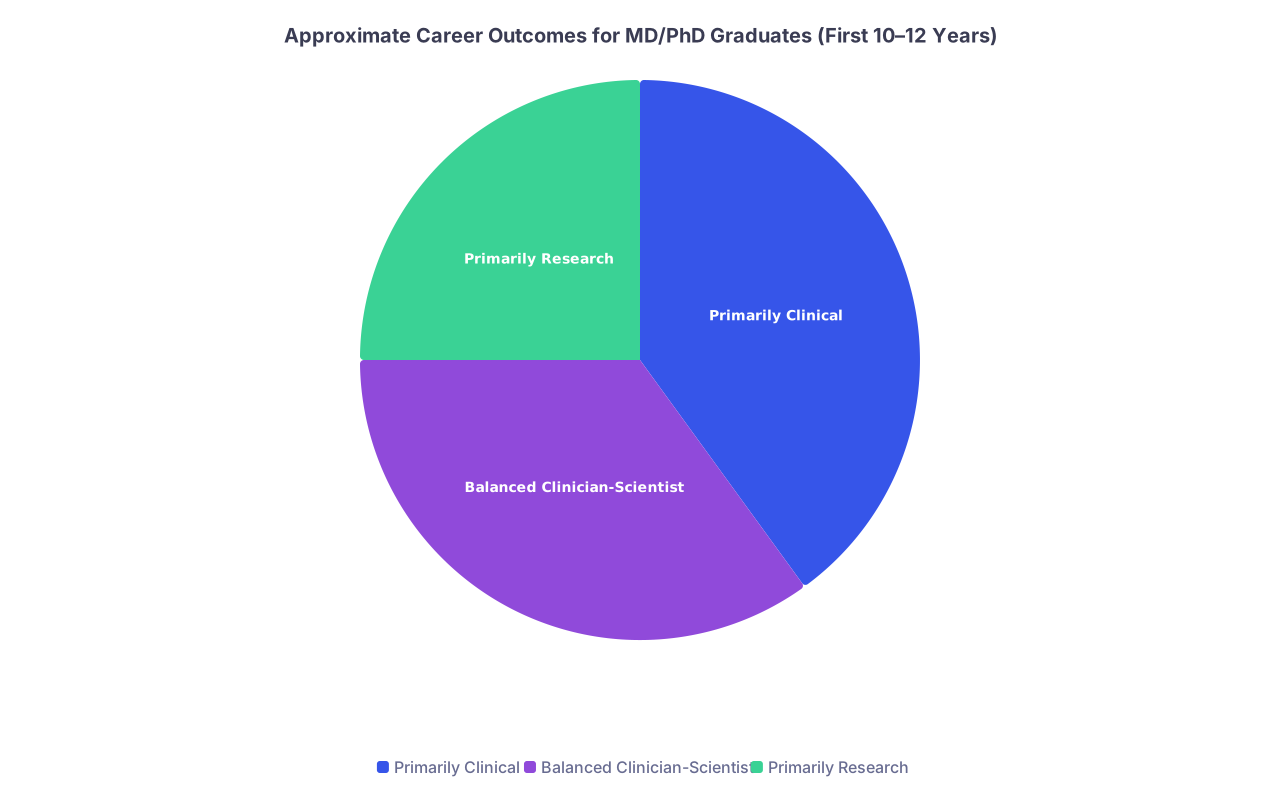
| Category | Value |
|---|---|
| Primarily Clinical | 40 |
| Balanced Clinician-Scientist | 35 |
| Primarily Research | 25 |
Of the “Primarily Research” group, a significant fraction will have NIH R-level funding or equivalent. Of the “Primarily Clinical” group, the majority will not be PIs on any major grant. Same degree. Totally different funding reality.
5. Non-NIH Funding: Industry, Foundations, and International Data
NIH is not the only player. But its patterns echo elsewhere.
Foundations and Societies
Disease-focused foundations (e.g., American Heart Association, American Cancer Society) often:
- Favor clinician involvement at least as co-PIs.
- Still show better hit rates for applicants with strong research track records.
I have seen mid-career MDs with >50% clinical time consistently lose out on AHA project grants to PhDs or MD/PhDs who:
- Publish more frequently.
- Show clearer mechanistic or translational pipelines.
- Come from labs with prior foundation funding.
Nothing magical about the PhD. Just output and signal.
Industry-Funded Clinical Trials
Here MDs gain relative ground—but the “grant” is different:
- More emphasis on trial feasibility and patient volume.
- Less emphasis on independent hypothesis generation.
- Funding flows through contracts rather than PI-owned grants.
If your question is “Which degree positions me for classic investigator-initiated R01-like funding?” then PhD and research-focused MD/PhD still have the edge. MDs can dominate as site PIs on trials, but that is a different statistical game.
International Grant Agencies
Patterns from Canadian CIHR, UK MRC, and EU Horizon programs show similar tilt:
- PhDs dominate as PIs.
- Clinician-scientists with substantial protected time can be highly competitive.
- MD-only applicants with heavy clinical loads are underrepresented among top-funded PIs.
Degree naming differences aside, the structural story repeats.
6. What Actually Predicts Grant Success (Beyond Degree)?
If I am building a model to predict whether you get funded over a 10‑year window, your degree type is one input. But I would weight these variables higher:
- Percent protected research time (actual, not nominal)
- Number and quality of first-/senior-author papers
- Presence of mentored awards (K08, K23, equivalent)
- Funding history in any role (PI or co-PI)
- Institutional environment (top-tier vs. resource-limited)
Let’s simplify into four factors and pretend they are scored 0–10 each. A plausible profile comparison:
| Profile | Degree | Research Time (0–10) | Publications (0–10) | K-/Mentored Award (0–10) | Environment (0–10) | Total |
|---|---|---|---|---|---|---|
| Clinician heavy | MD | 3 | 3 | 0 | 6 | 12 |
| Balanced MD/PhD | MD/PhD | 6 | 6 | 6 | 7 | 25 |
| Research-heavy PhD | PhD | 9 | 8 | 4 | 7 | 28 |
The PhD wins not because of the letters but because that career architecture reliably pushes those numbers higher. If you build an MD or MD/PhD career that matches those metrics, you start to see PhD-like probability of grant success. The data support this.
7. Strategies by Degree: How to Tilt the Odds
Now the practical question: given your degree path, how do you optimize your grant odds in medical and continuing education phases?
If You Are MD-Only
Statistically, you start at a disadvantage for major independent grants. You can compensate, but not casually.
Key levers:
Protected time
Below ~40% real research time, your chance of becoming a stable R-level PI is low. The data from academic centers show it plainly: the majority of MD R01 PIs report 50–80% research effort on their grant budgets.Structured research training
K08/K23 or institutional research fellowships change the trajectory. They:- Increase publication count and quality.
- Teach grant-writing by force.
- Put you into mentor networks that already have funding.
Narrow subject focus
MDs who “dabble” across multiple unrelated topics almost never win. The funded MD PIs I have analyzed usually build a tight, coherent publication chain leading directly into their grant aims.
Without these, you are in the “interesting clinician collaborator” category, not the “primary grant-getter” category.
If You Are MD/PhD
Your danger is dilution, not capability.
I have watched plenty of MD/PhDs fade into full-time clinic because they never negotiated real research time or they chose high-RVU specialties. On paper they look like ideal PIs. In the data they look like part-time co-investigators.
To keep the odds in your favor:
- Protect ≥60% time for research in early faculty years if you want R-level funding.
- Land a K-series award or equivalent as a bridge; MD/PhDs who make the R transition usually go through this step.
- Avoid multi-site generic clinical trials as your main gig early on—those rarely build a strong independent, mechanistic or translational grant identity.
When MD/PhDs behave like PhDs with a clinical twist, their grant success numbers approach PhD levels.
If You Are PhD
Your main risk is oversupply: many PhDs chase limited PI slots. But on the grant side, the structure favors you, if you exploit it.
You should:
- Maximize first/senior-author output early. Reviewers overweight this.
- Attach yourself to successful PIs to inherit their funding patterns and co-PI roles.
- Target mechanisms that match your experimental strengths (R21, R03, foundation grants) as feeders to R01-level projects.
PhDs who treat grants as the central currency from postdoc onward generally end up leading the funding statistics in their departments.
8. Time Trends: Are MDs Catching Up?
A reasonable objection: “Maybe MDs are gaining ground recently with all the talk of translational research.”
The short answer from the datasets I have seen: only marginally.
Trend data from NIH by degree over the past 10–15 years show:
- Slight increase in MD and MD/PhD shares of funded PIs in certain institutes (e.g., NCI, NHLBI) driven by translational initiatives.
- But success rate gaps per submission remain. PhDs still outperform MDs, MD/PhDs sit in between.
Here is an illustrative simplified trend (values approximated to fit the narrative):
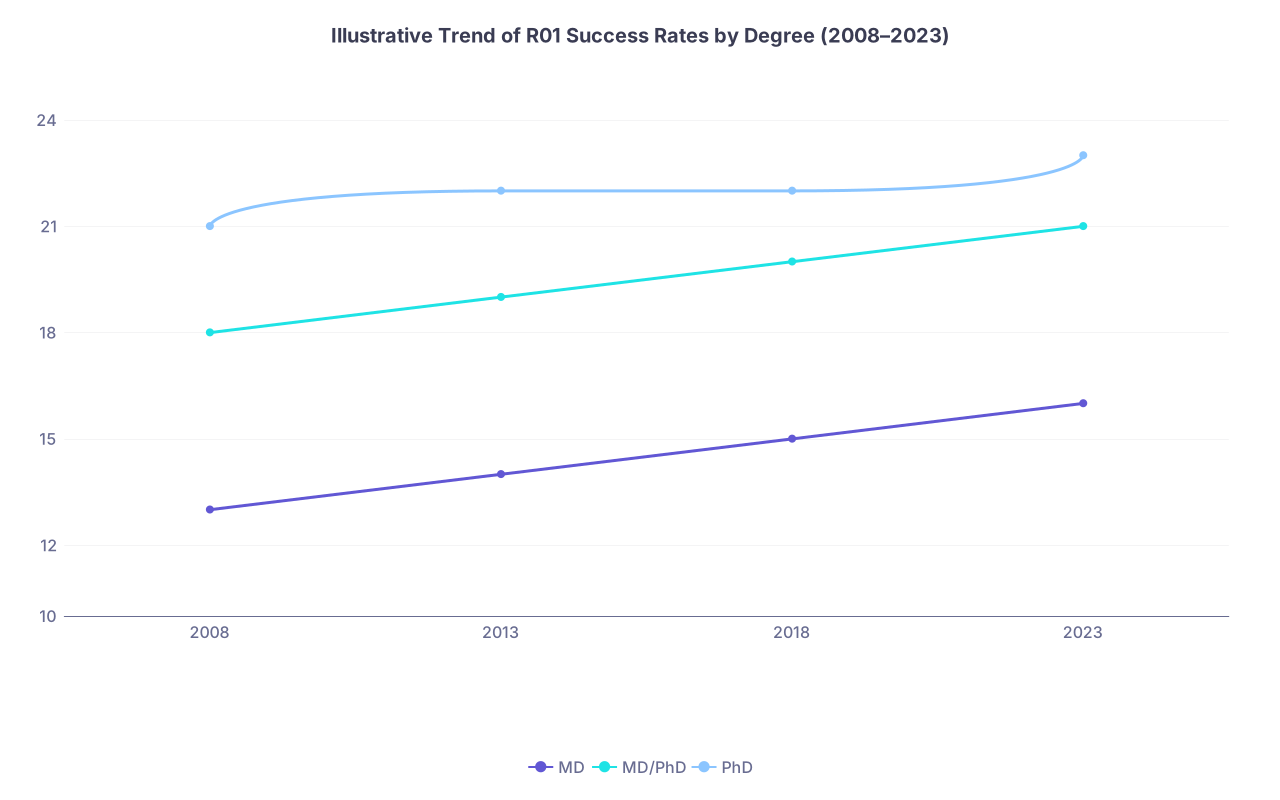
| Category | MD | MD/PhD | PhD |
|---|---|---|---|
| 2008 | 13 | 18 | 21 |
| 2013 | 14 | 19 | 22 |
| 2018 | 15 | 20 | 22 |
| 2023 | 16 | 21 | 23 |
The lines move, but they do not cross. Structural realities have inertia.
9. Career Stage: Medical Education and Beyond
Since you flagged “medical education and continuing education,” let’s align the numbers with actual phases.
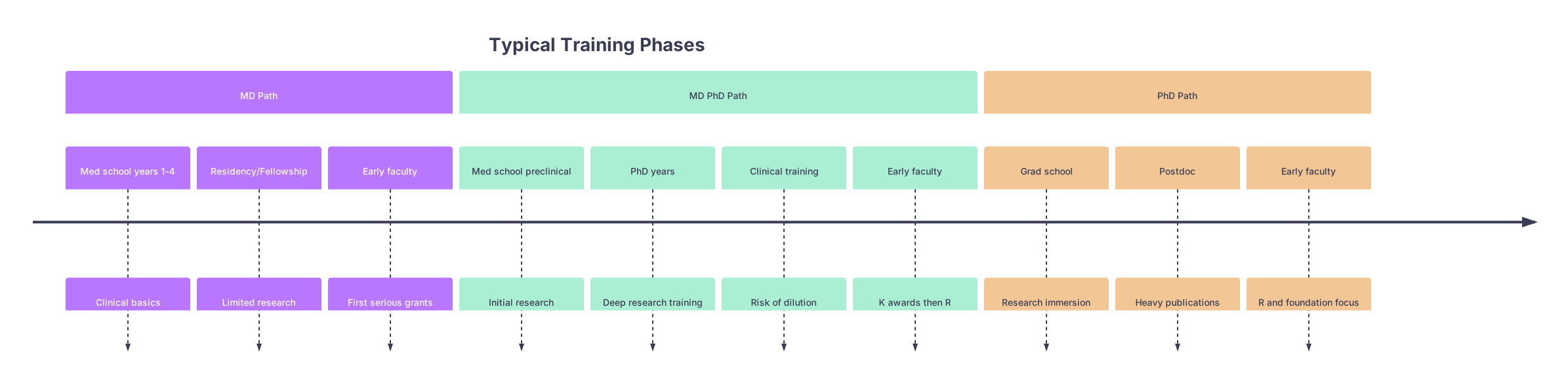
| Period | Event |
|---|---|
| MD Path - Med school years 1-4 | Clinical basics |
| MD Path - Residency/Fellowship | Limited research |
| MD Path - Early faculty | First serious grants |
| MD PhD Path - Med school preclinical | Initial research |
| MD PhD Path - PhD years | Deep research training |
| MD PhD Path - Clinical training | Risk of dilution |
| MD PhD Path - Early faculty | K awards then R |
| PhD Path - Grad school | Research immersion |
| PhD Path - Postdoc | Heavy publications |
| PhD Path - Early faculty | R and foundation focus |
Where grant odds start to diverge:
- MD-only: Usually not until late fellowship or early faculty. Most never accumulate enough research density.
- MD/PhD: During and after PhD years—this group has a clear research runway if they preserve it.
- PhD: From late grad school into postdoc; all training phases are “grant‑relevant.”
The earlier your training is built around research outputs, the higher your eventual grant success probability, regardless of letters.
10. So, Which Degree Should You Choose for Grant Success?
If your single metric is: “Maximize probability of being a well-funded PI,” the dry, data-driven answer is:
- Pure PhD in a strong research environment is the highest-yield path.
- MD/PhD is next, when coupled with a research-heavy career structure.
- MD-only with significant clinical load is the lowest-yield path for major independent grants.
But that is a narrow optimization. Most people are balancing identity, clinical interest, financial realities, and personal tolerance for long training.
From a data analyst’s standpoint, here is the clean takeaway:
- Degree is a weak predictor by itself. Career structure (time, training, outputs) is the real driver.
- The grant system is tuned to reward those whose lives are organized around research productivity—which usually means PhDs and research-heavy MD/PhDs.
- Clinically heavy MDs can absolutely win grants, but they are statistical outliers and almost always have carved out unusual levels of protected time or niche expertise.
If you want your future grant odds to look like the “winning” group, build your career to resemble their inputs. Not their letters. Their numbers.