
The reflexive claim that “MD–PhD is the smarter financial move because it’s free” is wrong or at least badly incomplete.
If you want the straight answer: purely financially, for most people, an MD plus residency plus (optional) fellowship beats an MD–PhD, even if the MD–PhD is fully funded. But. If you are aiming for a narrow slice of academic careers, the MD–PhD can make sense even with the financial hit.
Let’s walk through this like an attending going over a consult: what’s the question, what are the options, what matters, and what does the math say.
The Core Question: What Are You Actually Comparing?
You’re really comparing two timelines:
MD–PhD path
- 2 pre‑clinical years
- 3–5 PhD years (4 is common)
- 2 clinical years
- 3–7 years residency (depends on specialty)
- Optional 1–3 years fellowship
MD + Fellowship path
- 4 years MD
- 3–7 years residency
- Optional 1–3 years fellowship
On average, the MD–PhD adds 4–5 extra training years before you can earn a full attending salary. That gap is where the financial difference lives.
You’re trading:
- No (or minimal) med school tuition + small stipend
for - 4–5 extra years of low pay and delayed attending income.
So the real financial question is:
Is free tuition + stipend worth giving up several years of attending-level earnings and starting to invest/saving later?
Hard Numbers: What the Money Actually Looks Like
Here’s a rough but realistic comparison using ballpark US numbers. These will vary by specialty and region but the pattern is stable.
Assumptions:
- Private MD: $60–70k/year tuition + living expenses → total COA ~$80k/year, 4 years → ~$320k borrowed
- Interest: ~5–7% federal average
- MD–PhD: tuition waived + stipend ~$30–40k/year during PhD years
- Resident salary: ~$65k starting, slow increases
- Attending salary:
- Primary care: $220–280k
- Hospitalist: $250–330k
- Competitive specialties (cards, GI, ortho, derm, etc.): $400–800k+
Let’s lay out the training lengths and when you start “real” money.
| Path | School Years | Residency+Fellowship | Total Years to Attending | Typical Age at Attending |
|---|---|---|---|---|
| MD Internal Med | 4 | 3 | 7 | 29–31 |
| MD Cards (IM + Cards) | 4 | 6 | 10 | 32–34 |
| MD–PhD IM | 7–9 | 3 | 10–12 | 34–37 |
| MD–PhD Cards | 7–9 | 6 | 13–15 | 37–40 |
Now, visualize where the money shows up.
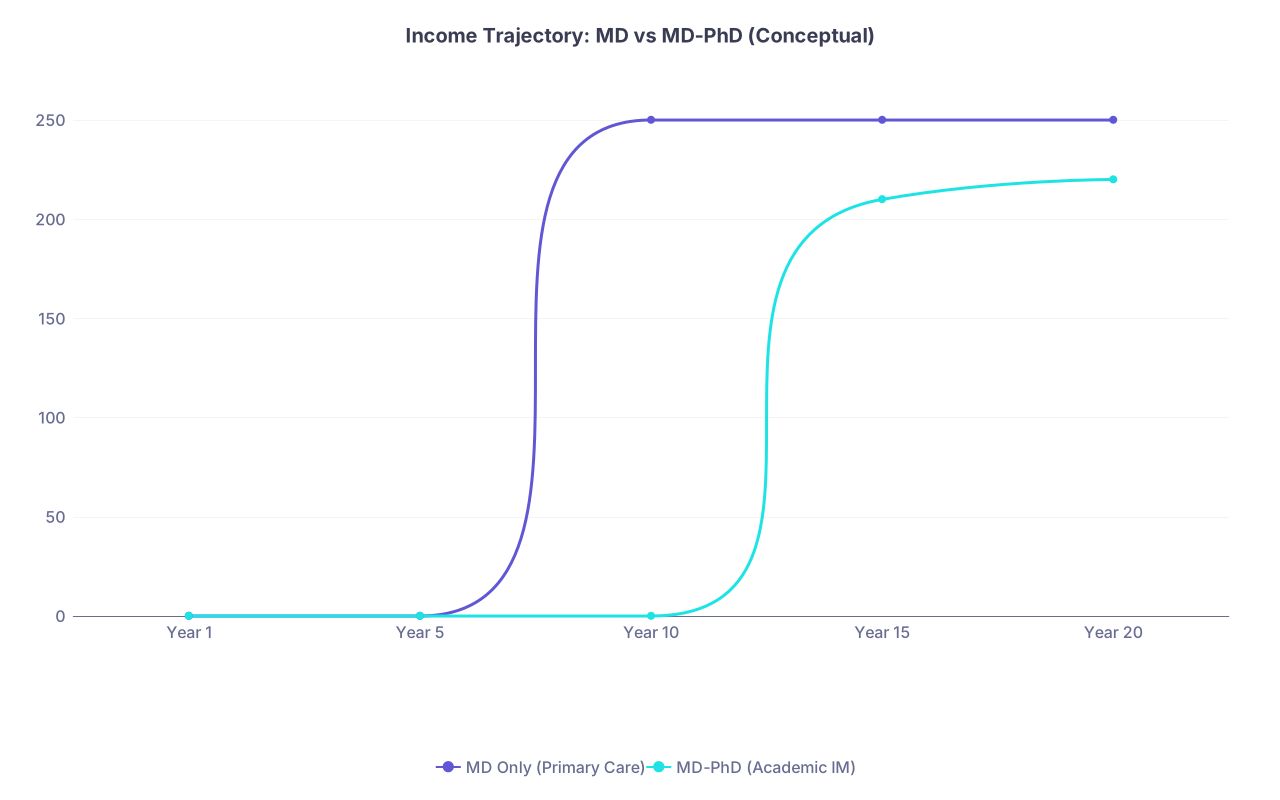
| Category | MD Only (Primary Care) | MD-PhD (Academic IM) |
|---|---|---|
| Year 1 | 0 | 0 |
| Year 5 | 0 | 0 |
| Year 10 | 250 | 0 |
| Year 15 | 250 | 210 |
| Year 20 | 250 | 220 |
Numbers are simplified to show the idea:
- The MD starts earning attending money 4–5 years earlier
- The MD–PhD has some stipend + no tuition but lags in high-earning years
Even if your MD debt is $300–400k, the extra 4–5 years of attending income almost always beats the saved tuition—especially once you factor compound growth of investing early.
The Three Big Financial Levers
If you want a decision framework, stop debating abstractly and run your numbers based on three levers:
- Specialty and Attending Income
- Length of PhD and Training
- Debt, Repayment Strategy, and Lifestyle
1. Specialty: This Is the Single Biggest Variable
The financial impact of doing an MD–PhD vs MD plus fellowship is radically different if you become an academic pediatrician vs an orthopedic surgeon in private practice.
In broad strokes:
Low–moderate paying specialties (academic primary care, pediatrics, IM, neurology, psych)
Here, MD–PhD hurts you more financially, because:- Attending salaries are often $180–260k in academia
- You delayed those earnings by 4–5 years
- You don’t have the upside of a $500–800k private practice later
Mid–high paying specialties (cards, GI, onc, radiology, anesthesia, EM, hospitalist, etc.)
MD path reaches those salaries earlier. Even with big loans, you have:- More years of high income
- Earlier retirement savings and compounding
- Flexibility to pay down debt aggressively
Very high-paying surgical specialties (ortho, neurosurg, plastics, ENT private, etc.)
MD–PhD is usually a huge financial loss compared with a straight MD unless you:- Stay heavily academic
- Actually use the PhD for funded research time
- Value the non-financial aspects more than money (which is valid)
Here’s the blunt reality:
If you’re thinking “I might want ortho or derm for the lifestyle and income,” an MD–PhD is almost never the smarter financial move.
2. PhD Length and Training Time
The “typical” MD–PhD is sold as 7–8 years total for the combined degree.
In real life, I’ve watched a lot of MD–PhDs:
- 4 years MD
- 4–5 years PhD (sometimes 6)
Total: 8–9 years pre-residency
Every extra PhD year has a price tag:
- Lost attending income of maybe $200–400k per year (depending on specialty)
- Lost retirement contributions and compounding
- Additional years of resident‑level or stipend‑level living
One extra PhD year can financially wipe out the tuition savings you got from a “free” med school, especially if you go into a higher-paying specialty.
So if you’re considering MD–PhD and your program is not:
- Well structured
- Known for getting students out in 4 years of PhD
- Transparent about time to degree by mentor/lab
You should assume on the longer side. And adjust your math accordingly.
3. Debt, Repayment, and How You Actually Live
Debt isn’t just the principal. It’s how long you carry it and at what lifestyle.
Things that tilt the scales:
Loan forgiveness / PSLF / academic careers
If you’re truly going academic, working at nonprofit hospitals, and planning to stick around for 10 years, your MD loans may be forgiven under PSLF with an MD-only route. That reduces the advantage of “free” MD–PhD tuition.Aggressive repayment vs minimums
High-income MD in private practice who lives like a resident for 3–5 years can wipe out $300–400k of loans relatively quickly. I’ve seen it done. You pay more pain early for more freedom later.Family money / scholarships
If someone else is paying for med school or you have large scholarships, the “MD–PhD is free” advantage evaporates fast.Geographic / COLA differences
Earning $250k in low-cost Midwest and paying off loans aggressively looks very different from $250k in San Francisco with no financial discipline.
When MD–PhD Makes Sense Financially (or At Least Isn’t Crazy)
Let me be very clear:
There are scenarios where MD–PhD is not a financial disaster and may be broadly reasonable.
Scenario A: You Want a Research-Heavy Academic Career
If your ideal week is:
- 60–80% research
- 20–40% clinical
- At a major academic center with NIH funding
Then MD–PhD helps you:
- Compete for K awards, R01s, and physician–scientist tracks
- Land structured positions with protected research time
- Get better start-up packages, mentoring, and promotion pathways
Financially, it’s still often a neutral to negative compared to a clinically heavy MD. But you’re not playing a pure money game. You’re buying:
- A career you actually want
- Less burnout from full-clinical FTE
- More control over your work content
Here, the MD–PhD is less about maximizing dollars and more about maximizing fit and survivability in academia.
Scenario B: You’d Otherwise Pay Full-Freight Private MD
If your only MD options are:
- $70k/year private med schools
- No significant scholarships
- You’re pretty confident you want low-paying academic fields
Then a funded MD–PhD that:
- Truly covers full tuition
- Gives you a livable stipend
- Doesn’t drag PhD years out forever
…could be financially reasonable. You avoid $300–400k of principal debt. But again: reasonable, not clearly superior to MD + fellowship in most cases.
Scenario C: You Use MD–PhD to Enter Industry or Highly Paid Research Roles
Sometimes MD–PhDs:
- Move into pharma/biotech
- Take leadership or translational roles
- End up with total comp rivaling or beating some clinical tracks
This is not the “standard” MD–PhD academic path, but it exists. In that world, the PhD can speed promotion and compensation. Financially, it can work out well. But you shouldn’t bank on this as your main plan during M1.
When MD + Fellowships Is Clearly Smarter Financially
MD + residency (+/- fellowship) usually wins financially if:
- You want:
- Cards, GI, heme/onc, pulm/crit, radiology, anesthesia, EM, surgery, etc.
- You plan:
- Significant private practice or hybrid work
- You are okay with:
- Doing research without a PhD (yes, that is very possible)
- Maybe being more clinically heavy than an MD–PhD lab PI
Reasons it wins:
- You start attending life 4–5 years earlier
- Those early years of $250–500k income compound fast if you invest
- You can absolutely still:
- Do clinical trials
- Publish
- Lead quality projects
- Even hold NIH funding with the right mentorship and track record
The big myth: “Without an MD–PhD, you can’t be an academic physician–scientist.”
I’ve watched plenty of MD-only attendings run labs, hold R01s, and chair departments. They just took a different, often more flexible route.
A Simple Framework to Decide for Yourself
Do not decide based on:
- Prestige
- Parental expectations
- Vague “I like science” vibes
Do it like this:

| Step | Description |
|---|---|
| Step 1 | Want career with majority research time? |
| Step 2 | Willing to extend training 4 to 5 years? |
| Step 3 | Do MD plus fellowship |
| Step 4 | Comfortable with lower academic pay vs private practice? |
| Step 5 | Strong mentorship and fast PhD program available? |
| Step 6 | MD-PhD reasonable choice |
If at any point you flinch at:
- Longer training
- Lower lifetime earnings
- Academic politics and grant chasing
Then you’re not choosing MD–PhD primarily for financial reasons. And that’s fine—just be honest with yourself about that.
Key Misconceptions You Should Ignore
Let me kill a few bad arguments I hear repeatedly:
“MD–PhD is free med school so it must be better financially.”
Wrong. Tuition saved is vastly outweighed by 4–5 years of lost attending income in most cases.“You can’t get into competitive academic jobs without MD–PhD.”
Also wrong. MD-only physicians with strong research portfolios get excellent academic jobs all the time.“PhD makes you a better clinician.”
Marginal at best. It may make you a better researcher. Clinician? That’s mostly residency, fellowship, and experience.“Residency debt is unmanageable without a PhD waiver.”
Untrue. It’s stressful, yes. But with a high-income specialty and disciplined spending, I’ve watched people knock down six-figure debts in under a decade.
The Bottom Line: Financially, What’s Smarter?
If you strip away prestige and identity, and you ask only:
“Which path likely leads to more lifetime money and flexibility?”
Then for most people:
- MD + residency + optional fellowship is financially smarter
- You start earning big earlier
- You get more years of compounding investments
- You can still do meaningful research if you want
MD–PhD only starts to “compete” when:
- You are committed to a research-majority academic life
- You are okay with lower clinical income and longer training
- You use the PhD effectively (funded research, real lab, solid grants)
If you’re 50/50 about clinical vs research, lean MD + fellowship.
You can always re-orient toward research. You can’t get back the extra years you burned in a PhD if you end up 90% clinical anyway.
Practical Next Step
Open a spreadsheet today and model two specific paths for yourself:
- Path 1: MD + your likely specialty + possible fellowship
- Path 2: MD–PhD + same specialty
Put in:
- Training years
- Approximate salaries year by year
- Loan amounts and simple repayment assumptions
Seeing the 10–20 year cash flow in black and white will make the decision a lot clearer than vague “MD–PhD is free” slogans.
FAQ (Exactly 7 Questions)
1. Does MD–PhD ever beat MD financially in lifetime earnings?
Occasionally, but it’s the exception. It might happen if you:
- Do an MD–PhD
- Move into high-paying industry, leadership, or biotech roles
- Have strong negotiation power based on your dual degree
But in the conventional academic physician–scientist path, MD–PhD usually earns less over a lifetime than an MD who leans into high-paying clinical work.
2. How much does an MD–PhD typically cost out of pocket?
Most US MSTP programs:
- Cover full med school tuition
- Provide a stipend (~$30–40k/year) through all 7–9 years of training pre-residency
You still pay in opportunity cost: lost attending years, delayed earnings, and delayed investing. That “shadow cost” is often several hundred thousand to over a million dollars in lifetime terms.
3. Can I still do serious research as an MD without a PhD?
Yes. Many MD-only physicians:
- Get into research tracks during residency/fellowship
- Complete research fellowships, MPH, or MS degrees
- Obtain K awards, R01s, or become site PIs for trials
You’ll need strong mentorship and a supportive environment, but the initials “PhD” are not a mandatory ticket to a research career.
4. What if I start an MD–PhD and then decide I hate research?
You can drop the PhD and continue as MD-only at many programs, but:
- You may lose some or all tuition coverage depending on the year
- You’ll have spent extra years in training with little return
This scenario is more common than programs admit. If you’re not genuinely excited by independent research, do not commit to MD–PhD.
5. Does MD–PhD help match into competitive specialties?
Marginally, in some cases, especially for academic programs that value research. But:
- Strong Step scores (or now Step 2), clinical grades, and letters matter more
- MD-only with a strong research portfolio often competes just fine
You should not do a PhD just to “boost” match odds. That’s a massively inefficient way to improve an application.
6. How should I factor PSLF and loan forgiveness into this decision?
If you:
- Plan to work at nonprofit hospitals for 10+ years
- Use income-driven repayment correctly
Then a large chunk of your MD-only debt could be forgiven. That makes “free MD–PhD” much less compelling financially, because the government is essentially subsidizing your education anyway.
7. I love both bench research and patient care equally. What should I choose?
If it’s truly 50/50:
- Start with MD-only
- Do research during med school, summers, residency, and maybe a research fellowship
- Decide about a PhD or advanced degree later (you can still do one mid-career)
Choosing MD–PhD locks in extra years and opportunity cost early. You rarely regret keeping more flexibility while you figure out what you actually like day-to-day.