
You are not “behind” because you do not have tons of research. You are just undecided. Those are very different problems.
The MD vs PhD decision gets warped by social pressure, prestige fantasies, and bad Reddit advice. Especially if you have limited research experience, people will either tell you “Just do MD, you do not have enough research for PhD” or “Do MD‑PhD, you can decide later.” Both are lazy answers.
You need a decision process, not another opinion.
This is your action blueprint. Step-by-step. If you follow it honestly, you will either:
- Commit to a PhD path with a clear, realistic plan to fix your low research experience, or
- Commit to MD (or MD‑PhD) knowing you are choosing it for the right reasons, not because you “failed” at research.
Let us cut through the noise.
Step 1: Strip the Decision Down to the Real Question
The real question is not “PhD vs MD?”
The real question is:
“Do I want my primary professional identity to be a scientist generating new knowledge, a physician caring for patients, or a hybrid physician-scientist—and what evidence do I have from my own life to support that?”
You are currently missing one key ingredient: evidence from experience.
So before you overthink:
- Stop asking, “Could I do a PhD?”
- Start asking, “Where have I already shown I enjoy research/clinical work when no one was watching and no grades were involved?”
Make a 10-minute brutal inventory:
- Times you lost track of time reading or working on something scientific
- Times you felt deeply drained or bored by lab work or clinical experiences
- Times you proactively sought out more of something (extra shadowing, more data analysis, more reading methods papers, etc.)
If your list is:
- Heavy on patient contact, light on data / literature → you start MD‑leaning
- Heavy on reading/figures/methods, light on people → you start PhD‑leaning
- Genuinely mixed → MD‑PhD or sequential MD → research training later is still on the table
You are not locking in yet. You are just forming a starting hypothesis about yourself.
Step 2: Understand What Each Path Actually Looks Like (Not How People Romanticize It)
Most people deciding MD vs PhD are comparing fantasy jobs:
- “PhD = thinking big thoughts in a lab. MD = helping patients and being respected.”
Reality is less flattering and more specific.
| Path | Main Focus | Typical Training Length | Core Daily Work |
|---|---|---|---|
| MD | Clinical care | 7–11 yrs (med+res) | Patients, notes, teams |
| PhD | Research | 5–7 yrs | Experiments, analysis |
| MD-PhD | Clin + research | 10–14 yrs | Mix of both, in phases |
What MD Life Actually Centers On
MD training (med school + residency):
- You spend most of your time:
- Talking to patients and families
- Writing notes and orders
- Collaborating with nurses and other trainees
- Juggling time pressure and responsibility
- Research is:
- Optional in many fields
- Often nights/weekends or elective time
- Easier to “taste” than to do deeply
If you never want to be the person carrying a pager, making real-time decisions when things go sideways, MD is the wrong main degree.
If you feel strangely energized in high-stakes, time-pressured environments (ICU, ED, OR), that is a strong MD signal.
What PhD Life Actually Centers On
PhD training:
- You spend most of your time:
- Designing and troubleshooting experiments
- Writing code, running stats, building models, or working with cells/mice/humans
- Reading and writing papers and grants
- Getting rejected (papers, grants, fellowships) and tweaking projects
- Patient contact:
- None, unless your research involves human subjects, and even then it is not clinical care
If your “research” so far was:
- 3 months of unpaid pipetting with no ownership
- A poster where you never really understood the question
That is not real research exposure. But it also does not mean you hate research. It just means you have never done the real thing.
MD‑PhD: The Hybrid
This is the track most over-applied to by people with:
- Vague “I like both science and helping people” statements
- Minimal research experience and no idea what 7+ dedicated research years feel like
MD‑PhD is for you if:
- You want to run a lab and also see patients
- You are mentally okay with:
- 7–8 years of training before you are even a resident
- Spending big chunks of your career applying for funding
- Constantly switching between clinic and lab or doing blocks of each
It is not a “safer MD with bonus research.” It is a long, specific, and narrow path.
Step 3: Diagnose Your Current Research Deficit
You said it yourself: low research experience.
Let us define that more clearly. You are “low” if:
- You have:
- No long-term research (≥1 year)
- Or only brief summer research with no real responsibility
- Or no understanding of hypothesis → methods → analysis → manuscript
- You cannot answer:
- “What was the central question of your project?”
- “What did you personally contribute that no one else did?”
- “What went wrong and how did you troubleshoot?”
If that is you, you have three problems:
- Admissions will see a mismatch if you claim you want to be a researcher.
- You lack the experience to know if you enjoy actual research.
- You risk overcommitting to a path you only conceptually like.
Now we fix those one by one.
Step 4: 12–18 Month Action Plan to “Test Drive” Research Properly
You do not need a 3‑year postbac to decide MD vs PhD. But you do need one serious project.
Target: Minimum 12 months of real research where you:
- Have your own subproject
- Attend lab meetings
- Read primary papers regularly
- Are involved in analysis and interpretation
Step 4A: Choose the Right Research Environment
You are not trying to win a Nobel Prize here. You are trying to get clarity.
Look for:
- A PI who:
- Has taken undergrads / students before
- Can clearly explain an approachable project for you
- Has weekly or biweekly meetings with you or your direct mentor
- A lab that:
- Publishes consistently
- Has at least one grad student or postdoc who could mentor you
Avoid:
- Labs where you are told, “We will see what you can help with” and nothing concrete appears
- Labs where undergrads only wash glassware or run routine assays with no intellectual ownership
Step 4B: Commit to a Real Time Block
Minimum:
- During undergrad/postbac:
- 10–15 hours/week for at least two semesters
- During a gap year:
- Full-time research assistant (paid or unpaid) for 1 year
If you are already in med school:
- Use:
- Summer between M1–M2
- A dedicated research year (many schools allow this)
- Scholarly concentration or longitudinal project
The key is continuity. Six weeks will not tell you if you like research. It will only tell you whether pipettes are annoying.
Step 4C: Demand an Actual Project, Not Just Tasks
On day 1–7 in the lab, ask:
- “What is the central question of the project I will be working on?”
- “How will we know if the project is successful 1 year from now?”
- “At what point could I have a poster or abstract from this work?”
If they cannot answer, that is a red flag.
Your project does not need to be huge. But you should:
- Learn the background reading
- Design or at least understand the design of the experiments
- Be responsible for data collection and/or analysis
- Help interpret the results
That is how you find out if research actually excites you beyond the resume line.
Step 5: Parallel “Clinical Reality Check” (So You Do Not Idealize Medicine Either)
While you fix your research exposure, you also test whether clinical work is genuinely appealing.
Bare minimum:
- At least 50–100 hours of:
- Direct clinical volunteering (ED, free clinic, hospice, outpatient)
- Or structured shadowing in multiple fields (primary care, hospital-based, maybe a procedure-heavy specialty)
This is not about:
- Watching cool surgeries
- Collecting hours
- Writing “I want to help people” in your personal statement
You are looking for:
- Do you enjoy being around sick people regularly?
- Do you feel energized or drained after a half day in clinic?
- Do you like the teamwork and communication under pressure?
- Can you tolerate the messy parts: waiting, bureaucracy, difficult patients?
If you dread clinical time but love the reading and research, that is a strong data point.
Step 6: Map Your Timeline – What Changes If You Choose MD vs PhD vs MD‑PhD?
You need to see the time cost clearly.
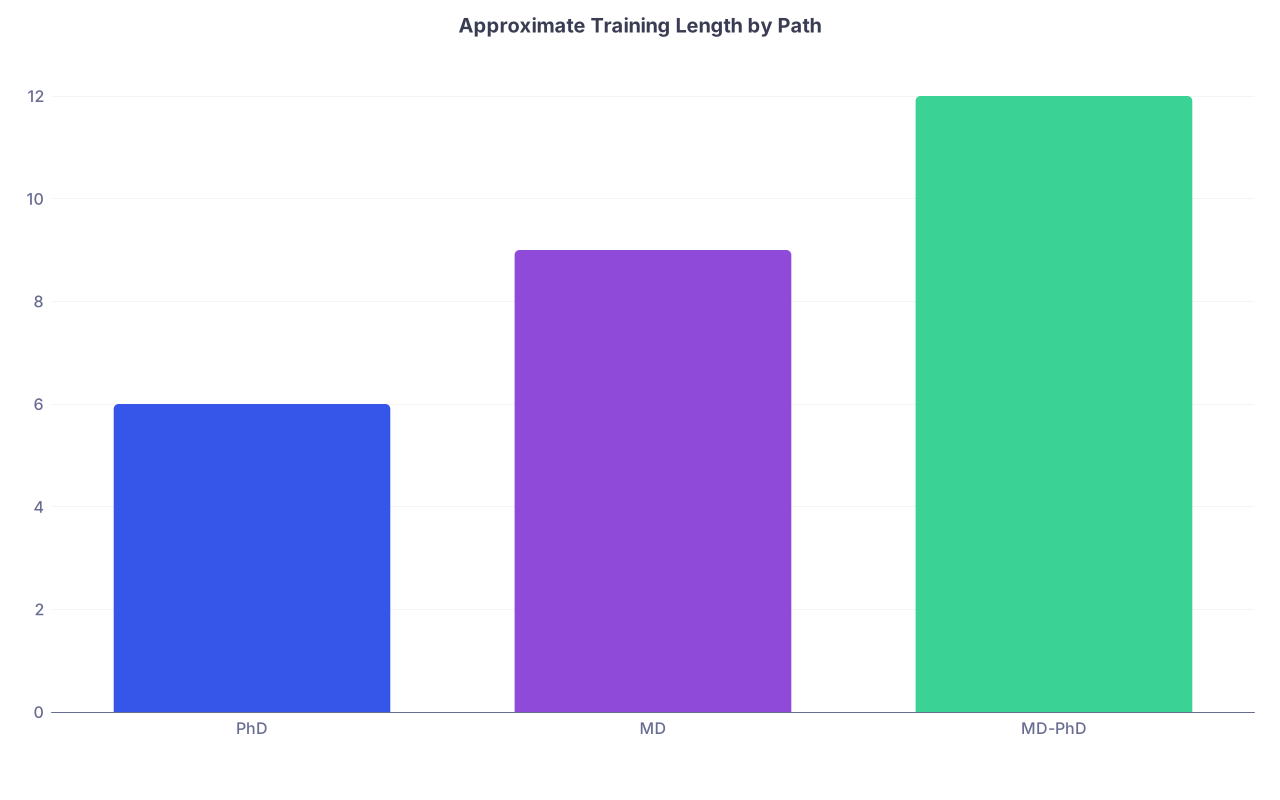
| Category | Value |
|---|---|
| PhD | 6 |
| MD | 9 |
| MD-PhD | 12 |
(This is a rough average in years from start of degree to independent attending or faculty position, assuming: PhD ~6 years, MD ~4 yrs + 3–5 yrs residency, MD‑PhD ~8 yrs + residency.)
If You Choose PhD First
You are signing up for:
- 5–7 years of:
- Stipend-level income
- Deep, intensive work in one field
- High failure/rejection tolerance
- Afterward:
- Postdoc(s) if academia
- Or transition to industry / government / data science roles
Clinical care is off the table unless you later apply to med school separately. That is a long, double path. I have watched maybe a handful of people do PhD → MD. It is not “normal,” but it is possible.
If You Choose MD First
You are signing up for:
- 7–11 years to independent practice:
- 4 med school
- 3–7 residency/fellowship
- Research can be:
- Layered in as electives, a research year, or during residency/fellowship
- Formalized later via:
- Master’s (MPH, MS in Clinical Research, etc.)
- Research fellowships
- K‑award pathway
This is the path for someone who:
- Likes research but is not sure they want their entire identity to be science
- Values the security/flexibility of a clinical career
If You Choose MD‑PhD
Now you are committing to:
- 7–8 years in school:
- 2 preclinical MD years
- 3–5 PhD years
- 2 clinical MD years
- Then residency/fellowship (3–7 more years)
You delay:
- Substantial income
- Autonomy
- Geographic flexibility
You gain:
- Structured support to become a physician-scientist
- Tuition coverage and stipend at many programs
- Early integration of research and clinical thinking
But you should only pick this if:
- You already know research is not a phase
- You have enough real research to prove that to yourself and to admissions
Step 7: Build an Application Strategy That Matches Your Reality, Not Your Ego
Once you have at least:
- 12+ months of real research
- Solid clinical exposure
- A gut sense of which work energizes you more
Then you pick one of four strategies.
Strategy A: Low Research, Clear Clinical Passion → MD‑Focused
Profile:
- A few short research experiences, nothing long-term
- Strong clinical exposure and genuine enthusiasm
- Limited evidence you enjoy the research grind
Action:
- Aim primarily for MD programs
- Frame your research as:
- Evidence of intellectual curiosity
- Willingness to contribute to scholarly work
- Consider doing:
- Optional scholarly projects during med school
- Maybe a research year once you are more mature and clear
Do not:
- Force yourself into MD‑PhD apps because “research looks good.” Commit to clinical excellence first. You can still do powerful clinical or translational research as a physician.
Strategy B: Growing Research Experience, Still Uncertain → MD with Heavy Research Emphasis
Profile:
- 1–2 years of research underway but not enough to feel certain
- You like research but have not yet led a project to completion
Action:
- Apply MD broadly, with:
- Personal statement leaning clinical
- Secondaries or activity descriptions that highlight your research curiosity
- On the ground in med school:
- Join a serious lab early (M1)
- Do a summer research block and maybe a research year
- Revisit MD‑PhD–like roles later (e.g., NIH-funded research tracks, T32 fellowships)
You are not shutting doors. You are choosing a stepwise proof-of-concept rather than locking into an 8‑year program based on partial data.
Strategy C: Strong Research Commitment but Late Start → Fix the Gap Then Apply MD‑PhD or PhD
Profile:
- You know you love research:
- Reading methods
- Debugging code/experiments
- Talking about mechanisms and models for hours
- But your record is thin so far (low publications, short projects)
Action:
- Take 1–2 gap years in full-time research:
- RA positions at an academic center or NIH
- Aim for:
- 1–2 posters
- Strong letters from PIs
- Clear ownership of a subproject
- Then apply:
- MD‑PhD if you still genuinely want both clinic and lab
- PhD if you realize you do not care that much about clinical care
- MD with a research focus if the clinical side pulled ahead
This is the option people are afraid of because it “delays” them. It actually saves many from a 10+ year misalignment.
Strategy D: You Realize You Want Science, Not Clinical Work → Full PhD Path
Profile:
- Clinical exposure feels draining or uninteresting
- Lab or data work feels deeply rewarding
- You read primary papers for fun, not just for exams
Action:
- Stop forcing the MD narrative.
- Build a strong PhD application:
- Extended research experience
- Co-authorships if possible
- Clear statement of scientific interests and fit with specific labs
- Consider programs:
- Traditional PhD in biomedical sciences
- MD‑equivalent science-heavy roles (e.g., clinical research PhD working closely with clinicians without being one)
You are not “less than” for dropping the MD goal. You are just honest.
Step 8: Decision Framework – 30-Minute Gut Check After You Have Done the Work
Once you have:
- 1+ year real research
- 50–100+ hours clinical exposure
- At least one substantial research product (poster, major project)
Sit down and answer, in writing, without performance:
- If I had to give up one forever—bench/data research or patient care—which loss would hurt more?
- On my most exhausting days in the lab vs clinic, which exhaustion felt more “worth it”?
- Which environment do I look forward to on Sunday night: lab/analysis or clinic/ward/OR?
- Do I want to be the person:
- Discovering mechanisms and therapies, or
- Choosing treatments and talking to patients about them?
Your answers will not be perfect. But they will be more accurate than whatever you are thinking right now with limited exposure.
Visualizing the Process
Here is how your next 18–24 months could look if you actually follow through.

| Step | Description |
|---|---|
| Step 1 | Today - Low research experience |
| Step 2 | Secure 12 month research position |
| Step 3 | Obtain 50-100 clinical hours |
| Step 4 | Complete 6 months research |
| Step 5 | Lean MD path |
| Step 6 | Complete full 12 months research |
| Step 7 | Apply MD with research interest |
| Step 8 | Apply PhD or MD-PhD after gap year |
| Step 9 | Use med school to refine research role |
| Step 10 | Build long term scientist or physician scientist career |
| Step 11 | Enjoy research? |
| Step 12 | Enjoy clinical work? |
Common Pitfalls You Need To Avoid
I have watched dozens of students tie themselves in knots over this. The same mistakes show up every time.
Using prestige as your compass
- “MD‑PhD sounds more impressive.”
- Terrible reason. Prestige wears off around year 5 of training. Misfit does not.
Ignoring your energy signals
- If you leave lab every day emotionally flat but “proud” of your productivity, that is a yellow flag.
- If you leave clinic tired but mentally alive, pay attention.
Overweighting one amazing or terrible experience
- One bad PI does not mean you hate research.
- One inspiring attending does not mean you love medicine.
- You need patterns, not one-off highs/lows.
Applying MD‑PhD with truly minimal research
- Committees are not fooled by one summer in a lab.
- You will get hammered in interviews: “Tell me about your hypothesis, method, limitations.”
- If you cannot comfortably answer, fix your experience before applying.
Refusing gap years out of fear
- A 1–2 year gap used deliberately (real research + clinical work) is almost always better than guessing a 10–14 year training path.
- You do not get bonus points for rushing into the wrong track.
If You Need a Simple Rule of Thumb
Use this as a crude but surprisingly useful filter:
If you love research and are willing to sacrifice money and time for it →
- PhD or MD‑PhD, depending on how much you also love clinical work.
If you like research, but cannot imagine giving up patient care →
- MD with structured research opportunities.
If you are not sure you like research because you have not really done it →
- Stop overanalyzing MD vs PhD.
- Spend 12–18 months making yourself sure.
That is the blueprint.
FAQ (Exactly 4 Questions)
1. Can I get into an MD‑PhD program with low research experience if my stats are very strong?
You might get a couple of interviews at lower-tier programs, but it will be an uphill battle. MD‑PhD admissions care less about raw GPA/MCAT and more about demonstrated research commitment and potential. If you cannot walk an interviewer through a project in detail—what was asked, how it was tested, what you personally did, and what went wrong—you will look misaligned. Get at least 1–2 years of serious research, ideally with a poster or manuscript, before aiming for MD‑PhD.
2. If I start an MD program, is it “too late” to become a serious researcher later?
No. Plenty of physicians become strong clinician‑scientists without an MD‑PhD. They do this through: a dedicated research year in med school, research‑heavy residencies/fellowships, mentored K‑awards, and sometimes additional degrees (MS, MPH, PhD later). What you lose is some early protected time and funding, not the entire possibility of a research career. The key is to choose research‑friendly environments during training and find good mentors early.
3. What if I do a PhD and then realize I want to treat patients after all?
PhD → MD is absolutely possible, but it is long. You will still need to complete the full 4 years of med school and then residency, so you are looking at 12–18 years total training. Some people do this and are happy with the decision, especially if their PhD field enriches their later clinical work. But you should not plan on this as your default pathway. If you already strongly suspect you want both science and clinical care, MD‑PhD or MD‑first with research later is usually more efficient.
4. How do I talk about my low research experience in applications without looking weak?
You do not apologize for it; you contextualize it and show a trajectory. Emphasize: why you sought out the research you did, what you learned from it, how it changed your thinking, and what concrete steps you are taking to build more experience (e.g., a current RA position, ongoing project, or planned gap year). For MD apps, frame research as one dimension of your intellectual curiosity. For PhD or MD‑PhD, you must pair that honesty with active, substantial efforts to deepen your research foundation before matriculation.
Key points:
- You cannot think your way into the right choice; you need 12–18 months of real research and solid clinical exposure as data.
- Choose MD, PhD, or MD‑PhD based on where you consistently feel most alive: lab/analysis, clinic/patients, or both—and be honest about that.
- If your research experience is currently thin but your interest is real, fix the gap with intentional, long-term projects and, if needed, a gap year before you commit.