
Last quarter, a senior scientist at a biotech company sat across from me, still in her badge and safety glasses imprint on her face. PhD in hand, decade of industry R&D, stock options vesting nicely—and a quiet bombshell: “I think I want to apply to MD programs.” She’d already googled enough to be terrified. Age, debt, lost income, “overqualified,” all of it.
If you’re that person—or close to it—this is for you. You have an industry PhD, you’re established, and now you’re seriously considering stepping into the MD world. Let me walk you through what actually matters, what you have to fix, and what you should stop worrying about.
1. First Pass: Are You Actually in the Right Lane?
Before we talk logistics, I want you to be brutally honest about one thing: do you actually want to be a physician, or are you trying to escape your current job?
I’ve seen three common patterns in industry PhDs thinking about MD:
- Burned-out scientist: hates corporate politics, constant pivots, layoffs, and the “deck-building” life.
- Frustrated translational researcher: wants to be the one actually making decisions on patients, not watching from across the street in the lab.
- Late-blooming clinician: did the PhD first, always had a quiet “what if” about medicine, then industry made it louder.
Only group 2 and 3 usually end up remotely satisfied as physicians. Group 1 often discovers that medicine has more politics, more bureaucracy, and significantly less control over your schedule for a long time.
Run through three questions:
- Can you picture yourself in clinic seeing 15–25 patients a day, with EMR clicks, prior auths, and non-stop people contact? Not for a week. For years.
- Are you willing to give up income and status for 8–12 years (med school + residency, maybe fellowship) to be an intern at 40+ getting yelled at by a 28-year-old chief?
- Do you want to own patient outcomes, including the nights you go home and replay a decision in your head?
If that still sounds like a “yes,” not a rom-com fantasy, then good. You’re in the right conversation.
2. The Reality Check: How Schools See You
You’re not a typical applicant. Admissions will not read you like a 21-year-old senior applying straight from undergrad.
They will immediately look for:
- Are your academic fundamentals still intact, or have they atrophied?
- Does your career trajectory make sense with medicine, not instead of it?
- Are you running toward medicine with clarity, or running away from industry?
They will not care that:
- You have 20+ publications in high-impact journals, if your MCAT is weak.
- You led a team of 15 scientists, if you cannot show direct patient-facing experience.
- You’re “overqualified on paper” for “studying again” (schools don’t see it that way; they see a career change).
Your PhD and industry work are assets, but they are supporting evidence, not the main act. The core pillars are still:
- Recent, rigorous science foundation
- Strong MCAT
- Documented clinical exposure
- A coherent story about why MD now
You will win or lose primarily on those. Not on your CV length.
3. Academics: Fixing the Transcript and the Science Story
Step 1: Audit your academic history like an adcom
Pull everything: undergrad transcript, any postbac, grad school, etc. Then look at it with an admissions brain:
- Cumulative undergrad GPA
- Science GPA (BCPM)
- Trend: flat, rising, or falling?
- Any glaring issues: repeated failures, long gaps, light science
If your undergrad is:
- 3.5+ overall and 3.4+ science with solid upper-level bio/chem/phys: you’re probably academically viable already, assuming you’re not 20+ years out of school.
- 3.0–3.4 with weak science or missing prerequisites: you’re in “repair and update” territory.
- Below 3.0 or heavy academic damage: you probably need a formal postbac or SMP (Special Master’s Program) if you’re dead set on MD.
Do not assume your PhD erases a weak undergrad. It doesn’t. I’ve seen committees explicitly say, “Great PhD, but the undergrad foundation just isn’t there.”
Step 2: Make sure your prerequisites are current and complete
Pull the requirements for a few representative MD programs (state schools + a couple privates). Most will want:
- 1 year general chemistry with lab
- 1 year organic chemistry with lab (some accept biochem substitution)
- 1 year biology with lab
- 1 year physics with lab
- Math (stats and/or calc)
- English / writing
If you’re 10–15 years out, some schools will side-eye ancient prereqs, especially if your MCAT isn’t stellar. Others are more flexible, especially if you’ve done relevant graduate-level coursework.
If your prerequisites are:
- Missing: you need a targeted postbac (doesn’t have to be formal; could be DIY at a local university, but get solid grades).
- Super old and your MCAT is a question mark: strongly consider taking a couple of upper-level sciences (physiology, cell bio, biochem) now and crushing them.
4. The MCAT Problem: You Don’t Get to Skip This
Yes, you did a PhD. Yes, you passed quals. None of that exempts you from the MCAT.
For nontraditional, PhD-level applicants, the MCAT is often:
- A rude awakening in CARS (verbal/reading-heavy) and psych/soc.
- A test of stamina as much as content.
- The quickest way for adcoms to decide if your ancient undergrad GPA is still relevant.
If you want MD programs to take you seriously, you should be targeting something like:
| School Tier | Competitive MCAT | Comment |
|---|---|---|
| State MD (in-state) | 509–515 | Depends on GPA & story |
| Mid-tier private | 512–518 | Stronger is better |
| Top-20 research | 517+ | Plus heavy research/fit |
You can match slightly below these if other parts of your app are exceptional and aligned, but don’t count on it.
Tactically:
- Give yourself 4–6 months of serious prep alongside your job.
- Use full-length practice tests to simulate the grind; don’t rely on just content review.
- Do not underestimate CARS just because you write papers. It’s a different game.
If you crash and burn a first attempt (I’ve seen 502 from brilliant PhDs), do not panic. Retake once, after a serious pivot in study strategy. But multiple low MCAT scores will kill the “PhD genius” narrative fast.
5. Clinical Exposure: Your Biggest Blind Spot
Industry PhDs often overestimate how “clinical” their work looks. Working on oncology drug trials without direct patient interaction is not clinical experience. Presenting at tumor board occasionally is not enough.
You need to show:
- You understand what physicians actually do day-to-day
- You have seen real patients, with all the messiness that entails
- Your decision to pursue MD is informed, not theoretical
That usually means:
- Shadowing physicians in at least one outpatient and one inpatient setting (primary care + hospitalist, or similar)
- Consistent clinical volunteering: ED volunteer, hospice, free clinic, nursing home, patient escort, etc.
- Optional but strong: paid clinical work (scribe, EMT, medical assistant) if you can swing a role change
Aim for:
- 50–100+ hours of shadowing
- 100–200+ hours of hands-on clinical volunteering
Does every school have hard cutoffs? No. But if you show up with 15 hours of shadowing and a line in your essay about “wanting to help patients,” you’re not getting far.
You’re already working full-time in industry. So you have to be surgical here:
- Ask physicians in your company’s medical affairs, pharmacovigilance, or translational teams if you can shadow their clinical practice (many still see patients).
- Plug into local academic hospitals or teaching clinics; they are more used to nontraditional observers.
- Pick one clinical volunteering role you can sustain weekly or biweekly, not five things you drop after a month.
6. Translating Your PhD and Industry Work into a Compelling MD Story
Your edge isn’t that you “have a PhD.” It’s what you actually did and how it connects logically to the physician role.
Examples that work well in admissions rooms:
- You led translational oncology trials, sat in on investigator meetings, and realized you wanted to be the person at the bedside discussing options with patients—not just the one designing the protocol.
- You worked in medical affairs, constantly interfacing with clinicians, watching how they reason and communicate, and you realized your strengths align more with patient-facing decision-making than bench work.
- You saw repeated breakdowns between research and clinical practice, and you want to sit at that intersection with authority as a physician-scientist.
And no, that doesn’t mean you must do MD/PhD. A straight MD with a research-heavy career is perfectly reasonable.
Your applications—personal statement, activities, secondaries—should show, not just state:
- How your research improved your ability to think under uncertainty
- How you handle long-term projects, failure, and revision
- How you collaborate with multidisciplinary teams (regulatory, clinical, commercial, etc.)
- Any patient-centered component in your current work (compassionate use programs, patient advisory boards, etc.)
Where people screw this up is when they:
- Sound like they think MD is just “more authority” on the same science.
- Downplay the human side and over-index on wanting to do “translational work.”
- Give the impression they’re using MD as a career escape hatch because industry annoyed them.
Be explicit about the trade-offs. Adcoms respect applicants who acknowledge, in writing or interviews, the financial and lifestyle costs they’re walking into.
7. Timing, Money, and the Age Question
You’re probably in your early-to-late 30s. Maybe older. I’ve seen 40+ start med school and do just fine, but you have to know what you’re buying.
Rough sketch if you start med school at 36:
- Age 36–40: medical school (no real income, heavy debt unless you have savings)
- Age 40–43+: residency (salary ~ $60–75k depending on state and PGY year)
- Age 43+: attending
Compare that to staying in industry:
- You might already be making $150–250k+ with upside and equity.
You cannot ignore that math. You need a real financial plan:
- Run actual numbers: debt load vs current savings, retirement projections, family obligations.
- Talk to your partner, if you have one, very concretely about roles, childcare, location constraints.
- Consider less debt-heavy routes: in-state MD, military HPSP if that fits you, maybe DO schools that offer good aid (yes, DO is a valid path—patients do not care).
On age: Adcoms will absolutely ask “why now?” and silently wonder “can this person physically and mentally handle training?” Your answer needs to show:
- You understand the demands (late nights, call, exams, boards).
- You have a track record of sustained effort and resilience.
- You are not planning to retire at 55 and leave a big gap of underutilized training.
8. School Strategy: MD vs DO, Research vs Community, U.S. vs. Alternatives
Some quick, unsentimental guidance.
If your profile is:
- Strong undergrad (3.5+), PhD, great MCAT (515+), robust clinical experience → apply broadly to MD, including some research-heavy programs where your background fits. DO as optional backup if you’re anxious.
- Mediocre undergrad (3.2), strong PhD, decent MCAT (510–512), good clinical → target a wide range of MD including your state schools, plus DO strongly.
- Weak undergrad (<3.2), even with PhD, MCAT <510 → MD will be uphill. You may need academic repair or should look closely at DO, or even reconsider whether MD is the right vehicle.
Avoid the trap of:
- Applying only to Top-20 MD because “my research is strong.” Those places have their pick of 520+ 3.9 kids who also did research.
- Ignoring DO because of ego. Patients and employers care about how good you are, not the letters. Certain ultra-competitive specialties are harder from DO, but for primary care, many IM subs, psych, etc., DO is perfectly fine.
If you’re thinking about international med schools (Caribbean) as a fallback, be very cautious. With your background, you should fix the academic gaps and aim for U.S. MD/DO first. Caribbean is high-risk relative to your baseline options.
9. How to Package Yourself on Paper
Think of your application as a narrative stack:
- AMCAS primary: your raw data and the first version of your story.
- Activities: where you prove you didn’t just sit in labs and offices.
- Personal statement: why medicine, why now, why you.
- Secondaries: where you show fit with each school and answer the red-flag questions (career change, age, etc.).
A few specific moves that work well for industry PhDs:
- Make one of your “most meaningful” experiences a clinical one, not just your PhD work. Shows your priorities have shifted.
- Use another “most meaningful” for your PhD/industry project that clearly intersects with patient impact.
- In your personal statement, briefly acknowledge your success and satisfaction in research, then pivot to where it fell short of what you want long-term.
Avoid the pity or apology narrative. You are not “giving up on your prior career” or “starting from zero.” You are reorienting with a pile of transferable skills. Own that.
10. Interviews: Where You Win or Lose as a Nontraditional
You will get specific questions:
- “Why leave a successful career now?”
- “How will you adjust to being a trainee again?”
- “Tell me about a time you worked with someone who disagreed with your conclusions.” (They’re probing ego and hierarchy tolerance.)
What they’re really checking:
- Ego: Can you handle being on the bottom again without being insufferable?
- Flexibility: Are you set in your ways or can you adapt to a new culture?
- Stamina: Do you still have the energy for exams, call, long hours?
You should have concrete stories ready for:
- Mentoring junior scientists or staff (translates to teaching and team-based care).
- Navigating conflict with clinicians or regulators.
- Failing on a project and changing course.
Also, be ready for subtle skepticism like, “Do you think you might be happier staying in a physician-adjacent role instead?” Your answer should acknowledge those roles but make clear why they’re not sufficient for you.
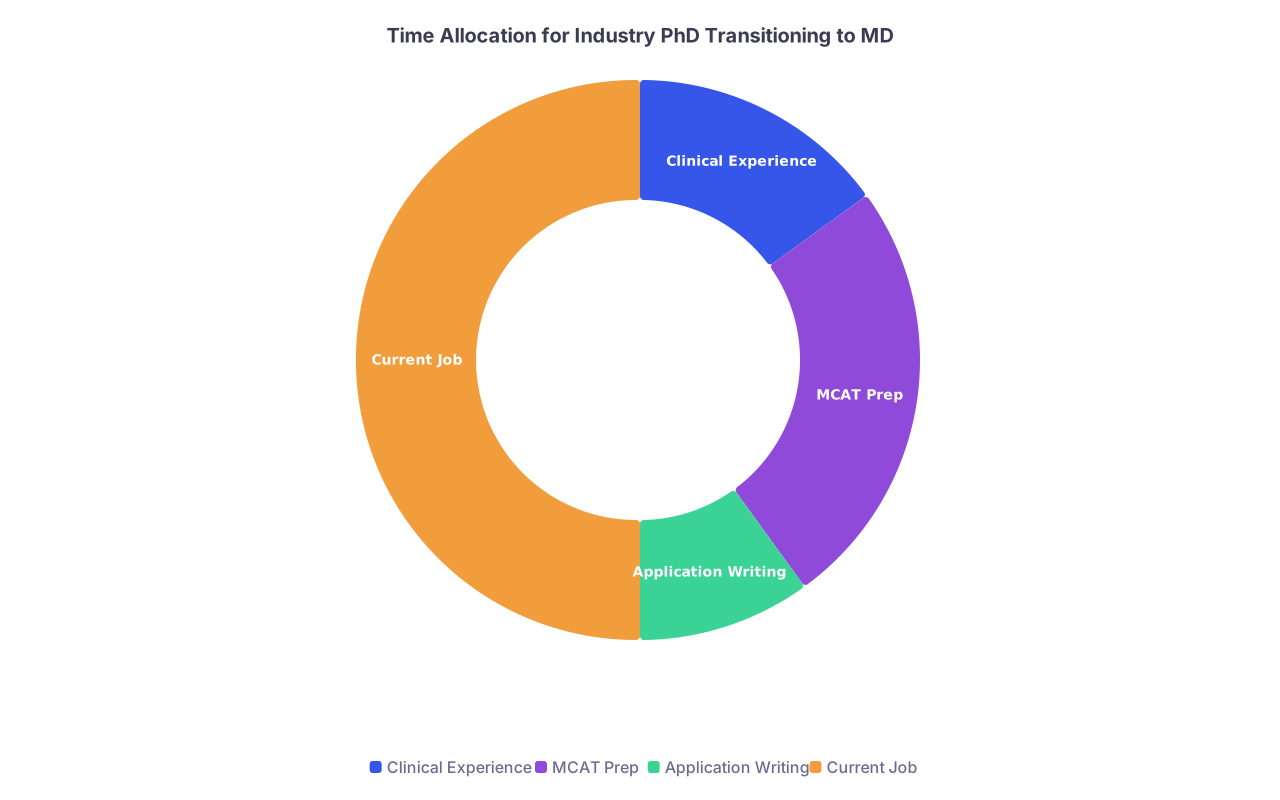
| Category | Value |
|---|---|
| Clinical Experience | 15 |
| MCAT Prep | 25 |
| Application Writing | 10 |
| Current Job | 50 |
11. A Pragmatic Timeline for an Industry PhD Pivot
You’re probably juggling this on top of a demanding job. So think multi-year, not “I’ll apply in 6 months.”
A realistic, compressed version:
Year 0–0.5
- Shadowing and clinical volunteering start
- Audit prereqs and sign up for missing/refresh courses
- Begin light MCAT content review
Year 0.5–1
- Ramp up MCAT prep seriously
- Solidify 100+ hours of clinical exposure
- Continue courses and maintain A-level performance
- Take MCAT at ~9–12 months into this process
Year 1–1.5
- Apply in June with MCAT done, letters lined up, and clinical boxes checked
- Secondaries through the summer
- Interviews in fall/winter
- Continue clinical exposure during all of this
Yes, that’s about 18–24 months of prep while working. That’s what a responsible transition looks like. When I see people try to compress this into 6–9 months, they almost always end up reapplicants.

| Step | Description |
|---|---|
| Step 1 | Industry PhD Role |
| Step 2 | Self Assessment |
| Step 3 | Update Academics |
| Step 4 | MCAT Prep and Exam |
| Step 5 | Clinical and Shadowing |
| Step 6 | Prepare Application |
| Step 7 | Submit Primary |
| Step 8 | Secondaries and Interviews |
| Step 9 | Matriculate to MD Program |
FAQ (Exactly 4 Questions)
1. Am I too old to start medical school if I’m late 30s or early 40s with an industry PhD?
No, but you’re not young—pretending otherwise is delusional. Late 30s is very doable if you’re healthy, realistic about residency demands, and financially prepared. Early 40s is possible but requires sharper trade-off analysis: what specialty you’re aiming for, how long its training is, what your retirement horizon looks like, and whether your family is actually on board, not just politely nodding. I’ve seen 40+ matriculants succeed, especially in fields like internal medicine, psychiatry, family med, pathology. But they had a rock-solid “why” and a clear financial plan.
2. Will my PhD and publications compensate for a mediocre MCAT or weak undergrad GPA?
No. They might get your file a second look, but they will not rewrite the laws of physics. A 503 MCAT with a 3.2 undergrad GPA and a stellar PhD is still a weak academic profile for MD. The MCAT is your chance to show you can perform at or above the level of traditional applicants now, not 10–15 years ago. Think of your PhD and industry work as powerful context and an advantage at research-heavy schools, but they’re not a shield against core academic metrics.
3. Should I apply MD/PhD since I already have a PhD and love research?
Usually no, unless you’re planning a very specific physician-scientist path that genuinely needs dual training (e.g., complex translational oncology, high-level NIH-funded lab leadership, etc.). You already have deep research training. An MD alone is enough to anchor a research-heavy career if you choose the right residency and environment. MD/PhD adds many extra years, delays your attending income even more, and some programs will quietly wonder why you’re asking for a second PhD slot when others have none. For most industry PhDs, MD with protected research time is a better route.
4. Could I get the impact I want by moving into a non-MD clinical-adjacent role instead (e.g., medical affairs director, clinical scientist, PA, NP)?
Sometimes, yes—and you should take that question seriously. If what you want is more patient contact but not full responsibility for diagnosis and management, roles like PA or NP can be faster and less financially punishing. If you want to shape clinical strategy without doing direct patient care, medical affairs or clinical development leadership might already be the right lane, and you just need a different company. But if you’re honest with yourself and realize you specifically want to be the physician in the room making the call, signing the orders, leading the team—then none of those substitutes will scratch that itch. At that point, MD (or DO) is the right, if brutal, road.
You’re not a 21-year-old wondering what to do with your life. You already built one. Now you’re deciding whether to build a second, very different one on top of it. If you choose this, do it with your eyes wide open, your numbers tight, and your story coherent. Get those clinical hours, respect the MCAT, fix the transcript holes, and then apply like you mean it.
Once you’ve crossed that line and committed, the next chapter is surviving medical school as the “older one in the room” with a PhD and a mortgage. That’s a different playbook entirely—but you have to get in first.